

TUM dropout. Building the universal factory. @structisAI backed by @fdotinc @HustleFundVC prev. physics
Zurich
Joined July 2025
- Tweets811
- Following858
- Followers1.6K
- Likes4.2K




Roberto retweeted

After spending a month in our hacker house, the best I can explain the energy is what we called "gonahdus" in the Finnish army @EURoboticsHouse


Roberto retweeted

After just one week at ERH, I'm already learning so much and feel grateful to be surrounded by builders of this caliber.
Roberto is a great example of the hustle mindset I find so inspiring in entrepreneurs.

Roberto retweeted

The Era of Evals is coming to AI robotics.
Today we’re launching Reality Check: our leaderboard & first public robot manipulation benchmark.
14,400 real-world rollouts. Four models. Multiple tasks & data regimes. Object placements. Confidence intervals. FR3 Duo stations.
1/10

Dynamic attacks require dynamic defence.
Static code is no longer good enough.
Agents defending 24/7 against agents.
I honestly thought this is common knowledge by now.

Greg Brockman says OpenAI pointed Astra at its own systems until it ran out of vulnerabilities to find:
"We took 25% of our production engineers and said, 'Sorry, all your projects are on hold. You are now defending. You are now up-leveling our security architecture. You're going to use the models to find all the holes.' And we found a number of serious issues, and we fixed them."
"We found some new problems, but eventually it saturated. We basically have found, to our knowledge, all of the P0s, all of the critical problems that Astra is smart enough to find. And of course, there will be a new model, there will be a new round."
"You want to be in this tight loop of new cyber capability drops, you deploy it against your systems, you find the new holes, and ideally, you've managed to automate this, what we call defense factory. That's what we're building internally."
"There are ideas, for example, formally verifying all of software, that are possible with AI."
@gdb @bhorowitz
quick update. Was able to reduce training cost dramatically.
Previous: π0.5: 5h/1k steps
Now: → 2.87s/step (~48min/1k ) on a single 5090.
Rank-64 LoRA. Batch 32. Full vision training.
Pushing toward the silicon’s ceiling. Make the gpus go brrr.

Roberto retweeted

BREAKING: Nvidia declares physical AI could become “10x larger than digital AI” with Jensen Huang predicting every industrial company will become a robotics company.


Because I had question about the kit and how it compares.
To make clear this set includes leader follower arm, which often times with comparable arms, means either buying only the follower and building a leader yourself or having to get the same arm with a leader end effector which basically leads to double the price.
This set includes follower AND leader!
structis.ai/hardware.html

First limited Batch 01 is live.
S1 Kit. Leader-follower. €3990.
Built in Germany.
4 kg payload, 700mm, cnc aluminium reinforced, backdrivable, LeRobot native.
Limited run
Order now!
structis.ai/hardware.html
LFG.
@StructisAI


Only of its class in europe!
Go get yours today.
First limited Batch 01 is live.
S1 Kit. Leader-follower. €3990.
Built in Germany.
4 kg payload, 700mm, cnc aluminium reinforced, backdrivable, LeRobot native.
Limited run
Order now!
structis.ai/hardware.html
LFG.
@StructisAI
Roberto retweeted
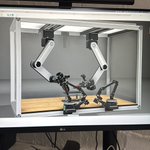
Built this over the last 10 months, solo, in a garage near Hamburg: the arms, the cell, the teleop and training pipeline. Now the first autonomous runs on a real customer part.
The goal is bigger than assembly. We are building an API for atoms: robots that learn any physical task from real work, and pay for themselves while learning.
Hiring the first engineers now. Hardware, ML or both. Early equity. DM me.

One of our first autonomous successes on the gland assembly.
How it works: we teleoperate the task first. That becomes training data for our model, which then attempts it autonomously. When it makes mistakes, we intervene and show it how to recover. Those corrections make the policy more robust and push the success rate up.
The model runs end to end, down to switching the screwdriver on and off.
Every task we run on the real robot grows the dataset. The bet: the more diverse it gets, the less data a new task needs.
