

⭕️ AI & Cybersecurity Keynote Speaker | Helping leaders harness AI securely | Founder & Executive Chairman, @ramsac_ltd | Bestselling Author | Vistage Speaker
UK
Joined February 2009
- Tweets43.1K
- Following7.8K
- Followers19.3K
- Likes58K







Pinned Tweet
⭕️ Most AI adoption fails not because the tech doesn’t work, but because there’s no clear business case.
Harnessing AI helps you create policies, training, ROI measures, and governance so AI delivers value instead of chaos.
amazon.co.uk/stores/Rob-May/…


Rob May | AI & Cybersecurity retweeted

🚨 John McGinn on Aston Villa’s 2-1 victory over Manchester City:
“Before the game, the manager told us something very simple. He said, ‘If you want to beat Manchester City, first you have to prove you can run with them.’
And that was basically our preparation throughout the week.
We weren’t spending the whole week talking about Haaland, or how much their players cost, or how good they are on the ball. We already knew all of that.
The manager wanted us to match them physically. Every run, every sprint, every second ball. If one of their players covered ten metres, we had to be prepared to cover eleven.
I remember one training session where we were absolutely exhausted. We’d just finished an exercise, and a few of the lads thought we were done.
The manager called us back.
Someone said, ‘Boss, we’ve already done that one.’
He said, ‘Yes, but Manchester City won’t stop running because you’re tired.’
So we went again.
He kept telling us, ‘Don’t give them the advantage before the ball has even been kicked. If they run, you run. If they press, you press. If they fight for a ball, you fight harder.’
And he was right.
You can have the best tactical plan in the world, but if you’re always arriving two seconds later than your opponent, what’s the point?
We knew there would be difficult moments. You don’t play Manchester City and expect to control everything for 90 minutes.
But we felt that if we could stay with them, compete for everything and make the game uncomfortable, we’d have a chance.
Then Nicolas Jackson decided to make all that running worthwhile.
His first goal was brilliant. The way he attacked the space, the confidence in the finish. That’s exactly what you need against a team like City because you might not get many opportunities.
Then they equalised, and that’s when you start asking questions of yourselves.
You’ve worked all week for this. You’ve run yourselves into the ground. Now they’ve scored, and you have to find another way.
I remember looking around at the lads, and nobody seemed interested in settling for a draw.
Then Nicolas got the ball outside the box.
I was actually expecting him to take another touch.
He didn’t.
He hit it low, and the next thing I knew, we were celebrating.
I went over to him and said, ‘Nico, do you know how much running we’ve done for you today?’
He laughed.
I said, ‘I’m serious. Some of us can barely feel our legs.’
He told me, ‘That’s why I scored two. One wasn’t enough.’
And I loved that.
Because that’s what a team is supposed to be.
You’ve got players chasing, tackling, covering for each other, doing the things that don’t always appear in the highlights. And then you’ve got somebody like Nicolas who makes all that work count.
We didn’t beat Manchester City because we had eleven players who were technically better than theirs.
We beat them because we were prepared to work for each other, and when the moments came, Nicolas was ruthless.
After the match, the manager was pleased, but he still reminded us about the running.
I told him, ‘Boss, I think we’ve run enough for one week.’
He smiled and said, ‘Good. We’ll start again on Monday.’
That’s Unai Emery for you.
But if Nicolas keeps scoring twice every time we run like that, I don’t think anybody will complain.”


⭕This is a fascinating interview with @sama @OpenAI at @Stanford, my single biggest takeaway is this:
Push things that already show promise to scales no one has tried before. Empirically, the most interesting and valuable outcomes Sam has seen (in AI, at Y Combinator, and in startups) come from emergent properties at scale, effects that simply do not exist at smaller sizes and that the consensus usually underestimates or actively discourages.
He has no clean theory for why this happens. He just notes that it keeps happening, that most people under-do it (because things break in unpredictable ways and smart people give reasons not to), and that the upside has repeatedly been large.
I think everything else in the talk orbits this idea:
Affordable tokens now let small teams do what used to require large engineering orgs.
ChatGPT emerged by noticing what users were already doing with the API and scaling that behaviour.
Coding was the longer-term “control the computer” bet.
Intelligence is becoming a new utility, but the real constraint is cheap, abundant delivery at scale.
Betting against further scaling (of models or of products) has repeatedly looked premature.
In short: find something that works a little, then scale it harder than feels reasonable. The non-obvious, high-leverage results tend to appear there!

Rob May | AI & Cybersecurity retweeted

Microsoft is on track to pay Anthropic more than $2 billion annually to power Copilot, even as it increasingly switches to OpenAI models to cut costs and improve margins.
Full story: thein.fo/4iqBKp2

Rob May | AI & Cybersecurity retweeted

Copilot Notebooks can now delegate simple work to Copilot, create interactive reports, edit Word, Excel, PowerPoint files directly with the full power of Office, and more.
Learn more: msft.it/6018atw8s

ALT Text reads, “Pathways to Innovation: Charting Our Future at Arches National Park Offsite.” A scenic view of Arches National Park with two people standing near a rock formation.
Rob May | AI & Cybersecurity retweeted

Sam Altman (CEO of OpenAI):
"You don't need to write prompts anymore. You need loops and graphs."
In 39 minutes he shows how to use LLMs better than almost anyone does
Chats → Prompts → Loops → Graphs
skip the loop and every mistake comes back as something you blame on the model
skip the graph and you're the one deciding every job by hand, every single day
that's the gap between using AI and having AI work for you
watch it today
then save the full graph engineering guide below before everyone catches up ↓


Rob May | AI & Cybersecurity retweeted
The full power of Office is coming to Copilot. Create, edit, and collaborate with Word, Excel, and PowerPoint in one connected experience, without losing context or switching tools. Now rolling out in Frontier.

Starting today, the full power of Microsoft Office is rolling out to the Copilot App in Frontier. We're bringing together the capabilities that your business runs on every day within Word, Excel and PowerPoint inside of the new OS for work.
This new experience supports your entire workflow, from the first prompt to the finishing touches. You can collaborate with others, use branded templates, and return to earlier iterations through version history as your work evolves. In the same workspace, you can choose from a robust library of frontier models or use the Auto router to match the right model to the task at hand.
Learn more in my blog post: techcommunity.microsoft.com/…
The skills that top employers are looking for.
I was at the University of Birmingham yesterday, and one slide has stuck with me. It's the World Economic Forum's Future of Jobs Report 2025, showing the skills top employers want now and the ones rising fastest to 2030.
The top three rising skills are AI and big data, networks and cybersecurity, and technological literacy, which won't surprise anyone who works in my world. What caught my eye is what sits beside them. Creative thinking, resilience and agility, curiosity and lifelong learning, leadership and social influence are all in the rising list too, and resilience and creative thinking appear in both columns. Analytical thinking is the number one core skill today, yet it slips to ninth on the rise list, which tells me it's becoming the baseline, not the differentiator.
I think that's the real message for anyone worrying about AI and jobs. Technical skills get you in the door, but the human ones decide how far you go, because anyone can now ask an AI for an analysis. Knowing which question to ask, having the curiosity to challenge the answer and the leadership to act on it is where the value sits.
It also fits what I see every week with business leaders. The ones struggling with AI rarely have a tool problem, they have a habits, culture and learning problem.
So here's my challenge. If you looked at your own team against the rising list, how much are you investing in the technical skills, and how much in the human ones?


Rob May | AI & Cybersecurity retweeted

“We’re building Copilot as a new OS,” says Satya Nadella.
Satya Nadella is calling Copilot a “new OS for work,” and this time, the idea makes more sense because Microsoft is not really talking about replacing Windows 11.
It is turning Copilot into a work hub that sits above Word, Excel, PowerPoint, Teams, code, agents, files, meetings, and business data.
The new Copilot app now has Home, Chat, Cowork, Code, and Autopilot. Word, Excel, and PowerPoint can run inside Copilot, and changes still sync back to the normal Office apps.
So you have Code, which lets you describe an app, tracker, dashboard, or workflow in plain English and generate it inside the company tenant.
And my personal favorite is Autopilot, which is the bigger step: a persistent agent with its own identity, memory, workspace, and governance.
Microsoft is trying to move Copilot away from being a button stapled onto every app and toward becoming the AI layer across work.
This version of Copilot at least looks closer to the product Microsoft has been trying to describe for three years!

ALT Copilot OS for Work

I've delivered four AI sessions up and down the country this week, and one line on one slide has landed every single time.
"Don't send me something that will take me longer to read than it took you to create."
Different audiences, different rooms, same reaction. A laugh, then a pause, because everyone's either sent that email or received it.
AI hasn't made writing easier. It's made producing volume easier, and those aren't the same thing. The gap between them is where trust quietly erodes, one unread report and one skimmed update at a time.
If it took you thirty seconds to generate, don't expect someone else to give it three minutes.

AI governance doesn't have to mean slowing everything down. This practical six-layer framework covers everything from AI inventory and responsible deployment through to human oversight and compliance, giving you a clear map of where your organisation stands and where the gaps are.
I’ve explained it in more detail on my blog: thoughtprovoked.co.uk/blog/s…

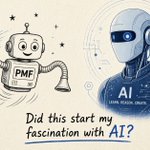
⭕️ Did a French-speaking robot called PMF start my fascination with AI?
thoughtprovoked.co.uk/blog/d…




What did the task you just automated used to teach the person doing it? thoughtprovoked.co.uk/blog/w…
