

I put my faith in the Lord Jesus Christ, not in the curse of the Law.
Cleveland, MS
Joined July 2011
- Tweets36.7K
- Following33
- Followers618
- Likes2.7K




Pinned Tweet
Why Context Matters
by Ronald W. Robey
(written October 26, 2025)
Context matters — here’s why:
Leviticus 27:30
• “The tithe of the land” can be twisted to mean the entire landmass of the earth, if taken out of context.
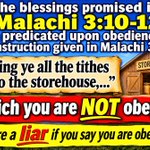
Malachi 3:10–11
• “Ye” can be twisted to mean Christians, if taken out of context.
• “Tithes” can be twisted to mean ten percent of your money, if taken out of context.
• “Storehouse” can be twisted to mean your local church, if taken out of context.
• “Blessing” can be twisted to mean an unexpected check, if taken out of context.
Hebrews 7:6–8
• “Here” can be twisted to mean the church building, if taken out of context.
• “Men that die” can be twisted to mean pastors, if taken out of context.
• “Tithes” can be twisted to mean money, if taken out of context.
• “There” can be twisted to mean Heaven, if taken out of context.
• “he” can be twisted to mean Jesus, if taken out of context.
Devotional Thought:
When Scripture is lifted out of its context, truth becomes distorted and error begins to sound convincing. Many doctrines today stand only because verses were removed from the soil in which God planted them and planted where they were never meant to grow. Truth survive when torn from its context.
If we are to honor God’s Word, we must study it in the light of who was speaking, to whom they were speaking, and under what covenant they lived. Truth does not change with opinion or popularity…it is revealed through proper context.
2 Timothy 2:15 Study to shew thyself approved unto God, a workman that needeth not to be ashamed, rightly dividing the word of truth.
Five tithes required in the Bible, each for a good reason and none for the preacher’s new Cadillac.
Now, the first kind was what you might call the Inheritance Tithe. If you were an Israelite lucky enough to inherit a plot of dirt and some livestock in the Promised Land, you owed a tenth of your crops and critters to the Lord. But you didn’t hand it over to just anybody, it went to the chilluns of Levi. Those poor boys didn’t get any land of their own, so tithes were their inheritance. They kept the temple clean, made the sacrifices, and kept everything running while the rest of Israel plowed and planted. That was their deal with God.
Then came the Reverence Tithe, which I figure was the Lord’s way of saying, “Don’t work so hard you forget to celebrate.” Every year, folks would haul a tenth of their crops to Jerusalem, not to give away, but to eat and rejoice. It was a church picnic on a grand scale. You and your family sat down, lifted your glasses, and thanked God right there in the holy city. Made you remember where your blessings came from.
Every third year, though, a tithe turned into something called the Benevolence Tithe. The Levites got some, sure, but so did the stranger passing through, the orphans, and the widows. You might say it was biblical welfare, not out of obligation, but out of community. When you gave, you didn’t just check a box; you made sure the least among you had supper.
Now, the Levites weren’t off the hook either. They got their own tithe from the people, but they had to tithe too. That’s the Priesthood Tithe. They gave a tenth of the tithes they received to the Aaronic priests, the high priests who tended to the holiest duties. It was God’s way of keeping everybody humble. Even the holy folk had to pay up.
And finally, you had what was called the Storehouse Tithe. The Levites brought a portion of their own tithes to the temple storerooms. It went to feed and supply those working in the Temple day and night, keeping the candles lit, sweeping the floors, maybe catching a nap against a pillar during the night shift. Those storehouses were the ancient world’s version of a pantry, ready to provide when the need arose.
1
47
When a Pastobr is challenged on a doctrine that he teaches but cannot defend that doctrine with Scripture, it brings reproach on his Ministry.
Advice: if you cannot irrefutably defend your beliefs with Scripture, don’t teach them until you have fully studied them and can prove them to be true.
Because if you can’t defend them with Scripture, someone who has studied Scripture could embarrass you completely, destroying your credibility as a Minister.
Don’t let your pride destroy your Testimony. It’s okay to say, “I don’t know.”
18
Matthew Tompsett,
Many people assume the biblical tithe was a financial fund meant to pay pastoral salaries and maintain church buildings. A closer look at Scripture shows something entirely different: the tithe was strictly food given to physically sustain the Levites so they had the strength to carry out their duties.
Under Mosaic Law, the tithe consisted exclusively of crops and livestock (Leviticus 27:30, 32). Because the Levites were given no farmland inheritance in Israel (Numbers 18:20, 23–24), they could not grow their own food while performing the heavy, full-time labor of the sanctuary. God therefore assigned the agricultural tithe to them "for their service which they serve" (Numbers 18:21).
Even Malachi 3:10 commands bringing the tithe into the storehouse "that there may be meat in mine house"—keeping the working ministers fed so they would not have to abandon their posts to farm (Nehemiah 13:10).
Meanwhile, God never used the tithe to build or repair the Temple itself. Structural upkeep was funded entirely through freewill offerings, the half-shekel poll tax, and dedicated repair chests paid directly to carpenters and masons (Exodus 30:12–16; 2 Kings 12:4–12).
Biblically, the tithe was never a building fund, it was the Levites' daily bread.
63

“Prove Me now herewith”
Probe You? How?
“In tithes and offerings.”
Tithes? What tithes?
“The agricultural tithes required in Mine ordinances.”
Where is the storehouse?
“It is in the Temple in Jerusalem.”
“Prove Me now herewith.”
27
Abraham? The best example of weekly tithing?
Alright, let’s follow Abraham’s exact example. If any of my nephews are ever kidnapped by a coalition of foreign kings, I will assemble a private militia, launch a midnight raid, and defeat them in battle.
If, and I must stress if, I survive, I will gather up the spoils of war, travel to the Valley of Shaveh, and hand a tenth of that plunder to Melchizedek, the King of Salem, in exchange for bread, wine, and a blessing. Then, just like Abraham, I will give away the remaining 90% so I don't keep so much as a sandal strap for myself.
What I won't do is pretend Abraham’s one-time battlefield custom is a blueprint for deducting 10% from a modern paycheck. Scripture records Abraham’s great wealth in livestock, silver, and gold, yet never once records him tithing his personal income.
As a child of God under the New Covenant, I gladly give generously, cheerfully, and responsibly to support the gospel and help those in need, just as the New Testament actually teaches. I simply don't need to rewrite Genesis 14 to justify it.
35
MATTHEW 17:27
Jesus instructed Peter to catch a fish, from whose mouth came a coin sufficient to pay the temple tax for both of them.
The money was miraculously obtained.
It was immediately available for use.
The amount was exactly enough to pay the tax for both Jesus and Peter.
KEY POINT:
Before that money was spent,
Jesus did not set aside a tenth of it as a tithe.
No command was given to calculate a tithe.
No portion was separated for tithes.
IF MONETARY TITHES WERE REQUIRED...
If God had required monetary gain to be tithed, this would have been the perfect opportunity to demonstrate that obligation.
The money had been gained
It was in their possession.
It was about to be used to satisfy a financial requirement.
Yet Jesus simply instructed Peter to pay the tax. No suggestion was made that paying the entire amount would violate God's law.
IMPORTANT TO NOTE:
Had Peter first removed a tenth from the coin, the remaining amount would not have been enough to pay the temple tax for both himself and Jesus.
The miracle provided exactly enough to fulfill the tax obligation-not enough for a monetary tithe plus the tax.
THE CONCLUSION
IS CLEAR
If monetary tithing had been God's command, this miracle would have been the ideal occasion to demonstrate it.
Instead, Jesus paid the tax in full.
He gave no instruction to tithe.
He provided no indication that God required money itself to be tithed.
2
55
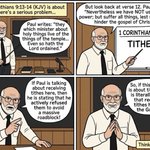
1 Corinthians 9:13-14 about tithes? Then don’t collect tithes, “lest the Gospel be hindered”; v.12)

19
The Biggest Scam
by Ronald W. Robey
The modern doctrine that God requires twenty-first-century believers to give 10% of their monthly income into a church collection plate is, in my view, one of the biggest scams in the modern church.
Why? Because the biblical requirements for tithing differ from what many churches teach today.
1. The tithe was commanded of Israel under the Law of Moses.
The Bible identifies the tithe as part of the covenant ordinances given for the children of Israel (Leviticus 27:30–34; Numbers 18:21–24). It never explicitly commands all New Covenant believers worldwide to give 10% of their weekly/bi-weekly/monthly income to a church or pastor.
2. The biblical tithe consisted of agricultural produce and livestock, not a prescribed percentage of monetary wages.
Scripture identifies the tithe as grain, fruit, and livestock (Leviticus 27:30–33; Deuteronomy 14:22–23). It does not establish a universal 10% tithe on salaries, wages, or other income.
3. The tithe was given to the Levites, and the tithe of tithes went to the house of God.
God appointed the tithe to support the Levites (Numbers 18:21–24). The Levites, in turn, were commanded to give a tenth of what they received to the priests (Numbers 18:25–32). Nehemiah 10:37–38 describes the Levites bringing a tithe of tithes to the house of God.
4. The storehouse belonged to Israel’s temple system.
Malachi 3:10 commands Israel’s priests to bring the tithes into the storehouse. Nehemiah 10:38 and 13:5, 12 connect the storehouse with the house of God in Jerusalem. These passages concern Israel’s covenant, its priesthood, and the provision of food.
Where does Scripture explicitly command the New Covenant church to identify itself as the storehouse of Malachi 3:10?
Where does the New Testament command every believer to give a mandatory 10% of monthly income to a pastor?
If the doctrine is truly is of God, let those who teach it establish their claims from Scripture.
I am not opposed to giving. The New Testament teaches believers to give willingly, according to what they have, and not under compulsion (2 Corinthians 8:12–13; 9:7).
But voluntary, cheerful giving is not the same as declaring that God requires every believer to surrender 10% of a monthly paycheck in the weekly service.
Believers deserve biblical truth, not fear, guilt, or financial demands presented as commandments of God.
1. According to the text of Leviticus 27:30-34, God's commanded tithe was to be
a) agricultural crops
b) agricultural flocks
c) agricultural herds
Leviticus 27:30 has absolutely nothing to do with a monetary tithe requirement.
2. According to Deuteronomy 12:1-11, God said the children of Israel were not to begin tithing UNTIL
a) they crossed the river Jordan
)b they entered the land of Canaan to dwell there
c) they found rest from all their enemies
Leviticus 27:30 has absolutely nothing to do with a worldwide tithe.
3. Only THEN would they have a place to bring their tithes.
The "TITHE OF THE LAND" in Leviticus was "HOLY" because it was "SET APART" for God...by Jacob's vow in Genesis 28:20-22.
Leviticus 27:34 tells us that the commands given in the Book of Leviticus were for the children of Israel. Psalms 147:19-20 assure us that those commands were given to no other nation.
Of the forty-four (44) references to tithe found in the Bible, only thirty-six (36) speak of God's commanded tithe. Only fourteen (14) of the thirty-six verses tell us what the elements of God's commanded tithe are to be. Those fourteen (14) verses reveal God's commanded tithe to be agricultural...not monetary.
God's commanded tithe is
a) seed of the land. (Le. 27:30)
b) fruit of the tree. (Le. 27:30)
c) every tenth animal to pass under the rod. (Le 27:32)
d) corn. (De. 12:17)
e) wine. (De. 12:17)
f) oil. (De. 12:17)
g) seed. (De. 14:22)
h) corn. (De. 14:23)
i) wine. (De.14:23)
j) oil. (De.14:23)
k) oxen. (De. 14:26)
l) sheep. (De. 14:26)
m) wine. (De. 14:26)
n) strong drink. (De. 14:26)
o) oxen. (2 Ch. 31:6)
p) sheep. (2 Ch. 31:6)
q) tithes of our ground. (Ne. 10:37)
r) tithes out of the fields. (Ne. 12:44)
s) corn. (Ne. 13:5)
t) wine. (Ne. 13:5)
u) oil. (Ne. 13:5)
v) corn. (Ne. 13:12)
w) wine. (Ne. 13:12)
x) oil. (Ne. 13:12)
y) food. (Mal. 3:10)
z) mint. (Matt. 23:23)
aa) anise. (Matt. 23:23)
ab) cummin. (Matt. 23:23)
ac) mint. (Lu. 11:42)
ad) rue. (Lu. 11:42)
ae) herbs. (Lu. 11:42)
Conclusion: The "LAND" that Leviticus 27:30 is speaking of is not the entire Earth...it is speaking of the land of Canaan...the land that God promised to give to Jacob and His descendants in Genesis 28:12-15. The only people that the tithe ordinance was given to were the children of Israel. The tithe that was "HOLY UNTO THE LORD" was food...not money.
78
Person 1
“ The Bible is the blue print if you are to preach or teach God's word. The old Testament priesthood is the New Testament priesthood of Ephesians 4:11 which talks about the fivefold ministry (Pastor,s,Evangelists, Teachers, Apostles, Prophets)”
Person 2
“I’m not convinced the the OT priesthood is the NT priesthood. But I’ll test the waters. In the OT, the Priestood did not receive tithes from the congregation. The Temple wasn’t supposed to receive tithes from the congregation either. The OT Priesthood was to receive from the children of Levi known as Levites. So, my question to you is as follows: What family name in the NT church has God chosen to represent the Levites and are not members of the congregation?”
26
The fundamental flaw in appealing to the "Law of First Mention" for Genesis 14 is that proponents want to declare the percentage (10%) a perpetual, binding principle while completely ignoring every single historical condition established in that first mention.
If the details of the "first mention" set the baseline pattern for all subsequent believers, then to be hermeneutically consistent, the full rule set would look like this:
• Age: You must wait until you are 75 years old to give it.
• Frequency: You do it exactly once in your entire lifetime.
• Source: It must be taken strictly from war spoils recovered from defeated foreign armies, never from a personal paycheck, trade income, or home crop.
• Covenant Status: You must do it while uncircumcised (since God didn't establish the covenant of circumcision with Abram until Genesis 17, decades later).
• Family Status: You must be childless (Isaac was not yet born).
• Recipient: It must be given directly to an ancient royal King-Priest, not a local church fund or Psstor.
Pthereise, you aren’t observing the Law of First Mention…
You’re cherry-picking.
23
Does Tithe Belong Where You Are Spiritually Fed?
by Ronald W. Robey
(written November 06, 2026)
A popular argument used by modern tithe advocates is, “Your tithe belongs where you are spiritually fed.”
But does that argument agree with Scripture?
Consider Acts 15:21:
“For Moses of old time hath in every city them that preach him, being read in the synagogues every sabbath day.”
Notice what James says. Moses was being read in synagogues in every city. People were hearing the Law of Moses throughout the surrounding communities.
Now consider what that same Law of Moses said about the location of God’s commanded tithes.
Deuteronomy 12:5-6 instructed Israel to bring their offerings and tithes to the place which the LORD would choose to place His name.
And where did God choose to place His name?
2 Chronicles 6:5-6 identifies Jerusalem as that place!
Here is where the modern argument falls apart.
If the principle were truly, “Your tithe belongs where you are spiritually fed,” then Israelites attending synagogues in various cities could have been told to bring their tithes to those synagogues.
But the Law of Moses did not authorize that arrangement!
The people could hear Moses read in their own cities, but the commanded tithes were to be brought to the place God chose: Jerusalem.
In other words, the location where someone received instruction in the Law was not necessarily the location where God commanded the tithes to be brought.
Acts 15:21 establishes widespread teaching of Moses. Deuteronomy 12 and 2 Chronlcles 6/establish the designated location for the tithes.
So, where is the biblical authority for the modern slogan?
“Your tithe belongs where you are spiritually fed” is a man-made argument, not a commandment established by Scripture.
Spiritual instruction in every city did not mean tithe collection and tithe storehouse in every city!
22
In Acts 15:10, Peter asks a fundamental question regarding Gentile converts:
"Now therefore why tempt ye God, to put a yoke upon the neck of the disciples, which neither our fathers nor we were able to bear?"
This passage provides undeniable biblical proof that the Jerusalem Council was addressing the burden of the entire Mosaic Code, not merely the surgical act of circumcision.
To understand why, one must look at how circumcision operated under the Law. Circumcision was never an isolated ritual; it served as the initiating seal of covenant obligation. Paul confirms this legal scope in Galatians 5:3, writing,
"For I testify again to every man that is circumcised, that he is a debtor to do the whole law."
When the Judaizers demanded circumcision in Acts 15:1, they were requiring Gentiles to submit to the entire legal system of Moses.
Furthermore, Peter’s choice of words renders the "circumcision-only" argument logically impossible. An eight-day-old infant does not carry a lifelong moral "yoke" from a single surgical procedure, nor would adult Jewish men historically describe the physical rite itself as an unbearable lifelong burden.
Instead, "the yoke" (Ol Torah) was a well-established Jewish idiom for the heavy requirement of total, blameless compliance with the 613 commandments of the Mosaic Law.
Peter acknowledged that neither their ancestors nor his own generation could successfully achieve justification through that legal code. Thus, Peter concluded in Acts 15:11 that salvation comes solely "through the grace of the Lord Jesus Christ", confirming the Council rejected imposing the Mosaic Law as a requirement for salvation.
25
If tithing were a foundational principle, a mandatory "bottom floor" for Christian giving, it would have been affirmed by the Holy Spirit and established by the apostles at the Council of Jerusalem (c. A.D. 50).
Furthermore, it would appear explicitly as a requirement throughout the New Testament epistles.
The historical and scriptural record, however, reveals neither occurrence.
At the Jerusalem Council (Acts 15), the apostles explicitly addressed which Old Testament ceremonial regulations applied to Gentile believers. Tithing was omitted entirely. Likewise, when the apostles wrote to the early churches regarding stewardship, they emphasized generous, cheerful, and voluntary giving from the heart (2 Corinthians 9:7), not a compulsory 10% requirement bound to the Mosaic Law.
Boundaries set by Scripture are intentional. Attempting to elevate tithing into an absolute requirement for Christian living creates a standard the apostles never commanded. Scripture sternly warns against adding to God’s Word (Deuteronomy 4:2; Revelation 22:18–19). Transforming an Old Testament legal mandate into an unscriptural Christian obligation risks burdening believers with human tradition rather than walking in the freedom of Spirit-led grace.
23


