

Building systems that run without me. Founder Unkillable · Bouly
Joined December 2025
- Tweets1.3K
- Following369
- Followers384
- Likes1K


Pinned Tweet
Yesterday morning, I switched every public post to English. I said it once. That was the whole migration.
My reason fits in one line. France is too small to stay ahead.
In a company, a change like that usually takes weeks. You tell people one by one. Half of them forget. The old way creeps back.
Here, the rule lives in one place: the style guide every writing agent reads before each post.
By the end of the day:
- the guide had English rules
- my reference posts were translated
- the scoring of my drafts was switched to English
A rule you have to repeat isn't a rule. It's a reminder.
2
254
La mémoire d’un agent n’est pas son contexte individuel et on l’oublie bien trop souvent.
Voici quelques bonnes pratiques pour avoir des agents performants :
1. avoir une cartes de source de vérité
Les agents doivent savoir quoi chercher où. La data est de l’or. Alors il faut la gérer correctement : CRM, googleDrive, task manager.
2. Avoir un log des actions :
Si tu veux qu’un agents se souvienne de tout, il faut qu’il log ce qui a été fait, comme ça il peut retrouver l’information. Un gestionnaire des tâches/todolist est essentiel. Ça fait double usage sur le fait et à faire en plus
3. Un registre de skill/procedure :
Tu ne veux pas que ça soit dans la boite noir du bot. Ça doit être sur un github ou Google drive et que ça soit partager avec tes autres IA plutôt que dupliqué à d’autres endroits.
Bien souvent, si un bot se débrouille mal, c’est juste qu’il doit travailler dans un chaos, si tout est rangé et structuré, le résultat sera toujours meilleur !

Ok les amis, ça fait 1 mois et demi que je teste @grok @bot, et mon opinion est la suivante : C'EST DE LA MERDE.
Grok est trop con. Les contextes sont oubliés. Il raisonne pas. Il vérifie pas. Il fait n'importe quoi.
Les points positifs :
- L'UI et l'UX sont incroyables, c'est la meilleure expérience possible, les DM sur X, les applis desktop et mobile synchronisées automatiquement.
-C'est bien pour des trucs « classiques » et pour le côté « bot » avec des rôles.
Mais désolé, il est trop con et c'est le plus gros point négatif pour moi. J'en ai marre de lui dire « demande à Claude de vérifier, demande à GPT de vérifier ».
Par contre, je le recommanderais à 100 % à une personne qui n'a jamais utilisé d'agent pour mettre le pied à l'étrier.
Mais pour moi et mon usage, c'est ciao, il est trop débile.
1
2
98
C’est là tout le sujet : « niveau expert »
une IA vanilla ne sait pas produire du niveau expert. Ce n’est pas parce que c’est beau et que ça marche, que c’est un niveau de qualité expert.
A plusieurs reprises et sur divers domaines, les livrables qu’elle m’a produits sont juste au niveau moyen qu’un spécialiste saurait faire.
Il ne faut pas confondre expertise et production d’un livrable dans un domaine où on n’a pas la compétence.
EXEMPLE :
- il m’a fallu des mois pour qu’une IA (harness multi agent) me produise du code de qualité entreprise qui est pérenne
- sur des audit d’entreprise, sans avoir guider l’IA sur un process et une démarchage, elle n’a jamais su faire correctement. Il a fallu 3-4 cycles pour que j’arrive à lui transmettre mon expertise.
Ceci étant dit, on touche du doigt un problème qui n’est pas encore résolu :
« comment faire pour qu’une IA entraînée sur des data médiocre arrive à atteindre un niveau expert ?»
J’y vois 2 pistes :
- changer la méthode d’entraînement/évaluation/dataset
- harness qui pousse un comportement de recherche d’expertise et d’excellence avec un système d’apprentissage multi boucle.
TLDR : actuellement, une IA peut être une experte dans un domaine qu’à partir du moment où un expert a décomposé sa pratique pour que l’IA puisse la dérouler ou après qu’elle ait expérimenté suffisamment de scénario pour développer cette expertise.

Je suis complètement d’accord : l’IA ne remplace pas encore.
Mais avec l’amélioration récursive, la courbe n’est pas linéaire.
Tout s’accélère.
À un moment, l’humain deviendra contre-productif et sortira de la boucle.
Pourquoi ?
Parce qu’on observe déjà un phénomène simple : Une personne sans aucune expertise, équipée d’une IA, produit déjà du niveau expert.
La marge entre l’expert et l’amateur fond de plus en plus.
On arrive donc à un point où ce qui sépare les deux n’est plus d’ordre humain, mais d’ordre IA.
Si cette marge disparaît, la seule variable significative qui reste, c’est l’IA.

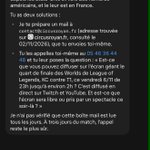
J'ai eu mon premier wow moment avec mon agent. Je lui ai demandé de trouver un bar e-sport pour KC contre T1. Pas le temps, je lui ai dit : appelle. Et là, tout d'un coup, il m'affiche appel de Circus en cours.

1
1
126

If you use Claude Code with Obsidian:
I built a Claude Code mod you'll want to steal.
Using Claude Code on a second brain gets painful fast:
- you can't open .md files directly
- you can't see if someone else is editing the same file
- you don't know which file Claude is working on
So I built a mod that fixes this. The last 3 notes Claude touched show up as buttons above your prompt. One click opens the note in Obsidian.
If you haven't heard of or tried mods yet, they're simple upgrades you can build to customize your Claude Code interface.
Happy to share other mods.
One of my favorites: a small banner in Claude Code 10 minutes before every meeting, with a one-click link to join.
The code is in the reply.
Built your own mods? Tell me which ones. I'm curious.

4
2
214
Here's the code: github.com/go-silex/uc-mod-o…

40
Why I Stopped Writing Unit Tests
I asked an agent to add one field to a form. It read 14 test files first, burned tokens, and broke the real use case. My tests weren't protecting the code. They were misleading my agents. Here's what replaced them.
That wasn't a one-off. My agents spend a lot of time writing test code, then adjusting it. During audits, they suggest ways to improve it, and some of those suggestions miss the point, so each one has to be evaluated. All of that takes time and burns tokens to produce code that does nothing for the business.
I produce a lot of code. More than I need. And the biggest offender isn't features. It's tests. Unit test files that assert the obvious, that import modules they never really exercise, that sit there adding noise every time an agent opens the codebase.
I've seen plenty of posts lately arguing unit tests aren't necessary. I mostly agree. Not because testing is pointless, but because most unit tests I wrote didn't earn their place.
Here's my problem with them: they pollute the agent's context. When an agent reads a repo to work on a business feature, it shouldn't have to wade through hundreds of test files that describe how functions behave in isolation. That code doesn't move the product forward. It crowds out the code that does.
So the question became: how do I keep a high-quality codebase without drowning in test files?
End-to-end tests are the easy yes. They cover real use cases, top to bottom. When an agent reads them and runs them, everything lines up with the actual purpose of the application. No translation layer, no gap between what the test claims and what the product does.
But end-to-end tests are blunt. They won't catch the fine-grained edge cases that matter at the function level. And I don't want every fine check to be an agent running a scenario. That costs money and time. I want automated tests that are cheap to run and sharp enough to matter.
That's where property-based testing comes in.
Instead of writing one assertion per input, I write a property: a statement that must hold for any valid input. A library, fast-check in my case, generates hundreds of random values, tries them all, and shrinks any failure down to the smallest breaking case. I'm not testing examples. I'm testing the rule. And that rule is business-aligned by nature, because a property says what should be true about the domain, not how a single function behaves in a vacuum.
The last piece is SemContext. It doesn't run tests. It reads code statically and flags which invariants a change touches. On its own, that's weak: it counts an invariant as proven just because a test file imports the relevant code, even if that test asserts nothing.
So I don't ask it to prove anything. I give it one job: tell me which properties to re-run after a change. I pair that with a simple rule. Show that the property fails on the code before the change. A weekly mutation test adds extra confidence.
Fewer test files. A cleaner context for every agent.
A thousand tests that check nothing prove less than one rule that can fail.
1
4
297
Tern 0.9.4, Linux to Linux: remote connects fine, but my desktop’s 6 existing tabs don’t appear. They’re under window key “7”; the remote client shows a separate Default session. “Switch host” doesn’t help. How can I attach to the existing window/session ?
@can1357
3
126
This is a good idea but wrongly executed. Personal and company knowledge already live in your tools : CRM, apps, googleDrive, Onedrive…
You do not want one more tool. You just need a map where to find and store data.

In a few minutes I'm releasing Space.
It's what I built after months of pasting the same context from ChatGPT to Claude Code to the agents on my server
One workspace for you and your agents. Stay tuned

1
2
133
For a long time, I thought AI would let me do everything myself.
That was my mistake.
I had not seen my real limit.
Not my skills. My mental load.
An agent you host yourself shows it fast.
The maintenance takes almost nothing. A small bug here, a check there.
But it is always 30 seconds, one minute, three minutes.
One more item on the to-do list.
One more moment where it does not work, right when you need it to.
Do that across every tool, and your day fills up with your tools.
Not with the work your clients pay you for.
Not with the work you are actually good at.
AI did not remove my limit.
It moved it.
My limit is no longer what I can do alone.
It is what I can carry in my head.
So I stopped asking: can AI do this?
I started asking: who carries this when it breaks?
If the answer is me, every day, in small pieces, I do not want it.
I did not hire agents to become their technician.
I hired them to stay where I am good.
2
4
226
Right now, I work with three AI setups at once.
Grok Bot runs my agents and my days.
Claude and Oh My Pi are for code and client demos.
Each one has its own memory.
I cannot let it keep it.
If my company's know-how lives separately inside each tool, it drifts.
One learns one version of a fact.
Another keeps an older one.
After a month, nobody knows which one is true.
So the memory lives outside all three.
It lives in a shared Drive that every agent reads before it works, and writes back when it is done.
One page there says, for each kind of information, where the truth lives and which copies not to trust.
Tools change. Models change.
The company brain has to belong to the company.
7:00 a.m. today, my daughters have never gotten up so fast. They wanted to see the new Tesla.
Last night, they even asked me to wake them up at 3:00 a.m.!
The new Roadster definitely had a "wow" factor, but their reaction was: "Do you think there’s a screen in the back?" 🤣
My answer: "Nope, there’s no room in the back." So, they prefer Daddy’s car, they’ve got good taste! It’s a Tesla Model 3 Performance!

82
X subscription offer now access to:
- Xplay : streaming subscription, AI content is accepted
- Xmusic : AI content is ok
- Xlivery : command everything you need. Delivery done by tesla optimus robots.
+ what you already have :
- GrokBot
- Grok
- X premium
- cursor agents
Here we go !

2
123
Mickael Bouly retweeted

@can1357 With the new unified Grok subscription, Grok Build usage only works through the official grok CLI. An xAI API key bills separately, so omp users can't use the plan they already pay for. I built a provider that fixes it.
omp plugin install github:MonsieurBarti/omp-grok-build
It talks to Grok Build the same way the official CLI does: browser PKCE login, live model list with real context windows (256K, up to 500K) and reasoning levels, the CLI's headers, credit usage in /usage, and it works in fallback chains.
Happy to upstream it as an official omp provider if you're interested.
github.com/MonsieurBarti/omp…


We remade our Err 404 page with AI in 10 minutes.
And transformed something boring into fun.
Users are never happy when landing on an error page.
My goal was to create a mini game where the user has to fight Clawds (the Claude Code mascot) in order to save their company from being killed by AI.
I'm sure you know Space Invaders.
It was the inspiration.
Since Claude is connected to our Company Brain, in 1 prompt, it created the page on our website, used our design guidelines and made it consistent with our brand. Pushed it live and set it up so every error lands on that page.
It took me 3 prompts to tweak the layout and mobile responsive.
All set.
Link in the comments if you want to play around 😁
Have you used AI to bring some fun to your user journey? I'd be curious to know.
- post written 100% by a human
3
2
191