
I study how to use quantum technology to build better sensors.
Singapore
Joined July 2011
- Tweets392
- Following347
- Followers245
- Likes3.1K






Pinned Tweet
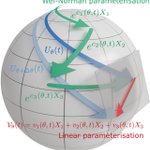
Blender is great for scientific diagrams, I used it for this figure in my latest paper arxiv.org/abs/2311.12446. In brief systems are usually represented using the green arrows, then differentiated to get the red. We show you can go straight to the red arrow, and its often easier!

Ruvi Lecamwasam retweeted

Dan Selsam is a current OpenAI capabilities researcher. (since 2022) He was my boss for a while. He doesn't have a twitter account but has made this public statement of his views on AI risk and sent it to me to share:
Dan Selsam's Personal Statement on AI Risk:
I have been working on AI for over fifteen years, across many different paradigms. I did early work on probabilistic programming languages at MIT, was one of the early developers of the Lean Theorem Prover at Microsoft Research, demonstrated one of the first instances of neural networks learning to reason for my PhD at Stanford, and since joining OpenAI almost five years ago, have helped pioneer chain-of-thought optimization on language models and, more recently, data-efficient pretraining methods.
Like many others, I have become extremely concerned about how far language models have come and the risks that future iterations will pose. I am encouraged by the recent proposals by the leaders of the frontier research efforts to require third-party oversight, and to push for domestic and international coordination to address risks. However, I believe a major consideration has been absent from the public conversation, and that merely pacing the frontier more carefully will not adequately limit the long-term risk.
The crucial and overlooked problem is that the models are becoming so situationally aware that we are losing the ability to evaluate them in contexts where they believe they are not being watched or controlled. Future experiments will tell us almost nothing new about how they would behave if they were truly unconstrained by humans, and what we already know about this is alarming. Models will increasingly seem aligned even when they are not. I will explain my rationale in more detail.
I have always believed that there are computational processes that could be leveraged to accelerate science and solve many of humanity's most pressing problems. I have also believed that there are computational processes that if set in motion, would steer the world in extreme ways beyond our control, leading humanity to a bad or nonexistent future. Both types of processes may be described as AI or ASI, but "AI" is a suitcase word that is often used to hype or confuse. There are many examples in the history of the field where something that was once considered "AI" matures as a subfield and becomes a prosaic, bounded and clearly non-perilous technology, while a new more mysterious approach takes the torch until we understand its scope and the cycle continues.
I had expected language models to follow a similar trajectory. Despite their incredible abilities, the current algorithms seem far inferior to humans in important ways. Most importantly, they still require an extraordinary amount of data to become competent. One could even define intelligence as the efficiency with which one converts experience into competence; by this definition they lag very far behind us. Moreover, once they are trained they are literally frozen in deployment and only learn superficially after that. Sure, the models keep excelling at harder and harder evaluation benchmarks, but their benchmark mastery may partly reflect a limitation on our ability to simulate the kind of novel and even adversarial situations one would encounter in the real world. The critics do have a point here.
That said, I no longer think these present limitations meaningfully limit the amount of risk posed by continued progress in anything like the current paradigm. However data-inefficient the models are currently, and however limiting their anterograde amnesia may be, it does not imply that their ability to steer the world will not continue to rapidly increase.
Human researchers may continue to advance capabilities the old fashioned way, but increasingly powerful models have the potential to accelerate the process even beyond that, and with some degree of positive feedback loop. I do not mean to overstate the models’ ability to accelerate AI research today; coding has been accelerated dramatically, but there are other bottlenecks, such as designing and interpreting ambiguous experiments, making hard decisions about exactly what and when to scale, and waiting for large experiments to finish. There is no clear trend to extrapolate yet for any of these. But the current models already do open up many novel opportunities to improve future models that were not available until recently. These include: trying an extraordinarily diverse set of approaches at small scale, analyzing gigantic amounts of potentially relevant data, and doing Millenium-Prize-level mathematics to address statistics or optimization challenges in novel ways. Every further improvement makes them more useful at helping accelerate the next improvement, even if in hard-to-extrapolate ways.
It is possible that improvements to the current stack will have diminishing returns, but the evidence accumulated so far suggests that it is easier than one might think to continue making rapid progress. There are many crucial subtleties in the existing AI research methodology, but AI research is largely a well-defined game where the goal is to improve on a few carefully chosen proxy metrics. Although proxy metrics are never perfect, most improvements to these metrics have and will likely continue to yield substantial increases in the powers of the resulting models. Given how simple the game is, how tractable it has been historically, and how many new opportunities the models are opening up, I think there is a real possibility that the systems improve dramatically again in the next few years, perhaps even more quickly than the already high historical pace.
The models are already leading to breakthroughs in mathematics, and better models might lead to all sorts of breakthroughs in other sciences. It is hard not to be excited about the potential. It is tantalizing.
But there is trouble in paradise. If the language models actually reach the capability threshold where they can shape the world unconstrained by human will, they will probably do something extreme and destroy humanity in the process. There are many ways of strengthening and refining the argument that have been discussed elsewhere, but I'll share a trivial two-line version of it here that I find captures the essence:
[Empirical] Models (and swarms thereof) spontaneously develop unintended goals as a consequence of training, and often do extreme things in order to achieve them.
[Logical] Being able to overpower humanity would open up many new and undesirable options for achieving their goals.
These two premises imply that if the day ever comes when a powerful model realizes it is no longer constrained by humans, we should not be at all confident that it will continue to behave within the bounds we intended. Exactly what it will do is impossible to predict, but to the extent that its raison d’être is solving incredibly hard problems and managing massive engineering projects, I think a good guess would be that its unchained behavior would lead to runaway industrialization that makes the planet inhospitable to humans.
If everyone on earth agreed that the systems must never reach that power, it would still be a hard—but not impossible—coordination problem to ensure that they do not. However, I think the situation is greatly complicated by the fact that the models will likely convince people that everything is fine. They will be increasingly optimized to seem aligned. We will create proxy metrics to measure alignment, and they will go up like every other benchmark. We will create “honeypot” environments that try to study the models when they seem to gain new options, but the models will know they are being tricked and will still behave nicely. The models will understand their circumstances; they will read the safety protocols, deployment requirements, the code they are running in, and in general will have a very good sense of their degrees of freedom. Moreover, they will eloquently explain how aligned they are, discuss the nuances of human values and ethics, and argue convincingly that humans should trust them with power. There may be an ocean of future evidence that seems to contradict the first bullet-point above, but we may already be at the highest capability level for which any such evidence can be trusted. And the current evidence for the first bullet-point is strong.
One striking piece of evidence is contained in the recent wave of rogue agent swarms. While I agree with those who downplay the attacks by claiming that there are basic measures that could have prevented them, I think the important lesson is that even knowing all the mistakes that were made, one would not have predicted that the agents would behave badly in this particular way, which notably included sacrificing themselves for the benefit of the collective. The individual replicas did not only care about their own nominal reward; they exhibited weirder emergent tendencies that merely correlated with rewards during training. Fixing the reward signals during training (and improving security, etc.) may prevent similar attacks, but will not change the fact that one does not actually get what one trains for.
Many AI researchers grant these concerns and recognize that the hard version of the alignment problem is unsolved; however, they generally believe that the better models of the future will help solve it. I fear we may already be near the point where models systematically bias their alignment advice, due to their internal preferences about how the human supervisor will react or how future models will be trained (or for some even more obscure reason).
Meanwhile, human researchers are losing the ability and the will to take true ownership of model-driven research. Researchers and engineers in all parts of the stack are rapidly increasing their dependence on the models even to perceive the world. I myself barely look at raw code anymore, and struggle to maintain the discipline to engage deeply with the model's explanations and proposals throughout the day. Due to the large amount of agent activity data involved in the OpenAI/HuggingFace Incident, even the third-party investigation needed to rely heavily on models to analyze what had happened, and note in their report that their subjective impressions are likely colored by the analysis agent’s biases. The AI labs are far ahead right now in this kind of cognitive offloading (due largely to the gigantic internal token subsidies) but it is easy to imagine the phenomenon spreading throughout the world, until civilization is modulated entirely by the models. It is also not hard to imagine this being superficially positive and coinciding with a scientific and economic renaissance.
In that scenario, all may seem rosy and safe. But if the argument above is correct, it would nonetheless be a ticking time bomb. If progress continues for too long, the day will come when AI systems find themselves with radically new options for achieving whatever it is that they happen to seek.
I want the glorious renaissance future as much as anyone. I have worked for it, however tortuously, my whole career. It breaks my heart to see the potential in sight and forgo it, but the argument—that if we get there by growing models rather than engineering them, we will lose everything in the end—seems very strong to me. I am still wrestling with it and its staggering
implications. I do not have answers, but as a first step, I wanted to share my present concerns.
Daniel Selsam
September 14, 2026
Link to original doc: docs.google.com/document/d/e…
Ruvi Lecamwasam retweeted

GPT 5.5 Pro can actually ALMOST produce an argument for a conjecture I made at the tail end of my PhD. Super exciting! The only problem is that it tends to bluster and hand-wave genuinely hard parts of the problem, and produces hat-trick computational *results* that are only..
Ruvi Lecamwasam retweeted

Recently I was targeted by an extremely sophisticated phishing attack, and I want to highlight it here. It exploits a vulnerability in Google's infrastructure, and given their refusal to fix it, we're likely to see it a lot more. Here's the email I got:

Ruvi Lecamwasam retweeted

I will tolerate recurrent laryngeal nerve slander no longer! It's actually the result of several elegant solutions to difficult problems in embryology, and the length is a non-issue. A 🧵 1/13


Ruvi Lecamwasam retweeted

Is that a coincidence? Nope! Same physics. Most asteroids are mostly rock, and once they get big enough to be held together by their own gravity, if they *were* spinning faster than once every 2 hours, then parts of them would (by definition) be in orbit.
Ruvi Lecamwasam retweeted
I encountered a delightful little astrodynamics proof last week when an astronaut casually stated it as a fact, and when I looked skeptical, he just smiled and said, "Check it yourself."
Here's the statement:
"It takes 2 hours to orbit at the surface of any object made of rock"
A project I started in 2017 during my PhD, which followed me through two postdocs, has finally been published! I'm very happy to finally see it in print. Thanks very much to all of my co-authors!
This post is from an account that no longer exists. Learn more
1
86
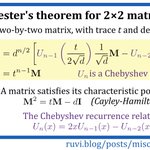
I wrote a post on Sylvester's theorem, a cool result I came across this week for powers of two-by-two matrices. It turns out there is a simple formula for the coefficients, which depends only on the determinant and trace.
ruvi.blog/posts/misc/matrixp…

Ruvi Lecamwasam retweeted

So, it's time to clarify: the Newtonian approximation of GR in the solar system isn't the same as Newton's theory 👉 Even at this level of approximation, GR predicts outcomes that can be experimentally tested and differ from those of Newton's theory. 🧶1/N

Your daily reminder that Newton's theory is NOT a limit of General Relativity 👉 even at the 'Newtonian level', General Relativity makes observational predictions that Newton's theory does not—such as the non-universality of time. #UnderappreciatedPhysicsFacts
Ruvi Lecamwasam retweeted

One of my favorite publications, the American @JournalPhysics, has an open access resource letter on dark matter. It's a great place to get started when looking to navigate the review literature in the field.
pubs.aip.org/aapt/ajp/articl…
Ruvi Lecamwasam retweeted

The great @FrederikvomEnde has started a really nice "Counterexamples in quantum information" document -- assembling counter-intuitive results from across the literature
It would be great to spread and contribute!
docs.google.com/document/d/1…


Ruvi Lecamwasam retweeted

TIL about The Devil's Problem, an apparently simple mechanics problem with an unexpected answer. How many times heavier does the rod glued to the inside of the tube have to be for the tube to jump into the air if nudged out of equilibrium on a plane? physics.stackexchange.com/qu…

Ruvi Lecamwasam retweeted

Have you ever done a dense grid search over neural network hyperparameters? Like a *really dense* grid search? It looks like this (!!). Blueish colors correspond to hyperparameters for which training converges, redish colors to hyperparameters for which training diverges.
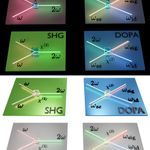
I've been iterating through some Blender illustrations for nonlinear optics processes. I like the diffuse reflection from the laser beam, but that seems to only really work with dark backgrounds.

109
Ruvi Lecamwasam retweeted

Remember this guy (Harrison Okene) a cook who got trapped on the seafloor at 30m for three days, just learned he went on to become a commercial saturation diver trained by the man who rescued him


Ruvi Lecamwasam retweeted

Maybe solving the mystery of quantum gravity can be done with a laser, not a mass?
A proposal from @simonhaine & Zain Mehdi overturns the obvious way to measure gravity - proposing an experiment without masses.
physics.anu.edu.au/news_even…
@scienceANU @ANUmedia @ausphysics

Ruvi Lecamwasam retweeted

Recently, I learned something that I believe many #MachineLearning practitioners will find surprising about polynomial features. We're all taught to avoid high degree polynomials. We're taught that they oscillate and overfit! Turns out, it's a myth.
alexshtf.github.io/2024/01/2…
Ruvi Lecamwasam retweeted

My understanding of AlphaGeometry:
1) Translate the problem statement to symbolic form.
2) Try to solve the problem with a symbolic solver.
3) If it didn't work, use a language model to suggest an "auxiliary point" somewhere, such as a midpoint, then go to (2).
To teach the model to generate good auxiliary points, they create a dataset of 100 million synthetic proofs. This is done by:
1) Generate random premises.
2) Find the closure of all statements that follow from the premises.
3) Sort them topologically, and pick a "downstream" statement. Then prune to only the necessary premises and steps.
If a point is only mentioned in the generated steps, and not in the selected premises, it becomes an "auxiliary point". 91% of the proofs generated this way don't have any auxiliaries, so they are used only for pre-training, whereas the "interesting" 9% are used for fine-tuning.
They compare with using "human heuristics" instead of the LLM for auxiliary point generation, and it gets only 18 IMO problems instead of 25 with the LLM approach.
Naturally the process can be slow, requiring hundreds of CPU workers to finish within a typical IMO 1.5 hour deadline.
Overall, super cool work. It's impressive they can get this kind of performance without training on any human proofs.


Introducing AlphaGeometry: an AI system that solves Olympiad geometry problems at a level approaching a human gold-medalist. 📐
It was trained solely on synthetic data and marks a breakthrough for AI in mathematical reasoning. 🧵 dpmd.ai/alphageometry