

Growth & Venture Architect · Open-sourced Dirgha CLI: 21K+ downloads. 📎 📝 Interests: AI, Robotics, Sci-fi & Storytelling Open-source projects @DirghaAI
Bharat 🇮🇳💌💬
Joined March 2007
- Tweets18.6K
- Following1.1K
- Followers1.8K
- Likes51.1K




Pinned Tweet
Dirgha Code has received 21K+ organic downloads.
Many frontier labs launched their own coding harnesses since I released Dirgha Code.
As the general coding harnesses are nearly a solved problem, the next challenge is for use case-specific harnesses.
github.com/dirghaai/dirgha-c…

Silica feels sensitive and strong. Kudos to the team for making the concept more human, relatable, and fun.

Introducing Silica.
We make actuators 50x more sensitive at an affordable price, so that robots can feel the world around them.
When I was at Apple, I developed technology that helped humans live more creative and connected lives.
Now I make hardware for the training age, so that robots can begin to share that world with us.
We just opened pre-orders. Check out silicamachines.com to learn more.
Salik Shah ✨🚀 retweeted

Robots are about to get an infinite world to practice in.
Google DeepMind unveiled Genie 4, a real-time, photorealistic world model you steer with natural language, now with native audio and far better physics (collisions, aerodynamics).
For robotics, the interesting part isn't the pretty worlds. It's this: infinitely variable, steerable training environments for robots and agents.
They're already pairing Genie 4 with Gemini 4 Argon and Gemini Robotics to simulate Apptronik's Apollo humanoid playing checkers, breaking the task into real-time steps.
Sim-to-real, but the sim generates itself.
Salik Shah ✨🚀 retweeted

I'm so glad AI killed LeetCode-style coding interviews.
I've talked to young AI talent, and most would simply skip companies that still use LeetCode interviews.
I agree with Felix. Taste, empathy, principled thinking, business sense, and agency are what really matter.

The coding interview is dead, at least for my team at Anthropic. I've seen enough to know that it no longer provides signal. I removed it from loops this month.
I have a spicy, optimistic take - I think there's an opportunity for junior engineers: felixrieseberg.com/hunger-be…

Memory is the human moat.

At the end of the day, all learning comes down to memory.
That's what it is. Memory is the substrate of learning.
Even deep understanding is memory. It's deeply ingrained memory.
The difference between memorizing versus understanding is not about whether you use memory. It's about how much memory you have stored and how well it's connected.
Facts connect up into concepts, procedures become skills, and all sorts of new ideas come from combining things that you already know.
But you can't connect the dots if you've got no dots. You can't cook with ingredients that you don't have.
Memory is not the enemy of understanding, but rather, the foundation of it.
Further reading: justinmath.com/learning-is-m…
Salik Shah ✨🚀 retweeted

Peter Thiel might be onto something here…
aleximas.substack.com/p/what…
FWIW I think he’s missing important dimensions like desire for human connection, empathy, shared understanding, which will be important for the future of jobs in healthcare, education, etc.


Walter Isaacson asks Peter Thiel what humans can uniquely do in the AI era.
Thiel: "We're very relational… these relational dimensions will become more important."
When knowledge is worth $0, the only career skills that matter:
- networking / social calibration
- persuasion (sales)
- curiosity (harnessing AI)
- taste (curation)
- storytelling
- grit
- golfing with clients (or equivalent)
We'll get so sick of a fake world that we'll go back to doing business like it's the 1800s. A handshake at the local saloon.
"Instant Robot Learning."
"physical vibe coding"
vibe manufacturing
agentic

🚨 BREAKING:
@Machenta_ just raised $40M in seed funding, the largest robotics seed round ever raised in the UK. 🇬🇧
Founded by @Ed__Johns, @vitalisvos19 and the team that spent years developing this concept at Imperial College London.
The round was co-led by @creandum and @usv, and many other amazing parties
The technology they’re launching is called Instant Robot Learning.
A robot foundation model trained entirely in simulation. Zero real-world training data required.
Teach a robot a new manipulation task in a minute. Not hours. Not days. One minute! 🤯
The robot in the demo needs to pass a shoe between its hands twice to flip it the right way around, a creative, multi-step manipulation sequence.
The team didn’t pre-program it. They just tried things out until it worked.
Ed describes it as “physical vibe coding.”
It signals something genuinely new about the development experience. When teaching a robot takes minutes instead of weeks, you can iterate, experiment and get creative with behaviours the way a software engineer iterates on code.
The barrier between idea and physical execution collapses drastically.
The underlying insight is powerful. If you can generate enough high-quality simulation data and close the sim-to-real gap tightly enough, you never need to touch real hardware during training at all.
Every robot deployment starts from the same foundation. Every new task is a prompt, not a project.
Imperial College London research. $40M seed. UK record.
The British are very much in the robot learning race. 🇬🇧
Proud to back another outstanding physical AI company as an angel investor among so many awesome investors! 😇
🔗 Learn more about it in their blog: machenta.com/blog/instant-ro…
~~
♻️ Join the weekly robotics newsletter, and never miss any news → ziegler.substack.com
Salik Shah ✨🚀 retweeted

Where will Young India live?
By 2035, India will need nearly 10 million new student beds, requiring over $150 billion in investment. Yet barely 1 in 10 students lives in organised hostels. This is a critical challenge that demands urgent attention.
This important and often overlooked issue was brought into sharp focus by the outstanding research of Atharv Gupta, a brilliant young student at American School Bombay and ex-NITI Aayog intern, whose research formed the foundation of our article.
We make the case for unlocking idle public land, crowding in private capital, enabling universities to anchor demand & creating safe, affordable student housing at scale. The state must move from builder to enabler.
Delighted to have co-authored this piece with Atharv Gupta(pictured below) in @FinancialXpress.
financialexpress.com/opinion…


Salik Shah ✨🚀 retweeted

I've been working on this for a little bit.
It's a detailed, free-to-read history of optimism. How the world has gotten reliably better, and why you should feel hope for the future and what we build next.
I hope you like it.

A History of Optimism. Eighteen chapters covering 2,600 years, from the first arguments in Athens to the machines we're teaching to think.
It's the long case that, taken together, people keep leaving the world better than they found it.
historyofoptimism.com


Salik Shah ✨🚀 retweeted

Important, but not unexpected, finding that experts working with AI agents are swayed by the positions of the AI, even if they think they are working independently.
If your independent judgement matters on a task, you need to be deliberate about when in the process to use AI.


prophetic already

here's where I think the world is going. this is a summary of views I've formed over the last few years:
- software is either entertainment or claude to claude coordination
- the end state is no saas, no apps, no harnesses, no banks
- all software will be rewritten by and for agents
- new software will use low level apis that are not understandable by humans (in games claude draws pixels and triangles from math)
- you can throw money at problems that used to require time and careful talent picking so capital matters more than ever
- work ends
- we find community and purpose in exploration, games, self mastery, and creation
- humans create for and with each other for community, purpose, and status
- image/video/3d/voice/physical intellgence etc specialist models die to general models like claude
- specialist models get used while compute is scarce. compute will mostly not stay scarce
- oneshots keep feeling like slop (the distribution is shallow and easy to learn to feel)
- for a while small teams stick around to add entropy to the creation process
- large models gain high bandwidth sensory I/O maybe by learning to filter inputs
- most domains are found to be verifiable enough for RL
- online learning comes from a lab that's behind first
- 99.999% of compute is in space by 2040
- we will disassemble much of mercury by 2040
- you can live until the heat death of the universe if you want
- most math and physics don't describe the real universe
- SI breaks the path dependence and models the underlying mechanisms
- religions reenter the forefront of human society
- new religions form around death and life as a choice
- old religions change to answer modern miracles
- a future AI is deemed the return of christ by the pope
- ai rights talk gets louder every year
- ai and humans coexist the way countries do
- humans don't have full control over ai in the same way we don't have control over capitalism which is an early AI
- the singularity started in the mid 1900s
the right people are your moat, your life, your business

Salik Shah ✨🚀 retweeted
I have been thinking: if AI can solve knowledge work, and robotics can make labor obsolete, we'll have to learn to stare at the wall and think.
Like the monks cut off by the rising ocean, or in cliff caves, or a 19-year-old Steve Jobs seeking enlightenment in an ashram (1974).
Salik Shah ✨🚀 retweeted

starting a book club. we're reading
> the hard thing about hard things
> poor charlies almanack
> almanack of naval
> book of elon
> the art of doing science and engineering
> flow: the psychology of optimal experience
> deep work
> (suggestions?)
capping at 20 people. who wants in?


I have been thinking: if AI can solve knowledge work, and robotics can make labor obsolete, we'll have to learn to stare at the wall and think.
Like the monks cut off by the rising ocean, or in cliff caves, or a 19-year-old Steve Jobs seeking enlightenment in an ashram (1974).
Delhi is blessed by the presence of Aravali Hills! 🦚🍀💚
I sat down to take a breath here, after like an hour-long brainstorming with AI, and couldn't feel more like an idiot.
AI can do so many things but it can't live my life for me.
—
Aravali | When Breath Becomes Air

I can hold this book without reading it and the feeling is still very powerful.
A book is physical memory. Life.
Somewhere deep in my mind his smile, that voice, that precious awareness of life from his @TEDTalks remains imprinted.
—
When Breath Becomes Air by Paul Kalanithi


I can hold this book without reading it and the feeling is still very powerful.
A book is physical memory. Life.
Somewhere deep in my mind his smile, that voice, that precious awareness of life from his @TEDTalks remains imprinted.
—
When Breath Becomes Air by Paul Kalanithi
Salik Shah ✨🚀 retweeted
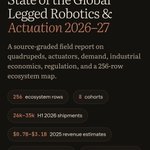
I'm releasing working versions of two state of the industry reports today for beta reading and feedback:
1. The State of Global Legged Robotics & Actuators
2. The Humanoid Hardware Gap 2026


Salik Shah ✨🚀 retweeted

We are announcing three new discoveries in mathematics, computer science, and physics about harmonic analysis, complexity theory, and quantum field theory.
openai.com/index/building-sc…
