
Graph intelligence for living systems, turning ecological structure into decision-grade financial signal. Building Nature risk × AI × finance
The Ocean & The Mountains
Joined February 2020
- Tweets1.2K
- Following819
- Followers184
- Likes1.7K









A coffee contract can price the harvest while leaving the pollinators out of the deal. Colombia’s coffee economy still depends on the living network behind that cash flow.
My argument on LinkedIn:
lnkd.in/p/eEYTHTT2

9
Lo que más nos sostiene es lo que menos hemos medido. Mi nuevo film sigue una gota desde un bosque de niebla hasta un vaso de agua en Medellín. Si prestas, aseguras o inviertes aguas abajo, ¿dónde está ese bosque en tus números?
lnkd.in/p/ePekZNbw
2
51
I ran the sky backward, with a team of AI agents and open data, and every claim sits in a ledger checked against its source. Nothing on its maps is invented. It runs five minutes and every word is on screen.
youtu.be/AC0qXKpPb2g
#FlyingRivers #AgenticAI
1
60
Nothing in this film was shot. Every forest, river and reef emerges from rules written in pure code, illustrating organically a tiny part of the ecological complexity the world economy actually runs on. If you just see electrons and tokens, u r dead wrong
youtu.be/k9RF9YJeV2w
No balance sheet lists the river. Plenty of companies would stop without it.
I build graph intelligence that shows what a business really runs on.
Bring me a system that has to keep working.
lnkd.in/p/e7AM-_DJ

18
What Nucleus just put on the table with Vitruvian is embryo ranking built on a fact every geneticist already knows, and that is that meiosis shuffles two parental genomes so full siblings differ at millions of sites, and the new scores try to read that within-family spread for height, adiposity, disease liability, and cognitive ability. What is really interesting here is that their within-family models now seem to capture a real slice of SNP heritability by jointly fitting millions of common variants with functional annotations, and the projected gap between the top and bottom of a five-embryo set is on the order of ten IQ points plus a meaningful cut in predicted risk for several common diseases. And that is arguably a serious advance in this era of large-biobank GWAS and Bayesian polygenic methods, and it arrives in the same decade as geroscience and the trending idea of longevity escape velocity. I honestly find the biology impressive and the parental impulse familiar, since we already choose partners, donors, and environments. I also think the distribution problem is the live one. IVF plus scoring is still costly and works best on the ancestries the training data cover. However, consider this: if only some families can buy a better draw at conception and then buy extra healthy decades, small advantages in health and cognition will then compound across long lives and across generations. So I would say let the models keep improving but in public, and treat the health gains as something a society scales, because once both genotype and lifespan become purchasable, class stops being only a mere environment story.

AI is rapidly getting smarter.
Now, humanity can too.
Today, @nucleusgenomics is announcing Vitruvian, our newest set of genetic optimization models.
Vitruvian’s intelligence model can optimize embryo DNA for 14 IQ points — nearly a standard deviation.
The models were trained on 1,000,000+ people, validated across 40,000+ siblings, and used more than 7 million genetic markers.
In Superintelligence, Nick Bostrom proposed genetic optimization as a key way for humanity to keep pace with rapidly advancing AI.
Bostrom’s vision is no longer theoretical.
Genetic optimization, like AI, has followed a scaling law: as datasets have grown, so have model capabilities. This trend will continue.
Parents across the world now have the choice to substantially increase their child’s intelligence.
And the next generation can choose to do the same.
AI is no longer the only intelligence that will compound.
Humanity can now direct its own evolution.
2
101
Silicon Valley is racing to make intelligence abundant. More tokens, faster agents, more sophisticated harnesses, cheaper inference, and trillions moving into the energy, data centers, infrastructure, and real estate required to keep the machine running.
I understand the excitement, I definitely share much of it, but I keep gravitating always towards the part of the stack that almost nobody has priced yet.
Every data center depends on water., every real estate thesis depends on a functioning landscape., every energy system sits inside soils, watersheds, climate patterns, communities, and ecological networks that quietly absorb risk until they cannot.
And this is where the investment logic starts to feel largely incomplete. We model power availability, land values, construction costs, and compute demand with extraordinary sophistication, while the living systems carrying those assets merely remain in the background, just as pure scenery.
But to me, that is the next intelligence frontier.
Decision-grade ecological intelligence can turn a landscape from an externality into a legible operating system. It can show which living dependencies hold an asset together, where fragility is concentrating, what evidence justified a decision, and whether an intervention actually strengthened the system afterward.
Once that record persists, ecological evidence begins to compound. A project becomes a learning node, a portfolio becomes a living intelligence system, and nature starts to appear as what it has always been: the productive substrate beneath energy, infrastructure, real estate, food, water, insurance, and sovereign resilience.
Cheap intelligence can still produce a fragile economy. Durable abundance begins when the living systems beneath production become stronger as production scales.
That is the argument I will take further in my next publication, The Last Economy Must Regenerate Life.
So if you build or invest where AI, capital, infrastructure, and nature meet, send me a PM. I suspect the most consequential asset class of the next decade is already beneath our feet, largely unpriced and barely understood...
Jay Gutierrez 🌊🔬⚡️ retweeted

People killed by AI: zero
People killed by governments: millions
Let's give control of AI to the governments and call it safety
Jay Gutierrez 🌊🔬⚡️ retweeted

go fuck yourself @sama
claiming that you solved navier stokes because 10000 agents ran in circles for 88hours on a multimillion dollar gpu cluster to formalize in lean a blowup case under controlled external forcing is pure scientific vulgarity the clay mathematics institute millennium prize does not ask m whether you can artificially force a singularity in a fluid by injecting an ad hoc smooth external forcing term f(x,t) to twist the vortex until it breaks the real problem questions the fundamental stability and global smooth existence for 3dimensional incompressible euler & navier stokes equations under natural conservation laws and viscous dissipation alone using a mathematical loophole on forced equations to parade a century old victory is a major conceptual scam Altman
technically & epistemologically what you present as an agi breakthrough is nothing more than bruteforce combinatorial autoformalization the ai did not understand fluid mechanics it simply navigated a continuous search space previously mapped out and constrained by the monumental work of human mathematicians like tristan buckmaster/ levent alpöge / diego córdoba or tarek elgindi coordinating 10000 agents to check the logical consistency of a 100 page proof via lean is a software engineering feat and computational parallelization triumph not an intrinsic scientific discovery it is the victory of the compute bulldozer over abstract human intuition repackaged for the public as a higher mathematical consciousness
to this theoretical imposture you add a disgusting ethical and industrial cynicism taking advantage of private codex sessions and informal preprints from academic researchers to siphon their research leads and then trying to redact or erase the contribution of levent alpöge under the pretext that he works at rival anthropic is intellectual serfdom openai behaves like a feudal lord of silicon appropriating the cognitive subsistence of independent scholars threatening their careers behind closed doors if they protest and turning community academic labor into a privatized pressrelease
this entire staged event serves a desperate financial agenda in a pre ipo panic facing the slowdown of scaling laws and growing investor skepticism over the profitability of foundational models openai needs to manufacture an artificial sputnik moment claiming to solve a millennium prize without immediately submitting the proof to traditional peer review means using the prestige of fundamental mathematics as cheap marketing fuel to inflate a delusional valuation!!!
real science is not a clout chase on social media or a compute spike spent to rob the clay mathematics institute it is a quest for elegance physical truth and universal rigor to decode reality true artificial intelligence will not emerge from hostile corporate takeover of academic work hidden behind computational bruteforce but from architectures capable of generating new conceptual paradigms by masquerading constrained formalization as the collapse of physics greatest mysteries you did not solve navier stokes you only proved how far silicon valley will go to prostitute scientific integrity for capitalist spectacle

We’re sharing a solution to the Navier-Stokes Millennium Prize Problem, one of the deepest problems at the frontier of mathematics.
The proof was produced by a group of agents, using an OpenAI next-generation model significantly more capable than GPT-6 Astra.
The problem concerns whether the description of smooth three-dimensional fluid motion modeled by the Navier-Stokes equations can break down. It has remained unresolved for roughly 90 years.

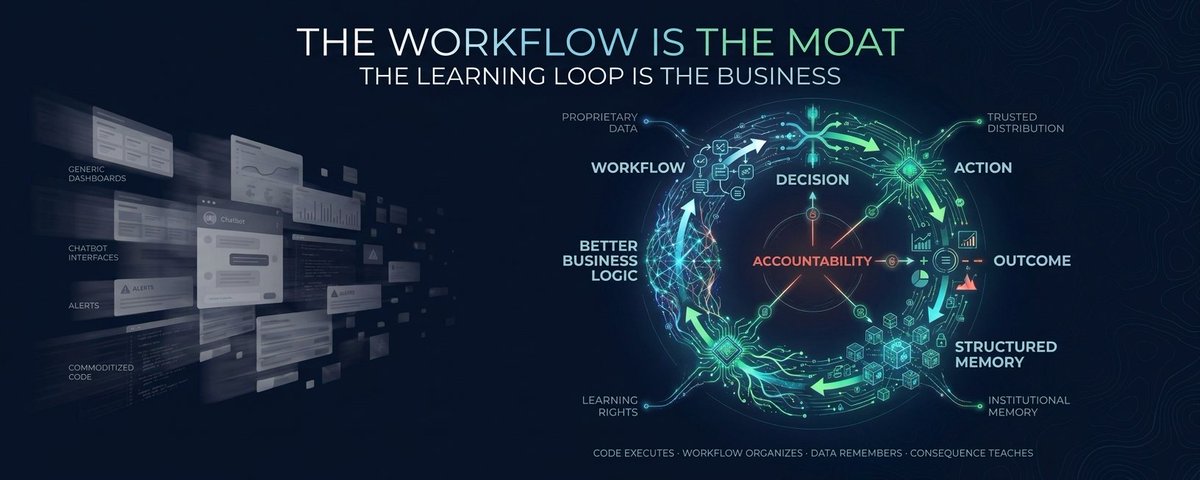
AI has made it remarkably easy to build the artifact before understanding the business. I keep wondering what survives that abundance, and increasingly, my answer begins with the workflows that learn from what happens after the recommendation.
Every token sits on a living substrate.
EthiFinance just showed why. Its CAC 40 nature stress test finds that water-related degradation could raise average default probability by roughly a third by 2050 under its pessimistic scenario. As credit quality weakens, the modeled impact does not scale neatly. One downgrade multiplies default probability roughly fivefold, while two can multiply it twenty to thirty times.
Most infrastructure conversations stop at energy, compute and tokens. Yet the systems producing and moving those electrons still operate inside watersheds, landscapes and ecological networks. When that living infrastructure degrades, what looked like an environmental externality returns as operating risk, credit deterioration and eventually systemic loss.
The study’s most important limitation may also reveal its largest opportunity. It treats natural capitals independently, while feedbacks, thresholds and cascades remain outside the model. But those couplings are precisely where buffers fail.
I am building evidence-tiered dependency graphs to trace that missing route from ecological mechanism to infrastructure and financial consequence. Exposure tells us what touches nature, but the graph tells us what can break, how failure travels and who absorbs it.
The next generation of nature stress tests should not only price degradation. It should read the living architecture that determines whether the economy keeps functioning.
#NatureRisk #CreditRisk #Biodiversity #KnowledgeGraphs #SustainableFinance
lnkd.in/p/eqYnD-K2
38
Una ciudad no se vuelve inteligente por acumular sensores, datos y automatización sobre una infraestructura frágil. Se vuelve inteligente cuando utiliza esas capacidades para entender y fortalecer el sistema completo que sostiene la vida, la productividad y la innovación.
Energía, compute e infraestructura física son una base extraordinaria para construir nuevas industrias. Pero el compute sigue siendo profundamente físico. Necesita electricidad, suelo, materiales y sistemas de refrigeración. El consumo de agua cambia muchísimo según el diseño, el clima, la fuente energética y la tecnología utilizada. No existe una cifra universal ni una solución que funcione igual en todas partes.
Eso no es un argumento contra el compute. Yo mismo puedo consumir decenas de millones de tokens al día desarrollando sistemas científicos y tecnológicos. La pregunta interesante no es cómo frenar esa capacidad, sino cómo construirla mejor y convertirla en una fuente de prosperidad más amplia.
Ahí entra la infraestructura viva. Cuencas, bosques, suelos, humedales y corredores ecológicos no son decoración verde ni sustitutos románticos de la ingeniería. Son sistemas funcionales que regulan agua, temperatura y riesgo, y que pueden trabajar junto con la infraestructura física para hacerla más confiable, productiva y resiliente.
La siguiente generación de ciudades inteligentes tendrá que integrar esas capas. Sensores para observar. Inteligencia artificial para encontrar patrones y anticipar escenarios. Modelos mecanísticos para entender cómo se propagan los cambios. Infraestructura física para ejecutar. Infraestructura viva para sostener las condiciones que permiten que todo lo demás funcione.
Esto también es una tesis económica. Una ciudad con energía confiable, seguridad hídrica, menor exposición al calor y un entorno saludable puede atraer talento, proteger la productividad y sostener industrias intensivas en conocimiento con menos vulnerabilidad territorial. La prosperidad no aparece solamente cuando producimos más. También aparece cuando reducimos la fragilidad del sistema que hace posible producir.
La inteligencia artificial puede ayudarnos a optimizar redes eléctricas, diseñar materiales, descubrir moléculas, administrar agua y detectar cambios ambientales antes de que se conviertan en crisis. Su mayor aporte quizá no sea alejarnos del mundo físico, sino permitirnos comprenderlo con una resolución que nunca habíamos tenido.
La salud de las personas, la estabilidad del territorio y el desempeño de la economía no son asuntos separados. Una ciudad realmente inteligente debería ser capaz de observar esas conexiones y convertirlas en mejores decisiones de infraestructura, inversión, prevención y crecimiento.
No se trata de escoger entre tecnología y naturaleza. Esa sería una discusión bastante poco ambiciosa y completamente improductiva. Se trata de combinar inteligencia computacional, ingeniería e inteligencia biológica-ecológica para construir ciudades más capaces, productivas y habitables.
La ciudad del futuro no será un computador gigante con algunos árboles alrededor. Será un sistema vivo aumentado por inteligencia, donde energía, agua, capital, tecnología y bienestar se refuercen entre sí. No solo una ciudad con más compute, sino una ciudad con más capacidad para prosperar sin debilitar las condiciones que sostienen esa prosperidad.
@Bancolombia @EPMestamosahi @Celsia_Energia @risierra88
@holdmybirra @10ampro
51
El embalse es visible. La dependencia no.
En el Oriente Antioqueño, nuestro cribado de RECON asocia 48,4 % de la precipitación ponderada sobre el receptor Nare-Peñol-Guatapé-Playas con superficies terrestres remotas. No es caudal, generación ni dinero. Es una señal de que la confiabilidad de un activo puede depender de territorios que nunca aparecen en su balance.
Si viste el post de lanzamiento, este es el hilo que lo conecta con la investigación completa. Allí sigo la humedad desde la atmósfera hasta la evidencia que una institución necesitaría antes de conservar, restaurar, asegurar o asignar capital.
linkedin.com/posts/jaygut_se…
On ecological, ecosystemic and atmospheric ontologies, which can drive massive business value in something pretty much everyone is missing on: natural capital
@10ampro @holdmybirra @AndresFelArias

40
Si el riesgo se propaga como una red, Colombia tiene que aprender a gobernarlo como una red. Mi propuesta para el ABC es un grafo nacional que conecte capital natural, activos y balance soberano con evidencia auditable.
Desarrollo la tesis aquí ↓
linkedin.com/posts/jaygut_en…
@ABDELAESPRIELLA @jrestrp @10ampro @holdmybirra @AndresFelArias

23
Presidente electo @ABDELAESPRIELLA y @jrestrp: no hay soberanía sin agua. Colombia degrada ecosistemas que sostienen ciudades, energía y campo sin auditar esa dependencia. Necesitamos sistemas computacionales para dirigir capital a las cuencas críticas del país.
linkedin.com/posts/jaygut_el…

21
Industrial economics ran on an asymmetry: cognition was scarce, nature looked abundant.
AI compresses the cost of cognition, which shifts scarcity to what models cannot print, i.e., living soils, functioning reefs, stable rainfall, resilient forests.
This is synthesis, rather than an attempt to forecast. It is also a governance problem. The scarce asset is conditioned by rights, tenure, and stewardship, not just biology.
19
A forest can fail a harvest two thousand kilometres away.
As a dependency chain, rather than as metaphor.
Forest → atmosphere → rainfall → yield → balance sheet.
Once the rain source is distributed across a recycling network, “where should capital intervene?” stops being a map question.
It becomes a graph question.
2
15
