

MD + Computer Science, working on Clinical AI. Internal Med Resident @MayoClinic. // MD @ILLINOISmed; CS @ASU.
Phoenix, AZ
Joined August 2014
- Tweets548
- Following233
- Followers1.7K
- Likes4.5K




This is an excellent perspective, one of the most balanced I’ve seen!
As a resident, I’ve wrestled with this same conundrum of experiencing a clear value in using AI tools vs importance of building personal experience and “reps”.
One of the ways I resolve this is that I’ve learned how much of medicine involves systems thinking, so much more so than it appears before actually starting residency.
And being able to effectively think in systems — whether in software engineering, machine learning, or medicine — requires knowledge deeper than abstractions, even when we have access to information at our fingertips.
Karpathy’s classic RNN posts, which I encountered in undergrad, introduced me to this concept of “leaky abstractions” (citations in reply), which has been a pretty big motivation for striving to understand things even as LLMs can provide solutions.

I think @ZekeEmanuel and others are wrong about AI replacing physicians, but AI is already playing an important role in my clinical life. I’ve come to rely on @OpenEvidence enormously, and I believe it’s making me a better doctor. At the same time, I worry that frictionless access to clinical decision support is making my learners worse.
I wrote about this for @nytopinion: nytimes.com/2026/09/25/opini…

Refs:
- Karpathy’s neural net posts: karpathy.medium.com/yes-you-…
My personal experience embracing the value of memorizing (and therefore understanding) clinical concepts, which I think applies heavily here as well: samrawal.com/blog/memorizing…


Some thoughts on the necessary next steps of integrating clinical AI into physicians workflows, as they become more agentic and capable --
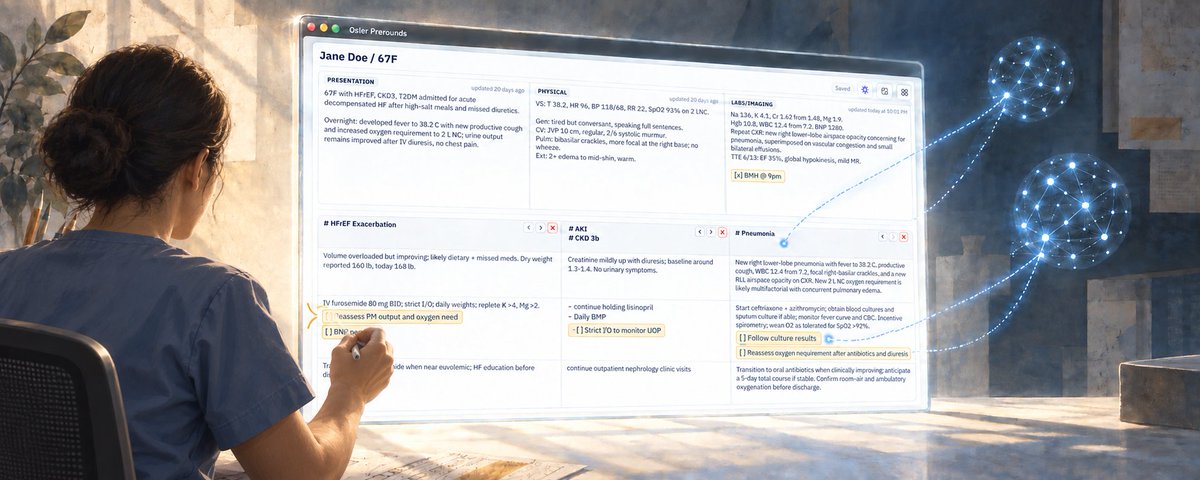
One cool aspect of Osler Prerounds is that, since all the data is stored where you choose, tools like @ChatGPT w/ EMR access can also read/write to Prerounds as wanted!
In this way, Prerounds goes from being just a personal clinician dashboard to a window that can harness clinical AI in a highly customizable and intuitive way.
Ie, clinicians can ask ChatGPT to define reminders, follow-ups, update labs conditionally, etc, and auto-update their Osler Prerounds dashboards!
this is also ai-agnostic: works with ChatGPT/Codex, Claude Code, local models, or whatever is approved by your local institution’s PHI policies!

Hi clinician friends - I'm really excited to release Osler Prerounds! Prerounds is a tool I built for hospital medicine, to serve as a "command center" to think, plan, and track everything during busy inpatient service.
I've been using it daily on inpatient medicine service, and it has been extremely useful in helping me better reason about, and stay on top of, patient management.
Some useful features:
- quickly store and track evolving patient data across your entire service
- TODO tracking across all patients + timed reminders for tasks
- export to PDF/printout to take with you during rounds
- all data is stored 100% locally, with nothing leaving your computer!
Available now, for free! any feedback welcome :)
In general, I’m excited for the large potential for clinicians to build effective “windows” for powerful general AI tools with EMR hooks, to significantly accelerate their workflows
teapawt.net/thekaransinghal/status…

Interestingly, this value of "knowing how to derive/obtain information" vs "knowing the information" is something that I personally did a 180 on, when making the transition from computer science to medicine.
Coming from a discipline where understanding fundamentals was much more important than memorizing details, I did not initially grasp the value of memorizing a wide range of facts in early med school. It wasn't until over a year in that I started seeing the value of being able to draw connections between facts I had committed to memory.
wrote a post about this several years back - samrawal.com/blog/memorizing…
This is one of those anthropomorphizations that I do think holds value when thinking about what makes an effective clinical LLM.


When language models first started using tools well, I was sympathetic to the narrative that instead of scaling up language models, all we needed was a strong enough "cognitive core", say 1B parameters, and anything else could be done with tool use, like browsing the internet or executing code. I think a lot of people were sympathetic to this argument, and indeed it is pretty hard to come up with a meaningful task that cannot be in principle achieved by a 1B model with adequate access to tools. For example, any esoteric fact that a large language model would know can be, in principle, retrieved from the internet and reasoned over by a 1B language model.
However I now think this is totally wrong for one simple reason: doing tasks quickly and naturally without tool use matters a lot.
The way that I internalized this reason was actually in my personal journey learning badminton this year. In badminton I am very much like a "1B cognitive core". While I can physically do every movement in a badminton shot that my coach teaches me, it requires a lot of work to mentally remember every cue and put it together. In practice I can do a shot almost perfectly, but I struggle to do it across a point and I definitely can't do it consistently in a game. This is obviously different from someone who has practiced a shot ten-thousand times and effortlessly executes it as a natural instinct.
In the same way, language models knowing a fact internally, without tool calls, is meaningful. The first reason is that we obviously care about speed; you'd much rather get an answer immediately than have the model think a long time to be sure of its answer or browse the web. A second reason is that there are some things that are simply best learned via backpropagation over lots of data. If you ask about how people generally think of the Shambhala music festival, you'd rather a large language model give you an aggregate opinion based on all the data on the internet, than get a regurgitation of the first three reviews that show up in a web search. A third reason is that having to do a lot of work to find an answer is not as reliable as already knowing the answer. While this does not have to be true in theory, it is probably true in practice, at least for now. If you have to re-look up facts or redo a mathematical derivation all the time there is a higher chance of mistakes, which can compound in a long-horizon task.
Once you buy that it is valuable to do things parametrically without tool use, then you must buy the argument that a 1B cognitive core is not sufficient. There is an information limit to how much knowledge can be internalized by a 1B model, and we will surely want AI to know more than that. Even 1T probably won't be enough. We will want the AI to know as much about our world as possible, we will want it to be updated with new information, and our expectations of what AI can do for us will continue to grow.
In summary, tool use enables small models to do a lot more, but those who demand the highest quality intelligence will always want larger models. Bitter lesson strikes again.
Hi clinician friends - I'm really excited to release Osler Prerounds! Prerounds is a tool I built for hospital medicine, to serve as a "command center" to think, plan, and track everything during busy inpatient service.
I've been using it daily on inpatient medicine service, and it has been extremely useful in helping me better reason about, and stay on top of, patient management.
Some useful features:
- quickly store and track evolving patient data across your entire service
- TODO tracking across all patients + timed reminders for tasks
- export to PDF/printout to take with you during rounds
- all data is stored 100% locally, with nothing leaving your computer!
Available now, for free! any feedback welcome :)
Some brief thoughts on this study (longer reflections later) about how the frontier model vs domain-specific model conversation interacts with the broader notion of AI in clinical practice.
1. The ability to personally manipulate how models respond is remains underrated
Any trainee through the medical system will know that the way information is communicated, analyzed, and acted on can vastly differ from physician and speciality.
That aspect of communication -- what details to reinforce, what values to skip, how to communicate differential diagnoses in an objective manner -- is a function of many factors, one of which is trust in the presenter.
As each physician uses these tools to augment their own personal style of thinking, the ability to shape and structure the manner in which these tools convey answers will directly impact how effective and preferable using these tools will be.
To that extent -- frontier LLMs, which offer at least some degree of steering model outputs via custom instructions, projects, etc. -- will naturally have an advantage. Allowing clinicians to manipulate these workflows such that they can better intuit where the tools may fail vs be useful will be huge. [0]
[0] teapawt.net/samarthrawal/status/20…
2. LLMs are superhuman persuaders
"i expect ai to be capable of superhuman persuasion well before it is superhuman at general intelligence" - Sam Altman
We have definitely crossed this point, at least with using LLMs to answer clinical questions: for a particular question, chances are there will be some paper on some data that can positively affirm the implicit bias within that question.
And since models are remarkably capable at synthesizing complex information into a cohesive narrative, they will be able to give a very reasonable-sounding answer to a clinical question, whether or not it is truly applicable in that scenario (ie, has reasonable external validity).
Relying on personal clinical "preference" to select an LLM tool of choice can therefore be quite dangerous, because a style of answer may not correlate with the applicability of the answer.
This is something I try to be cognizant of whenever I use LLMs, particularly in the clinical setting, in order to be watchful against this error mode.
([1] Related slides - How I use LLMs in Clinical Research & Practice - teapawt.net/samarthrawal/status/19…)
3. The boundary between answering a question and clinical reasoning is blurry
even before the adoption of LLMs, there was always a bit of grey area between looking up information and clinical decision-making. For example: an article on UpToDate will give you basic facts and data about a particular condition, but also segue into next steps (thereby helping clinicians reason about problems). By itself, this is not a bad thing - in fact, it can be very valuable.
Now though, tools are able to remarkably synthesize facts, studies, empiric results, and clinical guidelines into a single, cohesive answer.
Where does answering a question stop, and making a decision based on explicit and implicit phrasing of the clinical question end? This undoubtedly reshapes how we think about clinical practice, and therefore being aware of this process will be extremely important to clinicians moving forward, in my opinion.
(some more on this topic here - [2] samrawal.com/blog/augmenting…)

For medical information, general AI frontier models (Google, OpenAI, Anthropic) outperformed specialized @openevidence and @UpToDate as assessed by 12 US clinicians, randomized and blinded to which model and extensive testing/benchmarks. This was not anticipated. @NatureMedicine
nature.com/articles/s41591-0…

Sam Rawal, MD retweeted

Seeing a lot of bitter lesson/scale > specialized model tweets about this study, but short of OE/UTD intentionally buying weaker models, this result is more of a *harness* issue than a model one.
MedQA score ranges across models were within 9 points (so less likely a base knowledge gap); the gap between gen vs clinical models widened on the real world clinical question answers, where the problems were mostly in omission and disorganized outputs rather than wrong facts.
For medical information, general AI frontier models (Google, OpenAI, Anthropic) outperformed specialized @openevidence and @UpToDate as assessed by 12 US clinicians, randomized and blinded to which model and extensive testing/benchmarks. This was not anticipated. @NatureMedicine
nature.com/articles/s41591-0…
New on 🔵 Pearls: automatically save key concepts from your OpenEvidence questions to your Pearls library. There, it's auto-tagged, contextualized, and can auto-create an Anki card!
I learn a lot from OE questions and can easily refer back to some of those concepts this way!
Pearls → Anki autogeneration flow:
teapawt.net/samarthrawal/status/20…
Added the most personally-useful new feature to my app for capturing clinical pearls: auto-convert your pearl into an Anki card and directly import it!
🔵 Pearls now can:
- sync your pearls across devices
- automatically fetch relevant context (ie guidelines, papers, consensus) for your pearls
- auto-tag, filter, search
- automatically build Anki Cloze cards
Available for free at the same link; feedback welcome!!


Sam Rawal, MD retweeted

I’m pleased to share Mayo Clinic has announced a strategic collaboration with @Microsoft to develop and deploy a frontier AI model designed specifically for healthcare. Read more: newsnetwork.mayoclinic.org/d…

Sam Rawal, MD retweeted

One of the most useful use-cases I've built is a personalized scientific newsletter twice a week to stay up to date. I get papers on topics I care about, summarized the way I like, with links to read the full paper.
Setup:
beampath.org/libraries/toolk…
Repo:
github.com/ramezkouzy/scient…

I must say - I’ve anecdotally noticed a MASSIVE improvement in @openevidence results on this over the past month or few - specifically, much better grounding to the clinical context without swinging the other way into subtle confirmation bias.
Feels like the reasoning focused on the clinical intent is much improved, without overoptimizing to an “agreeable” reward function.
This is imo the biggest area of caution with using clinical LLM tools (which I’ve noticed more with domain-specific medical AI tools compared to ChatGPT):
Chances are, for a clinical question, there will be *some* studies to be found supporting a particular hypothesis. The real question is whether, in the context of your specific patient, utilizing those particular studies makes sense or not.
But LLMs being “superhuman reasoners” will sometimes be able to convince you the way you were leaning towards in your question is the right move, with sometimes inappropriate data as justification.
Starting from residency, we often see the dangers of anchoring bias (latching on to an earlier diagnosis at the expense of not thoroughly ruling out others), and I think priming ourselves to always be vigilant against LLM anchoring bias will continue to be super important.
New feature - automatically generate a query → launch the new @UpToDate Expert AI tool to get more details about the specific topic you are studying!
(I’m not affiliated w/ MKSAP or UTD, just using these for my studying!)

Also updated the tool to work with Codex app server or OpenAI API key, with optional fallback method.
github.com/samrawal/chrome_a…

Encountered a surprisingly massive footgun (if used in clinical context) when using ChatGPT with memory turned on - I asked a question regarding immunosuppression management, and then started a new thread with another question.
However, ChatGPT answered the second question in the context of the first question (despite immunosuppression not being a part of the question).
It seems there is a latent assumption that multiple sequential threads that are related enough must be about the same person/topic - for obvious reasons, if overlooked, this could lead to WILDLY inaccurate results in a busy clinical context with multiple sequential threads about different topics.
At least for ChatGPT’s offering for clinicians - this should definitely not be a default. The solution for now is perhaps turning off memory, as useful as it can be.