

cardiologist & life long learner & AFL04 & AUTF10 & Kosuyolu Heart Education and Research Hospital
İstanbul, Türkiye
Joined June 2013
- Tweets741
- Following836
- Followers1K
- Likes2K





Süleyman Çağan Efe retweeted

As @realarainmd also said, “Do we absolutely need IVI? Perhaps not. But it would be very useful to understand the problem.”
Following the algorithm, I think I would choose NC then OPN or IVL depending on whether IVI is available.
and what did you solve? @mirvatalasnag

Süleyman Çağan Efe retweeted

Evaluating Intracoronary Imaging-Guided PCI: Balancing Evidence Synthesis and Exploration of Heterogeneity | JACC jacc.org/doi/10.1016/j.jacc.…
Enjoyed writing this commentary with one of the smartest folks on X
@ihtanboga

Süleyman Çağan Efe retweeted
Coming from you, I’ll definitely take that compliment! 😊 Really enjoyed writing this editorial with @kaulcsmc in @JACCJournals . Thanks for the collaboration and all the thoughtful discussions along the way.
And congratulations to @SripalBangalore , @GreggWStone , @ziadalinyc , @SVRaoMD , @mmamas1973 , and @DLBHATTMD for such a comprehensive and thoughtful synthesis in “Intracoronary Imaging-Guided Percutaneous Coronary Intervention: An Updated Meta-Analysis of Randomized Trials.”

Evaluating Intracoronary Imaging-Guided PCI: Balancing Evidence Synthesis and Exploration of Heterogeneity | JACC jacc.org/doi/10.1016/j.jacc.…
Enjoyed writing this commentary with one of the smartest folks on X
@ihtanboga
Süleyman Çağan Efe retweeted
Thank you, @opensourcecards, for the invitation and for sharing my appraisal. Special thanks to @jtsaxon and @BrettSperryMD for this initiative to make cardiovascular science freely accessible to all. Delighted to contribute!

🆕 New in OpenSource: Cardiology
"Routine Microaxial-Flow-Pump Support During High-Risk PCI: A Critical Appraisal of CHIP-BCIS3"
@ihtanboga on the trial testing whether planned Impella CP protects patients during complex PCI without shock.
Mechanical action ≠ protection. 🧵
Read it free @opensourcecards - link below


Süleyman Çağan Efe retweeted
A critical reappraisal of routine LV unloading in high-risk PCI: CHIP-BCIS3

Süleyman Çağan Efe retweeted
The recent RCA stenosis and SCD paper is a good teaching example. Through a single study, we can discuss time zero, immortal time, prediction vs. causality, confounders, mediators, colliders, overadjustment, etc..


Süleyman Çağan Efe retweeted
Yes, it is a difficult mission.🙄
But I will try to show, through simulation, how the ORBITA-CTO results might turn out.
1/


Mission Impossible - The ORBITA CTO Reckoning!
Your mission agent @ihtanboga, should you choose to accept it, is to predict the results of ORBITA-CTO using any Bayesian and non-Bayesian tools at your disposal.
You may use any data from the ORBITA trials and prior CTO RCTs. Good luck!
⚠️ This message will self destruct in 7 days - when the results come out! 😂
Süleyman Çağan Efe retweeted

Among patients with atrial fibrillation at high risk for stroke and bleeding, left atrial appendage closure was not noninferior to medical therapy in reducing the risk of stroke, embolism, major bleeding, or death at 3 years. Full CLOSURE-AF trial results: nejm.org/doi/full/10.1056/NE…
Editorial: Left Atrial Appendage Closure — Another Overused Method in Cardiology? nejm.org/doi/full/10.1056/NE…

ALT A graph of the primary end point
Süleyman Çağan Efe retweeted

Classical statistics asks: “Given this data, how likely is my hypothesis?” Bayesian statistics flips this. It asks: “Given this data, how should I update my beliefs?”
medium.com/p/bayesian-statis…
#datascience #RStats #machinelearning #datascientist #statistics

Süleyman Çağan Efe retweeted

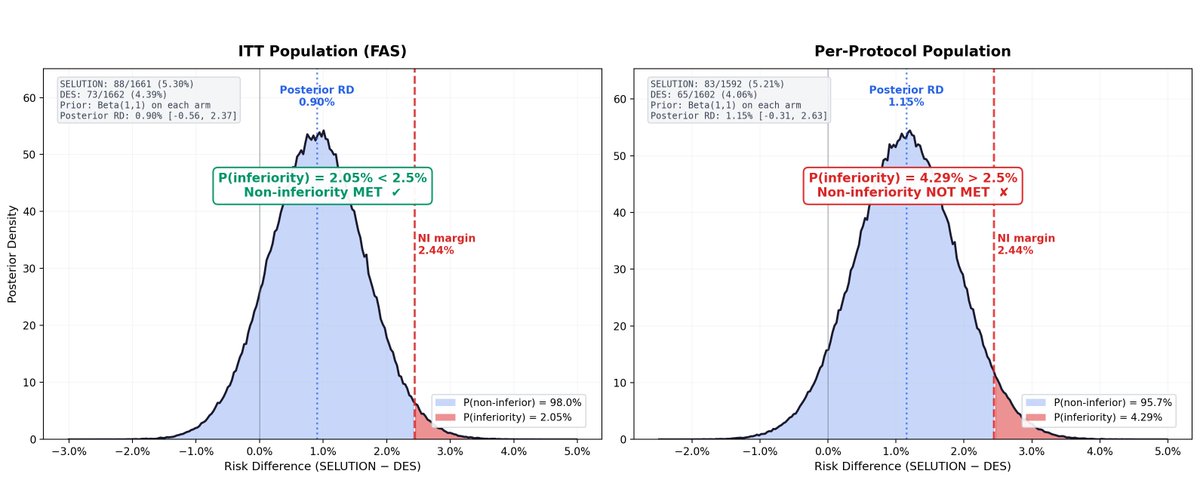
#cardioX is more alive than ever. On the same day that @ihtanboga delivers two incredible articles on COBRRA and SELUTION DeNovo, and a masterclass no one interested in biostatistics and trial interpretation should miss, @ehj_ed publishes a debate I joined with @thiele_holger, @cvrints, and others on the significance of the RF-CL model for estimating pre-test probability of coronary artery disease. This article actually originated from the X discussion shown below, where @ihtanboga had also shared a valuable calculator, and I learned a lot from @cvrints as well. These coincidences close the circle. Long live the sparks between scientific literature and social media that keep the debate alive.
academic.oup.com/eurheartj/a…


There is one thing that, even as a reviewer and despite having pointed it out during the process, I really haven't understood about the new ESC guidelines for chronic coronary syndromes.
Using the new Risk factor-weighted clinical likelihood (RF-CL) model, one can calculate individual risk based on symptoms, sex, and the number of cardiovascular risk factors, and so far so good.
In this way, the calculable pre-test probability scores range from 0 to 45%. However, the recommendations for additional diagnostic tests are also applicable to patients with a risk higher than 45%.
Now, how does one calculate a pre-test probability higher than 45% based on the RF-CL? With risk enhancers like PAD, resting ECG, etc.? With the calcium score?
In fact, the calcium score can be used to determine the new pre-test probability, but I don’t think this is a good reason to perform it on everyone, also because its value lies mainly in recategorizing patients into the very low-risk group when it is zero.
However, it seems you cannot determine the new pre-test probability with risk enhancers, unless it is meant that the presence of one of these factors automatically shifts the patient into at least the moderate-risk category.
In short, if anyone has figured out how to arrive at the precise number for values above 45%, they’d be doing me a favor, because I can't understand it from the text.

Süleyman Çağan Efe retweeted
1. We all ask this every single day: "Can this stent actually reach my target diameter?" This tool answers in seconds. 👇
🔗 tanboga.netlify.app/stent-ap…
Süleyman Çağan Efe retweeted

🫀 First-in-human valve-in-valve TAVI in mechanical prostheses
Bench-to-bedside study: disc dislodgement & retrieval followed by successful TAVI.
Published in European Heart Journal.
👉 academic.oup.com/eurheartj/a…
@escardio @PCRonline @secardiologia @CNIC_CARDIO @sacyl @TCTMD

Süleyman Çağan Efe retweeted

Accuracy of Smartwatches in the Detection of Atrial Fibrillation: A Systematic Review and Diagnostic Meta-Analysis @ihtanboga @scaganefe @taylanakgun @drmcap_mc @drselimtopcu @AslanMir28
jacc.org/doi/10.1016/j.jacad…

Süleyman Çağan Efe retweeted

🏛️ A 200-Year Journey Through Coronary Disease and Myocardial Infarction 💥
From bloodletting to genomics — the story of humanity’s fight against the #1 killer.
📜 🔹 Origins (1700s–1900s):
🩺 Heberden (1772) → first clinical description of angina.
🧠 Pathologists later linked it to coronary “ossification” and thrombosis.
⚡ Herrick (1912) defined myocardial infarction (MI) and promoted rest as therapy.
❤️ ECG transformed diagnosis (1919).
📈 🔹 Epidemiology & Risk Factors (1940s–1960s):
🧩 Framingham Heart Study (1948) unveiled risk factors: hypertension, cholesterol, smoking 🚬.
🩸 NHLBI launched preventive programs 🫶.
💡 Realization: CAD and MI are preventable diseases, not fate!
🏥 🔹 Coronary Care Revolution (1960s):
📊 Hospital mortality for MI = 30% 😱
👨⚕️ Julian (1961) → created Coronary Care Units: ECG monitoring, CPR, early defibrillation ⚡
💪 Result: In-hospital deaths halved.
🧰 🔹 Invasive & Interventional Era (1950s–1980s):
💉 Forssmann catheterized himself (1929) 😳
🎥 Sones developed coronary arteriography (1958).
🔧 Favaloro introduced CABG (1969).
🎈 Grüntzig pioneered angioplasty (1977) → foundation of PCI 💫
🧬 Cross-disciplinary teamwork reshaped cardiology forever.
💊 🔹 Modern Therapeutics (1970s–2000s):
🧫 GISSI & ISIS-2 ➡️ fibrinolysis + aspirin ↓ mortality.
🩻 PCI + stents revolutionized reperfusion 🚀
💊 ACE inhibitors, beta-blockers, statins, aldosterone blockers ➡️ longevity ↑.
⚙️ ICDs, CRT, LVADs transformed heart failure care ❤️🔥
🧬 Gene therapy (SERCA2a) emerging 🧪
🧬 🔹 Biology of Atherosclerosis:
🧠 Atherosclerosis = chronic inflammatory disease 🧨
💣 Plaque rupture → thrombus → MI
🧪 Furchgott, Ignarro, Murad → nitric oxide as endothelial relaxant → Nobel 1998 🏅
🧬 Brown & Goldstein → LDL receptor pathway discovery → Statins revolution 🏆
🧫 🔹 Molecular & Genetic Era (2000s–present):
🧬 Genomics, pharmacogenomics, stem cells, molecular targeting
🧩 Genome-wide studies reveal new genes for CAD (lipid metabolism + inflammation).
🧬 Personalized medicine emerges: warfarin genotype dosing, clopidogrel resistance (CYP2C19).
🌱 Stem cell therapy & cardiac regeneration — still early but promising 🌟
🌍 🔹 Global Cardiovascular Health:
CVD = #1 cause of death worldwide 🌎
Drivers: aging, smoking, sedentary lifestyle, poor diet 🍔
💡 Need: prevention, education, low-cost care, and global collaboration 🤝
💬 🔹 Take-Home Message:
From 1812’s “strangling of the chest” to today’s molecular cardiology,
our progress has been extraordinary — but the mission continues.
🫀 Prevention, innovation, and equity are our next frontiers. 🚀
📣 #Cardiology #NEJM #CAD #MyocardialInfarction #HistoryOfMedicine #CardiacImaging #Prevention #Atherosclerosis #Statins #PCI #InnovationInMedicine #HeartHealth #PrecisionCardiology
