

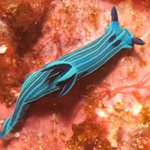





ALT A photograph of a nudibranch made from a vibrant, flower patterned origami paper.


ALT digital scan of the original color plate

ALT same plate but with superimposed number labels 1-7 for ID key






ALT This viperfish was imaged during the 700-meter (2,297-foot) transect to explore the water column above Hydrographer Canyon during the 2021 North Atlantic Stepping Stones expedition.

ALT A close look at a beautiful jelly in the genus Solmissus. These jellies are also known as “dinner plate jellies,” for good reason! This observation was made during Voyage to the Ridge 2022 expedition at 500 meters (1,640 feet) depth.

ALT This beautiful imagery of a larvacean inside of its mucus “house” was captured at a depth of 900 meters (2,950 feet) during the Seascape Alaska 3 expedition. Larvaceans are solitary, free-swimming tunicates that produce these fragile mucus houses to help filter small particles (food) from the water. The larvacean lives inside of its house until the mucus filter becomes clogged, at which point the animal will abandon the house, swimming away to build a new, and unclogged, structure. Given the number of white particles (marine snow) seen in the image, this house was quite full and was vacated while we examined it closer!

ALT While exploring the water column at a depth of 700-meters (2,297-feet) during the 2021 North Atlantic Stepping Stones expedition, we imaged this physonect siphonophore. Although siphonophores may appear to be single organisms, they are actually colonies of many individual hydrozoans (called zooids), each specialized for different functions such as swimming, feeding, reproduction, and defense.


