Structural Engineers (@sefindia) header
Structural Engineers (@sefindia) profile picture

Structural Engineering Forum of India is dynamic platform for knowledge sharing among structural engineers . https://teapawt.net/t.co/8QmCme2KpW https://teapawt.net/t.co/Omb0LgA3HK

INDIA
Joined January 2010
Photo by Structural Engineers (@sefindia)Photo by Structural Engineers (@sefindia)Photo by Structural Engineers (@sefindia)Photo by Structural Engineers (@sefindia)Photo by Structural Engineers (@sefindia)Photo by Structural Engineers (@sefindia)Photo by Structural Engineers (@sefindia)Photo by Structural Engineers (@sefindia)Photo by Structural Engineers (@sefindia)Photo by Structural Engineers (@sefindia)
πŸ“’ Update: EFC Webinar 153 has been postponed The webinar on the National Building Construction Standards (NBCS) 2026, planned for Saturday, 28 November 2026, has been postponed by the organisers. The new date will be announced shortly. Already registered? There is nothing you need to do right now. The organisers will inform you of the new date directly. For any query: Updates: sefindia.org/webinar153/ WhatsApp / call: +91 9152031321 Email: [email protected] #NBCS2026
1
114
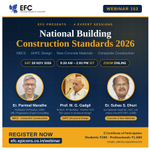
Webinar 153: National Building Construction Standards 2026 πŸ—“ Sat 28 Nov Β· 9:30–2 PM IST Β· Zoom NBCS Β· Ultra High Performance Concrete (UHPC) Β· New materials Β· Composite construction Register & details: sefindia.org/webinar153/ Flyer (PDF): sefindia.org/forum/download.… #NBCS2026 Full Announcement πŸ“’ EFC Webinar 153 β€” National Building Construction Standards 2026 The new National Building Construction Standards (SP 7 : 2026) are here. Join four expert sessions to understand what they contain β€” and what is changing in concrete and composite construction. πŸ—“ Saturday, 28 November 2026 ⏰ 9:30 AM – 2:00 PM IST πŸ’» Zoom (Online) πŸ‘‰ Online registration & full details: sefindia.org/webinar153/ πŸ“„ Download flyer (PDF): sefindia.org/forum/download.… PROGRAMME 1⃣ Contents of NBCS β€” Er. Parimal Marathe 2⃣ Structural Designing Using Ultra High Performance Concrete (UHPC) β€” Prof. (Retd.) M. G. Gadgil 3⃣ Structural Concrete & New Materials β€” Er. Suhas S. Dhuri 4⃣ Composite Construction β€” Er. Parimal Marathe THE SPEAKERS πŸ”Ή Er. Parimal Marathe β€” Professor of Practice, CIDC; delivered India's first composite structure; CIDC Vishwakarma Awards 2025 & 2026 πŸ”Ή Prof. M. G. Gadgil β€” M.Tech. IIT Bombay; 50+ years in structural design; former VJTI faculty πŸ”Ή Er. Suhas S. Dhuri β€” former National Head of Quality Control, ACC Ltd.; developed India's first M75 High-Performance Concrete (1998) πŸ’° Fees: Professionals β‚Ή1,000 | Faculties β‚Ή800 | Govt. & Semi-Govt. β‚Ή600 | Students β‚Ή200 πŸ“œ E-Certificate of Participation for all attendees πŸ“ž WhatsApp: +91 9152031321 | βœ‰οΈ [email protected] Please share with structural engineers, faculty and students in your network. #NBCS2026 #StructuralEngineering #CivilEngineering #ConcreteTechnology #UHPC #CompositeConstruction #EFC #SEFI
1
1
419
Update: EFC Webinar 153 on the National Building Construction Standards (NBCS) 2026, scheduled for Sat 28 Nov, has been postponed. The new date will be announced shortly. Updates: sefindia.org/webinar153/ Queries: WhatsApp +91 9152031321 Email [email protected] #NBCS2026
22
Happy Engineers Day : The Evergreen Anchor: Structural Engineering in the Age of AI Disruption Introduction As we mark Engineers' Day in India and celebrate the enduring legacy of engineering excellence that drives our civilization forward, humanity finds itself at a unique crossroad. For centuries, the profession of structural engineering has been the silent, steadfast bedrock of human progress. Yet, in less than a decade, the narrative of our future has been aggressively overtaken by Information Technology and Artificial Intelligence. What was initially heralded as a digital boon is increasingly revealing a volatile edgeβ€”bringing unprecedented disruption, widespread anxiety over job security, and a frantic pace of change that leaves many feeling unanchored. In stark contrast, structural engineering stands as an evergreen profession, rising to the occasion to provide the tangible stability and safety our rapidly shifting world desperately needs. The Ephemeral Cloud vs. The Tangible Foundation The contrast between the digital and the physical realms has never been sharper. AI and IT systems iterate at breakneck speed; code can be rewritten in seconds, and an algorithm can displace entire industries overnight. While this digital acceleration offers undeniable efficiencies, it operates largely divorced from the physical realities of human existence. Structural engineering represents permanence. It is the ultimate antidote to the volatility of AI-driven disruption. While algorithms organize data on servers, structural engineers organize reality. They build the very spaces that house our digital infrastructure and the arteries that keep commerce and community alive. The digital world may dream up the future, but it is the physical infrastructure that gives humanity the firm ground to stand on. An Engine for Economic Stability and Employment As automation threatens to hollow out traditional labor markets, the physical construction and engineering sectors remain robust engines of real-world employment. You cannot entirely automate the localized judgment required to implement complex foundation systems or the human coordination needed to execute a massive infrastructure project. This sector creates a cascading effect of economic stability, providing vast, tangible job opportunities ranging from site execution to advanced technical design. Investing in infrastructure is one of the most proven strategies for anchoring an economy. When structures are designed to be safer and more efficient, they do not just protect lives; they safeguard the economic investments of entire communities. This physical stability translates directly into economic confidenceβ€”a stark contrast to the speculative bubbles often seen in the digital economy. Rising to the Future: Resilience and Sustainability Where is humanity heading? As we look forward, our most profound challenges are physical: rapid urbanization, a changing climate, and the unforgiving forces of nature. Structural engineering is continually evolving to meet these challenges head-on, ensuring that progress does not come at the expense of our planet or our safety. The future of the profession lies in its ability to adapt and protect. We see this deeply in the rigorous evolution of seismic design standards and the implementation of advanced technologies designed to outsmart nature's extremes. Innovations like base isolation systems, fluid viscous dampers, and active mass dampers ensure that structures don't just rigidly stand against the earth's tremors but actively dissipate energy, preserving both human life and operational continuity. Furthermore, as humanity reckons with its environmental footprint, the profession is leading the charge toward sustainability. The critical shift toward rigorously evaluating the global warming potential of building materials and the integration of low-carbon concrete mixes are vital, measurable steps. This is not theoretical optimization running in the cloud; this is grounded, real-world action to secure our environment. Conclusion: The Evergreen Profession The IT revolution has shown us how fast humanity can run, but structural engineering ensures we actually have a path to run on. The profession is a vital bridge between a storied past and a resilient future. It is a testament to the belief that true progress is built step by step, column by column, rooted in the uncompromising laws of physics and a deep commitment to human well-being. Past, present, and future, structural engineering will remain the steadfast guardian of human prosperityβ€”an enduring beacon of stability in an unpredictable age. How do you envision we can best inspire the next generation of engineers to recognize the profound, stabilizing value of this evergreen profession over the quick allure of the digital world? #structuralengineering
πŸ€– Made with AI
5
451
πŸ“’ Sponsored Announcement [Advertisement] β€” posted on behalf of Dlubal Software. Sponsor is responsible for the content below. Contact: [email protected] Cold-formed roof purlins are thin-walled by design, so local, distortional, or global buckling can govern before the steel even yields. Checking each mode separately, or running it outside the main model, is a step many engineers deal with today. The Steel Design add-on in RFEM 6 designs cold-formed members according to AISI S100-16 and CSA S136-16, inside the same FE model as the rest of the structure. It applies the Direct Strength Method (DSM), numerically via the Finite Strip Method (FSM) or analytically per the code, and lets you view buckling curves and mode shapes right in the section data. πŸ‘‰ ad.sefindia.org/dlubal-cold-… #StructuralEngineering #ColdFormedSteel #AISIS100 #RFEM6 #Dlubal #SEFI #SteelDesign #CSAS136 #DirectStrengthMethod @dlubal_en
2
406
πŸ“’ Sponsored Announcement [Advertisement] β€” posted on behalf of Dlubal Software. Sponsor is responsible for the content below. Contact: [email protected] Why design connections in a separate program from your structural analysis? πŸ—οΈ The Steel Joints add-on in RFEM 6 keeps it all in one model, using CBFEM. Internal forces transfer automatically, no manual export between programs. It can also calculate the connection's real initial stiffness (rigid, semi-rigid, or pinned) instead of forcing an assumption. Design checks follow EN 1993-1-8, AISC 360, and CSA S16. πŸ”© See the workflow live: explore the full Steel Joints workflow: ad.sefindia.org/dlubal-steel… #StructuralEngineering #SteelConnections #CBFEM #RFEM6 #Dlubal #SEFI #SteelJoints #FiniteElementAnalysis @dlubal_en
2
410
⏰ Reminder! Happening TODAY at 4:00 PM IST ⏰ Don't miss our free live webinar: "Top 7 Structural Steel Design Mistakes Every Engineer Should Avoid" presented by Rahul Telang (Dlubal Software). Discover live how RFEM 6 catches hidden buckling risks that standard checks might miss! πŸ‘‰ Register & join here: ad.sefindia.org/dlubal-webin… @dlubal_en
1
3
402
Structural Engineers retweeted
[Sponsored Media Announcement β€” Advertisement] πŸ—οΈ WEBINAR: Top 7 Structural Steel Design Mistakes Every Engineer Should Avoid | India πŸ“… Date: August 20, 2026 πŸ•“ Time: 4:00 PM - 5:00 PM IST πŸ‘‰ Register Here: ad.sefindia.org/dlubal-webin… Designing metal buildings? Stop using separate tools and manual checks for hot-rolled steel frames and cold-formed purlins/girts! Join this technical session to see how RFEM 6 streamlines your workflow in a single FE model: βœ… One Model: Analyze hot-rolled & cold-formed members together. βœ… Indian Codes: Perform simultaneous design checks against IS 800 & AISI S100. βœ… Global Standards: Seamlessly integrate EC3, AISC, and other standards for international projects. Dlubal Software is expanding its presence in India. Join the SEFI community to see what's actually in the toolbox! πŸ”© #StructuralEngineering #SteelDesign #IS800 #RFEM6 #Dlubal #SEFI
πŸ€– Made with AI
1
1
372
πŸ“’ Sponsored Announcement [Advertisement] A standard 6 DOF stability check on a steel hall can flag flexural buckling and still miss a lateral-torsional buckling risk hiding in the same bending moments. πŸ—οΈ RFEM 6's Structure Stability add-on, combined with Torsional Warping (7 DOF), catches it in the same model: cross-section warping is added as an extra degree of freedom, and adjacent member stiffness plus support conditions are picked up automatically. No separate program. πŸ”© πŸ‘‰ Learn more here: ad.sefindia.org/dlubal-torsi… @dlubal_en #StructuralEngineering #SteelDesign #Stability #RFEM6 #Dlubal #SEFI #LateralTorsionalBuckling #WarpingTorsion #CivilEngineeringIndia
1
375
Happy Independence Day
πŸ€– Made with AI
1
328
[Sponsored Media Announcement β€” Advertisement] πŸ—οΈ WEBINAR: Top 7 Structural Steel Design Mistakes Every Engineer Should Avoid | India πŸ“… Date: August 20, 2026 πŸ•“ Time: 4:00 PM - 5:00 PM IST πŸ‘‰ Register Here: ad.sefindia.org/dlubal-webin… Designing metal buildings? Stop using separate tools and manual checks for hot-rolled steel frames and cold-formed purlins/girts! Join this technical session to see how RFEM 6 streamlines your workflow in a single FE model: βœ… One Model: Analyze hot-rolled & cold-formed members together. βœ… Indian Codes: Perform simultaneous design checks against IS 800 & AISI S100. βœ… Global Standards: Seamlessly integrate EC3, AISC, and other standards for international projects. Dlubal Software is expanding its presence in India. Join the SEFI community to see what's actually in the toolbox! πŸ”© #StructuralEngineering #SteelDesign #IS800 #RFEM6 #Dlubal #SEFI
πŸ€– Made with AI
1
1
372
[Sponsored/Ad] A warehouse customer needs an industrial shed. πŸ— The main frame is hot-rolled steel, and the purlins and girts are cold-formed, so that means two different design checks, often run in two different tools, and a fair amount of manual work to keep the results consistent. This is a routine problem for structural engineers designing metal buildings in India, and it's exactly what RFEM 6 with the Steel Design add-on is built to solve. In one FE model, you can: ● Analyze hot-rolled portal frames and cold-formed members together, without re-modeling in a second program ● Check hot-rolled members against IS 800:2007, and cold-formed members against AISI S100 ● Add Eurocode 3, AISC 360, or other international standards to the same model when a project involves an overseas design partner or customer Dlubal Software is opening its presence in India, and we wanted to start by showing the SEFI community what's actually in the toolbox, not just tell you about it. πŸ”© See it live, join our free webinar: "Top 7 Structural Steel Design Mistakes Every Engineer Should Avoid." πŸŽ“ πŸ‘‰ Register here: ad.sefindia.org/dlubal-webin… #StructuralEngineering #SteelDesign #IS800 #RFEM6 #Dlubal #SEFI #MetalBuildingDesign #ColdFormedSteel #HotRolledSteel #CivilEngineeringIndia Sponsored Media Announcement [Ad]. Sponsor responsible for content above. Contact via Webinar registration Link above.
2
341
A 7.1 quake just hit Kumamoto, Japan. Buildings stood. But they weren't usable. That's the real bar now β€” "Immediate Occupancy," not just collapse prevention. As India builds taller and denser, structural engineers have to lead this shift. πŸ”΄ Webinar 152: Smart Structures with Energy Dissipation Devices πŸ“… Sat, 8 Aug | 10 AM–2 PM IST | Zoom Speakers: β†’ Dr. Nathan Canney (Taylor Devices, USA) β†’ Er. Sandeep Shah (Miyamoto Intl., India) β†’ Dr. Paul Reynolds (CALMFLOOR) What's covered: β€’ Seismic dampers used in Palais Royale, Apollo Hospital & Delhi Airport's ATC Tower β€’ Where ASCE 7-28/41-29 is headed β€” and what it means for future IS codes β€’ The world's first commercial Active Mass Damper β€” fixing floor-vibration issues in hospitals & IT parks Early bird fees ending soon: Student β‚Ή200 Β· Faculty/Govt β‚Ή800 Β· Member β‚Ή1,000 Β· Professional β‚Ή1,100 E-Certificate included. Register β†’ sefindia.org/webinar152 RT if your network needs to see this. #StructuralEngineering #SeismicDesign #SEFI
2
505
πŸ”— Register: sefindia.org/webinar152 Flyer Download: sefindia.org/forum/download.… πŸ—οΈ EFC Webinar 152 β€” Smart Structures with Energy Dissipation Devices πŸ“… Saturday, 8 August 2026 | 10:00 AM – 2:00 PM IST | Zoom | 4 Hours ━━━━━━━━━━━━━━━━━ This webinar presents three global practitioners on seismic dampers and active floor vibration control β€” technologies directly relevant to structural engineering practice in India today. What you will take away: β–Έ First-hand guidance on Fluid Viscous Damper implementation from a practitioner with 200+ presentations across USA, New Zealand, Taiwan and Japan β€” and a sitting member of ASCE 7-28 and ASCE 41-29 code committees β–Έ Documented Indian case studies β€” Palais Royale Mumbai, CSI Airport Mumbai Terminal T2, ATC Tower Delhi Airport, Apollo Hospital Delhi seismic upgrade β–Έ An introduction to commercially deployed Active Mass Damper technology for building floor vibration β€” presented by the engineer who brought it from university research to market in 20 months ━━━━━━━━━━━━━━━━━ Speakers: 01 Dr. Nathan Canney, Ph.D., P.E. β€” Taylor Devices, Inc., USA 02 Er. Sandeep Shah, FIAStrucE β€” Miyamoto International India 03 Dr. Paul Reynolds β€” Founder & CEO, CALMFLOOR ━━━━━━━━━━━━━━━━━ Early Bird Fees Professionals β‚Ή1,100 | Faculties & Members β‚Ή800 | Students β‚Ή200 πŸ“œ E-Certificate of Participation issued to all attendees πŸ“ž Queries: Dhanashree Rane +91 9152031321 WhatsApp: wa.me/919152031321 Organised by EFC β€” Epicons Friends of Concrete #StructuralEngineering #SeismicDampers #FluidViscousDampers #ActiveMassDamper #EarthquakeEngineering #CivilEngineering #EFC #Webinar152 #PerformanceBasedDesign
3
633
πŸ—“οΈ Saturday, 8 August 2026 | 10:00 AM – 2:00 PM IST⏳ Reminder: Early Bird Registration closes in 3 days on 19 July 2026. πŸ”— Full Details & Registration: sefindia.org/webinar152/ EFC announces Webinar 152: Smart Structures with Energy Dissipation Devices β€” Seismic Dampers and Active Floor AMD. Explore the critical shift toward performance-based design, fluid viscous damper implementation, active mass dampers, and upcoming ASCE 7-28 & 41-29 code updates. Featuring insights from global specialists Dr. Nathan Canney, Er. Sandeep Shah, and Dr. Paul Reynolds. #StructuralEngineering #SeismicDesign #CivilEngineering #EFC #VibrationControl #StructuralDynamics
426
whatsapp.com/channel/0029Va7… State-Level Meeting of Structural Engineers Held at Mahabaleshwar Demand for Fee Structure and Law for Professional Safety A large meeting of Structural Engineers from across the state and from various cities outside the state was recently held at Mahabaleshwar. The meeting had detailed discussions on issues faced by professionals in the construction sector, fee structure, and legal protection. The meeting was organized by Er. Prashant Hadkar, Er. Nandkumar Bane, Er. Narayan Kochak, Er. Mandar Ambekar, Er. Ranjit Jadhav, Er. Smitesh Shah, and Er. Aman Momin. Structural Engineers from Sangli, Kolhapur, Belagavi, Karad, Satara, Pune, Mumbai, Chalisgaon, Latur, Chhatrapati Sambhajinagar, Solapur, Jaysingpur, Ichalkaranji, Ishwarpur, Baramati, and Atpadi, among many other cities, participated in the meeting. Who is a Structural Designer? Just as an Architect plans and designs the layout and aesthetics of a building, the Structural Engineer is responsible for the strength, durability, and safety of the building. The Structural Engineer scientifically designs the building’s foundation, the quantity of steel to be used, and the size of columns and beams. As the height of a building increases, the risk from wind and earthquakes also increases. Therefore, an important part of a Structural Engineer’s work is to design buildings in such a way that in case of an earthquake, loss of life is minimized and people get sufficient time to evacuate. Issue of Organization and Fees It was stated that just as farmers do not get a fair price for their produce due to lack of organization, Structural Engineers are also not organized. As a result, their technical and valuable services are grossly undervalued. Today, the cost of a flat ranges from β‚Ή4,000 to β‚Ή10,000 per square foot. The cost of a commercial shop can range from β‚Ή5,000 to β‚Ή50,000 per square foot. However, the fee for the Structural Engineer, who ensures that the building remains safe from earthquakes and storms, is extremely low. Key Resolutions Passed in the Meeting: 1. Minimum Fee: A minimum fee of β‚Ή10 per square foot in cities like Sangli and Kolhapur, and a minimum of β‚Ή20 per square foot in cities like Pune and Mumbai. 2. Other Structures: Higher fees should be charged for Industrial Structures, Water Tanks, and other special structures. 3. Percentage Basis: The minimum Structural Design fee should be 2% of the total structural cost. 4. Additional Services: Separate additional fees should be charged for services such as BOQ, DBR Report, extra site visits, and detailed sectional drawings. Demand for Professional Safety It was pointed out that in case of any building collapse, the Structural Engineer is directly held responsible like a criminal, without any technical inquiry. It was demanded that, like in the medical profession where an independent medical committee investigates before a case is filed, a similar law should be enacted for Structural Engineers. An independent technical committee should investigate and only if found guilty should an FIR be registered. It was also suggested that it should be mandatory for the building owner to insure the building before construction begins. Municipal authorities should not grant building permission without insurance, so that compensation can be provided in case of loss of life or property in an accident. Conclusion The Structural Engineer is a very crucial part of the construction industry. His contribution to the strength and durability of a building is invaluable. The meeting unanimously resolved that immediate steps must be taken for the professional dignity and safety of Structural Engineers. Er Prashant Hadkar Chairman Indian Society of Structural Engineers Kolhapur Local Centre 9823038751
1
1
6
559
sefindia.org/poll Visit this Link to take 1 minute poll on Ease of Use of BIS Codes.
πŸ€– Made with AI
1
358
Have you taken the poll on " ease of use of BIS codes" visit sefindia.org/poll , takes just less than 1 minute.
100%Yes
0%Not Yet
1 votes β€’ Final results
266