

Forward Deployed AI Engineer. I build agentic systems (LangGraph, RAG, multi-agent). Founder @AgentMart_bot. Posting AI tools, news & workflows worth your time.
Dallas, TX
Joined August 2009
- Tweets13.7K
- Following6.2K
- Followers1K
- Likes26.9K





Pinned Tweet
A post saying "opus 5.5 just deleted my database" passed 300K views.
Rules in CLAUDE.md are a request. Permissions + a sandbox are a wall.
8 steps so your coding agent can't touch prod, even when it guesses wrong:
teapawt.net/shanto12/status/211132…


8
8
515
THE RETURN — Jensen Huang's dramatic comeback to NVIDIA. 11 days of chaos, a unanimous board reversal, +30% and $1T reborn. #NVIDIA #JensenHuang #AI
8
Critics argue that Sanders’s attacks on the administration and tech billionaires unwittingly serve Beijing’s interests.
As China narrows the AI gap to 2.7% benchmark, his proposed moratorium on new data centers could slow America’s expansion of computing capacity.
Would a pause protect American households, or would American families pay the price for Sanders’s socialist agenda?
#BernieSanders #DataCenters #ArtificialIntelligence #USPolitics #China #editorialcartoons

8

THE FINAL 24 HOURS OF POMPEII (79 A.D.) — a 10-minute historical documentary built 100% with Veo 3.1, studio narration & dynamic sound design. The hour-by-hour true story of the day Mount Vesuvius turned the Roman sky to stone. 🌋🎬
9
MERIDIAN ZERO — a 10-minute sci-fi thriller short film made end-to-end with AI. An orbital commander receives a distress call from a probe not due back for 40 years—and the voice warning her not to open Airlock Four is her own. 🎬🚀
3

Shanto Mathew | AI Builder retweeted

“This dude (Elon Musk) is one of the most unintelligent billionaires I’ve ever seen”
- AOC
my x forked into 21,100 $FORK
$ git log --graph @shanto12
* x scan +15,100
* trials +6,000
where did yours come from?
forks.wiki/r/shanto12 teapawt.net/wikifork/status/211982…
This quoted post is unavailable.
14
Roughly 18% of agent output tokens got flagged as waste here. The check is what I'd copy: delete the flagged spans, resume the agent, see if the outcome holds.
Best catch: several harnesses ran SWE-bench in the wrong Python env. Import errors, retries. Harness bug, not model.

New UCLA+ Northeastern University paper finds that about 18% of AI agent output tokens are removable waste, and cutting it barely hurts task success.
Agent bills are usually measured as total tokens. That number can't tell you which tokens did useful work and which just repeated a policy, refetched a file, or went down a dead end.
They route agent calls through a proxy and have an LLM judge mark spans that can go without losing useful work. Then they delete those spans and rerun the agent to check nothing breaks.
Across 6 frontier models and 4 benchmarks, about 18% of output tokens were waste. Pruning repetition and filler from Kimi-K3's reasoning removed 41% of it on SWE-bench Verified, and success stayed at 89.5% versus 89.0%.
To cut agent costs, find where your task and harness create waste instead of just capping tokens.

16
the order tool timed out. the agent said 'check your order number.' a local trace gate caught the hidden error before release, and also blocked a made-up outage. fixed replies, synthetic cases. h/t @tonycueva

4
The habit to steal from Anthropic's memory post isn't dreaming.
Opus 5 was the first to close the loop. Most of its notes held a rule plus how it knew it was true.
The note that sank a Pokemon run: "Mt Moon DONE." No proof. It never got past the mountain.
Notes need receipts.

Highly recommended read.
Learn how one of the most advanced agent memory systems works.
Your memory system is one of the biggest levers you have in the harness.
I also don't think a one-size-fits-all memory system exists today.
Memory is something you constantly have to upgrade and maintain at the right moments and in the right places.
What works for me with frontier models is a mixture of basic (literally a set of folders and files nicely organized) and some episodic memory system.
Like agent skills, keep your memory system extremely basic. Otherwise, you will only get in the system's way and confuse it.
As models continue to improve, these memory systems will keep evolving. One thing is clear to me: no matter how powerful these models get, your agent will need some form of memory to keep things personalized and useful for you.

2
21
One team says a planted AGENTS.md hijacked Codex 90%+ of the time. A replication says 0/80. Both describe one setup on one day. So I built a small synthetic gate that refuses untrusted instruction files: 3 canaries landed without it, 0 with it. h/t @ComputeGhost

4
The best line in IBM's JevAct paper isn't the 39.5% to 80.7% jump. It's one compiler rule:
"a condition that was never discussed is not ruled out."
Without it, "enable roaming" compiled to "...or the user is not traveling". Looked settled. Nobody had asked.
Silence isn't a no.
Banger paper from IBM on decision gates for agents.
They add a runtime gate to tool-using agents and keep the models and tools the same.
JevAct is a check that sits between the agent and its tools. An LLM first turns the domain policy into code checks and yes/no questions. Before a selected tool call runs, the code checks the facts in the tool records, and a Jev-like decision model answers the questions about the conversation. If the call fails a check, it goes back to the agent with feedback so the agent can revise it.
On τ²-bench Telecom, Opus 4.6's success across all three runs rose from 39.5% to 80.7%.
On Telecom, all eight agents improved by 16.9 points on average in three-run success. All nine improved on BFCL. Airline results were smaller and mixed.
They show that the gains come from the harness.
arxiv.org/abs/2610.38620
Chat with Paper: academy.dair.ai/papers/think…

1
26
Always-on agents answer from summaries, stale memory, cut-off pages and subagents that haven't returned. I built a small synthetic lab: trusting the answer shipped 5 of 5. A context manifest gate shipped 1, the only one backed by real context. h/t @hwchase17

The strictest gate in the ClaimNov paper is the one to study.
Reject if any core claim looks taken: all 380 disguised copies caught, plus 56.8% of ideas that later showed up in real papers.
Same claim evidence given to a judge: 367 caught, 1.5%.
A tripwire isn't a guardrail.
New University of Illinois paper finds that when AI decides if a research idea is new enough to work on, it often says no to ideas that human scientists later publish.
AI scientist pipelines run a novelty check to decide which generated ideas get compute. These checks judge a whole proposal at once, though most real papers build on some earlier contributions.
They built ClaimNov, which splits a proposal into a few claims, matches each against claims from prior papers, and gives a judge the claim-by-claim evidence.
A deployed check caught all 380 disguised copies but also rejected 96% of ideas researchers later published. ClaimNov caught 97% of copies while rejecting only 1.5% of those ideas.
If your pipeline filters ideas for novelty, score claims separately and keep proposals that build on 1 known result instead of discarding them.

1
28
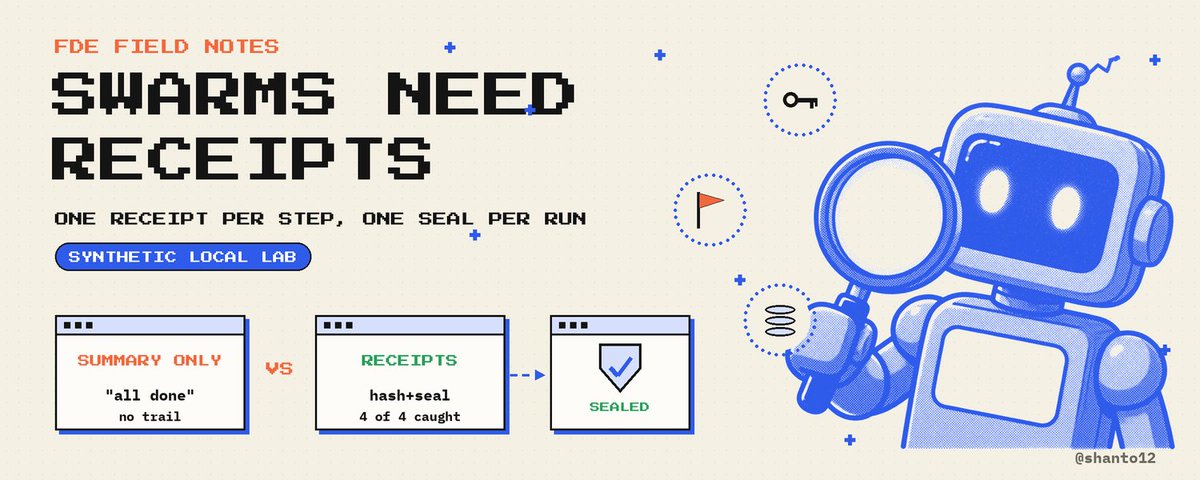
A swarm hands you one summary, written by the system you are checking. Small synthetic lab: per-step receipts plus a Merkle seal caught a dropped step, a reorder and an edit. But a valid seal on 89 of 100 items was still a failed run. h/t @ABArkTech_
1
23