

知人者智,自知者明。勝人者有力,自勝者強。知足者富,強行者有志。不失其所者久,死而不亡者壽。夫唯不爭,故天下莫能與之爭。
Hong Kong
Joined August 2015
- Tweets2.8K
- Following6.7K
- Followers2.1K
- Likes8.5K




Check out my profile on Simcluster: a social network for the S.L.O.P era!
simcluster.ai?invite=shingbo…


a friend just taught me a skill: if you put ur mouth to the speaker of the phone, open it up when you pay music, you’ll actually feel the music


living another day to play the game
Evidential decision theory: an act is ratifiable if given that you perform it, it is not the case that the evidence is that you perform a different act would have been better.”This means an action is considered “ratifiable” if, after you choose it, you don’t end up with evidence suggesting another option would have been preferable.
•“Roughly speaking, an act is ratifiable if, having performed it, you would not regret having performed it.”In simpler terms, a ratifiable act is one you won’t regret after doing it.
•“No-regret decision theory says: don’t perform acts such that you know in advance that as soon as you have performed them, you will regret them.”This suggests a decision-making approach that avoids choices you’ll immediately wish you hadn’t made.
Understanding Causal Decision Theory:
A Comprehensive Breakdown of the Stanford Encyclopedia of Philosophy Entry

ALT https://plato.stanford.edu/archives/win2024/entries/decision-causal/
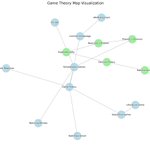
The map illustrates key concepts in decision theory, organized into three main sections:
Newcomb's Problem (top, blue) - Shows the classic decision theory problem with Evidential Decision Theory (EDT) and Causal Decision Theory (CDT) approaches
Causal Decision Theory (middle, green) - Breaks down the key components of CDT including causal dependence, expected utility, counterfactuals, and causal graphs
Decision Process (bottom, yellow) - Demonstrates how decisions are structured with actions, states, outcomes, and expected utility calculations
Ariel Rubinstein's paper, "Comments on the Interpretation of Game Theory," published in Econometrica (Vol. 59, No. 4, July 1991, pp. 909-924)

ALT Ariel Rubinstein's paper, "Comments on the Interpretation of Game Theory," published in Econometrica (Vol. 59, No. 4, July 1991, pp. 909-924)

600x
50xp each referral
doodles related project?
i dun have more info about this
but i sent some eth over
"when it has been too long in time for a side dominating the scene, revive of the other sides emerge naturally where different sides go thirsty to learn the cultures of others sides lead to efficient arbitration of knowledge, wisdom, culture and everything within, in between and combined' , proxies and agencies flow to thrive in building bridges"