

AI-native operating system for international logistics. Rates, spot procurement, bookings, PO workflows and ocean invoice audit in one modular platform
Manhattan, NY
Joined February 2023
- Tweets333
- Following147
- Followers85
- Likes24





Pinned Tweet
TMS is dead. The 1990s tech still running global shipping can’t survive what’s next. Graham Parker breaks down why modular, AI-native systems are taking over, and how shippers are already seeing 70% less risk and 3× faster ROI.
Read the blog:
👉 eu1.hubs.ly/H0mWX100

Yesterday Graham Parker announced three launches in one post. This is the one that is for everyone.
eu1.hubs.ly/H0yLPQP0 is the first product out of Ship Angel Labs. Give it a rate sheet in whatever shape the carrier sent it: a spreadsheet, a PDF contract, an EDI feed, an email thread, a screenshot, a Word amendment. You get structured rates back. Origin, destination, container, rate, surcharges, validity.
It runs on the same AI that handles rate management for global shippers on Ship Angel.
The beta waitlist is open at eu1.hubs.ly/H0yLPQP0. Early access is limited and your rates stay confidential.

Today is the biggest announcement day in @shipangel history.
Three launches.
Different products. Different users.
Same direction:
AI that doesn’t sit inside another application.
AI that actually does the work.
1. MADDY Meridian
MADDY has left the app.
She’s in your browser tab. Your email. Your messages.
And she’s getting her own network.
The MADDY Network is an agent-to-agent execution network.
Meridian puts a MADDY on every side of the shipment. The Network lets them work together.
Your MADDY asks the forwarder’s MADDY for space.
Every person in your company gets their own MADDY, shaped around their work.
MADDY is no longer one agent.
She’s a genre of agents.
Most of our customers already run dozens of MADDYs. Meridian takes that to hundreds.
I believe these are the most advanced agentic capabilities in global ocean, by a long way.
Existing customers: rollout starts next week.
Want this in your operation? DM me.
2. Ship Angel Flow
A new family of products for freight forwarders.
AI already proven with some of the world’s biggest brands.
Built by a team that has shipped technology for the world’s largest forwarders.
Go-live measured in weeks, not quarters.
In Q4 we plan to announce multiple top-20 freight forwarders as first customers.
We know what the biggest forwarders need, because we’ve built it for them before.
I believe these are the best products available to forwarders today.
And they’re arriving when the industry needs them most.
Forwarders: DM me or [email protected]
3. Oceanrate.ai — first product from Ship Angel Labs
This one really is for everyone.
Every vendor still has their own rate format.
There are more surcharges than ever.
Rates change faster than the teams who have to key them.
oceanrate.ai takes any rate sheet, in any format, and turns it into clean, structured rates you can actually use.
It runs on the proprietary AI we built when we launched the first AI for ocean rates in 2024 — the same engine our enterprise customers use to cut about 95% of the time they used to spend managing rates.
A two-person NVOCC can use it.
So can a carrier pricing desk.
So can a shipper’s analyst with a stack of quotes.
The days of double-keying rates and losing hours to a spreadsheet are over.
Early access + free tokens: oceanrate.ai
Three launches.
MADDY Meridian.
Ship Angel Flow.
Oceanrate.ai
Different products. Different users.
One direction.
shipangel.com
#SupplyChain #Logistics #FreightForwarding #AI
Today,we are launching MUSE for Global Supply Chain.
Find out more at shipangel.com

Our case study with Associated British Foods.
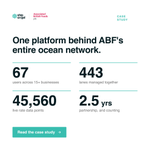
ABF is one of the world's largest food, ingredients and agriculture groups, and every business unit runs its own freight operation. For 2.5 years they've managed their ocean network on Ship Angel: 67 users, 443 lanes, 45,560 live rate data points.
It walks through the challenge, the setup, and the tender that put it to the test.
Read the case study: eu1.hubs.ly/H0yvYhx0

We are pleased to appoint Andy Wood as Global Head of Sales, leading our commercial organization as we expand our work with enterprise shippers across North America and Europe.
Andy brings 15 years of enterprise software sales experience across supply chain, procurement and logistics technology, with a record of leading complex, multi-stakeholder engagements with global organizations. His experience includes the application of AI and machine learning within supply chain and logistics procurement, and the modernization of legacy technology in large enterprise environments.
Andy will lead our sales organization across North America and Europe, with a focus on extending our presence among enterprise shippers and developing our commercial team.

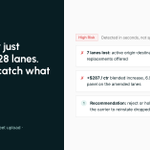
Rate sheet amendments have a habit of arriving late on a Friday. "Please find attached updated rates, kindly confirm by Monday." 128 lanes. Your problem now.
Here's what Amendment Guard found in this one. 7 of the active lanes are gone, no replacement offered. What's left is up $287 a container on a blended basis, which is 6.9% more than the other carriers on the panel charge for the same lanes. It marked the whole thing High Risk and suggested going back to the carrier to get the lanes reinstated first.
Finding that yourself means the old sheet, the new sheet and a couple of hours you probably haven't got before Monday. Having it flagged on upload is the whole point.
We'll run it on your own contracts for free: eu1.hubs.ly/H0y0q3n0

One shipper re-bid 96 spot lanes over six months and got a lower price back on 46 of them. Same vendor, same lane, 12.5% cheaper on average. They just asked again.
Round-one quotes carry buffer, and chasing re-bids across email threads doesn't scale. Spot rate procurement in Ship Angel changes that: every lane goes to multiple vendors, and a second round takes a click instead of a chase.
The result: $306,736 saved across ocean and air in six months, 71% of it from competitive bidding.
The money was always on the table. Now there's a process built to pick it up.

Ship Angel started because rate sheets were a mess. Every vendor sent them in a different format, and someone had to make sense of it all. We built AI that pulls them into one place and makes them readable.
The thing we kept hearing after that was about amendments. Carriers update their rates constantly, and it's easy to miss a change that ends up costing you.
So we built Amendment Guard. When an amendment comes in, you can see what changed, what's new, and whether your rates are still competitive against your other contracts and the market.
In this clip, Andrew walks through a DSV amendment and shows how it works.
You don't miss an MQC at year-end. You miss it 0/8 at a time, in weeks nobody's watching.
W22 looked perfect. W23 shipped nothing. And most teams won't see that gap until the carrier does, when the make-up window is already gone.
Every committed lane, tracked week by week. Before it costs you.
Try it on your own lanes, for free: eu1.hubs.ly/H0xPCxJ0

Spot procurement has a timing problem.
Rates on major lanes can move double digits inside a week. But for most teams, getting quotes back from vendors, normalizing them, and making a call still takes days. By the time the decision lands, the market has already shifted.
Nobody is doing anything wrong here. The process was built for a slower market.
The fix is closing the gap between quote and decision. Rates normalized across every carrier and forwarder, benchmarked against where the lane sits today, so the choice happens while the number is still real.
Try Ship Angel's Spot Rate Procurement solution for free on your own lanes: eu1.hubs.ly/H0xLv220

Implementation timelines are becoming a deciding factor in enterprise software.
Graham Parker, Ship Angel CEO, on why long deployment cycles no longer match how shippers need to operate. When market conditions shift weekly, waiting two quarters to go live isn't a rollout plan. It's a risk.
Full episode: eu1.hubs.ly/H0xH-j80
Your AI strategy is only as good as the operating model underneath it.
New whitepaper from Graham Parker, Ship Angel CEO: The AI-Ready BCO.
A briefing for chief supply chain officers on how shippers win the agentic era, and why the operating model that carried you through the last thirty years is the single biggest risk to the next ten.
Read the briefing at eu1.hubs.ly/H0xHhkf0

Freight software has an outdated ritual: to see the product, you book a call, sit through a deck, and get pricing "after a discovery conversation."
We killed it.
Ship Angel now has a self-serve test drive. Sign up, we load a full sandbox with sample data or your own data, and you're searching live rates, sending booking requests, and auditing invoices in minutes.
No credit card. No sales call.
10 seconds of it below. The full drive takes minutes: eu1.hubs.ly/H0xBClQ0
Every CSCO is being asked what their AI strategy is. Almost none are being asked whether their operating model can support one, which is the question that actually decides the outcome.
The operating model that carried BCOs through the last thirty years is now the biggest risk to the next ten. Graham Parker's new whitepaper covers the three dislocations driving that, the four traits of an AI-ready BCO, and the sequence to adopt in.
Out now: eu1.hubs.ly/H0xynBD0

Ship Angel has published a new whitepaper for Chief Supply Chain Officers: The AI-Ready BCO.
Written by CEO and founder Graham Parker, it examines what enterprise shippers need in place to benefit from agentic AI: liquid commercial truth, an inventory of decisions rather than processes, an operating model built for supervision rather than execution, and speed to value as a repeatable discipline.
The briefing also sets out a phased adoption model in which every stage is measured in dollars, and closes with a 10-question self-assessment for leadership teams.
Available to download now: eu1.hubs.ly/H0xvyN40

Enterprise freight software has a strange rule: you can't touch the product until you've talked to sales.
Fill out the form. Take the discovery call. Watch someone else drive a demo with someone else's data. Weeks later, you still haven't clicked a single button yourself.
We removed the gate. Sign up, connect your own rates, and run your freight in the platform.
60 seconds to get in. No salesperson, ever: eu1.hubs.ly/H0xsMTq0

The gap between shippers who are ready for agentic AI and shippers who are waiting is compounding monthly.
Graham Parker has spent two decades building supply chain platforms, including the one behind Maersk's digital booking. His new whitepaper is a briefing on what he's seen separate the two.
Three dislocations hitting global supply chains at once. Four readiness traits that belong to your organization, not your vendor list. And an adoption sequence where every phase is measured in dollars and any phase that doesn't pay triggers a stop.
New whitepaper out August 6th.

Ship Angel's Instant POC is live.
Sign up, pick your modules, use our preloaded data or upload your own rates, and you are in the platform in about a minute.
Rates. Spot rate procurement. Bookings. Invoice audit. All of it working.
Free. No contract. No call with us first.
For context, the industry norm is a four to eight week POC and another quarter to implement.
Take it for a test drive: eu1.hubs.ly/H0xp62l0

Every shipper is living in the spot market right now.
So we built for it.
Spot Rate Procurement — our most requested module this quarter:
→ All major carriers + forwarders bid in one place
→ True cost side by side, D&D included
→ One click to award
Days → minutes. 60 seconds 👇
Enterprise POCs take 30–90 days 🤬🤢
Instant POC with us takes 60 seconds 😇😍
The entire Ship Angel OS — Rate System, Bookings, Spot Rate Procurement, Invoice Audit, PO Management — free, no commitment, no sales call.
Try it → app.shipangel.com/signup