






I am convinced my source of enlightenment will be X. The amount of nonsensical responses, bad language and extreme calls for destructive action this platform induces is enough to test the patience of a saint.
By all means disagree because dialogue is the point but don’t stoop to behaviour which in real world would be completely unacceptable.
1
136
If there’s one country I don’t envy at the moment, it’s Saudi Arabia.
Some of its biggest detractors, who question its Islamic credentials, root for its downfall and cheer on the Houthis, are also the ones who expect it to:
Champion every Muslim cause globally.
Prioritise the interests of the wider Muslim world over its own national interests.
Confront Israel, yet shun American military support even when its own security is threatened.
It’s every effort to modernise and diversify its economy is questioned. Its role in regional tensions are amplified while those of other regional powers is overlooked.
I wonder why - because it administers Mecca and Medina? Becoz it chooses bargains over ‘adventurous causes’ that have destabilised other states? Or something else?
3
249


Another #Dubai safety fan girl moment:)
My car mechanic called to ask me to collect my car I had given for repair. I told him I can only come between 1.15 to 2.15 pm since I have meetings. The garage is closed in the afternoon for Friday prayers but I needed it for a trip planned tomorrow.
His solution - I will keep the car outside with the key inside. Read that again….car outside and open.
It’s a BMW and yet none of us thought anything about the safety risk. He left the car, I went in the timeframe to collect and am now driving back😂🤣
In 1980, it took 20% interest rate to threaten America's technological dominance. Today, even the prospect of a 25-basis-point hike makes Wall Street so nervous.
While reading Chris Miller's #ChipWar, I came across an interesting historical parallel. In the early 1980s, AMD's CEO, Jerry Sanders complained that Japanese chipmakers could access capital at 6-7%, while he was paying 18%.
US interest rates approached 20% in 1980 (Volcker era) and have historically averaged around 5-5.5% since 1954. Ultra cheap money post-2008 was the exception, not the norm.
But there is no denying that today's American economy is also structurally different:
- Federal public debt at nearly 100% of GDP, versus 26% in 1980.
- A significantly smaller manufacturing share of GDP. While AI and related tech are producing some great growth numbers, the question remains about 'circular financing' and 'bloated valuations'
- Financial markets increasingly dependent on cheap liquidity.
- Growing technological and economic competition from China and the 'Global South'.
Meanwhile, the AI, semiconductor and robotics boom is driving enormous capital expenditure.
So where do you stand in this economic debate: can AI, robotics, and the tech economy and thus the financial market not survive without cheap money? Or is this just a healthy correction to the 'actual normal'?
The real question is should I panic or not🤣?
1
3
430
OPEC will slowly unravel. UAE set the precedent without any backlash, and other countries will follow. But this has less to do with national assertion and more with the new global oil (hydrocarbon) architecture.
-The largest source of incremental hydrocarbons in the future will be the US and the Western Hemisphere. Considering OPEC was formed partly to break the Western companies' monopoly, what really is the point?
- Hydrocarbon production is becoming increasingly multipolar. Greater competition and more supply options will dilute OPEC's collective bargaining power.
- OPEC sanctified the petrodollar architecture to a great extent. Countries will now want the flexibility to negotiate bilateral contracts, potentially pricing in dollars but settling in other currencies with major buyers such as India and China.
OPEC may survive as an institution, but its ability to dictate global oil market dynamics will diminish.
Thoughts? Counter opinions...?

Iraq starts a new fight with OPEC, rejecting the oil production capacity assessments (Baghdad is seeking that its capacity is recognized above 5m b/d).
Earlier this year, Iraq already threatened with leaving the cartel if it didn't get its way.
bloomberg.com/news/articles/…

Iraqi government is reasserting its authority - not just over armed militias, but also in areas administered by constitutionally autonomous regional governments.
Iraqi PM Ali al-Zaidi has ordered federal control over oilfields in Kurdish-controlled territories, border crossings and regional oil-export approvals, following investigations into oil smuggling.
This development is significant, particularly coming after Baghdad's intervention in the Kataib Hezbollah stronghold of Jurf al-Sakhar.
While Kurdish constitutional autonomy and militia power are fundamentally different, the common thread remains Baghdad's attempt to consolidate control over national territory, revenue streams and strategic infrastructure.
For me, this reinforces my long-term ME thesis: that national state sovereignty is being reasserted over all challengers... one country at a time...

National sovereignty over armed and proxy groups in the Middle East....one step at a time
Yesterday, Iraq's new businessman-turned-politician PM, Ali Al-Zaidi, reached a tentative compromise with Iran-backed Kataib Hezbollah after threatening to send troops into its stronghold of Jurf al-Sakhar.
The dispute was alleged oil smuggling worth millions of dollars. The compromise saw federal forces regain a foothold, while militia units were partially redeployed.
Similar pattern to many ME countries...
- Syria: President Ahmed Al Sharaa is attempting to bring competing militias and armed factions under central authority following Iranian ally Bashar Al Assad's fall in 2024. Good progress...
- Lebanon: The new government under General Aoun is trying to reassert the state's monopoly over weapons, challenging Iranian ally Hezbollah's military autonomy. Work in progress, as both Hezbollah and Israel complicate the process.
- Iraq: A new PM, backed by main Shia political parties, is challenging entrenched Iran allied militias even as the US military footprint reduces in the country
I have argued this for some time: The Middle East is moving, unevenly and painfully, from 'forever wars' dominated by proxy groups with plausible deniability for states - to greater national sovereignty.
This is also part of a bigger global economic power struggle. Stronger states are needed to unlock the reconstruction process, energy and trade corridors and realise the Gulf (Global South) ambition of making the region an important node in AI and tech development. Beneficial to both the US and China....
Of course, one compromise does not prove a thesis and Iraq has a long way to go. However, taking all developments in Syria, Lebanon, Palestine and now Iraq, a clear transition is underway. As Iran stays locked up in multiple challenges, will these states be able to integrate proxies and rebuild?
Let me know your thesis and thoughts?
nbcnews.com/world/middle-eas…

1
2
442

Not a climate or energy expert, but genuinely curious: who expected #COP31 to be a major success in today's geopolitical environment?
A few reasons why I didn't:
Europe has learnt two brutal lessons in energy security: Russia's invasion of Ukraine and the disruption of Qatari LNG exposed the risks of overdependence on any single energy source or supplier. Energy security cannot be sacrificed for climate ambitions.
The US and its Western Hemisphere are now a hydrocarbon superpower with growing commercial and geopolitical incentive to protect its energy markets, especially Europe.
Europe itself needs a breather. With high energy costs, declining industrial competitiveness and economic pressures, how much appetite is there for an expensive and politically difficult transition?
The Gulf needs to sell hydrocarbons. After the economic fallout of the US-Iran war, Aramco, ADNOC and QatarEnergy have even greater incentives to maximise revenues and support their national economies. No wonder the 'long live fossil fuel' lobby in COP31 was led by Saudi Arabia.
Add potential Iranian supply and increasingly diversified global production, and predictions of peak oil and gas demand become even more uncertain.
My takeaway from COP31: Energy security is returning to its roots.
When Jimmy Carter championed energy security in the 1970s right after Saudi Arabia's oil embargo, the priority was diversification, affordability and reliability, not decarbonisation alone.
Perhaps that's where we're heading again: a pragmatic mix of oil, gas, renewables and nuclear, driven as much by geopolitics and economics as by climate ambitions.
288
#JensenHuang is back and #nvidiastock is up 26% 🤣🤣.
This US market is only for those who trade directionally and patiently.
Thank God I bought at the drop; now time to sell:)
254
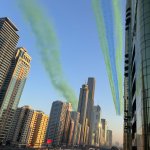
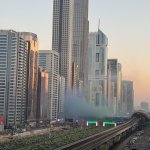
Damnnn….Dubai does everything in style. Our personal dance party, air and drone show.
I think I also saw a penguin, dolphin and monster😂🤣
#DubaiMarathon2026


The next big beneficiary of the overvalued AI stock market 'correction' could be India. Here's my geopolitical take.
An interesting divergence this week: US and Asian technology-heavy markets suffered their worst week in many years. Yet Indian equities recorded four consecutive weekly gains and the rupee has strengthened to 92.67 against the dollar.
Foreign investors have poured roughly $12 billion into Indian equities this month.
While this round is simply capital rotation, it also offers a glimpse of a more structural, long-term trend.
Global investors will increasingly remain optimistic about tech while becoming uncomfortable with concentration and valuations of global AI trade - in the US and adjunct markets like Japan, South Korea and Taiwan.
As AI valuations eventually correct, India can emerge as the most attractive Global South destination for a significant portion of that capital with its:
- Strong consumption, industrial and infra-led growth
- Large, liquid and increasingly accessible capital markets
- Financial democratisation through digital ID, digital payment systems, a huge number of DEMAT accounts and platforms like Zerodha.
- A growing deep tech ecosystem spanning semicons, AI, defence and space
India won't be immune to global corrections related to US monetary policy and debt, conflicts and geopolitical swings.
But over the next 5-8 years, its ability to attract and absorb international capital could grow substantially. I am bullish on the Indian stock market and the deep-tech story.
What is your investment hypothesis in the mid to long term?
#IndianStockMarket #Energingmarkets #DeepTech #GlobalSouth
2
338
Abu Dhabi's #MGX has an estimated unrealised mark-to-market gain of roughly $20 billion from #AnthropicIPO
The share price of Anthropic will fluctuate, but this is THE angle that most doomsday predictions about the UAE continually miss:
- Its role as a global allocator in the new technology world (investor in Anthropic, xAI, Mistral AI, OpenAI, Aligned data centres and the AI Partnership with BlackRock and others, to name a few)
- A prominent destination for 'outsourced' compute and AI hubs, its growing indigenous capabilities (models, sovereign data, applications) and its linkages/emerging 'sovereign corridors' with the Global South.
1
3
575
There is such a general fatigue in the UAE about the Middle Eastern continued nonsense (pardon my language) that no one even wants to discuss the topic. Whether Iran will go crazy again, whether the US will escalate, or whether the entire neighbourhood will combust - we don't care.
Instead, we are discussing the future of AI, how to convert events into opportunities and how we are grateful for all the protection rendered to us this year.
#Dubai #2026 #Mideast


National sovereignty over armed and proxy groups in the Middle East....one step at a time
Yesterday, Iraq's new businessman-turned-politician PM, Ali Al-Zaidi, reached a tentative compromise with Iran-backed Kataib Hezbollah after threatening to send troops into its stronghold of Jurf al-Sakhar.
The dispute was alleged oil smuggling worth millions of dollars. The compromise saw federal forces regain a foothold, while militia units were partially redeployed.
Similar pattern to many ME countries...
- Syria: President Ahmed Al Sharaa is attempting to bring competing militias and armed factions under central authority following Iranian ally Bashar Al Assad's fall in 2024. Good progress...
- Lebanon: The new government under General Aoun is trying to reassert the state's monopoly over weapons, challenging Iranian ally Hezbollah's military autonomy. Work in progress, as both Hezbollah and Israel complicate the process.
- Iraq: A new PM, backed by main Shia political parties, is challenging entrenched Iran allied militias even as the US military footprint reduces in the country
I have argued this for some time: The Middle East is moving, unevenly and painfully, from 'forever wars' dominated by proxy groups with plausible deniability for states - to greater national sovereignty.
This is also part of a bigger global economic power struggle. Stronger states are needed to unlock the reconstruction process, energy and trade corridors and realise the Gulf (Global South) ambition of making the region an important node in AI and tech development. Beneficial to both the US and China....
Of course, one compromise does not prove a thesis and Iraq has a long way to go. However, taking all developments in Syria, Lebanon, Palestine and now Iraq, a clear transition is underway. As Iran stays locked up in multiple challenges, will these states be able to integrate proxies and rebuild?
Let me know your thesis and thoughts?
nbcnews.com/world/middle-eas…
To be fair, this is a relocation, not a dismantling orchestrated behind the scenes by Iran and its linked Badr organisation. But avenues of negotiation are opening up within the different groups in Iraq, even as the US military footprint is reduced. I see it as glass half full than half empty....
1
193
Nvidia's Israel-linked outrage is a perfect example of how you make hay while the sun shines and then dump it....
Many people trading in stock markets made generational wealth on Nvidia, and now they are all outraged about its Israeli connections.
If you didn't know, then you need to research the companies you invest in a little better...
If you did and looked the other way, please drop the holier-than-thou attitude.
Take this as a lesson in global capitalism: it is hard to choose between principles and capital gains.
1
5
361