
Research Scientist @GoogleDeepMind Prev: MTS @MicrosoftAI, intern @GoogleDeepMind, PhD @Oxford_VGG, lead @OxfordAI, undergrad @oxengsci, IPhO 🥉 | Pump x Hunter
Joined October 2020
- Tweets112
- Following214
- Followers739
- Likes914






Suny Shtedritski retweeted

MAI-Image-2.5 is now #1 on the Artificial Analysis leaderboard for image editing! Amazing hillclimbing... compounding the gains!

Microsoft's MAI-Image-2.5-Pro debuts at #1 on the Artificial Analysis Image Editing Leaderboard, and takes the #7 spot in Text to Image
MAI-Image-2.5-Pro is Microsoft AI's quality-focused image model, launched July 23 in preview on Microsoft Foundry. It joins MAI-Image-2.5 and MAI-Image-2.5-Flash in a family Microsoft positions as covering the quality-speed-cost curve, so builders can pick the point that fits their job. Pro sits at the quality end: Microsoft describes it as its highest-fidelity image model to date, aimed at hero imagery, detailed editing, and precise in-image text rendering.
In the Artificial Analysis Image Arena, MAI-Image-2.5-Pro debuts at #1 on the Image Editing Leaderboard, surpassing Reve 2.1, GPT Image 2, and Microsoft's own MAI-Image-2.5. In Text to Image it lands at #7.
On Microsoft Foundry, MAI-Image-2.5-Pro is priced per token: $5 per 1M text input tokens, $8 per 1M image input tokens, and $106 per 1M image output tokens, which works out to roughly $108.5 per 1k 1024x1024 images. That compares to $48 per 1k images for MAI-Image-2.5 and $20 per 1k for MAI-Image-2.5-Flash.
MAI-Image-2.5-Pro is available in preview on Microsoft Foundry across seven global-standard regions, and can be tried out in the MAI Playground.
Congratulations to @MicrosoftAI on the release!
See below for comparisons between MAI-Image-2.5-Pro and other leading models in the Artificial Analysis Image Arena 🧵
Suny Shtedritski retweeted
There are no shortcuts to the frontier. Disciplined, patient, meticulous attention to detail is critical. To give everyone a good sense of our progress we've published a very detailed technical report (109 pages!) outlining how we trained MAI-Thinking-1 and what we learned along the way. microsoft.ai/wp-content/uplo…
It's exceptionally strong in reasoning and SWE benchmarks. I’m super proud that it’s at 53% on SWE-Bench Pro, placing it right alongside Opus 4.6 on one of the toughest coding benchmarks. We have a lot more work to do as we get it into production and climb on more real world use cases.
We also launched six other world class models. Here's the line up: microsoft.ai/
- MAI-Transcribe-1.5 is the best transcription model in the world, with SOTA accuracy across 43 languages, beating out Gemini and OpenAI’s flagship transcription models. It offers the best accuracy, 5x faster than rival models. It's now in Microsoft Foundry, where it’s the fastest, most efficient and most cost‑effective transcription model of any hyper-scaler.
- MAI‑Voice‑2 our latest speech generation model, with native‑sounding delivery and fine‑grained emotional control, available in 15 languages with lots more coming soon. And MAI-Voice‑2‑Flash provides the best value and speed for ultra latency‑sensitive Voice Agents.
- MAI-Code-1-Flash is our new inference efficient coding model, especially tuned for VS Code and GitHub Copilot CLI. It's a brilliant, fast model at just 5B actives, and delivers 51% on SWE-Bench Pro. Super excited to get it into prod and climb on more real-world tasks.
- MAI-Image-2.5 and Flash are two super strong models that deliver a step change in quality and surpass Nano Banana 2 on the image editing leaderboard. MAI-Image-2.5 delivers super strong performance on H100s, enabling deployment on existing infrastructure, with flexibility to scale across GB200/GB300 systems.
We're hiring! We're a lean, fast-moving lab made of some of the world's most talented minds. Come join us as we work on our next generation of models!

Suny Shtedritski retweeted

MAI-Thinking-1 is out!
Excited to share what we are building and how climbing from scratch (no distillation) actually works: simple recipes, rigorous science, self-distillation, patience, and great infra.
Check out our tech report has the full story of our RL climbs.
microsoft.ai/wp-content/uplo…


Super excited to announce seven new world-class MAI models today. They represent what we consider a new era in AI designed to keep you in control and on the frontier.
First is our text foundation model, MAI-Thinking-1, exceptionally strong on reasoning and SWE tasks.
- It’s a 35B active parameter MoE with a 256K context window. Independent human raters on Surge prefer it for overall quality in blind side-by-sides versus Sonnet 4.6, and it’s achieved 97% on AIME 2025, the key measure of its general-purpose reasoning abilities.
- It's at 53% on SWE Bench Pro, placing it right alongside Opus 4.6 on one of the toughest coding benchmarks.
- And since we co-designed our models with our own silicon, MAI-Thinking-1 is optimized on our MAIA 200 chip. Benchmarking head-to-head against the GB200, we see 30% better performance per dollar as well as a 1.4x performance-per-watt gain when running our MAI models on the MAIA 200 end-to-end.
Next is MAI-Image-2.5 and its Flash variant. Two super strong models now at #2 on the leaderboards, surpassing the score of Nano Banana 2 on image editing.
Last for now is MAI-Code-1-Flash, our new inference efficient coding model, especially tuned for VS Code and GitHub Copilot CLI.
- Code-1-Flash achieves 51% on SWE Bench Pro, despite having just 5B parameters, putting it closer to Haiku in size but cheaper in cost.
All of this is the foundation for Microsoft Frontier Tuning. It lets you customize our models to create custom, company-specific agents that only you control. You can make our model, your model. Your data. Your agents. Your moat.
Early adopters are already seeing a difference. When we tuned our models for McKinsey’s tasks, MAI delivered the highest win rate, outperforming GPT-5.5 on quality, while being 10x lower on cost.
Also really excited to be collaborating with the amazing team at Mayo Clinic to jointly train a new frontier AI model for healthcare.
Our announcements today mark another milestone on the road to humanist superintelligence. You can learn more and about our other new models in our latest blog: microsoft.ai/news/building-a…

Suny Shtedritski retweeted

MAI-Image-2.5 has officially released from @MicrosoftAI landing at #2 in the Image Edit Arena (Single-Image-Edit) with a score of 1401 and advances the Pareto frontier!
This puts the model +10 pts over Nano Banana 2, Grok Imagine Image Quality and ChatGPT-Image-Latest-High Fidelity.
Congrats to the @MicrosoftAI team on this big accomplishment!

Suny Shtedritski retweeted
Super excited to announce seven new world-class MAI models today. They represent what we consider a new era in AI designed to keep you in control and on the frontier.
First is our text foundation model, MAI-Thinking-1, exceptionally strong on reasoning and SWE tasks.
- It’s a 35B active parameter MoE with a 256K context window. Independent human raters on Surge prefer it for overall quality in blind side-by-sides versus Sonnet 4.6, and it’s achieved 97% on AIME 2025, the key measure of its general-purpose reasoning abilities.
- It's at 53% on SWE Bench Pro, placing it right alongside Opus 4.6 on one of the toughest coding benchmarks.
- And since we co-designed our models with our own silicon, MAI-Thinking-1 is optimized on our MAIA 200 chip. Benchmarking head-to-head against the GB200, we see 30% better performance per dollar as well as a 1.4x performance-per-watt gain when running our MAI models on the MAIA 200 end-to-end.
Next is MAI-Image-2.5 and its Flash variant. Two super strong models now at #2 on the leaderboards, surpassing the score of Nano Banana 2 on image editing.
Last for now is MAI-Code-1-Flash, our new inference efficient coding model, especially tuned for VS Code and GitHub Copilot CLI.
- Code-1-Flash achieves 51% on SWE Bench Pro, despite having just 5B parameters, putting it closer to Haiku in size but cheaper in cost.
All of this is the foundation for Microsoft Frontier Tuning. It lets you customize our models to create custom, company-specific agents that only you control. You can make our model, your model. Your data. Your agents. Your moat.
Early adopters are already seeing a difference. When we tuned our models for McKinsey’s tasks, MAI delivered the highest win rate, outperforming GPT-5.5 on quality, while being 10x lower on cost.
Also really excited to be collaborating with the amazing team at Mayo Clinic to jointly train a new frontier AI model for healthcare.
Our announcements today mark another milestone on the road to humanist superintelligence. You can learn more and about our other new models in our latest blog: microsoft.ai/news/building-a…
Suny Shtedritski retweeted

We are seeking a full-time Postdoctoral Research Assistant in Computer Vision to join the Visual Geometry Group (University of Oxford) to work on 3D and Spatial AI with Professor Andrea Vedaldi. The post is funded by ERC and is fixed-term for two years with a possible extension.
Suny Shtedritski retweeted

We are hiring star research and data engineers to invent the future of AI. [email protected]
If you’re finishing your undergrad or PhD at Imperial, Cambridge, Oxford, UCL, Toronto, MIT, MILA, UBC, ETH, Stanford, Caltech, UCLA, Berkeley, CMU, UW, NYU, Princeton, Columbia, Harvard, Yale or any other top school in STEM, please apply too. I love working with energetic people, who are prepared to work on what is needed to shape AI, make it safe, make it brilliant, make it creative, and make it useful in math, science, healthcare, education, energy and environment.

Look forward to having @satyanadella & @sama on @BG2Pod tomorrow. The deal. The skeptics. The re-industrialization of America. Power. Chips. Models. Agents. AGI. Regulation. Jobs. And more… 🧐🚀🇺🇸

Suny Shtedritski retweeted

Preprint is out: we solve the CFG conundrum!
Simple or out of distribution prompts benefit from unconditional generation, but challenging ones require to dial up the guidance strength.
But no need to rely on empirical observations. We introduce dynamic CFG via online feedback👇


Dynamic CFG: adaptive guidance for diffusion models
• Static CFG = “one-size-fits-all” fails across prompts
• New method: online feedback from latent evaluators (CLIP, fidelity, prefs) → dynamic per-step CFG
• Just +1% overhead, big gains in alignment, quality & text rendering
• On Imagen 3: up to 55.5% human pref. win-rate


Suny Shtedritski retweeted

When life gives you lemons, Andrea makes lemonade 🍋
Kudos to Andrea Vedaldi doing an excellent work presenting his paper in spite of an incident w/ the poster #cvpr2025

Suny Shtedritski retweeted

Thrilled and honored to receive the Best Paper Award at #CVPR2025! Huge thanks to my fantastic collaborators @MinghaoChen23, @n_karaev, Andrea Vedaldi, Christian Rupprecht, and @davnov134. Could not be there without you!


Suny Shtedritski retweeted
Many Congratulations to @jianyuan_wang, @MinghaoChen23, @n_karaev, Andrea Vedaldi, Christian Rupprecht and @davnov134 for winning the Best Paper Award @CVPR for "VGGT: Visual Geometry Grounded Transformer" 🥇🎉 🙌🙌 #CVPR2025!!!!!!


Suny Shtedritski retweeted

We are presenting Dual Point Maps as a #CVPR highlight tomorrow!
Learn about our novel, data-efficient representation for 3D/4D deformable objects—an alternative to classical template shape models.
📍🕑 ExHall D, Poster #100, afternoon session
🌍dualpm.github.io
Suny Shtedritski retweeted

Ever wish you could turn your video generator into a controllable physics simulator?
We're thrilled to introduce Force Prompting! Animate any image with physical forces and get fine-grained control, without needing any physics simulator or 3D assets at inference. 🧵(1/n)
Suny Shtedritski retweeted

🚀Excited to announce our @CVPR 2025 paper:
Unbiasing through Textual Descriptions!
We release UTD-descriptions for 1.9M videos and object-debiased splits for 12 datasets!
🔗Project: utd-project.github.io @NagraniArsha Bernt Schiele @HildeKuehne Christian Rupprecht 🧵👇

Suny Shtedritski retweeted

Introducing JEGAL👐
JEGAL can match hand gestures with words & phrases in speech/text. By only looking at hand gestures, JEGAL can perform tasks like determining who is speaking, or if a keyword (eg beautiful) is gestured
More about our latest research on co-speech gestures 🧵👇
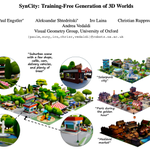
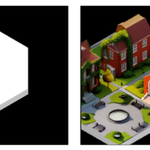
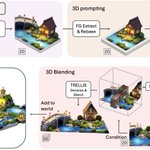
Fancy vibe generating an entire 3D scene with a text prompt? The code for SynCity 🌆 is out 👇

We have just released the code for SynCity 🌆 (arxiv.org/abs/2503.16420) on GitHub: github.com/paulengstler/sync… Please let us know if you encounter any issues and do share your generated worlds with us!

9
512
Very excited to share that the code for SynCity 🌆 is out!
Check out github.com/paulengstler/sync…
For more details about the method, please see the project page research.paulengstler.com/sy…


Suny Shtedritski retweeted

Humans learn from one continuous visual stream, but large video models have to be trained on billions of web videos.
We found that learning from such sequential streams is challenging for video models—and we introduce a family of "orthogonal optimizers" to bridge the gap!
Suny Shtedritski retweeted

Have you wondered why you can pour water accurately even in dark or in opaque bottles? Turns out the sound of pouring secretly hides physical properties that we implicitly infer. Can we train machines to infer these?
Know more at our poster @ieeeICASSP (April 10, 830-10 AM IST)!