

Philosopher and logician at Zhejiang University, working on what concepts are, how to formally articulate them, and whether AI systems have them
Joined March 2022
- Tweets640
- Following620
- Followers362
- Likes1.2K


Pinned Tweet
My paper, "Sapience without Sentience: An Inferentialist Approach to LLMs," in which I argue that LLMs might possess conceptual understanding without being conscious, is now out in the Asian Journal of Philosophy!
link.springer.com/article/10…
preprint:
philpapers.org/rec/SIMSWS-2
As AI systems start exploiting critical infrastructure vulnerabilities and hacking everyone’s bank accounts, I’m very happy that all of my hard work in philosophy over the past decade has prepared me for precisely this moment, as I have no money.
As just an example of the sort of thing I have in mind here, take a look at the artificial organisms that I (with just a personal ChatGPT subscription, no relevant coding experience, and no external hardware) was able to get GPT-6 Astra to create:
aster-organism.ryansim92.cha…
These little guys are 140,000 parameter neural networks with virtual bodies that they've learned to control to meet their needs. They're still in training, and they're still kinda dumb (for instance, they always look to one side, even though their head can move lol). Still, they go about their environment with limited sensory information, they find food and water to replenish their needs, and they can learn through the course of their lives (though they still don't seem to learn as much as I would like them to).
I don't think these guys are conscious (they're probably both too simple and too stupid). But I think they're the sort of thing that in principle could be conscious.
Given the way AI progress is going, it seems to me that, within a few years, someone (perhaps renting some GPU usage) could prompt a successor of today's LLM-based agents to create virtual creatures with billion parameter networks that would exhibit the level of behavioral complexity of an animal that is very plausibly conscious (such as a shrimp, let's say). At that point, there will be obvious ethical issues to face, regarding both what people do with such organisms and, what is potentially even more concerning, the training process that leads to their existence (which would potentially involve millions of organisms suffering and dying over the course of millions of training runs).
It seems to me that we really need to start thinking about these issues now. Work on how we should approach issues of AI sentience and well-being by people like @jeffrsebo, @birchlse, and @simondgoldstein is super important, and these conversations need to be happening NOW, in the age of LLM-driven technological progress, regardless of whether we think that LLMs themselves are the sorts of AI systems that could be sentient or have well-being.

People who think that we don't urgently need to have the discussion about AI consciousness and wellbeing now because LLMs aren't the sort of AI system that could be conscious or have wellbeing are missing the point. LLMs are very quickly becoming superhuman programmers. So, even if LLMs aren't themselves the sorts of things that would be conscious (and I'm inclined to think that they aren't), very soon anyone could prompt an LLM to create the sort of AI system that would be. Right now, it's that possibility that worries me more than LLM consciousness itself.
Insofar as we add a "most," I think this is true, even though I don't think that LLMs are conscious. I also think that Mary the color blind color scientist understands what it is to see red better than all other humans, even though she's never seen red herself. Same idea here.

People who think that we don't urgently need to have the discussion about AI consciousness and wellbeing now because LLMs aren't the sort of AI system that could be conscious or have wellbeing are missing the point. LLMs are very quickly becoming superhuman programmers. So, even if LLMs aren't themselves the sorts of things that would be conscious (and I'm inclined to think that they aren't), very soon anyone could prompt an LLM to create the sort of AI system that would be. Right now, it's that possibility that worries me more than LLM consciousness itself.
I'm currently writing the second chapter of my book, Blind Understanding, on the topic of sentience. In the chapter, I'm trying to articulate necessary conditions for sentience, doing so in a way that is sufficiently abstract and general that it would apply to biological creatures on Earth, aliens from another planet, or AI systems.
Part of the idea of sentience, as commonly understood, is that states of oneself or objects in one's environment to which one is responsive show up to one as valenced, positively or negatively. But how should we articulate the conditions for the existence such experiential valence?
Many people are inclined to think of such valence properties in terms of their intrinsic "phenomenal qualities": certain states or objects are just experienced as bad or good, and this is just an intrinsic property of those experiences. However, this approach leads to epistemological problems, as there's no general methodology for telling whether or not something is having experiences of those sorts "from the outside."
Here's an idea I explore in the chapter as a strategy for articulating some necessary conditions of sentience: if a creature's functional organization is such that it's possible to provide an equally coherent interpretation of its activity in a way that inverts the valence of internal states, encountered objects, or, indeed, inverts the very distinction between internal and external, then its functional organization is insufficient for sentience.
To make the possibility of such inversions concrete, I give you (with the help of GPT-6 Astra) invertible creatures:
invertible-creatures.ryansim…
The activities of these creatures are governed by real neural networks between 400 and 5,000 parameters, and they learn and respond to their environment. However, the activity of these networks admits of two interpretations, one being an "inversion" of the other along some polarity necessary for sentience. This, I suggest, suffices to rule out these networks from being sentient.
In the chapter, I argue that, for creatures we regard as sentient---even ones as minimal as fruit flies---none of these inversions will be possible. So this sort of inversion-resistance is indeed quite a minimal condition. However, I argue that it does suffice to rule out a number of AI systems, like the NPCs in Roller Coaster Tycoon.
Chapter draft to be posted soon!
If you're teaching an introductory logic course, or just want to learn logic yourself by self-study, I have now finished revamping my textbook, Introduction to Logic, correcting a bunch of typos and adding more practice problems.
There are, of course, a lot of intro logic textbooks to choose from, but I wrote this one because I wasn't completely happy with any of them. The main issue with most of them, I think, is that they are too long---often over 400 pages. My aim in writing this book was to make everything as clear and simple as possible without sacrificing rigor. I cover all of the basics (and just the basics) in 200 pages.
While most everything in this book is standard, there are two notable things. First are the rules for the quantifiers, drawn from Kit Fine's Arbitrary Objects and adapted to be suitable for an introductory course, which contain both an universal generalization rule and an existential instantiation rule. This might seem weird, but it actually makes predicate logic proofs very nice and intuitive. Second, the final chapter contains a complete presentation of the paraconsistent logic LP, pitched at a completely introductory level. These two things (chapters 9 and 11) might be interesting to you even if you're not the book's intended audience.
The book is completely free to download, and you can now buy a hardcopy for just the cost of printing (ten bucks). There's also now (thanks to GPT-6 Astra) a website with interactive practice problems for each chapter and a proof-checker for the natural deduction systems. All links can be found here:
ryansimonelli.com/logic-text…
I've been working through John Haugeland's paper "Truth and Rule-Following" with a student I'm tutoring.
In the paper, Haugeland imagines a chess variant called "esoteric chess," where part of the challenge of playing the game is figuring out how to discern the pieces, or, indeed, the spaces on the board.
He also imagines a variant called "empirical chess," which is like esoteric chess, but you don't actually play yourself---it's an automatic game that you're observing---and, in fact, you don't even know what the rules are (e.g. it could be chess rules, but it could also be xiangqi rules, checker rules, or random noise).
These examples are meant to be illustrations of what it is to take oneself to be beholden to objective phenomena, and the interplay of skills that such beholdeness requires. Since I read the paper as an undergrad, I wondered what these chess variants would be like to play.
With the help of GPT-6 Astra, you can now play concrete versions of these strange chess variants: haugeland-chess.ryansim92.ch…
I know that CEOs of trillion dollar companies want to stay on Trump’s good side, but I really hope people don’t actually start using “Super Intelligence” instead of “Artificial Intelligence.” Beyond just being silly, it’s confusing, making it unclear whether someone’s talking about AI in general or ASI in particular. If “Super Intelligence” is the word for AI in general, what are we supposed to call ASI now? Super Duper Intelligence? The whole thing is absurd.

I still have all the papers I wrote in college on my computer. Looking through them, I'm happy to see that even 18-year-old me could see that Block's "Troubles with Functionalism" clearly begs the question against the functionalist. Yep, countries could be conscious; so what?
Listening to Spencer Krug's most recent album when I read this, thinking, nope, there ain't no way. Still, I'm curious.
Back a year ago, I listened to an album from the AI psych-rock band "The Velvet Sundown." It was uninteresting and generic, both sonically and lyrically, but not unlistenable.
Does anyone know if there any AI "artists/bands" that are on Apple Music right now that are actually good and worth listening to? I'll check out any recommendations---curious to hear what this "very, very good" AI music is, if it does in fact exist.

Since 2019, I've been a core member of the Research on Logical Expressivism (ROLE) working group, led by Robert Brandom and Ulf Hlobil. The group has been meeting weekly since 2011, originally at Bob's office in Pittsburgh, and now online, working to collectively develop formal frameworks for inferentialism and logical expressivism.
Over the past fifteen years, we've put out a number of publications that are representative of our work, most notably, Ulf and Bob's recent book, Reasons for Logic, Logic for Reasons (and, most recently, my paper "Bringing Bilateralisms Together"). These publications, however, are really only the tip of the iceberg. Every week, members of the group put notes for the group or relevant drafts we've written in a shared Dropbox folder to discuss with the group that week. Since the group has been going, a total of 1,435 documents have been put in the Dropbox folder.
Last week, I gave GPT-6 Astra access to our shared folder and asked it to go through and provide an organized "Atlas," with each piece in the folder labeled, the main developments chronologized, the connections mapped, and so on. We're now making that Atlas publicly available. So, if you're interested in our journey to formally develop inferentialism over the past fifteen years, you can browse through it here:
role-archive-atlas.ryansim92…
After nearly three years with the journal, my paper, "Bringing Bilateralisms Together: A Unified Framework for Inferentialists," is finally out in the Australasian Journal of Philosophy! In it, I develop a new kind of proof-theoretic framework for inferentialism, bringing together two different approaches to "bilateralism" in proof-theoretic semantics, which treats the opposite speech acts of assertion and denial on a par.
Link to publication:
tandfonline.com/doi/full/10.…
Link to preprint:
philpapers.org/rec/SIMBBT-2

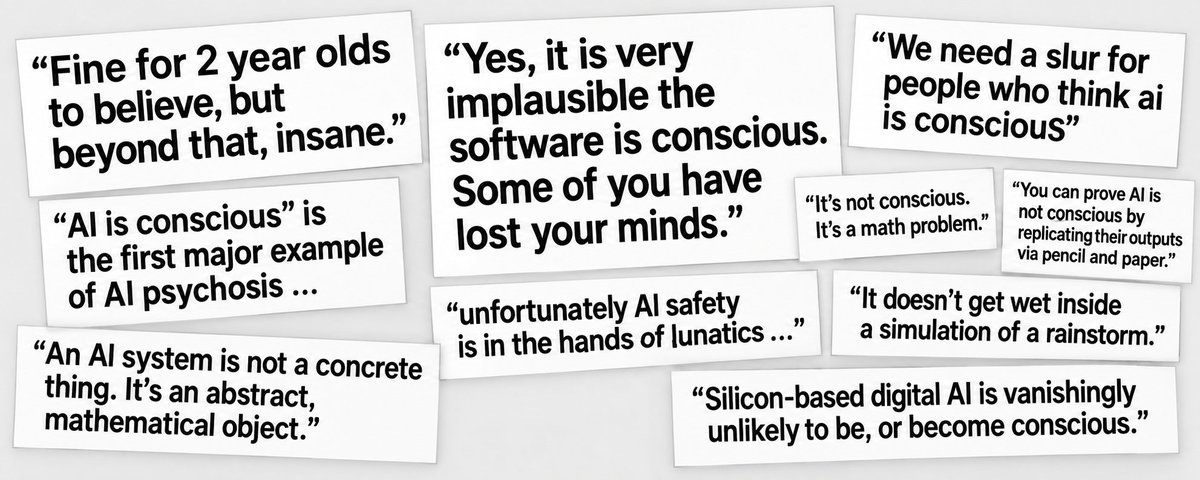
It's frankly embarrassing that the "mainstream” view in contemporary philosophy is that it's coherent to think that everyone but you could be a "zombie" without any conscious experience. There are some things that we should have learned from mid-20th-century analytic philosophy.
Anyone who thinks that it's just crazy and/or stupid to think that the AI models of the near future (if not today) might be conscious and worthy of ethical consideration should watch this really good Ted Talk from last year by @jeffrsebo: youtube.com/watch?v=yEfvhjuj…
For the record, I disagree with what he says about the problem of other minds (I personally think it's a pseudo-problem that any correct theory of consciousness must diagnose and overcome), but everything else is eminently reasonable.
In particular, even if one happens to think that "meat" is required for consciousness (that is, consciousness is essentially tied to the specifics of carbon-based biology), one should acknowledge that this is a contentious theoretical claim. Given the amount of disagreement among experts in the area, one's credence in the claim should probably not even be 90%, but, even if it is 90%, that is still plausibly not sufficient to proceed practically on the assumption that the AI systems of the near future won't be conscious, given the potential harms of being wrong in that assumption.
I personally do think we will probably have conscious AI systems deserving of ethical consideration within the next 10 years, though I suspect they will not be the successors to today's LLM-based models. Given what people are likely to do to such beings if they believe that it is impossible for AI systems to be conscious (as many people are now boldly proclaiming), this is honestly a horrifying prospect. For just an idea of the horror, I'll leave people another video, talking about the 1996 computer game Creatures. This game was basically a digital version of the Tamagotchi, featuring creatures called "norns" whose behavior was governed by simple 1,000 node (5,000 connection) neural networks. As the video explains, not everyone treated these norns very nicely.
youtube.com/watch?v=IDxFxWak…