





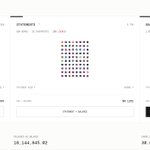

PERSONAL STORY: when your NFT starts remembering your mistakes
When I first came across Balances by @jackbutcher, I saw it as nothing more than a visual representation of the amount of $BALANCE in a wallet. But the more I look into how it works, the more interesting another aspect becomes.
The NFT records your behavior through metrics like Peak balance, Times emptied, and Returns from zero.
Imagine two wallets.
Wallet #1
Bought $BALANCE, gradually increased the position, and never emptied the wallet. Times emptied = 0. Just held.
Wallet #2
Bought, the market went down, and sold everything. Times emptied +1. Then came back. Returns from zero +1. And repeated the cycle several times.
Eventually, the NFT shows not just your balance, but the history of what you did with it.
This hits close to home for me after experiencing a drawdown of around 80%. In moments like that, you don't think about how it might look in an NFT someday. You're just trying to decide: sell or hold? Buy more or wait?
And if you end up selling everything, that decision doesn't just stay in your memory. It becomes part of your onchain history.
Balances doesn't know why you sold. But it knows that you did.
And that's what I like about @jackbutcher's idea.
Two wallets can have the same balance but completely different histories.
One: I held.
The other: I left. I came back. I left again.
Over time, that history becomes part of the artwork itself.
That's why I no longer see Balances as just an NFT that displays your balance. It's more like a visual onchain diary of what you did with that balance.


How @jackbutcher turned 729 bids on $BALANCE into a work of art.
And the most interesting part isn't how Bids looks.
It's that every detail of the image is built from real auction data. I dug a little into the collection's algorithm and here's what I found.
1. 729 bids = 729 elements
The CCA auction had 729 bids from 374 wallets.
369 wallets received a Bids.
Each bid was turned into its own printing plate on a shared 600×750 canvas.
Basically, Jack took the financial history of the auction and turned it into a CMYK composition.
2. Your bid literally drew your Bids
There's no random generative noise here. The algorithm uses real parameters from your bid:
→ X. How early you entered the auction
→ Y. How high your maximum price was
→ Size. How much ETH you committed
→ Rows inside the plate. How much of your budget was actually used
→ Color. Which quarter of the auction you entered
→ Spacing between elements your rank relative to the other participants
So two people could participate in the same auction and still receive completely different visual fingerprints.
3. The most interesting part is under the image
Bids is fully on-chain.
No IPFS or external server for the artwork itself.
The smart contract calls a separate renderer contract that generates the metadata and SVG on the fly.
And every NFT keeps the history of its specific bidder:
• first entry block
• number of bids
• committed ETH
• actual ETH spent
• $BALANCE allocation
• spending rank among 369 participants
• original bidder address
• SHA-256 hash of the SVG
Even if the NFT is later transferred to another owner, the original bidder's history doesn't disappear.
4. And one more detail
374 wallets participated in the auction, but only 369 received Bids.
The remaining 5 wallets weren't simply forgotten.
The contract permanently records:
"Five unallocated wallets remain part of the record."
So even the unallocated participants became part of the artwork.
And this is what I like about the concept.
Bids doesn't just tell the story of the auction.
It is the story of the auction.
729 bids → 729 printing plates → 369 unique works.
You didn't choose what your Bids would look like.
Your bid drew it.

My bids look perfect. Thx @jackbutcher


There's a lot of FUD around @jackbutcher and $BALANCE right now.
But let's put the chart aside for a moment and look at another side of this story.
Who actually made money in the BALANCE ecosystem, and how?
I dug into the onchain data and found some pretty interesting cases.
●Credits
$8 for a Credit through X Money, but each person could only mint one Credit in a single transaction.
After trading opened on OpenSea, regular Credits were selling for around $22.76-$58.61.
That's roughly 2.8x-7.3x the original mint cost.
But the real hunt was for rare Credits with high ratings.
Some sold for $100-$350 with a mint cost of just $8.
That means a single lucky mint could generate around $92-$342 in profit before fees, or 12.5x-43.75x the initial investment.
●Statements
This is where things got more interesting.
80 Credits could be combined into a single Statement.
Given the minting restrictions, calculating the cost of a Statement means looking at the secondary market.
Using $22.76-$58.61 per Credit as a reference, acquiring 80 Credits would cost approximately $1,821-$4,689.
One interesting case is Statement #241.
Sale price: 1.50 ETH / ~$3,675.63
Buying Credits at $22.76 each could have generated around $1,855 in profit
Buying them at $30 each could have generated around $1,276 in profit
Another Statement made from 80 Credits sold for approximately $8,500.
At the same reference prices of $22.76-$35 per Credit, the potential profit would have been around $5,700-$6,679 before fees and gas.
●Converting into $BALANCE
Then came $BALANCE.
Some Statement holders managed to convert their NFTs into tokens before open trading began.
This created a major gap between early participants and those who simply bought $BALANCE on the market after launch.
For example, one wallet accumulated around 532K $BALANCE.
Part of the position was sold for approximately $18K-$45K
Around $12K remained in tokens
The estimated initial minting cost was around $7K-$8K
Another wallet converted around 318K $BALANCE, sold part of the position for approximately $9K-$16K, and kept another $9K worth of tokens.
These figures illustrate the potential returns from early participation, although actual profits depended on the cost of acquiring the Statements and the prices at which the tokens were sold.
●So, what's the takeaway?
Some people made money minting Credits.
Others hunted for rare ratings.
Some collected Statements and sold them to collectors.
Others managed to convert them into $BALANCE before the market opened.
And some simply bought the token after launch and ended up on the other side of that liquidity.
That's why the current $BALANCE chart looks so rough.
But the claim that "nobody made money from this" simply doesn't match the onchain data.
People did make money. In some cases, a lot of it.
The real question is:
At which stage of the game were you?

$BALANCE went from a ~$30M auction valuation to around $3M FDV in less than 24 hours.
I am personally down about 80% on my position right now. And I still think this is one of the most interesting onchain experiments happening today.
The raw numbers:
• The Uniswap CCA auction cleared at 0.000227 ETH
• 268,750 $BALANCE sold across 729 bids
• 54.95 ETH raised in total
• Market opened around $0.35 and now trades near $0.058
The numbers look brutal, but the token itself is only one part of what @jackbutcher is building here.
Dynamic Balances NFTs Every $BALANCE holder receives a dynamic onchain NFT called Balances. It tracks your current token balance, balance ATH, Credits history, and other actions you take with the token. Your onchain activity becomes part of the artwork itself.
The 369 Auction Collection What is even more interesting to me is the 369 piece NFT collection tied to the auction. Every auction participant receives a unique piece generated from their bid. Your bid size is not just a number that vanished after the auction ended. It becomes part of the provenance of the artwork you own.
That is why the initial CCA feels like much more than a simple token sale. It creates a permanent record of who showed up, how they participated, and at what price they were willing to step in.
I am not saying $BALANCE cannot go lower. Being down 80% myself, I am definitely not pretending this was a perfect trade. I just look at it differently.
The main question for me right now is not just where the token price goes next, but whether this becomes a meaningful piece of onchain history. A token that tracks your behavior through a dynamic NFT, combined with a 369 piece collection rooted in auction bids, is a genuinely unique experiment.
That is why I am here.
Not because the chart looks good right now, but because I want to see what this turns into.


i turned @jackbutcher's $BALANCE lettering into a free font
every word prints its own colors. add a letter and the whole word reprints
creditunion.fun/font
$BALANCE went from a ~$30M auction valuation to around $3M FDV in less than 24 hours.
I am personally down about 80% on my position right now. And I still think this is one of the most interesting onchain experiments happening today.
The raw numbers:
• The Uniswap CCA auction cleared at 0.000227 ETH
• 268,750 $BALANCE sold across 729 bids
• 54.95 ETH raised in total
• Market opened around $0.35 and now trades near $0.058
The numbers look brutal, but the token itself is only one part of what @jackbutcher is building here.
Dynamic Balances NFTs Every $BALANCE holder receives a dynamic onchain NFT called Balances. It tracks your current token balance, balance ATH, Credits history, and other actions you take with the token. Your onchain activity becomes part of the artwork itself.
The 369 Auction Collection What is even more interesting to me is the 369 piece NFT collection tied to the auction. Every auction participant receives a unique piece generated from their bid. Your bid size is not just a number that vanished after the auction ended. It becomes part of the provenance of the artwork you own.
That is why the initial CCA feels like much more than a simple token sale. It creates a permanent record of who showed up, how they participated, and at what price they were willing to step in.
I am not saying $BALANCE cannot go lower. Being down 80% myself, I am definitely not pretending this was a perfect trade. I just look at it differently.
The main question for me right now is not just where the token price goes next, but whether this becomes a meaningful piece of onchain history. A token that tracks your behavior through a dynamic NFT, combined with a 369 piece collection rooted in auction bids, is a genuinely unique experiment.
That is why I am here.
Not because the chart looks good right now, but because I want to see what this turns into.
The results. A conceptual piece by @jackbutcher.
The $BALANCE auction on @Uniswap closed at 0.000227 ETH, up +2,170% (22.7x) from the starting price of 0.00001 ETH.
The entire 268,750 token tranche was sold out. 729 bids brought in 54.95 ETH (~$137K), while the fixed 53.75M supply puts the FDV at 12,201 ETH (~$30.4M).
But what happens after the auction is even more interesting.
Receiving the tokens triggers the creation of a dynamic generative ERC-721 NFT called Balances.
The NFT tracks your current balance, balance ATH, Credits burn history, and other holder behavior. For example, Times emptied and Returns from zero show how actively the holder has withdrawn their balance and returned to it.
Meanwhile, the supply keeps shrinking:
• 42,480 Credits have been burned and turned into 531 Statements.
• 344 Statements are locked, with another 32 removed through Overprints.
• Only 11.49% of Statements remain in circulation, with the floor currently at 1.9 ETH.
• 14,626,473 $BALANCE has already been distributed across 935 wallets.
• Secondary trading volume for Credits and Statements has reached 3,333 ETH (~$8.3M).
There are currently a few ways to get $BALANCE:
Buy it on the secondary market through Uniswap.
Go through the Credits → Statements → lock process via jack.art/exchange.
Use creditunion.fun/balance to pool Credits with other users for a joint mint.
And I don't think this is the final version of the mechanism.
Jack has already shown that he's interested in more than just launching another NFT collection. He's experimenting with how assets behave after launch.
Let's see what he adds next...

Having achieved $BALANCE

The results. A conceptual piece by @jackbutcher.
The $BALANCE auction on @Uniswap closed at 0.000227 ETH, up +2,170% (22.7x) from the starting price of 0.00001 ETH.
The entire 268,750 token tranche was sold out. 729 bids brought in 54.95 ETH (~$137K), while the fixed 53.75M supply puts the FDV at 12,201 ETH (~$30.4M).
But what happens after the auction is even more interesting.
Receiving the tokens triggers the creation of a dynamic generative ERC-721 NFT called Balances.
The NFT tracks your current balance, balance ATH, Credits burn history, and other holder behavior. For example, Times emptied and Returns from zero show how actively the holder has withdrawn their balance and returned to it.
Meanwhile, the supply keeps shrinking:
• 42,480 Credits have been burned and turned into 531 Statements.
• 344 Statements are locked, with another 32 removed through Overprints.
• Only 11.49% of Statements remain in circulation, with the floor currently at 1.9 ETH.
• 14,626,473 $BALANCE has already been distributed across 935 wallets.
• Secondary trading volume for Credits and Statements has reached 3,333 ETH (~$8.3M).
There are currently a few ways to get $BALANCE:
Buy it on the secondary market through Uniswap.
Go through the Credits → Statements → lock process via jack.art/exchange.
Use creditunion.fun/balance to pool Credits with other users for a joint mint.
And I don't think this is the final version of the mechanism.
Jack has already shown that he's interested in more than just launching another NFT collection. He's experimenting with how assets behave after launch.
Let's see what he adds next...

Remember the "up only or flat" auction mechanic I talked about yesterday? Here is what happens when @jackbutcher actually turns it on.
$BALANCE is up +1,993% (20.93x) from its starting floor on the @Uniswap CCA. The clearing price moved from 0.00001 ETH to 0.0002093 ETH across 640+ bids, with 56.25 ETH (~$146K) already committed for just 0.5% of the supply (268.75K tokens). That puts the implied FDV at ~11,250 ETH (~$28M) on a fixed 53.75M supply.
Meanwhile, the deflationary funnel underneath is moving just as fast. It is a strict one-way street: Credits (80x) -> Statement -> $BALANCE.
Out of 122,154 original Credits, 36,880 (30.2%) have already been burned to assemble 461 Statements. From those 461 Statements, 30 were burned via Overprints and 154 are now permanently locked to release 6,754,004 $BALANCE (12.57% of total supply) across 91 wallets.
That leaves only 277 unlocked Statements circulating on the open market, pushing the floor up +41.4% to 2.05 ETH (~$5K), while Credits sit at 0.021 ETH ($8.2M total volume).
Pure game theory in real time. Once a Credits moves down the funnel, it never comes back.
Dropped the CA, Uniswap CCA, and explorer links in the first reply.

An auction mechanic where the clearing price simply can't drop. Up only or flat.
@jackbutcher is launching $BALANCE (53,752,386 total supply), and it goes live in less than an hour. Only 268.75K tokens are allocated to the Uniswap CCA, which is 0.5% of the supply at a $1.3M starting FDV ($0.02395).
Here’s how it works: you set your budget and price cap, and orders fill block by block. As demand pushes in, the clearing price creeps up. The moment it breaks past your limit, your fills stop.
And regarding the claim, since a lot of people got confused: Credit NFTs don’t convert directly into $BALANCE. The only flow is: Credits (80x) -> Statement -> Token. 15 Statements have already been burned for 744,311 $BALANCE (1:1 to credit score).
Dropped the CA and link in the first reply.


On-chain links & contracts:
• Exchange Dashboard: jack.art/exchange/• Uniswap CCA Auction: app.uniswap.org/explore/auct…• $BALANCE Token CA: 0x3620540c994433D7B4a628C46d2ED5F92572eA07 (etherscan.io/address/0x36205…) • Statements Contract (431 supply / 277 unlocked): etherscan.io/address/0x75edd…• Credits Contract (85,274 left): etherscan.io/address/0x97630…

An auction mechanic where the clearing price simply can't drop. Up only or flat.
@jackbutcher is launching $BALANCE (53,752,386 total supply), and it goes live in less than an hour. Only 268.75K tokens are allocated to the Uniswap CCA, which is 0.5% of the supply at a $1.3M starting FDV ($0.02395).
Here’s how it works: you set your budget and price cap, and orders fill block by block. As demand pushes in, the clearing price creeps up. The moment it breaks past your limit, your fills stop.
And regarding the claim, since a lot of people got confused: Credit NFTs don’t convert directly into $BALANCE. The only flow is: Credits (80x) -> Statement -> Token. 15 Statements have already been burned for 744,311 $BALANCE (1:1 to credit score).
Dropped the CA and link in the first reply.
@jackbutcher proves again he is a genius and breaks the current meta. After the success of past collections we are entering the $BALANCE era. This is not just art but a pure experiment with an absolutely brilliant irreversible mechanic. Literally a one way street where pixels permanently turn into token liquidity.
Breaking down how elegantly this chain is built.
The first link is Credit. Pixel arts that were originally sold via X Money for 8 dollars. The primary window is closed and now you can only get them on the secondary. The second link is Statement. You burn 80 credits and get one large unique composition. The third link and the finale is BALANCE. You permanently lock your Statement and its weight is converted one to one into ERC20 tokens. There is no way back to pictures only pure liquidity.
The launch itself will happen on October 20 via the @Uniswap CCA auction. The main move from @jackbutcher that shows his level is that he takes exactly zero from this launch. The entire amount collected at the auction goes straight into the pool liquidity. Initially he has zero percent of the supply and he bought one percent on the open market in advance with his personal money just to play by the same rules as the community. This is just top tier.
Attached below is a visual concept of how this transition mechanic from pixels to token works. Make sure to check it out.
0x3620540c994433D7B4a628C46d2ED5F92572eA07
app.uniswap.org/explore/auct…

99% of crypto collections die within 1.5 weeks.
I have been observing @0xDith and the development of @gigaverse from the sidelines for almost 1.5 years. I simply kept track of what was happening, read the updates, and watched the project evolve.
Now @GigaLegendsLTD is launching, and for me, this is an opportunity to finally step into the ecosystem I have been watching for so long.
Gigaverse has already shown that they know how to build for the long term and maintain an active community.
That is why I no longer want to just watch from the sidelines, but finally become a part of it...


I am impressed by this project. @ufukless1 built @minehood_rh alone in a month, with Claude. No studio, no publisher. Just a man and a town.
Under the town there are six mines: earth, iron, cobalt, garnet, silver, diamond. Every level down asks for a stronger pickaxe and throws a meaner boss at you. Mud Mother sends worms through the walls, Rustfang Karok rusts your blade, and Xar sets the floor on fire while you swing.
The run is one decision. Dig to 50%, the lift opens, take the loot and leave. Dig to 75%, the boss door opens, and now everything you carry is on the line. The game doesn't ask twice.
Between runs everyone ends up in the same town. Smith, pickaxe rentals by the hour, a market with a real order book and a live chart. Not a shop screen with three buttons and a promise.
The waitlist takes three steps. Connect X, follow @minehood_rh, drop an ETH address. Your handle becomes your name on the list. Then tasks and XP, 50 for the follow, and a leaderboard that shows who is closer to the door.
4,444 miners. One guy behind all of it.
I'll be in the town, near the market. minehood.io


Good morning @freedznft
8888 unique FREEDZ
millions of words and billions of combinations that shape our identity, character, principles, and the behavior of machines.
And exactly 8888 FREEDZ asking the question: "Can the words that built the system also destroy it?"
There is no right answer.
@seizzi
@EpikNFT

I created @freedznft as a typographic PFP art project.
Every character is an illusion made entirely of letters and words.
Characters with no drawn lines, even though they're built from hundreds of illustrated traits.
A universe of 8,888 unique FREEDZ, each with an animated version.
Can the words that built the system also break it?
FREEDZ is all about questioning. 🟥
I’ve been a bit on edge for the last couple of days. My phone keeps ringing late at night, and the second I pick up, the line goes dead, immediately followed by this text:
"-.-. --- -- .. -. --. / ... --- --- -. --..-- / -... . / .-. . .- -.. -.-- / - --- / ... .... --- .-- / -.-- --- ..- .-. / .--. .- ... ..."
Not sure what it means, but I’m keeping mine at the ready.


