

Senior Investment Strategist @Bitwise | Not Financial Advice
Joined May 2019
- Tweets3.2K
- Following2.7K
- Followers7.2K
- Likes12.4K




Juan Leon retweeted

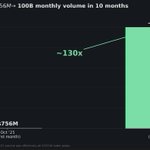
All asset classes are moving onchain. Tokenized stocks and stablecoins (which are really just tokenized fiat currency) are growing fast, with more to come.
We'll continue updating the financial system.

Summary of F5's earnings results:
- Revenue grew 13.3% YoY to $917.4 million, driven by a 23% increase in product revenue. That's nine straight quarters of double-digit product growth.
- Non-GAAP operating margin was 33.7% (-3.3% YoY), as sales/marketing (+27%) and R&D (+21%) outgrew revenue.
- FY 2027 guidance: revenue growth of 8% to 9%, non-GAAP EPS $18.00 to $18.30, a deceleration from FY26’s 11% growth.
- New $1.5B buyback authorization on top of $322M remaining, backed by $1.59B of cash.

Today, we announced our fourth-quarter FY2026 financial results, with 13% total revenue growth year over year and 23% product revenue growth year over year. 📈
See the full results: go.f5.net/e9cdjazr
#Earnings $FFIV
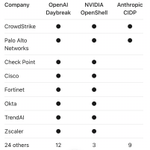
1/ 78% of CISOs have already had to pull permissions from an AI agent running in production. Only 18% check an agent’s identity before it acts.
A survey of 300 security chiefs out today shows how far agent identity security has fallen behind agent adoption, and who is building the fix. 🧵 below.


5/ 3 takeaways:
1. The labs sell through cyber security incumbents.
2. Platform breadth is the ticket into every room, and only two companies hold it.
3. The lists are new and open, so keep an eye on who gets added next (data, identity governance, resilience).
6/ Full lists:
OpenAI Daybreak Defense Network (20): Akamai, Cato Networks, Check Point, Cisco, Cloudflare, CrowdStrike, Darktrace, Elastic, Fortinet, IBM, Okta, Palo Alto Networks, Proofpoint, Red Hat, SentinelOne, Sophos, SpecterOps, Tenable, TrendAI (Trend Micro), Zscaler.
NVIDIA OpenShell Reference Architecture, security integrators (11): 1Password, Check Point, Cisco, CrowdStrike, F5, Fortinet, Microsoft, Okta, Palo Alto Networks, TrendAI, Zscaler.
Anthropic Critical Infrastructure Defense Program, founding partners (11): Accenture, Booz Allen Hamilton, CrowdStrike, Deloitte, Dragos, Hitachi, Insane Cyber, Nozomi Networks, Palo Alto Networks, PwC, Rockwell Automation.
Note: NVIDIA’s release also names other participants outside the security list, which are not counted: model builders (Anthropic, Cohere, Google, Meta, OpenAI, Perplexity, Reflection, SpaceX Super Intelligence), operating systems and clouds (Canonical, SUSE, Red Hat, Microsoft, AWS, Google Cloud), enterprise software (Cadence, Dassault Systèmes, IBM, SAP, Siemens, Synopsys, ServiceNow, Palantir), banks (BBVA, Santander), system builders and cloud providers.
Juan Leon retweeted

On Monday, @Bitwise filed our comment letter on the SEC’s proposed Regulation Crypto Assets. Our ask: a practical framework for a question Bitwise has wrestled with for nearly a decade. How do we determine whether a crypto asset is a security or is subject to an investment contract?
Bitwise evaluates crypto assets every day. We ask: What do they do? How were they created? Can we put them into our products? For years, answering that last question has required analysis with limited information and uncertain standards.
This letter draws on over five years of engaging with the SEC Staff on these issues. We’ve long wanted a framework a company can actually apply without commissioning a bespoke Howey analysis for every crypto asset.
Regulation Crypto gives us an opportunity to get there. The proposal focuses on issuers. Our letter proposes changes to make it work for companies like Bitwise that use crypto assets as the building blocks of investment products.
We make two principal requests:
1. A standard outsiders can apply to determine when a crypto asset is no longer subject to an investment contract, based on publicly available information. We can evaluate what an issuer promised, what it has done and what activities continue. We cannot verify its private intentions.
2. Clear rules for when non-issuers may rely on an issuer’s Form TR, how to make a determination when no Form TR exists, and what facts would make reliance unreasonable.
These questions shape what we can build for investors. This letter puts years of experience to work advocating for rules that give us greater certainty and room to build.
Read our letter: sec.gov/comments/S7-2026-27/…
Juan Leon retweeted

The beauty of DCA is that you don't need timing, just consistency.
At $50/week over the last 4 years (209 weeks), you end up with $18,087 worth of BTC vs. $15,278 of SPY.
What's crazier is that bitcoin:native is ~35% off from all-time highs.
