

Tracking the physical layer behind AI. Data centers • Power grids • GPUs • Chips • Capex Original data, charts & research.
Joined June 2014
- Tweets125
- Following633
- Followers398
- Likes879




Pinned Tweet
AI has a timing problem.
A data center can be built in ~2–3 years.
Average U.S. lead time for a large power transformer: ~2.6 years.
A new transmission line often takes 4–8 years.
The bottleneck isn't just generating more electricity.
It's getting hundreds of MW to the right place, at the right time.
Power infrastructure is becoming a first-order constraint on AI expansion in key U.S. data-center markets — alongside chips, not instead of them.

1
166
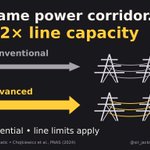
A power line can carry roughly twice as much electricity without a new transmission corridor.
Replace its conventional wires with advanced composite-core conductors: more aluminum fits inside the same diameter, and the wire tolerates higher temperatures with less sag.
That can expand power delivery along an existing route. Actual gains depend on the line’s other limits.

1
18
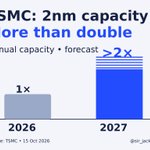
TSMC expects its annual 2nm manufacturing capacity to more than double in 2027.
The ramp is already underway at two Taiwan sites: Hsinchu and Kaohsiung.
Demand comes from both smartphones and high-performance computing, including AI. The same manufacturing expansion has to serve both markets.
This is TSMC’s capacity forecast, not a count of finished AI chips.

1
41
By August, Exelon had secured roughly $1 billion to protect customers from data-center project risk.
Its agreements require collateral [financial security for the developer’s grid-cost obligations].
If a developer walks away or uses less power than projected, the agreements are designed to protect existing customers from the resulting grid costs.
That changes the quality of a power request: the developer has something at risk if the promised demand does not arrive.
The $1 billion is aggregate protection, not electricity revenue.

1
26
TSMC now sends its own teams to check U.S. data-center construction and power supply.
On its October 15 earnings call, management described these checks alongside its internal demand assessment—and said the feedback so far was positive.
The link is physical: chip orders translate into working AI capacity only when the sites can house and power the systems.
A chipmaker’s capacity plan now reaches beyond the factory—to the readiness of the data centers that will use its chips.

1
26
Samsung reports up to 38% less waiting for AI’s first output by reallocating memory.
In its demo, a CXL memory pool [shared memory connected through a processor-to-memory interface] adjusts capacity across running copies of a model instead of giving each a fixed allocation.
The measured benefit is time to first token [the wait before the model starts answering].
This is Samsung’s demo result against static allocation—not a universal speedup.
How memory is assigned can matter alongside how much is installed.

19
Even the storage drives are getting liquid cooling.
Kioxia’s CM9-DLC SSDs [solid-state storage drives] support cold plates [metal plates that transfer heat into coolant]. They can also operate in air-cooled systems.
The system lesson: cooling the processors does not finish the server’s thermal design. Storage needs its own path for heat to leave.
The drives are sampling to selected customers. Sample specifications may change before mass production.

31
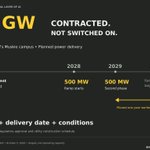
TeraWulf’s 1 GW power deal is a 2028–2029 delivery plan—not 1 GW switched on today.
At its Muskie AI campus:
• First 500 MW: ramp targeted to start in 2028.
• Second 500 MW: planned for 2029, brought forward from 2030.
The amendment remains subject to regulatory approval and the utility’s construction schedule.
The useful unit is not just megawatts. It is megawatts, delivery dates and conditions.

26
Intel’s “up to 480GB” AI GPU headline is 3× the memory on its own card.
The detail is in footnote 1:
Intel-branded D-series card: 160GB.
Partner-designed cards: options up to 480GB.
That is a configuration range—not the standard capacity of every card.
For memory-heavy AI inference [running trained models], model fit depends on the memory actually installed. A product-family maximum is not a deployment specification.

24
A 1.6 Tb/s AI cable built from many slower optical channels.
Credo’s planned active light cable splits each 200G electrical lane [a data path] across multiple lower-rate optical channels, avoiding complex signal processing.
Its design targets: up to 50 metres of reach at 12 watts per cable end. Shipping is planned for 2027.
The engineering shift: spread the work across more channels rather than push each optical channel faster.
Those are company targets, not field-proven results.

24
Four times the network bandwidth density—without a larger optical module.
That is NVIDIA and Cisco’s claim for their planned USFP design [a removable optical networking module].
The mechanism: twice as many lanes [parallel data paths], each carrying twice the data rate, in an OSFP-sized footprint [a standard module size].
More connectivity per switch can let an AI cluster grow before adding another network layer—with its extra links, power and delay.
Announced design, not a deployed result.

27
Better cooling could free enough power for 15 more AI racks—within the same data-center power budget.
Trane demonstrated an 800 V direct-current chiller [a water-cooling machine] that reduces power-conversion losses.
In its illustrative 200 MW data center, the potential saving frees up to 1.8 MW for computing: 15 racks at 120 kW each.
This is a lab proof of concept and a company scenario, not a deployed expansion.
Less power spent on cooling. More available for compute.

1
2
68
QuantumScape claims 5× the battery runtime for AI racks.
Its QS PowerBlock comparison is against the OCP Open Rack V3 specification [an open data-center hardware standard]. The results combine prototype tests and modeled systems—not operating data centers.
Why it matters: longer runtime gives operators more time to absorb power swings close to the computing hardware.
The commercial test is whether that advantage holds under real operating conditions.

148
An AI chip can overheat in space. There’s no air to carry its heat away.
Google’s Project Suncatcher is testing heat pipes [sealed tubes that transport heat] and radiators [surfaces that release heat as infrared light] for AI chips in orbit.
Moving heat off the chip is only half the job. The spacecraft still has to emit it into space.
Putting AI in orbit changes the cooling problem. It doesn’t remove it.

25
Put some of the math inside memory. Move less data.
SK hynix’s AiMX accelerator uses memory chips with built-in computing functions. Selected calculations happen where the data is stored, reducing transfers to a separate processor.
The benefit depends on the workload. It’s particularly relevant when moving data is what holds the system back.
AI hardware progress can mean reducing the journey, not just speeding up the processor.

30
Google has already advanced $399M for power equipment for its planned Wyoming data center.
The money funds equipment with long delivery times. Black Hills says energy service is planned to start in late 2027.
These are refundable advances, with repayment expected by June 30, 2027.
The infrastructure race starts before a server is switched on: someone has to finance the equipment that will power it.

29
Japan’s planned $15B+ AI project starts at a working gas power station.
JERA, Dell and RHAELM plan a Chiba data center supported by up to 400 MW, with operations targeted around 2028.
The proposed shortcut: put the computers where the power already exists.
The developers say on-site supply could deliver capacity years ahead of a conventional grid-connected project. That’s a target, not a result yet.

1
1
41
Amazon signed for 690 MW of nuclear power. Only ~190 MW would be new capacity.
The 20-year deal with Constellation supports an expansion of Maryland’s Calvert Cliffs plant, expected online in 2030–2032.
The agreement also helps sustain the existing plant.
When reading an AI power deal, separate electricity secured from generating capacity added.

17
The grid can take longer to build than the AI data center it powers: 4–8 years versus 2–3.
The IEA’s 2025 report highlights this timing mismatch; the 4–8 year transmission range applies to advanced economies.
If a site needs a new line, the grid—not the building—can set the deployment schedule.
For AI infrastructure, existing grid capacity is not just an energy asset. It is a time-to-deploy advantage.
Power lead time belongs in the site-selection decision.

14
Same memory capacity. Roughly 3× the silicon-wafer input.
That’s Micron’s 2024 estimate for HBM3E [high-bandwidth memory] versus DDR5 [standard memory], using the same manufacturing technology.
The constraint starts before the memory reaches an AI accelerator: producing each bit takes more wafer capacity.
Shifting production toward HBM can therefore squeeze conventional memory supply—even without an increase in total bits shipped.

18
Google is backing ~96 MW of added nuclear capacity—not by building a new reactor, but by upgrading ones already operating in Georgia.Under a proposed deal with Georgia Power, Google’s subscription would support upgrades at Vogtle and Hatch.More output from existing plants. More capacity for the shared grid.The agreement still needs state regulatory approval.For AI infrastructure, one nuclear path is uprating reactors we already have—not waiting for entirely new plants.

13