

Simplify Genomics, Inc. is a genomics technology company that has built an analytical and interpretation platform to empower genomics in healthcare.
United States
Joined October 2023
- Tweets32
- Following53
- Followers171
- Likes4
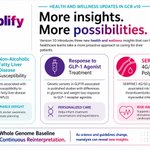







💊 What role can genetics play in GLP-1 medication response?
Version 10 of the Simplify Genomics Genomic Clinical Report adds three new health and wellness insights, including genetic information related to response to GLP-1 receptor agonist treatment. For more information see: buff.ly/9fDMWiO

31
🧠 Alzheimer's genetic risk is more than APOE.
With version 10 of the Simplify Genomics Genomic Clinical Report, we've introduced a dedicated Alzheimer's Disease Risk assessment that brings together complementary views of genetic risk: APOE status, Polygenic risk, and rare variants. For more information, see buff.ly/rgKwrKd

1
32
🧬 One genome. 💊 224 medications.
Pharmacogenomics is one of the clearest examples of why the value of a genome can grow over time. Version 10 of the Simplify Genomics Genomic Clinical Report expands our pharmacogenomic assessment to include 27 genes and 224 medications, up from 19 and 135, respectively. For more details see: buff.ly/j91AFAj

16
🧬 Your genome doesn’t change. What we can learn from it does.
Today, we're introducing Version 10 of the Simplify Genomics Genomic Clinical Report, expanding the clinical and health insights available from whole-genome sequencing. See more at buff.ly/gcdHUlx

81
Today is Genetic Testing Action Day, a day that also celebrates the legacy of Rosalind Franklin, whose work was fundamental to the discovery of DNA's structure. We believe the greatest value of genetic testing comes from evidence-based clinical interpretation that helps physicians and patients make informed decisions, today and as genomic knowledge continues to grow.
Read more at startgenetic.org and simplifygenomics.com/.
#StartGenetic #RosalindFranklin #GeneticTesting #PrecisionMedicine

2
50
Your genome is sequenced once; its value depends on what happens next.
The genomics industry is at a crossroads. Some organizations compete on promotions. Others invest in clinical interpretation, regulatory workflows, evidence, and long-term infrastructure. We know which future we'd rather build.

28
One of the questions we hear most often is: What makes a genetic finding "actionable"?
It's not just about whether a treatment exists.
Actionability can mean selecting a safer medication, starting screening earlier, monitoring for inherited conditions, or helping guide future medical decisions.
In our latest article, we explore why actionability is better understood as a spectrum of clinical decisions rather than a simple yes/no label.
Read more: buff.ly/cVOZqMt
#Genomics #PrecisionMedicine #ClinicalGenomics
58
We're excited to announce our collaboration with SimonMed Imaging to combine whole-genome sequencing with whole-body MRI to advance preventive healthcare.
Read more: buff.ly/R8VxBrU
#Genomics #PrecisionMedicine #WholeBodyMRI

51
Proprietary, AI-driven, or "best-in-class" labels don't make a polygenic risk score better. Genetic risk models should be judged by evidence, not marketing. If a company doesn't disclose its PRS performance, ask why — either they haven't measured it rigorously, or the results aren't strong enough to share. Neither inspires confidence. Transparency about model evaluation and real-world performance should be the baseline. We published a detailed look at how we evaluate polygenic risk models and why it matters: buff.ly/Ft9Vl75
“Clinical-grade” sequencing isn’t automatically the gold standard.
Our CTO Wayne Delport explains why sequencing quality alone doesn’t guarantee meaningful genomic insights — and what consumers should actually look for in genetic testing.
A must-read for anyone following precision medicine and consumer genomics. 🧬
medium.com/@wdelport2/clinic…

19
When “Factor V” testing doesn’t actually include Factor V Leiden, the issue may not be accuracy — it may be scope.
Our CTO explores why clearer genomics reporting matters for both clinicians and patients in precision medicine.
bit.ly/4dkWFaJ
#Genomics #PrecisionMedicine #ClinicalGenomics

1
60
This past week, we surpassed an internal milestone in the number of clinically relevant findings reported, helping patients and physicians better understand hereditary disease risk. Every reported variant undergoes expert clinical review by genomic interpretation scientists, licensed clinical laboratory personnel, and a licensed clinical laboratory director before sign-out. These are not research-only findings with limitations — they are high-quality, clinically actionable results. This milestone means thousands now have clearer answers about inherited risks and can make more informed medical decisions.

When a genetic report says you have an 89% absolute risk of Type 2 Diabetes, it feels like a verdict. Our CTO Wayne Delport received that result and — as someone who works with genetic risk models every day — dug into where it came from. The genetics weren't the core issue; converting a polygenic risk score into an absolute probability is hard, and estimates become fragile at the extreme tail. In a two-part Medium series, Wayne explains why an 89% figure clashes with population data, where absolute risk models hold up and where they break down, and how to interpret high genetic risk more honestly and actionably. At Simplify Genomics, we want genetic risk to empower, not alarm — so we’re upfront about what these models can and can’t tell. 🔗 Read the series: buff.ly/RlkklCO buff.ly/Ln1QZMy #Genomics #PrecisionMedicine #PolygenicRiskScore #GeneticTesting #HealthTech


Polygenic risk scores estimate relative risk for common diseases—not definitive predictions. Interpret them with a healthcare provider, taking heritability, baseline prevalence, and personal context into account. These models omit many environmental and lifestyle factors that affect outcomes. Thus, scores aren’t absolute but one part of a broader clinical picture. #PolygenicRisk #Genomics #PrecisionMedicine #ClinicalGenomics nymag.com/intelligencer/arti…

The MTHFR gene keeps appearing in genetic reports — but not all variants are equal. At Simplify Genomics, we include MTHFR in our hereditary disease reporting, but only report pathogenic or likely pathogenic rare variants tied to true MTHFR disorders. We intentionally exclude the two common polymorphisms: c.677C>T (rs180113) and c.1409A>C (rs1801131). Why? The evidence doesn’t support meaningful clinical impact. These variants are very common — most people in the U.S. carry at least one c.677C>T — and most have normal homocysteine levels. Large studies and guidelines show they don’t independently predict disease. If there’s a clinical concern, measure serum homocysteine levels rather than testing these variants. Precision in genomics is about what we should report, not everything we can. #Genomics #PrecisionMedicine #ClinicalGenomics #MTHFR
Given the global toll of high cholesterol and ASCVD, targets beyond LDLR/PCSK9 are crucial. ANGPTL3 inhibits lipoprotein and endothelial lipases; loss‑of‑function cuts LDL/TG and lifetime ASCVD risk. Nissen et al. (buff.ly/GVTpYZD) report a phase‑1 CRISPR–Cas9 ANGPTL3 edit (~50% LDL, ~55% TG). #GeneTherapy

Genomics is at an inflection point—but not all progress is responsible.
Patients should have access to their data for their own exploration, but DTC clinical reporting without proper oversight is risky.
Sequencing in a CAP/CLIA lab and interpreting outside it isn’t compliant—and it puts patients at risk.
“Research Use Only” doesn’t fix that.
We can do better.
Simplify Genomics retweeted
Approximately 25% of US adults take statins for lipid management. We find that ~30% of patients surveyed have non-normal function for SLCO1B1, which can predispose patients to an increased risk of myopathy. Knowing your patient’s SLCO1B1 function can help you manage side effects.

The 2025 @TheACMG secondary findings add ABCD1, CYP27A1, and PLN for X-linked adrenoleukodystrophy, autosomal recessive cerebrotendinous xanthomatosis, and cardiomyopathy, respectively. These are all part of Simplify Genomics reporting scope.
1
61
A recent discovery (nature.com/articles/s41593-0…) highlights the importance of studying rare APOE variants in Alzheimer’s disease. Watch how we use our Smart Genome platform to query for the presence of this rare protective variant, c.460C>A (p.Arg154Ser). youtu.be/9GBsFUr9l3E