

SMC Global Securities Ltd | SEBI Reg. No. INZ000199438 | Invest. Trade. Build Wealth. Disclaimer: https://teapawt.net/t.co/buTmVIxw9P
New Delhi, India
Joined May 2009
- Tweets22.2K
- Following3
- Followers21.8K
- Likes530
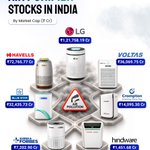





Air Purifiers Are Getting Attention. What About Their Stocks? 📈🌫️
From LG and Havells to Eureka Forbes and Hindware, several listed brands participate in India's air purification market.
- LG: ₹1,21,758.19 Cr
- Havells: ₹72,765.77 Cr
- Voltas: ₹36,069.75 Cr
- Blue Star: ₹32,435.73 Cr
- Crompton: ₹14,095.30 Cr
- Eureka Forbes: ₹7,202.90 Cr
- Hindware: ₹1,451.68 Cr
Which of these companies would you add to your watchlist?
#SMCGlobal #AirPurifierStocks #StockMarketIndia #MarketCap #Investing

317
📈 NVIDIA’s Growth Story Is Written in Billions!
Seven consecutive quarters of rising revenue highlight NVIDIA’s remarkable expansion.
* Jan 2025: $39.33B
* Apr 2025: $44.06B
* Jul 2025: $46.74B
* Oct 2025: $57.01B
* Jan 2026: $68.13B
* Apr 2026: $81.62B
* Jul 2026: $96.22B
With quarterly revenue up nearly 145% across this period, what’s next for NVIDIA?
#SMCGlobal #NVIDIA #QuarterlyResults #GlobalMarkets

1
306
🪔 Happy Diwali!
Wishing you good health, happiness & prosperity. May this new year light up your home and your wealth journey too. ✨
#HappyDiwali #Diwali2026 #SMC #MoneywiseBeWise

1
3
333
🪔 Your Diwali Week Market Guide is Here!
Don’t get confused this festive week - save this calendar:
06 Nov - Dhanteras: Market OPEN
07 Nov - Choti Diwali: Market CLOSED
08 Nov - Diwali: MUHURAT TRADING ✨
09 Nov - Post Diwali: Market OPEN
10 Nov - Balipratipada: Market CLOSED
11 Nov - Bhai Dooj: Market OPEN
Plan your trades in advance and make this Muhurat truly auspicious.
Save this post & share it with your trading friends!
Happy Diwali from SMC! 🪔
#SMC #Diwali2026 #MuhuratTrading #StockMarket #Diwali

SMC Group was pleased to be part of Traders Forum, Chicago, held on 4 November 2026.
Representing SMC Group were Dr DK Aggarwal, Chairman & Managing Director, SMC Investments and Advisors, and Ajay Garg, Director & CEO, SMC Global.
An excellent opportunity to connect with global financial market leaders and exchange industry perspectives.
Sharing a few glimpses from the event.
#SMCGroup #TradersForum #Chicago #GlobalFinancialMarkets


1
340
🆓📈 Join Us for a Free Webinar to “Master Options Trading using Support & Resistance” 📊
🕔 Date & Time: 15th Nov 2026, 5:00 PM onwards
📲 Register Now: tinyurl.com/ymrrpfbe
🎤 Speaker:
- Nitin Murarka, Head Research (Derivatives), SMC Global
@NitinNifty

278
Reliance Industries is much more than just an oil and gas company 📊
While Oil to Chemicals contributes 57.4% of gross segment revenue, Retail accounts for 22.8%, Digital Services 12%, Others 6.3% and Oil & Gas 1.5%.
The interesting part is how Reliance has built a diversified business spanning energy, retail, telecom, digital services and new-age opportunities, with O2C continuing to be its largest revenue contributor.
#RelianceIndustries #IndianStockMarket #BusinessAnalysis #Investing #EquityResearch
🤖 Made with AI

Are you holding any Hospital Stock? Let us know what you think of this!
Follow @smcglobal & hit the bell icon
32
So the real risk for hospital stocks is not that regulation exists today
It is that a highly profitable part of the hospital model is now under direct regulatory scrutiny
If the Court pushes for broader margin caps, the market may have to rethink how much of hospital profitability comes from healthcare delivery
And how much comes from pharmacy economics
1
28
But do not jump to the conclusion that a margin cap has already been imposed
It has NOT
The Supreme Court has reserved its verdict
The current case is examining stricter controls on non-scheduled medicines, mandatory generic prescriptions and possible statutory caps on medicines, devices and consumables
The final order will determine how serious the earnings impact could be
1
7
Now comes the part investors should care about
Pharmacy revenue can contribute a meaningful share of private hospital economics, often around 20–25% of revenueaccording to analyst estimates
If broad trade-margin caps are introduced, hospital earnings could come under pressure
And that is why hospital stocks have reacted negatively to the Court’s comments
1
9
The Court has not been convinced by that argument
The bench has essentially said that hospitals can recover infrastructure costs through other services
But charging extreme mark-ups on medicines simply because the patient has no alternative is difficult to justify
That distinction is important
1
5
Private hospitals have pushed back
Their argument is that pharmacy margins help fund the 24x7 infrastructure hospitals need
OTs, cath labs, MRI machines, medical staff, maintenance, upgrades and emergency capacity all cost money
Their case is simple:
Cut medicine margins, and hospitals may raise charges elsewhere
1
6
The government has already moved on selected anti-cancer drugs
Trade margins on some non-scheduled anti-cancer medicines have been capped at 30% of MRP
The Court’s obvious question:
Why stop there?
Why not extend tighter controls to a broader set of medicines, devices and consumables?
1
10
The government itself has acknowledged the problem
According to filings before the Court, mark-ups on some anti-cancer drugs can range from 170% to 700%+
For certain consumables, mark-ups can reach 100% to 1,000%+
This is not a small pricing anomaly
It is potentially a major profit pool
1
12
This is where the Supreme Court’s question becomes uncomfortable for hospital investors
If scheduled essential drugs can operate with regulated retailer margins, why should hospitals be able to earn several hundred percent mark-ups on other medicines and consumables?
That is exactly what the bench has been asking
1
8
Why can hospitals charge so much?
Because many hospitals insist that patients buy medicines and consumables only from their own pharmacies
Patients are often in no position to negotiate
And when treatment is urgent, pricing power shifts almost entirely to the hospital
1
9
And this is not an isolated case
The Court was shown examples like:
A drug with PTR around ₹3,000 carrying an MRP of nearly ₹27,000
A saline drip line procured for around ₹15 being billed at ₹250
The issue is not just medicine prices
It is the entire hospital pharmacy economics
1
7
The most shocking example discussed in court:
A chemotherapy injection available to a dealer for around ₹11,000 was billed to his wife for roughly ₹1.3 lakh by a private hospital
The hospital also refused to administer the medicine if the family sourced it independently
That is the kind of pricing behaviour under scrutiny
1
1
34