


Henry Smith retweeted

1/5 Cryo-EM gives high-resolution RNA structures, but only when high Mg²⁺ freezes out their motion.
At physiological conditions, RNAs are dynamic and 3D reconstruction fails. Can we still learn their folding equilibria?
New preprint: yes, straight from the raw particle images👇
Henry Smith retweeted

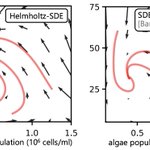
I'm excited to share this new work led by @smithhenryd! We develop Helmholtz-SDE, a faster and more accurate simulation-free inference algorithm for latent SDEs. The animation below speaks for itself!

Coming to @NeurIPSConf 2026: Can you learn dynamics from noisy observations 𝘄𝗶𝘁𝗵𝗼𝘂𝘁 𝗻𝘂𝗺𝗲𝗿𝗶𝗰𝗮𝗹 𝘀𝗶𝗺𝘂𝗹𝗮𝘁𝗶𝗼𝗻? Yes, and just as accurately as you can with simulation!
Paper: arxiv.org/abs/2606.16138
Code: github.com/lindermanlab/helm…
Thread🧵
Henry Smith retweeted

Same marginals. Different dynamics.
Gaussian Flow Dynamics + Gauge Matching learn temporal structure beyond one-time marginals, enabling more flexible, simulation-free neural SDE learning in continuous physical time.
arxiv.org/abs/2610.04390
#PhysicalTime #SDE #ML #GenAI

Henry Smith retweeted
Make sure to also check out the excellent paper from @smithhenryd @brianltrippe and @scott_linderman on Helmholtz-SDE that studies analytic approximations to the optimal gauge.
arxiv.org/abs/2606.16138

Henry Smith retweeted

Softmax attention is expressive, but its KV cache grows with sequence length. Linear attention keeps a fixed state size, but is less expressive.
In our #COLM2026 paper, Switching Linear Attention (SwiLA) gets the best of both worlds by switching among multiple linear maps 🧵

Henry Smith retweeted

How do we make quasi-Newton optimization methods practical for modern deep learning?
New preprint with @jooko303 @tanyaisanumber @gowerrobert on SoftServe -- a quasi-Newton method that designed for non-convex objectives, while also scaling to very large neural networks.

ALT SoftServe: a scalable quasi-Newton method for deep learning
Henry Smith retweeted

Joining the NeurIPS celebration: our curse of ambiguity paper will be a spotlight 🎉
We show that high entropy tokens need
1. More capacity to store
2. Larger embeddings to be represented
3. More training steps
4. More samples to reduce sampling noise
Scaling laws study performance averaged over all tokens in the data; our work zooms in and sheds some light onto which tokens are harder to learn 🔬


We often ask how hard a task is for an LLM to learn, but what about individual tokens?
Our new paper w/ @scott_linderman @hyundongleee digs into that question and reveals a curse of ambiguity: contexts with multiple possible next tokens are harder for LLMs to learn.


Henry Smith retweeted

New @open_rss blog (rs-station.github.io/2026/08…) on a question we’ve been thinking about a lot: what information about a molecular ensemble survives measurement and processing? @PilarCossio2 @EmilThomasen
A fuzzy cryo-EM map is not itself an ensemble. But an averaged measurement is not limited to an average structure either.
We use ensemble resolution to frame the better question: what differences between molecular distributions can the data actually distinguish?

Henry Smith retweeted
We often ask how hard a task is for an LLM to learn, but what about individual tokens?
Our new paper w/ @scott_linderman @hyundongleee digs into that question and reveals a curse of ambiguity: contexts with multiple possible next tokens are harder for LLMs to learn.
Henry Smith retweeted

Introducing Flux Matching, a generative modeling paradigm that generalizes diffusion models to vector fields that need not be the score function.
Enables structural priors in the dynamics, faster sampling, interpretable generation, and more!
w/ @StefanoErmon @Xiaojie_Qiu 🧵⤵️
Henry Smith retweeted

Parallelizing nonlinear RNNs is gaining traction!
More efficient than transformers; more expressive than linear RNNs.
My PhD thesis provides an intro guide to the math (Newton's method) behind the parallelization.
Great as a quick-start if you want to explore this new field!

Henry Smith retweeted

Excited to share our new work on cross-brain transfer of speech and handwriting BCIs! Some studies have required 10+ days of training data for peak BCI performance. Can pooling neural data from other users speed things up? 1/6
biorxiv.org/content/10.64898…

Henry Smith retweeted
My lab is presenting several papers at NeurIPS this week. Swing by the posters below to learn about our work!
🧵
Henry Smith retweeted

I'm very excited to share our work on SING, a new method for inferring latent dynamical systems from noisy time series data! I had a great time working on this project with @smithhenryd and @scott_linderman.
We'll be at @NeurIPSConf this week, swing by our poster to learn more!

New at @NeurIPSConf 2025: We are excited to share SING, our algorithm for unsupervised discovery of low-dimensional latent dynamical systems from high-dimensional, noisy observations. 🎶
Thread🧵

Henry Smith retweeted

OpenFold3-preview (OF3p) is out: a sneak peek of our AF3-based structure prediction model. Our aim for OF3 is full AF3-parity for every modality. We now believe we have a clear path towards this goal and are releasing OF3p to enable building in the OF3 ecosystem. More👇

Henry Smith retweeted
📣Announcing 2 @NeurIPSConf papers!
"Parallelizing MCMC Across the Sequence Length": uses Newton iterations to parallelize MCMC! 🤯
But can we parallelize any nonlinear state space model?
"Predictability Enables Parallelizability": proves what systems we can parallelize. 🧵
Henry Smith retweeted

🚨New paper! Generative models are often “miscalibrated”. We calibrate diffusion models, LLMs, and more to meet desired distributional properties.
E.g. we finetune protein models to better match the diversity of natural proteins.
arxiv.org/abs/2510.10020
github.com/smithhenryd/cgm