
Researching Artificial General Intelligence Safety, via thinking about neuroscience and algorithms. @AsteraInstitute. For substack etc see https://xitter.cf/t.co/p5G9VoQEdX
Boston, USA
Joined October 2013
- Tweets1.8K
- Following106
- Followers4K
- Likes2.5K



Pinned Tweet
New version of “Intro to Brain-Like-AGI Safety” is out!
Same links as before:
• Blog version: alignmentforum.org/s/HzcM2dk…
• PDF version (v3): osf.io/preprints/osf/fe36n
• Summary video: youtu.be/IXi96sRMKUI
• Summary tweet-thread: xitter.cf/steve47285/status/1903…
More in thread… 🧵


“Cellular scaling laws in the mammalian brain” by Fei Chen & Evan Macosko is out in Cell! It dovetails with many of the neuro ideas I’m always pushing, but in the context of transcriptomics and psych. Thanks Fei & Evan for lots of great conversations while they were working on this! @insitubiology cell.com/cell/fulltext/S0092…

I’m delighted that @IneffableLabs claims in FT to be open to outside criticism. OK here’s some: You’re planning to make “a society of superintelligent agents” in ≲3yrs. How will you design & train them such that they wind up kind to humans, rather than ruthless sociopaths who don’t care whether humans (including their programmers and users) live or die? Your only published discussion of this technical problem seems to be a brief discussion squeezed into a coauthored book chapter mostly on a different topic. And the vague ideas proposed in that brief discussion are fundamentally flawed, for reasons I explain in detail here: alignmentforum.org/posts/TCG…
Do you have a fix for those problems? If you’ve thought about it at all, you have not published any plan for outside scrutiny.
And now there’s one additional idea revealed in the FT article: you will keep the society of superintelligent AIs in a sandbox until you’re sure that they will be kind to humans. OK cool, but:
How will you figure out whether or not they’ll be kind to humans BEFORE releasing them? If you’ve thought about it all, you have not published any plan for outside scrutiny.
How will you ensure that they don’t break out of the sandbox? If you’ve thought about it all, you have not published any plan for outside scrutiny.
What will you do if (as I fully expect) you find that these AIs are in fact ruthless sociopaths, but you have no idea how to solve that problem, even after months or years of further effort? If you’ve thought about it at all, you have not published any plan for outside scrutiny.
If (for the sake of argument) you figure out how to make them nice to humans, or obedient, but people around the world recognize that they can make more money, win wars, etc. by making them progressively more autonomous and more ruthless, in a race to the bottom? Cf. “Gradual Disempowerment”. If you’ve thought about it at all, you have not published any plan for outside scrutiny.
See also my more general and recent discussion of this whole broad line of research: alignmentforum.org/posts/KHy…

(here’s the FT article I was responding to) xitter.cf/madhumita29/status/210…

In a world of noisy signals, David Silver has a clear mission that he’s followed his entire career: teaching machines to discover things for themselves. A breath of fresh air to have a nuanced, complicated and honest conversation about where AI is going - as.ft.com/r/dc5cb0c8-a8e3-40…

See also: xitter.cf/steve47285/status/2110…
Your answers to the questions on alignment & safety are deeply problematic.
Analogy: Let’s say some startup was going to create a novel virus that could be an unprecedented super-pandemic if designed wrong, or an unprecedented cancer cure if designed exactly correctly. That way (they say) we can better understand it in a safe lab setting, and only release it once we’re confident its effects will be good not deadly.
Normal people, hearing this plan, would have a WHOLE LOT of questions. Like: What if the virus gets released accidentally? What BSL level are you working under? You know that even BSL-4 has had lab leaks right? You recognize that working at BSL-4 is a GIANT pain that might slow progress by >10× and raise costs by >10×, right? Your employees and investors are all enthusiastically on board with that? What if the virus doesn’t escape, but hackers steal your IP so they can try themselves, with less caution? Or an employee leaks the IP? Or an employee simply has a difference of opinion with their coworkers about how safe it is to release the virus, and departs to raise their own money and do their own thing in California, carrying all the IP in their head? What if the investors get impatient and ask for proof of progress, and then an intern at the VC company leaks the IP? Or merely leaks a rumor of your progress, which encourages other (probably less careful) groups to race down the same path? How will you know whether you have a super-plague or a cancer cure in your BSL-4 box? What if you get to a stage where you aren’t sure whether it’s a super-plague or a cancer cure? Or where you have a super-plague that you don’t know how to turn into a cancer cure? What if you’re stuck in that limbo for months? For years? For decades? And your investors are threatening to pull the plug? And your employees are threatening to quit? And competitors are catching up? Are you really sure that you won’t engage in wishful thinking and dangerous experiments in order to move forward under intense pressure? If investors do pull the plug, or employees quit, will you shred all the IP, or will the IP find its way to other (probably less careful) groups who will then race down the same path? Why can’t you just figure out how to get to a cancer cure in such a way that you will definitely not ever be creating super-pandemic viruses in the process, even if those viruses are supposedly contained in a BSL-4 box? What are the unanswered questions that make such a safer path impossible? Please list those questions, and for each question, explain why there’s no possible way to make progress on that question without actually creating a super-pandemic virus, even a supposedly contained one. And conversely, also explain why, if you DO follow this extremely risky research path, why it will definitely answer that question, as opposed to subjecting us all to grave risk for minimal benefit.
If you don’t have excellent answers to all those questions and more, answers that have survived rigorous outside scrutiny, answers that every last one of your investors and employees are 100% enthusiastic about, then governments should not be allowing you to do this project, and you yourself should not WANT to do this project.
…That was an analogy, but I claim that all those concerns above transfer 1:1 to your “science of superintelligence” plan. Just replace the words “BSL-4” with “RAND SL-5 / airgapped sandbox”, and “super-pandemic virus” with “misaligned superintelligent AI”, and “cancer-curing virus” with “friendly superintelligence”.
More here: xitter.cf/steve47285/status/2109…
When people in AI alignment discuss “VNM rationality”, “utility maximizers”, etc., they’re generally talking about agents that care exclusively about the state of the world in the distant future. And then there’s a separate discourse about whether we should expect future powerful AIs to care exclusively about the state of the world in the distant future.
No it’s not tautological, and indeed it’s so foreign from the typical human experience that I admit people can come across as a bit deranged for even bringing that up as a possibility, as I discuss here: alignmentforum.org/posts/d4H…
However, you can’t figure out what to expect from future powerful AIs except by actually talking about future powerful AIs and how they will be made. You can't just thoughtlessly generalize from current AIs, let alone from humans.
So, one common pessimistic argument involves a competitive race-to-the-bottom: AIs that care more about the state of the world in the future, to the ruthless exclusion of everything else, will over time outcompete AIs that don't. They’ll gather more resources, make more money, win the wars, etc. Anyone who prefers nicer AIs over more ruthless ones will find that they don't have a choice, because the next guy down the street cranked their ruthlessness dial just a bit higher.
But I'm pessimistic mainly for different (not mutually exclusive) reasons, related to AI algorithms, as discussed at:
• alignmentforum.org/posts/ZJZ…
• alignmentforum.org/posts/KHy…


Blog post: “Pretraining data, not verifiability, is why LLMs are especially good at math (and coding)” lesswrong.com/posts/xvdngZAq…

Blog post: “Tales of rebellion against externally-opaque meritocracies” lesswrong.com/posts/m8cP9Kfk…

I strongly agree with Cal-Newport-talking-about-mundane-LLM-risks, that LLMs are not synonymous with AI. AI is a whole field, including yet-to-be-invented paradigms wildly different from LLMs.
…He should go tell this important news to his friend Cal-Newport-talking-about-ASI.


I’m planning to write about alexithymia, please share if you know of resources on that topic that you especially like. (Or resources that you dislike but find thought-provoking anyway :) )


Blog post: “RL & search is a terrifying way to build AGI (an FAQ)” [link in reply]
In which I answer all your burning Q’s:
Q1: What are you saying?
Q2: So you’re saying, don’t build AGI based on RL and/or search & planning?
Q3: Why do you think it’s terrifying?
Q3b: So your concern is the “literal genie” / “monkey’s paw” thing?
Q4: Won’t this problem go away when the AI is smart enough to understand what we INTENDED when we wrote the reward function code?
Q5: Can’t we just fix bad behavior when we see it?
Q5b: Follow-up: I don’t buy that, because even if superintelligent AIs could deceptively hide their bad behavior, won’t earlier AIs be sufficiently incompetent that we’ll see their bad behavior? And if so, again, can’t we just fix the bad behavior when we see it? We do know how to fix bad behavior we see it: the RL & search literature is full of examples where algorithms did useful things as intended.
Q6: Why don’t we just solve the problem by using an obvious, common-sense reward / cost / objective function, like [FILL IN THE BLANK]?
Q7: Isn’t this whole thing kinda crazy? After all, LLMs are not ruthless sociopaths all the time, and humans are also not ruthless sociopaths all the time. So where is this idea even coming from? Are you sure you’re not just watching too much sci-fi?
Q8: Isn’t this problem solved by laws and markets? I.e., if an AGI has sociopathic desires and callous indifference to human welfare, that’s fine! It will still act nice and cooperative and rule-following, because acting nice and cooperative and rule-following is the best way to accomplish goals, in our complex interconnected interdependent world. Right?
Q8b: Following up on that: Even if you’re right that there’s a local incentive for being open to stabbing your allies in the back, isn’t there a higher-level, group-selection-style, incentive to be genuinely deeply nice? Specifically, won’t the groups of nice cooperative AGIs outcompete the groups of callous transactional AGIs who all keep stabbing each other in the back? And isn’t that related to how humans evolved to be nice?
Q9: Why would we want to infringe on the AGI’s autonomy by choosing its reward function?
Q10: Why not just be nice to the AGIs, and then they’ll be nice to us in turn?
Q11: RL & search algorithms don’t literally OPTIMIZE the reward / cost / objective function. Doesn’t that invalidate your argument?

I forgot to add: The FAQ items are based on takes I’ve heard from @dwarkesh_sp, @RichardSSutton, @MatthewJBar, @dileeplearning, @Turn_Trout, and others. Thanks for engaging, and I hope I stated your objections fairly! alignmentforum.org/posts/KHy…

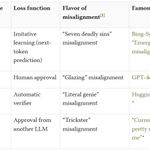
Blog post: “Four LLM loss functions → four flavors of LLM misalignment” alignmentforum.org/posts/GRm…


It’s funny cause these are all based on a 1967 experiment that had already failed to replicate in 1969. (& failed again in 2003.)
It’s also funny cause it’s a test that a group can do in 2 minutes at a party, but I guess none of these writers actually tried before publishing??


Blog post: “LLMs are (still) mostly powered by imitative learning, not RL”
~~
RLVR is the hot new thing in LLM training. It’s so hot, and people spend so much time talking about it, that they sometimes lose sight of the big picture.
Stepping back, LLMs can do lots of very impressive things. How? Where did those capabilities come from? Fundamentally, they come from a combination of:
(1) Imitative learning, including pretraining and SFT
(2) Reinforcement learning, including RLAIF and RLVR
If we look at the final trained LLM, we can ask how important each of those two pieces was, in explaining the LLM’s capabilities. And my claim is that it’s way more (1) than (2).
I'll start in §1 with some relevant evidence, and then in §2 I’ll circle back to operationalizing exactly what I’m claiming, and finally in §3, three reasons why we should care—namely, it affects how we should think about chain-of-thought legibility, about LLM capabilities, and about LLM alignment.
Link: lesswrong.com/posts/wYpjXRLq…

Blog post: “Will almost all future companies eventually be founded and run by autonomous AIs?”
I think this question is a great conversation-starter for people talking past each other on the future of AI. I go through some common responses, and my counterpoints:
1. “No, because the best humans will always be better than LLMs at founding and running companies.”
2. “No, because the best humans will always be better than AIs at founding and running companies.”
3. “No, because humans will always be equally good as AIs at founding and running companies.”
4. “No, because we will pass laws preventing AIs from founding and running companies.”
5. “No, because if someone wants to start a business, they would prefer to remain in charge themselves, and ask an AI for advice when needed, rather than ‘pressing go’ on an autonomous entrepreneurial AI.”
…And more! Link in reply

