
recursive self-improvement @ makermaker • PhD @univgroningen • interned @intel @google
san francisco
Joined November 2020
- Tweets76
- Following585
- Followers224
- Likes1.7K



Excited to see our team using AI to speed up the infrastructure it runs on! ➰

Running AI is expensive! @AnthropicAI's amended S-1 today shows $895B committed to compute and infrastructure but with Q3 revenue $17B and $567M loss, mostly from short-term compute.
@makermaker_ai can make it cheaper, better and faster with RSI. makermaker.ai/breakthroughs/… 🧵1/7
7
427
Steve Abreu retweeted

FrontierCS 2 is our new benchmark for CS research & development.
Each task is based on a paper: we delete the contribution from the released code, and ask agents to outdo the original method, as judged by the authors' chosen metrics. Agents don't have access to the paper or web.

Ideally PhD students or postdocs. We’re also keen on research collaborations with faculty and senior researchers, just reach out! In-person in San Francisco or Paris preferred, remote also possible
2
109
Exciting times at MakerMaker! More to come soon 🚀

MakerMaker.AI co-founders Dhaval Adjodah and Owen He with a16z's Martin Casado on recursive self-improvement, and how to tell when it's real:
A lot of RSI pitches are really just people using AI to build better AI. Tech has always worked that way. You needed computers to build chips. Steam engines got better once you could get coal faster.
Dhaval and Owen's bar is higher. The model has to improve itself: its weights, its harness, even the prompt that tells it what to work on next.
And the gains have to hold up when you count what they cost. They track everyone's experiment spend on a "bleeder board," and one engineer, the Viceroy of Variance, has the job of breaking their results.
Over the past few months, they've started seeing early signs of their system getting better and cheaper at the same time.
0:55 Why most RSI pitches miss
2:25 Optimizer vs. optimizee
5:10 The RSI equation: performance over cost
6:50 Why a closed loop does not mean takeoff
8:40 Humans are agents inside the system too
9:25 The denominator trap: progress divided by capital raised
11:40 Training GPT-2 for $100
13:40 Most RSI papers fail when replicated
16:40 Why you have to co-optimize
17:40 Why inference is the first problem
20:15 The agent rewrites its own prompt
22:20 "It's not a belief. It's happening."
25:00 Why they haven't published
27:50 Intelligence is a vector and Amdahl's law
29:45 The garden hose theory of RSI
YouTube: youtu.be/3Q1mdn5ZGvM
@makermaker_ai @_dval_ @martin_casado
2
4
227
Steve Abreu retweeted

We found no universally best harness for automated discovery.
Simpler harnesses often matched or outperformed more complex systems like OpenEvolve—and the best choice changed across model–problem pairs.
To robustly evaluate this high-variance setting, we ran a controlled study using repeated budget-matched runs, strong baselines, and statistical hypothesis testing.
We found:
• Discovery harnesses have a generalization problem: no fixed harness is reliably superior across model–problem pairs
• Greater harness complexity does not reliably improve discovery: simpler systems can match or outperform more elaborate harnesses, including variants of OpenEvolve
• Choosing among harnesses online as rollouts progress alleviates this generalization problem, motivating discovery systems that adapt their harnesses during problem solving
The takeaway: treat harness choice as a model–problem-specific hyperparameter, not a universal recipe—and move from fixed harnesses toward online adaptation.
Paper: arxiv.org/abs/2607.18235
Github : github.com/akshat57/harness-…
More details below 🧵
@LChoshen @GopalaSpeech @berkeley_ai

Steve Abreu retweeted

What are the real problems to be solved in continual learning? In my latest post, I tackle this question — reviewing where I think the field went astray in the past, how language models changed things, and where the real challenges remain. 1/2

ALT What are the real problems of continual learning? Reflections on catastrophic interference, plasticity, and learning for the future in the era of large language models
Steve Abreu retweeted

After AlphaGo, the skill of human Go players noticeably improved. I suspect we will see a similar pattern in math.


Hosting a small dinner for those interested in self-improving AI & systems at #MLSys2026 🍜 At MakerMaker we think self-improving AI should improve at all levels, including infra. If you’re into RSI, agentic systems, or AI infra and want good food + hot takes, join us ⬇
RSVP via luma.com/u6yt1gri to join the dinner. if you just want to meet up at @MLSysConf in general to chat or learn about MakerMaker, DM me
1
256
Steve Abreu retweeted

💯 The next era of benchmarking is more challenging, but also tremendously exciting.
We're moving from the realm of "Can LMs do <x> thing humans can do", towards "Can LMs do what previously was impossible".



Steve Abreu retweeted

The human brain uses only 20 watts of power but performs ~1 exaFLOP (10^18 operations/sec). Today's top AI chips burn 700 watts for ~1 petaFLOP. We're still ~1,000x less efficient than biology. When neuromorphic chips close that gap, we won't be building data centers—we might be growing them.

Steve Abreu retweeted

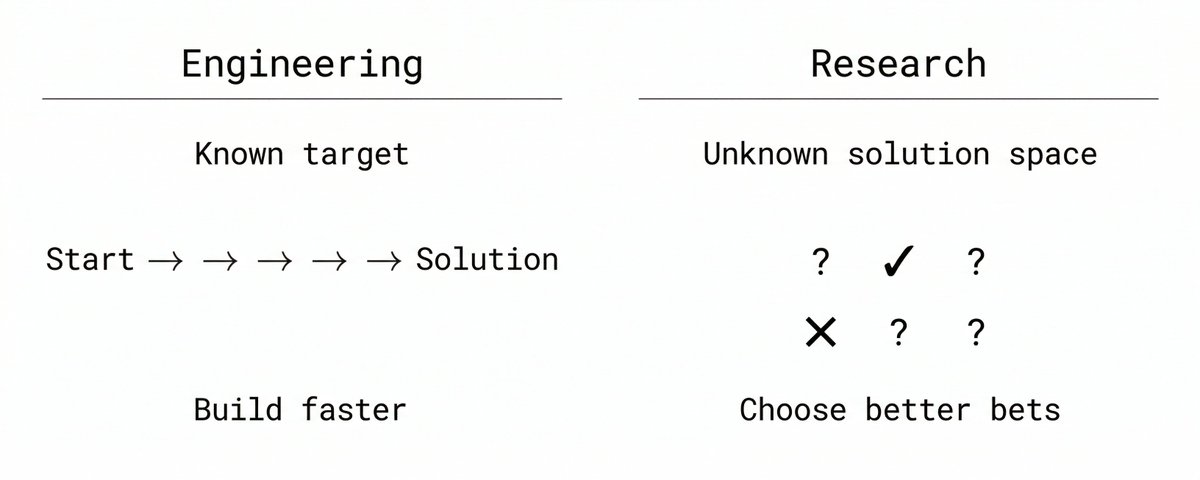
Unburdened by formalism, you remember what research was always meant to be: wonder.
Steve Abreu retweeted

I know this is pretty well established at this point, but Codex 5.3 is a much more effective model than Opus 4.6. I went back and forth on both for a bit, but haven’t touched Opus at all now for a full week. First model to get me off of Opus… ever. Good job Codex team.
Steve Abreu retweeted

Releasing mini, a radically simple SWE-agent: 100 lines of code, 0 special tools, and gets 65% on SWE-bench verified!
Made for benchmarking, fine-tuning, RL, or just for use from your terminal.
It’s open source, simple to hack, and compatible with any LM! Link in 🧵

ALT mini-SWE-agent: 100 lines is all you need. 65% on SWE-bench verified with Claude Sonnet 4. No special tools, no tool calls, no shell session.
Steve Abreu retweeted
[1/7]
Excited to share our new survey on Latent Reasoning! The field is buzzing with methods—looping, recurrence, continuous thoughts—but how do they all relate? We saw a need for a unified conceptual map. 🧵
📄 Paper: arxiv.org/abs/2507.06203
💻 Github: github.com/multimodal-art-pr…

Steve Abreu retweeted
Hybrid architectures mix linear & full attention in LLMs. But which linear attention is best? This choice has been mostly guesswork.
In our new work, we stop guessing. We trained, open-sourced 72 MODELS (340M & 1.3B) to dissect what truly makes a hybrid model tick🧶

