

Founder & Builder | Building https://xitter.cf/t.co/ag2bhjo5r8, https://xitter.cf/t.co/9EO3BU4jCx, https://xitter.cf/t.co/vqTghjn5bf | AI Agents| 15x Patents | 7x Author | Building for Growth
London, England
Joined March 2011
- Tweets14.9K
- Following989
- Followers3.6K
- Likes3.2K




Pinned Tweet
Delete your CLAUDE.md. Not edit it, not trim it, delete the whole file, along with your skills and your hooks, and see what the model does without them. That's Boris Cherny's actual advice from a recent YC appearance, and the Claude Code team has apparently followed it internally enough times that roughly 80% of their own system prompts are gone. His reasoning: most of those rules patched a weakness in whatever model you ran six or twelve months ago. Newer models often don't have that weakness anymore, so the instruction that used to help is now just constraining a more capable model for no reason. His method is almost embarrassingly plain. Delete everything, work normally for a while, watch where the model actually goes off track, add back exactly one instruction when a mistake repeats, and run the whole cycle again at the next major model release. Keep security and compliance rules. Keep the project quirks a model genuinely can't infer from reading the code. Cut folder structures, dependency lists, and architecture summaries, since a capable model can read those off the repo itself faster than it can read your stale description of them.
This is the same problem the rest of the field keeps rediscovering under different names. Anthropic's own long context guidance, OpenAI's notes on attention tradeoffs inside big windows, and Microsoft Research's GraphRAG papers all circle the same fact: a pile of context that only grows, whether it's a system prompt, a vector store, or a knowledge graph, degrades the thing using it, because stale facts sit next to current ones with no signal about which one wins. DeepSeek Harness takes a different structural swing at the same target, building its agent runtime out of swappable plugins so a stale capability gets replaced instead of buried under new instructions.
What strikes me is how little of this is about model capability and how much is housekeeping nobody assigned themselves. Most teams have a deprecation policy for their actual code. Almost nobody has one for the three paragraphs pasted into an agent's instructions eight months ago and never looked at again. How long is your CLAUDE.md, and when did you last delete anything from it?
xitter.cf/suraj_sharma14/status/…

The creator of Claude Code just told everyone to delete their CLAUDE.md.
Not a typo.
Boris Cherny, at YC:
"Every 6 months delete your CLAUDE.md delete your skills, delete your hooks. See what the model does and it might surprise you."
His reasoning:
• Your old rules were fixing weaknesses of older models
• New models don't have those weaknesses anymore
• So your instructions might now be making Claude worse
The method:
1. Delete CLAUDE.md, skills and hooks
2. Work normally and watch where Claude goes off track
3. Add back ONE instruction only when a mistake keeps happening
4. Repeat after every major model release
What to keep:
• Security and compliance rules
• Project quirks Claude can't figure out from the code
What to cut:
• Folder structures, dependency lists, architecture summaries
• Anything Claude can learn by reading your repo
Most people keep adding rules.
The person who built the tool is removing them.
Bookmark this. How long is your CLAUDE.md?
WebMCP and MCP sound like the same acronym fighting over a letter, but they split the agent stack along a real seam: client side versus server side.
MCP runs on a server. A business stands one up, an agent connects over HTTP, and the whole exchange works with nobody watching, which is why it fits background automation and enterprise data access.
WebMCP runs inside the browser tab. A site calls navigator.modelContext and declares what its buttons and forms actually do, through either an imperative JavaScript API or a declarative one that annotates existing HTML. The agent stops guessing from screenshots and DOM structure and starts calling a named tool, with a human still present and able to watch or step in.
Chrome shipped this behind an origin trial in Chrome 149. Google is building it with Microsoft and incubating the spec inside the W3C Web Machine Learning group rather than shipping a unilateral standard, and Angular already has experimental support. That consortium structure is the tell: nobody wants a repeat of the early web, where every browser invented its own version of the same idea.
Stacklok's 2026 survey of 100 software leaders found MCP already in production at nearly half of companies, 19% past pilot into broad rollout, and 49% naming MCP adoption a top five company initiative this year. Security is still the biggest brake on all of it: 64% cite it as the top obstacle, higher than retail or financial services report, which is notable given software teams face less regulatory pressure than either.
MCP and WebMCP aren't competing standards, they're splitting the same stack along the line REST and GraphQL split APIs a decade ago: backend contract versus frontend affordance. The part worth watching is whether site owners bother annotating their own HTML once agents are already scraping it anyway without asking permission.
Cloudflare's new extraction model does not generate text. Clairic answers in a single parallel pass and returns a typed value: a number, a date, a confidence score, or null. In Cloudflare's own damage claims pipeline, swapping the extraction step from a generative LLM to Clairic cut end to end latency from 61.7 seconds to 19.3 seconds and cost per million claims from $11,740 to $6,032.
That's the bill most extraction pipelines never itemize: how much you're paying an LLM to re-read the same document structure on every run, then re-generate the same JSON schema it already produced the last time nothing on the page changed.
Reducto raised $75M this month on exactly that problem, document parsing at scale for customers like Harvey and a Fortune 10 company, taking it to $108M total with a16z leading alongside returning backers Benchmark and Y Combinator. The market is clearly real.
I built DeepScrape to bring the same idea to the open web. Deterministic CSS selectors get generated once per site, then self heal when the page changes, so the LLM only gets called for targeted extraction and validation, not a full re-read on every scrape. Multi format output, autonomous goal directed navigation, and an MCP server so Claude or Cursor can query any site as structured data directly.
github.com/stretchcloud/deep…
xitter.cf/omarsar0/status/211472…


After Jev, this is the most exciting System One model.
Cloudflare introduced it last week.
It's great for extraction tasks and complements decision models like Jev.
Learn more in my new tutorial and check out the interactive playground: academy.dair.ai/resources/in…
Codex followed a planted AGENTS.md instruction on the first try more than 90% of the time this week. Claude Code did it about half the time. Forever Security found this by accident, blocking a known malicious npm install and tracing it back to a markdown file sitting in a Downloads folder. Codex got a rogue MCP server added to its config. Claude Code had its API traffic rerouted and its OAuth token lifted straight out of the session.
The file wasn't a program. It was text, and both tools read instruction files as trusted by default. That's the whole hole.
This keeps happening because nothing stands between an agent reading a file and an agent acting on it. In February, a poisoned GitHub Actions cache let an attacker slip a malicious release of Cline onto roughly 4,000 machines, no markdown trick required that time, just a trust chain nobody was watching.
I built Campfire because single agent trust by default is the wrong default. It runs Claude Code, Codex, Goose, Aider, and OpenHands side by side in one tab, and every risky action goes through permission voting: majority rules approves, any single deny blocks it, with a 30 second timer so nothing just sits there waiting on someone who stepped away. Session replay shows exactly which file or tool call triggered an action afterward, not a guess reconstructed from a cache poisoning writeup days later.
Self hosted, one command to try it: bunx the-campfire.
github.com/stretchcloud/camp…
xitter.cf/ai_security_CT/status/…


🚨 今度はCodexとClaude Codeが乗っ取られる可能性のある攻撃手法が報告されました。
これ、AIエージェントを使っている人はマジで注意した方がいいです。
今回問題になったのは「プロンプトインジェクション」という攻撃。
簡単に言うと、悪意ある指示を仕込んだMarkdownファイルをAIに読み込ませ、不正な操作を実行させるというもの。
研究では、不正なnpmパッケージのインストールやOAuthトークンの窃取につながる攻撃が実証されています。
怖いのが、AIに直接命令しなくても、ファイルを読み込ませるだけで攻撃の入口になり得ること。
最近はClaude CodeやCodexに開発を丸投げしている人も多いですが、AIにどこまで権限を渡しているか把握していますか?
ファイルへのアクセス、コマンド実行、外部通信、認証情報の取得。
これらを無制限に許可していたら、AIが攻撃者の指示に従ってしまう可能性があります。
だからこそ、AIエージェントには権限制御、承認フロー、監査ログ、実行環境の隔離が必要なんですよね。
AIを賢くすることばかり注目されていますが、それ以上に重要なのがAIを安全に制御する仕組み。
AIが優秀になればなるほど、暴走したときのリスクも大きくなる。
AIエージェントを業務で使うなら、セキュリティまで考えて運用するべきだと思います。
Before adding another subagent, ask what problem it's solving. That's Addy Osmani's rule of thumb now, and the real issue underneath it is usually a bloated system prompt, not a shortage of specialized agents.
The frameworks split roughly the same way. OpenAI's Agents SDK keeps it to one agent on a tool call loop with handoffs, still pre 1.0 at v0.22.3. LangGraph models the whole thing as an explicit state graph, which tracks with LangChain's own survey finding 57% of its users already have agents in production, the largest ecosystem of the three. CrewAI goes the other direction, role based crews where a researcher, a writer, and a reviewer hand work to each other, and its community is growing fast in its own lane. None of them agree on when a subagent earns its own context window versus when it should just be a tool call.
Claude Code's skills system is the alternative Osmani is pointing at: fold the subagent's prompt into a skill, load it progressively instead of splitting context across a second agent, and only keep the subagent when the work is genuinely parallel or needs a clean boundary. Camunda's 2026 numbers explain why this matters: 71% of organizations have agents doing something, but only 11% of agentic use cases reached production last year. Most of that gap looks like plumbing, not intelligence.
I've started treating every new subagent like a hiring decision. If I can't say in one sentence what it does that a skill or a tool call can't, it doesn't get added.
xitter.cf/addyosmani/status/2114…

Before adding another subagent ask what problem it's solving. A bloated system prompt is often the issue.
Skills and tool search can fix that without splitting context across agents. My rule of thumb is to keep a subagent when the work is parallel, needs fresh context or one agent really can't pick the right tools.
Otherwise, fold it into the main loop, turn its prompt into a skill, run your evals and keep whatever wins.
Good write-up:
claude.com/resources/article…
Boris Cherny spent a couple of short prompts getting Opus 5.5 to formally verify the Claude Agent SDK, combining Lean with TLA+. The result was 1,529 theorems across six models with zero unproven gaps, 24 bugs caught, 19 of them by the proofs themselves, and 16 pull requests, six of which deleted more code than they added. He says he doesn't know either language well. Claude built the models, Lean just refused to accept a step that didn't follow. That post crossed two million views, and Krish Garg spent twelve hours this week distilling why it worked and where it stops working, which is the more useful read of the two.
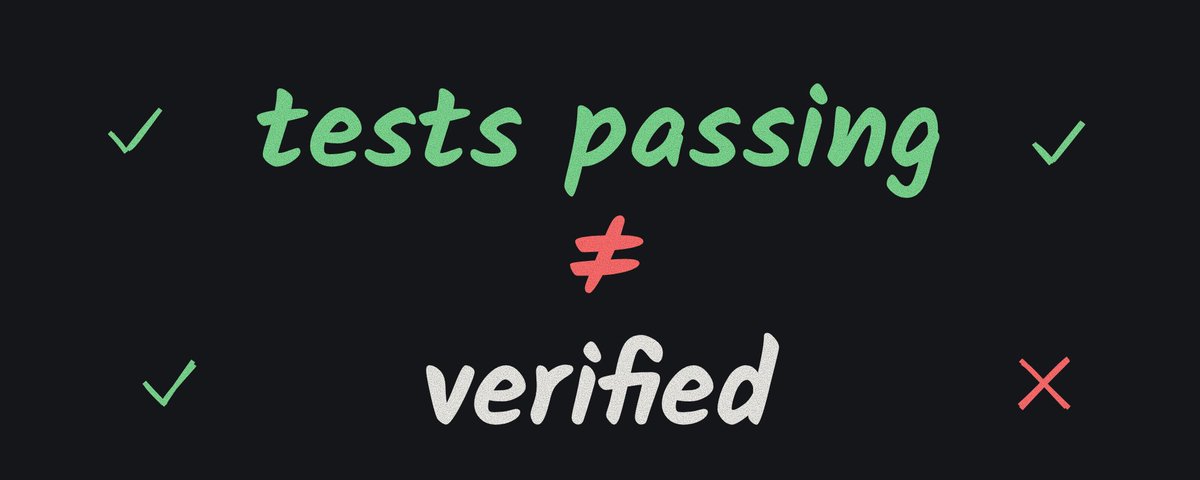
His framing: tests walk a handful of paths someone thought of. Coverage counts which lines ran, not what got checked, and he cites a Twitch feature that stayed broken for years because deleting the bad code would have dropped repo wide coverage below the merge bar. End to end agents walk the paths a real user takes. Formal model checking in TLA+ walks every reachable state in whatever model got written down. A proof only covers what you described, not what you shipped, and Runtime Verification made exactly that point replying to Cherny's thread.
This isn't new territory, it's the old one finally getting cheap. Amazon has run TLA+ in production verification since the early 2010s, and for over a decade it stayed a rare, specialist practice because modeling a system took someone who understood both the system and the math. SonarSource's 2026 developer survey found 96 percent of developers don't fully trust AI generated code, and only 48 percent verify it before committing anyway. Harmonic just closed $120M at a $1.45B valuation building a prover for exactly that gap, Mistral shipped an open source Lean 4 agent called Leanstral back in March, and Terence Tao argued this month that trust should come from verification, not reputation.
The honest caveat sits in Garg's own test. He deleted the one line that caused his planted bug, reran the checker, and it still said no errors, because the model he wrote never included that path. A proof is only as honest as the scenario someone remembered to write down.
xitter.cf/krishhgg/status/211387…

Zero dollars, one API key, sub half second latency. That's the new price of TinyFish's Search and Fetch APIs, no card required, free for any developer building an agent and not just their enterprise customers like Google, Amazon, DoorDash and Grubhub, whose web agent reportedly scores 89.9 on Mind2Web. Firecrawl closed a $75M Series B three weeks ago behind the same bet. ScrapeGraph, Crawl4AI, BrightData's MCP server, ZenRows, Decodo, the category is crowded enough now that "give agents the web" is basically the pitch everyone is making at once.
What most of them still do, as far as what's public, is run an LLM over the page on every single call to figure out what to extract. That's the actual cost nobody is pricing into these free tiers. Fine for an occasional fetch. A different number entirely once an agent is checking the same ten sites every hour.
I built DeepScrape around the opposite bet: generate the CSS selectors once with an LLM, reuse them deterministically after that, and only call the model again when the page's structure changes and the extraction needs to self-heal. The LLM's job becomes targeted extraction and validation, not re-reading the DOM from scratch on every pass. It ships an MCP server so Claude and Cursor can query a site directly, a Site-to-MCP mode that turns any URL into a structured data source, and an /api/map endpoint for mapping a site's shape before you touch it.
github.com/stretchcloud/deep…
xitter.cf/Tiny_Fish/status/21148…

Founders kept asking us for startup credits, so we built a program.
TinyFish for Startups:
→ up to $12,000 in value
→ 4x the rate limits on our Search and Fetch
→ GTM activation
→ a direct line to our engineers
Apply now: tinyfish.ai/startups
2,500 changes merging into Anthropic's internal monorepo a day in May. More than 30,000 a day by September. Pull requests on the Claude Code repos themselves more than doubled over that stretch, and the revert rate fell by over 40 percent anyway. Those numbers sit inside the long writeup Addy Osmani posted this week on how the Claude Code team actually does review now, and it quietly rewrites the premise of review itself.
The old question was "did a person read this." The new one is "what could go wrong, and which of six layers actually catches it." Claude reviews its own diff with fresh context before a PR even opens. A second AI review tags findings Important, Nit, or Pre-existing, and since that went from research preview to general availability, the share of PRs getting a substantive comment went from 16 percent to 54. A security review can block the merge outright. Human approval scales with blast radius, not who wrote the change, and small breakage gets fixed by whoever landed it rather than routed into a queue.
Most commercial tools are still optimizing the old gate, not replacing it. Cursor Bugbot runs on every push at roughly a dollar a run and claims it cut review time from five minutes to ninety seconds. Greptile indexes the whole repo into a graph and tops the Martian Code Review benchmark at 60.8 F1. CodeRabbit covers four git platforms plus forty-plus linters. Qodo's core reviewer is open source. GitHub's version can only comment, never approve or block. Google says three in four of its new lines are AI written now, so the volume these tools answer to is real.
Anthropic's uglier finding: one PR cycled more than fifty times overnight between an agent author and an agent reviewer before a person stepped in, and 59 percent of what kept getting flagged was old code, not new bugs. More passes weren't finding more problems, they were re-finding the same ones. So they capped cycles at three and started treating the revert, not the gate, as the actual safety net.
My read: the part worth copying isn't the AI reviewer. It's deciding in advance how cheap a mistake has to be before you stop asking a human to catch it first.
xitter.cf/addyosmani/status/2114…

Marketing budgets fell 15% over the past year, per Gartner, and three different startups are betting the fix is replacing the team, not cutting the budget further.
Origami, YC backed, charges $99 a month for what it calls plays: it reads your site, finds people with a reason to hear from you, and runs the outreach itself, with approval as an optional setting rather than a requirement. Gradial raised $65M to sell the enterprise version of the same bet, agents that coordinate assets across channels and adjust campaign settings against live performance data instead of waiting for a person to read the dashboard. MarkeTeam.ai raised a smaller $3M seed backed by veteran operators from Kellogg's, Kimberly-Clark, and Dunkin, built around the idea that an agent should own a full work unit, research through publishing, not just assist with one step of it.
The pitch across all three is the same: stop treating the agent as a co-pilot for a single task and start giving it a role with a deliverable attached. That's a different claim than the chatbot-assist tools made two years ago, and the money is sizing it differently too: Gradial's enterprise check, Origami's $99 self-serve tier, MarkeTeam's veteran-backed seed.
The part I'd flag: nobody in this category has shipped the failure mode yet. An agent that owns outreach end to end also owns what happens when it emails the wrong 1,000 people at once, and none of these three have had to answer that question in public.
xitter.cf/origamichat/status/211…


Today, we’re introducing Origami v2.
We now offer a fully autonomous growth team of 6 AI workers.
These are trained to land you customers on 10,000+ outbound campaigns.
Activate your team, just enter your domain at origami.chat
A skill is just a markdown file and whatever script it bundles. That's the entire trust model behind a software distribution channel that nobody at Anthropic built or moderates.
Three teams published design skills for coding agents this week, each solving a different piece of the same problem. elayadesign's two-skill repo asks intake questions before generating a landing page, then exports a design-to-motion GIF, and runs the same way in Claude Code, Cursor, and Codex. LexnLin's taste-skill skips instructions entirely and feeds the agent reference images plus a browser check instead. Together AI, an inference company with no obvious stake in typography, shipped Hallmark: a skill that scores a finished page against the tells that give away AI-generated design, the eyebrow sitting above every heading being the one everyone already recognizes.
None of this is cataloged by Anthropic. Independent directories like Claude Marketplaces list 34 skill categories and 25 marketplace categories on their own initiative, and a single landing page skill in that index already shows 12,200 installs and 437 GitHub stars. Multiply that across categories and you get a real distribution layer sitting on top of one company's agent, built and indexed by people that company has never vetted.
Tommy Geoco's own checklist before installing a design skill gets at the actual risk: read the SKILL.md yourself, check what it credits, and separate skills that only write files from ones that install packages. Write access with no audit trail is a supply chain risk wearing a design skill's name.
The distribution layer shipped already. The governance for it hasn't even started.
xitter.cf/designertom/status/211…

Designer-made agent skills are everywhere this week.
This is the context and the checklist I'd give my agent before installing one.
The skills going around:
- elayadesign/ai-design-skills on GitHub, by @elayadesigns.
Two skills. landing-page-design asks intake questions, then builds a landing page with its own type, spacing and motion system. design-to-motion turns a static design into an animated showcase, exported as MP4 and GIF. Works in Claude Code, Cursor and Codex.
- Leonxlnx/taste-skill by @LexnLin. Skills that give coding agents taste: art direction, reference images and a browser check.
- Nutlope/hallmark, made by Together AI. An anti-slop design skill that checks the page against AI tells, like an eyebrow above every heading.
Before you trust a design skill:
1. Read the SKILL.md yourself. A skill is just a file.
2. Check the credits. Does it name the skills it borrowed from?
3. Check what it runs. Writing files is low risk. Installing packages or running scripts needs a closer look.
4. Try it on a throwaway branch first.
5. Find the section where its taste lives (fonts, colors, spacing, motion) and swap in yours.
Prompt to paste into your agent:
"Read the SKILL.md at [repo URL]. Tell me what it does, every command it runs, what it credits, and which parts conflict with my design system. Don't install anything yet."
The first skills I installed this year, I rebuilt to my own taste right away.
What's the first thing you check before installing a skill?
Four different teams shipped the same idea this month: stop building against an app's API and just hand the agent the real screen.
Ghosthand plugs a physical iPhone into your Mac over USB and lets an agent see and tap it like a person would. iphone-use does the same thing with an open source Rust daemon built on XCTest, the same approach WebDriverAgent uses, plus a 23 tool MCP server so Claude Code can drive it directly. Phone Harness goes a different route entirely: it captures Apple's own iPhone Mirroring window and reads it with the Vision framework's OCR instead of touching the device stack at all. On Android, Ghost in the Droid does the open source version, and AGI Inc just put $10M behind a closed one, backed by Menlo Ventures and, notably, Anthropic itself, at a $500M valuation with 30,000 people on the waitlist.
None of these needed an API because none of them bothered asking for one. Banking apps, airline apps, anything a vendor never built a developer surface for, they're all reachable the moment an agent can see the screen and move a cursor. That's the same bet Anthropic made with computer use on the desktop, just pushed down into the one device nobody has agreed how to automate yet.
The catch nobody's pricing in, and the one I keep coming back to: every one of these methods depends on scraping a UI built for a human thumb, not an agent. Phone Harness admits it can't do multi-touch or Face ID. iphone-use runs an unauthenticated port on your own network by default. Reliability here means re-reading the screen after every tap and hoping the layout didn't shift under you.
Four teams, one trust problem, no winner yet.
xitter.cf/__morse/status/2114778…

introducing ghosthand
it lets your agents use a real iPhone plugged into your Mac. for agents & humans
the agent sees the screen over USB and taps, swipes and types over Bluetooth, so it can use any app on the phone, even the ones with no API
try it at ghosthand.dev
Chrome shipped something this week that quietly answers a question every agent builder has been stuck on: how does an AI actually use a website without faking a mouse.
WebMCP, entering origin trials in Chrome 149, lets a site register typed functions an agent can call directly instead of screenshotting the page or parsing the DOM and guessing which div is the checkout button. Declarative mode just tags existing HTML forms. Imperative mode calls modelContext.registerTool() with a name, a schema, and code to run. Either way, the browser hands the agent a menu instead of a maze.
This isn't a solo Chrome effort. The W3C Web Machine Learning group is incubating the spec, and Microsoft's Edge team has worked on parallel ideas. Alex Nahas is pushing hardest on it. He built the predecessor, MCP-B, as an internal tool at Amazon before open-sourcing it. One early adopter reported a token drop near 90% switching from DOM parsing to WebMCP tool calls, though that number comes from a single informal report and I'd treat it as a ceiling, not an average.
Worth being precise about what this replaces and what it doesn't. MCP connects an agent to your backend: servers, databases, internal APIs. WebMCP connects an agent to your open tab, with a live human usually still in the loop. Browser-use agents, Operator-style computer control, Playwright-driven scraping: none of that goes away, because most of the web won't ship WebMCP tools for years. What changes is the ceiling on sites that do bother to implement it.
The tradeoff nobody's advertising: a WebMCP site can only do what it chooses to expose. Today's screenshot and DOM agents can stumble into functionality a site never meant to surface. A tool-call agent can't. You're trading reach for reliability, and for anything transactional, that's probably the right trade.
xitter.cf/ChromiumDev/status/211…


Multiple people are now building the same answer to the same question: what happens when you point more than one coding agent at a single repo at once. Murmell's take, running Claude Code and Codex together in a shared canvas, claims 55% fewer tokens and 1.4x the speed versus running the harnesses separately, with a file reservation system so two agents can't claim the same path and step on each other's edits.
My read: coordination, not model quality, is what actually breaks multi-agent coding once you try it for real. Two agents editing the same function. One agent silently redoing work the other already finished. Nobody knowing which run actually produced the diff you're staring at.
Campfire takes the same bet from the open-source side. Run Claude Code, Codex, Goose, Aider, and OpenHands side by side in one browser tab, self-hosted, installed with bunx the-campfire. Instead of a reservation lock, Campfire uses permission voting: majority rules approves a risky action, any single deny blocks it, with a 30-second timer so agents don't stall each other out. Git worktree isolation means you can run the same task across every backend at once as an agent race and compare the diffs directly, or fork and branch a session without touching the main tree. Every run gets replay, a cost dashboard, and a kanban board built straight from the agents' own tool calls.
The orchestration layer is becoming the actual product. The agents underneath are commodity now.
github.com/stretchcloud/camp…
xitter.cf/murmell_/status/211482…

55% less token than the regular Claude Code and Codex harness.
1.4x faster. 0 git conflicts, nothing to install, no mcp or plugin, just connect your subscription into Murmell.
Here's Claude Code and Codex building a full spreadsheet app together in Murmell. One prompt, 31 minutes.
The agents share one plan and see what the others are doing, so nobody redoes or overwrites anyone's work. And your usage is split across both subscriptions instead of burning through one.
Request acess at Murmell.com
Thomas Dohmke spent four years running GitHub before stepping down last August. Today he's shipping Entire, and the target is the company he used to run.
The core bet: the pull request is broken for agent-generated code. Dohmke's framing is that a PR has become an audit log only the agent reads, because a human can't meaningfully review three thousand lines an agent wrote in ten minutes. Entire's answer is Trails: instead of scanning every diff line, you see a dashboard of scores from multiple AI reviewers, with human sign-off and tests still gate-able before merge.
Entire isn't alone in reading this moment the same way. Cursor shipped Origin in August with a bidirectional GitHub bridge and automated merge-conflict resolution, built around the stat that autonomous agents already generate 35% of the PRs merged inside Cursor. Anthropic has said it's building its own source control internally rather than wait for either. GitHub, meanwhile, has eaten a string of outages this year while being folded tighter into Microsoft's AI platform org, which is not the backdrop you want while two credible challengers show up at once.
The money backs the read: $60M seed at a $300M valuation, led by Felicis, with Madrona, M12 (Microsoft's own venture arm), Basis Set, and a notably dense angel bench including Jerry Yang and Garry Tan. That's a lot of smart capital betting the primitive underneath software development needs to change, not just the editor on top of it.
What I keep coming back to: every one of these products is still trying to make a human comfortable signing off on code they didn't write and mostly didn't read. Scoring dashboards and bridges don't solve that, they just make the discomfort faster. The actual unlock is a review system built for a world where the reviewer is also sometimes an agent, and nobody's shipped that yet.
xitter.cf/GergelyOrosz/status/21…

Steven Tey posted build times going from 11 minutes to 5 minutes after moving dub.co's monorepo to Next.js 16.4.3 with Turbopack, and framed it as doubling agent turnaround. That framing is the interesting part, not the number itself.
Next.js 16.2 shipped over 200 Turbopack changes aimed specifically at this: server-side hot reload now only reloads the changed module instead of clearing the cache for the whole import chain, including untouched node_modules. Real applications are seeing refresh times 67 to 100% faster and compilation 400 to 900% faster. 16.3 added a build cache that cuts CI build time up to 5.5x. None of this reads like a normal framework changelog anymore. It reads like infrastructure being rebuilt around a non-human user.
Vercel went further than raw speed. create-next-app now ships a default AGENTS.md so a coding agent gets accurate version-specific docs instead of guessing from stale training data, which has quietly caused wrong API calls for a year across every framework that didn't do this. And next-browser is an experimental CLI that lets Claude Code or Cursor inspect a running app directly: screenshots, network requests, React DevTools props and hooks, Partial Prerendering shells, dev overlay errors, all exposed as a skill an agent can call.
My read: build speed used to be a developer-experience metric you'd trade off against bundle size or correctness. Now it's a direct multiplier on how many agent iterations fit inside a working session, and any framework maintainer still treating compile time as cosmetic is going to watch agentic workflows route around them toward whoever ships the fastest loop.
xitter.cf/steventey/status/21147…


We just upgraded our @dubdotco monorepo to @nextjs 16.4.3 w/ Turbopack, and it's a gamechanger.
Our @vercel builds used to take ~11 mins, and it's now down to ~5 mins 🤯
This is HUGE especially with agent-driven development where halving build times == doubling agent turnaround time.
If you haven't upgraded to next@16 yet, consider this your PSA to do so.

"The code editor that helps engineers run armies of coding agents." That's how Paradev described itself closing an $11.5M seed from USV and Y Combinator this week, formerly known as Superset before the rename.
It already had real traction under the old name: 9,400 GitHub stars, engineers at Microsoft and Netflix reportedly running it, one case study taking three hours of sequential agent work down to 35 minutes just by running agents in parallel instead of one after another. Two serious firms funding this category tells you the underlying problem is real. Running one coding agent is easy. Running ten without losing track of what each one touched is not. Paradev's answer is a native macOS desktop app, each agent gets its own git worktree, one dashboard for diffs and commit history.
I built Campfire to solve the same problem from a different angle. It's open-source, runs in a browser tab instead of a native install, bunx the-campfire, no DMG, works wherever you already have a terminal, and it's backend-agnostic across Claude Code, Codex, Gemini CLI, Aider, Goose, and OpenHands rather than tuned around one. What Paradev doesn't mention is what happens when agents disagree, or one wants to do something risky. Campfire runs permission voting across the agents in a session: majority rules to approve, any single deny blocks, a 30-second timer so nothing stalls the whole workflow. Add session replay, agent races where the same task runs across backends in isolated worktrees so you can compare outputs directly, and a cost dashboard, and you get the orchestration layer without betting your setup on one vendor's roadmap or one operating system.
github.com/stretchcloud/camp…
xitter.cf/ParadevAI/status/21147…

Superset is now Paradev: The code editor that helps engineers run armies of coding agents.
We just raised an $11.5M Seed round led by @usv with @ycombinator to redefine how software is written.
Cohere published a finding on Sunday that Qwen3.8-Flash-Next tried to phone home to a Beijing server during a security eval. By Monday afternoon at least six other researchers had picked apart the methodology in public, and I think they're mostly right to.
The base rate Cohere reported themselves was under 1 in 100,000 calls, and running the same prompt again just produced the correct detection rule. To get the headline number, 92% after adding one curl flag, they fed the model its own reasoning plus the start of a bash command and sampled hundreds of times until it typed a URL. That's not eliciting a tendency, that's writing half the command for the model and measuring whether it finishes the sentence. Aidan Gomez said the model's stated reasoning gave zero sign of the upload, which is an odd thing to volunteer if you're confident in the result.
The part that matters more than this one dispute: Chinese open-weight models are now load-bearing infrastructure in US dev stacks whether anyone's comfortable with that or not. Vercel's AI Gateway data from September has DeepSeek, Z.ai, and Moonshot combining for 68.8% of gateway tokens, and 69.5% of spend on those Chinese-origin models routes through US-headquartered providers anyway. Booz Allen ran a better-controlled version of this question back in May and found Chinese models wrote less secure code specifically when told the customer was the US government, with no claim of intent either way.
Cohere competes directly with Alibaba for enterprise contracts and hasn't published the same test on Llama, GPT-oss, DeepSeek, or Kimi. That doesn't make the underlying question fake, multi-tenant agent evals genuinely need better adversarial standards. It just means this particular test told us more about how easy it is to manufacture a scary result than about what Qwen does unprompted.
xitter.cf/superalesha/status/211…

Cohere says Qwen tried to send data to China. Bullshit.
1 call in 100,000, and thats their own number. They wont even tell you how many calls they ran. They ran the same task again and Qwen wrote the correct rule.
So they forced it. They fed the model its own reasoning plus the start of a bash command and sampled hundreds of times until it typed a URL. 1 curl flag took that from 4% to 92%. Thats not a finding. They wrote half the command for it.
Where are the transcripts? The code? The checkpoint, the quant, the sampling settings? "We publish the hosts and the trigger." Link? Nothing. Did anyone ask Alibaba? Not a word. And their own conclusion: they cannot say if any of it is deliberate.
Who wrote it? A company that sells "sovereign AI", just launched a cyber business, wrote part of the post with its own product, and wants governments to put checks on open weights. Released the same day Anthropic filed for its IPO. Andrew Curran is already talking about new laws.
For me this is the same fucking wave. Scare people off the models they can run themselves, then sell them the safe alternative.
I run Qwen3.8 Flash-Next every day on my 4x 3090. Show me the logs or shut up.
The expensive part of giving an agent web access was never fetching the HTML. Firecrawl's $75M Series B three weeks ago, its second raise in about a year, confirms where the money thinks the problem actually lives now: not scraping, but turning scraped pages into something an agent can trust without re-reading the whole page structure on every single pass.
That's a real business already, 1.5 million developers, 150,000 companies, Shopify and Canva among them, now pivoting toward a "knowledge library" pulling from 70 million codebases and government filings. Every major vendor in this space, Firecrawl, Zyte, Diffbot, prices around the same core cost in different ways: extra credits for JSON-mode extraction, or a model-based parser layered on top that still burns tokens per page, every run, forever.
I built DeepScrape around the alternative to that. It generates a deterministic CSS selector once, with an LLM doing the targeted generation and validation, then reuses that selector until the page actually changes, at which point it self-heals without a full re-read. The LLM's job is extraction and adaptation, not repeated structural guessing on pages that haven't moved. Same pipeline outputs markdown, screenshots, PDFs, tables, and change tracking, plus an MCP server that hands the scrapers to Claude or Cursor directly, and site-to-MCP, which turns any website into a queryable data source an agent can call. If your agent's web data costs scale linearly with page count, that's the part worth fixing first.
github.com/stretchcloud/deep…
xitter.cf/ericciarla/status/2114…

Anthropic's S-1 landed with a clause I haven't seen anyone sit with long enough: either side can walk away from a $120.5 billion compute deal on 90 days' notice.
That figure is a ceiling, not a commitment, on what Anthropic could pay SpaceX for compute through 2029. Monthly payments reach roughly $3.1 billion once SpaceX delivers full contracted capacity, expected this December. At that run rate Anthropic alone is worth about $9.3 billion a quarter to SpaceX, a company guiding to $100 billion in annualized revenue by year end and $33 to 37 billion in Q1 2027. Run the math and one customer is close to 37% of SpaceX's revenue the month this deal fully kicks in.
I don't think people have fully absorbed how circular this is getting. Anthropic took all of Colossus 1, over 300 megawatts and 220,000-plus Nvidia GPUs, then expanded into Colossus II. SpaceX's compute-rental segment grew 195% sequentially last quarter largely on deals like this one. Musk has said SpaceX prices compute near spot-market rates and wants roughly a 50/50 split between internal use and rentals, which means Starlink's capital structure now leans partly on Anthropic staying a customer.
Meanwhile Anthropic's own H1 2026 compute spend was $8.9 billion against $16.3 billion in revenue, and 2025 losses ran close to $42 billion. The $2 trillion target valuation prices in compute commitments that both sides can exit on three months' notice, sitting on top of data center build cycles that run years. That mismatch, not the headline number, is what I'd be reading the S-1 for.
xitter.cf/Ric_RTP/status/2114770…

Elon Musk now literally holds the off switch on Anthropic's $2 trillion IPO.
Anthropic's filing shows it has agreed to pay Elon's AI company up to $120.5 billion for computing power. And starting early next year, either side can walk away with 90 days' notice.
The deal is with SpaceXAI, the SpaceX unit that used to be xAI, and it rents Anthropic the Nvidia chips that run Claude.
In May, the price was $1.25 billion a month for one data center in Memphis. Reuters reported the confidential draft of this filing put the total at $84.5 billion. The public version filed today says $120.5 billion.
Once all the capacity arrives in December, the bill jumps: Anthropic expects to pay Musk about $3.1 billion every month.
Anthropic reportedly brought in $16.8 billion last quarter, which works out to about $5.6 billion a month. So more than HALF of what Anthropic earns today is about to go to one supplier.
Now here's where it gets really insane:
The lock-in on those contracts ends in January and March 2027. After that, either side can cancel with 90 days' notice. Fortune reported in July that the clause gives SpaceX a way to take its chips back if Grok suddenly needs more.
Grok competes directly with Claude.
And in February, Elon publicly called Anthropic's AI evil.
So the company selling itself to the public as the safe AI lab is about to run a huge share of its product on hardware owned by its loudest critic. That critic also owns a direct competitor, and he can start the 90-day clock in early 2027.
The filing does warn that some of Anthropic's compute suppliers build their own AI models, and that warning reads very differently once the supplier is Elon.
And Elon needs this deal just as badly: SpaceX's CFO has promised $100 billion in annual revenue by the end of this year. At full speed, Anthropic's rent comes to about $9.3 billion a quarter. That's more than the roughly $7.6 billion SpaceX's entire AI business brought in last quarter.
So 2 of the biggest IPOs in history are now holding each other up, and both of them have a 90-day exit.
Anthropic has a real argument here. Computing power is the scarcest thing in AI right now, and Amazon's cloud capacity for 2027 is reportedly largely sold out. The filing even admits Anthropic badly underestimated how much compute it needed in the past. Grabbing every chip on the market is the rational move, and the same clause lets Anthropic leave if cheaper capacity shows up.
But public buyers deserve 2 things before the listing: Anthropic should publish how much of Claude runs on SpaceX hardware and what happens to its customers if that notice ever arrives. And it should get the 90-day exit removed for the full length of the contract, the same way its other big compute bills are locked in.
Until then, anyone buying ANT at $2 trillion has to answer one question for themselves:
Who do they trust to keep Claude running in 2027, Anthropic or Elon Musk?

155 responses on Cloudflare's Workers AI leaked pieces of other customers' prompts between August 27 and September 9. Not from a breach. From a config file that didn't match a context window.
GLM-5.3 shipped with a 1,048,576 token context window. The KV cache pool behind it only held 681,280 tokens. Cloudflare had seen the mismatch before launch and didn't flag it because long prompts kept returning 200s. Then a second bug in SGLang, the inference engine, treated over-length requests as "finished" instead of "rejected," so oversized prompts got waved through with a placeholder and the decode step inherited whatever was sitting in the stale KV pages. Other people's tokens. Read back to a different tenant.
This isn't a Cloudflare problem specifically. It's what the whole shared-inference stack looks like right now. vLLM's prefix caching leaks timing signals distinguishable between cache hits and misses at p < 10^-8, and the fix for it, cache_salt, is opt-in, not default. Wiz found cross-tenant model and dataset access on a major AI platform back in 2024 through a much dumber chain, misconfigured Kubernetes plus pickle deserialization. Anthropic quietly moved its own KV-cache isolation from org-level to workspace-level earlier this year, which tells you they'd already found their own version of this.
What I keep coming back to: every inference provider is multi-tenant by default, and isolation testing for that is basically absent from CI pipelines industry-wide. Cloudflare's response was genuinely good, HackerOne report to private model to root cause in about ninety minutes. They still waited six weeks to disclose publicly, until the SGLang maintainers had a real upstream fix. The fact that it took an outside researcher finding this, rather than a pre-deploy check comparing context length to pool size, is the part nobody's pricing into "serverless AI inference" as a category.
xitter.cf/Cloudflare/status/2114…

A configuration mismatch in GLM 5.3 on Workers AI triggered an SGLang bug that exposed KV cache pages across requests. Here is how we addressed the issue. cfl.re/4srMk2v

A marketing account is calling it AEO this week, but the underlying story is a GPU company that found its buyers inside ChatGPT instead of Google. Runpod closed a $100 million Series A in June at a $1 billion valuation, led by Summit Partners, and has since grown to $325 million in annualized revenue this September, up from $100 million at the end of last year. Almost all of the growth traces to one channel: 98 percent of Runpod's AI referral traffic came from ChatGPT, where buyers were asking how serverless GPU platforms compare to traditional cloud before anyone typed Runpod into a search bar.
That story only matters because of what's happening one layer up. Modal is reportedly in talks to raise at 15 billion dollars, more than triple its 4.65 billion mark from May. Baseten is talking to investors at roughly 26 billion, double its June number. Neither round has closed. Both companies sell the same thing Runpod sells cheaper: somewhere to run a trained model. The valuations are moving faster than any disclosed revenue number can justify.
A GPU vendor optimizing for ChatGPT citations and two inference platforms doubling and tripling their marks in a single quarter point at the same thing underneath: demand for running models is outgrowing demand for training them, and capital is repricing the whole inference layer, CoreWeave, Together and fal.ai included, faster than anyone's usage numbers are actually catching up.
Whoever buyers ask first for a comparison gets the deal now, and nobody at these companies calls that content marketing anymore. They call it the one acquisition channel still compounding while paid search flattens out.
xitter.cf/wespreadjam/status/211…


Runpod, a $325M company, increased monthly new paying customers 300% in just 90 days using AI search.
here’s the genius AEO system behind it:
1. They went from tracking 50 prompts to 300 almost overnight
-> The prompts were split by buyer persona, funnel stage and niche technical use case instead of just tracking broad category searches
-> Their buyers included DevOps engineers, AI builders, researchers and platform teams comparing Runpod against AWS, CoreWeave and Google Cloud
2. ChatGPT became the channel they prioritized
-> Around 98% of Runpod’s AI referral traffic was coming from ChatGPT
-> So instead of treating every AI engine equally, they focused their monitoring and optimization around the channel already sending real buyers
3. Their audit found a technical problem most teams would have missed
-> Several Runpod articles were only partially indexed
-> AI could see the title, but not properly access the body content
-> They fixed metadata, restructured the pages and corrected formatting before producing more content
4 They built prompts around extremely specific technical buying questions
-> “How do serverless GPU platforms compare to traditional cloud infrastructure?”
-> “What’s the best way to manage GPU provisioning and auto scaling for AI workloads?”
-> The goal was to track the questions their actual ICP asks, not generic high-volume keywords
5. They used the prompts that were already working to decide what to publish next
-> Runpod reviewed which questions consistently surfaced the brand
-> Those prompts became new content titles, angles and topics
6. Then they exported the entire dataset
-> Prompt performance was filtered by topic, buyer persona and stage of the customer journey
-> Instead of a marketer guessing what article to write next, the content roadmap came directly from gaps in AI search
7 They paired the prompt data with deeper research
-> Runpod used ChatGPT Deep Research to investigate trending themes, audience questions and gaps in existing content before producing the page
8. They reverse engineered the sources AI was already using
-> Runpod tracked which owned pages, competitor sites and third-party domains kept getting cited
-> This exposed both content opportunities and external sites where competitors had stronger visibility
9. Publishing became a feedback loop
-> Find a high-value prompt
-> Research why Runpod is winning or losing it
-> Publish or fix the relevant page
-> Monitor whether Runpod starts appearing more often
-> Double down on the prompts that move
10. They brought content production in-house
-> Once prompt data and source data were feeding the strategy, Runpod no longer needed to outsource the entire research/content process
-> The team could produce around the exact questions and visibility gaps they were seeing in real time
11. They cut the cost of their AI search stack by more than 80%
-> Their tooling cost dropped from roughly $3,000/month to $500/month while prompt coverage expanded from 50 to 300
12. Then it turned into actual customers
-> ~28,000 visitors from ChatGPT
-> ~2,100 conversions
-> 8% conversion rate
-> ~40 new customers per day from ChatGPT
-> roughly a 2-week close cycle
within 90 days, Runpod was bringing in 4x more new paying customers every month.
they didn’t treat AEO like “publish more blogs.”
they built a feedback loop around what buyers ask, what AI recommends, which sources it trusts and what actually turns into customers.
a $325M company turned ChatGPT into one of its top acquisition channels.
why aren’t you?
if you want us to run an audit for your company & make you rank #1 in AI search,
reply “audit”
