Stuart Cerne (@stuartcerne) header
Stuart Cerne (@stuartcerne) profile picture

Serial Founder, now building Meetball in public - a social network to help people connect IRL.

Lisbon, Portugal
Joined November 2014
Photo by Stuart Cerne (@stuartcerne)Photo by Stuart Cerne (@stuartcerne)Photo by Stuart Cerne (@stuartcerne)Photo by Stuart Cerne (@stuartcerne)Photo by Stuart Cerne (@stuartcerne)Photo by Stuart Cerne (@stuartcerne)Photo by Stuart Cerne (@stuartcerne)Photo by Stuart Cerne (@stuartcerne)Photo by Stuart Cerne (@stuartcerne)Photo by Stuart Cerne (@stuartcerne)
Stuart Cerne retweeted
3 things I wanted to understand about "agentic loops": 1. What are they actually? 2. Is it hype? 3. What are the real use cases? This is the most practical, clearly explained video on "agentic loops" on the internet (thx @Rasmic) youtube.com/watch?v=7clJ8IH7…
Here’s your monthly reminder that you shouldn’t be prompting coding agents anymore. You should be designing loops that prompt your agents.
81
99
15
1,008
129,285
Ask Claude to map your entire app's architecture into a single HTML page and JSON file. The HTML is for you. The JSON is for the next agent working on a new feature. Your codebase now explains itself.
73
261
15
3,252
291,573
Stuart Cerne retweeted
The biggest alpha leak of 2026 is that you can tokenmax $10k/mo with OpenClaw/Hermes + GBrain and get the AI that everyone will have in 2028 for $100/mo, but you can get it now, and that is the biggest single unlock you can have vs your competition
263
299
55
5,289
895,324
Stuart Cerne retweeted
Anthropic is paying up to $400,000 a year for an events role. They're looking for someone to own the execution of brand experiences that translate Anthropic's values into physical moments. This person will produce everything from intimate thought-leadership gatherings to large-scale industry activations. The top AI research lab in the world recognizes that to cross the chasm and reach everyday consumers, they need to lean into hospitality. They need to create visceral, unforgettable IRL experiences that make complex technology feel accessible and human. They understand that digital channels are getting increasingly saturated. Every feed is flooded with AI content... every inbox is overflowing. The massive opportunity now is offline, analog, in-person. The companies that win in the next decade won't just have the best product but the most emotional in-person presence and the most compelling storytelling. If you're in events, experiential marketing, or brand activations, this is your moment. The biggest tech companies in the world are betting on you.
133
123
102
2,196
1,591,802
It's been a while since the last post in X. We went through an amazing journey with @Meetballsocial team. That was sick! Booth at @unicornfactoryl at @WebSummit, lots of cool connections. @scrutautomation party was fun way to meet great people from Denver, US. I can continue this list... But the most important thing is that @Meetballsocial is live! We have the product, we have a team, we have users. What meetball does? Simple, but very important thing. Connect people with purpose. If you are a solo founder who wants to find people who are ready to help you, you definitely should check it out! ...and in the meantime, we begin to explore new horizons while the dust has not yet settled
2
5
120
Stuart Cerne retweeted
The purest reason to make something is not to make money and not even to make the thing. It’s to have the experience of making the thing - and no one can take that from you.
636
2,467
307
19,675
951,275
have you used chatgpt NEW "agent mode" yet? 9 craziest things chatgpt agent mode can do for founders: 1. autonomous competitor research - give it 50 competitor websites, it analyzes pricing, features, positioning, finds gaps, builds a competitive matrix while you sleep 2. lead generation on autopilot - feeds it your icp, it finds 500 qualified prospects, researches each company, writes personalized outreach, tracks responses 3. content calendar that writes itself - creates 90 days of social posts, blog topics, email sequences based on your audience data and engagement patterns (still requires a human editor in my opion) 4. customer interview analysis - transcribe 20 customer calls, it finds patterns, extracts pain points, suggests product features, writes user stories 4. financial scenario modeling - builds 10 different growth scenarios with unit economics, cash flow projections, break-even analysis for each business model tweak 5. product roadmap optimization - analyzes user feedback, support tickets, feature requests, prioritizes backlog based on impact vs effort scoring 6. market sizing and TAM research - researches your market from scratch, finds industry reports, calculates addressable market, identifies expansion opportunities 7. partnership outreach campaigns - identifies potential partners, researches decision makers, crafts partnership proposals, tracks outreach status 8. conversion funnel optimization - analyzes your entire customer journey, identifies drop-off points, suggests a/b tests, writes copy variations 9. investor deck creation - researches comparable companies, pulls market data, writes compelling narratives, creates financial projections, formats slides i still think it's just scratching the surface. some stuff has more to be desired. overall experience, was an 8.2/10. every major LLM will add agent mode, just like every major LLM added deep research. basically gives any solo founder a team of 10 PHD interns. bottom line: it'll save you 5-10+ hours a week on stuff you hate doing anyway. excited to see where agent mode goes in 6 months. still early days, but this feels like the future of how founders will operate. we're entering the era of the 10x solo founder.
106
140
16
1,600
222,625
143
2,533
116
21,133
1,134,267
I don't know why a bunch of band of vibe coders don't band together to vibe code free AI-powered alternatives to SaaS incumbents like Figma ($20B), Adobe ($16B ARR), DocuSign ($2.5B ARR) etc. This gotta be the most obvious $100M+/year startup idea of our time. So, legacy SaaS companies are sitting ducks. Their products were designed in a pre-AI world, with pre-AI economics. They have massive teams, expensive infrastructure, and shareholders demanding consistent growth. And more people than ever want to use these products, but they don't want to pay another monthly subscription. Meanwhile, a small team of vibe coders could band together tomorrow and build 90%+ of the functionality in weeks, not years and offer it for FREE to 99% of users. Thanks to tools like Replit, V0, Cursor, Bolt, Lovable etc and all these open-source models. And instead of charging monthly, you give it out for free, and charge power users per outcome. And you can layer on premium service to cash flow (I can talk about that on another tweet on what I'd do) What's holding people back? Is it the fear of taking on giants? The allure of building something "new" instead of "better"? Or people just like building on their own so they don't want to band together? I think the avg customer prefers a one-stop shop for all these free new AI saas powered tools. You don't need to raise VC if you don't want to. Every time I open one of these legacy products and see the same old interfaces with the same old limitations, I can't help but think we're at the beginning of a massive wealth transfer from incumbents to the teams bold enough to rebuild them from scratch. I'm not saying these incumbents are going to die btw. But I do think there's an opportunity (yeah a really big one) to peel off some of their sweet saas revenue and monetize it differently. Make it free for most. Nothing people hate more than a monthly subscription. Happy building.
386
144
66
2,482
459,614
Stuart Cerne retweeted
Most time is wasted, because it’s spent in anticipation of something in the future, rather than for the thing at hand.
461
3,594
202
29,767
1,201,049
What I love about cursor is it never says it can't be done.
46
15
5
331
30,601
Stuart Cerne retweeted
Replit’s agent v2 is insane… This thing went off for 14 minutes iterated with itself and built something really cool. Great job @Replit @amasad #replit #replitagent
15
39
9
301
92,238
Every giant oak was once a tiny seed. Start small, stay patient, and trust your growth. Your time will come
7
2
1
22
1,587
this is what's keeping me up at night these days... 1. google has become unusable. once you get used to "deep research" (thanks grok, perplexity etc), google feels like bringing a typewriter to a macbook meeting. 2. MCP will do for ai agents what REST did for web services - this standard protocol means an ai agent built for healthcare can instantly talk to billing systems, patient records, and insurance databases without custom code, unlocking thousands of new startup opportunities. it's really exciting! 3. we're seeing the entire cost structure of building businesses collapse - you can now build profitable companies serving tiny, weird niches that were impossible to reach when you needed a full team. what used to need 1000 customers to break even now needs 10. 4. it's not too late to be a creator or build a media business. creators are evolving into the new holding companies, consolidating influence, revenue streams, and audiences in ways that mirror corporate giants. somehow it's still early 5. really big arbitrage opportunity to buy businesses without taste and add taste. "taste private equity" has a nice ring to it. 6. figuring out LLM seo. billions of dollars will flow to new players who figure out how to get "cited" by LLMs. finally. 7. most ai apps are designed for websites not mobile. ai-first consumer mobile is really interesting. we saw with cal ai and the looksmaxing apps, that this is just the beginning. 8. every product launch needs video now - i'm watching great features die on landing pages while quick screen recordings go viral and drive thousands of signups. the social feeds have spoken. 9. what used to require millions in vc funding now needs an api key, some prompts and a tweet. this fires me up!! 10. faster than ever to launch something of quality. faster than ever to pivot. knowing when to pivot is an art. 11. i dont understand anyone who sitting in business school right now. literally everything is being rewritten. 12. who is building the app store for ai agents? companies will browse and hire pre-trained, specialized agents like we download apps 13. the way to stop a big player to compete with you in this new world is to own distribution. 14. you can spend a lot of time thinking about politics or checking emails or on social in the name of research, but not really moving forward anywhere. 15. we're about to see software companies capture value that used to belong to agencies, consulting firms, and entire departments. 16. we're about to go from "there's an app for that" to "there's your app for that. 17. minimum viable audience is more important than minimum viable product 18. I don't know how long this window stays open, but we're in a moment where all the rules of building businesses are being rewritten. and for the people who are playing with this new tools, putting stuff out there, creating audiences/communities, you've got an unfair advantage. i hope you get some sleep.
367
783
124
6,756
833,434
Stuart Cerne retweeted
If you're coding with AI read these 8 rules:
28
186
12
1,914
224,927
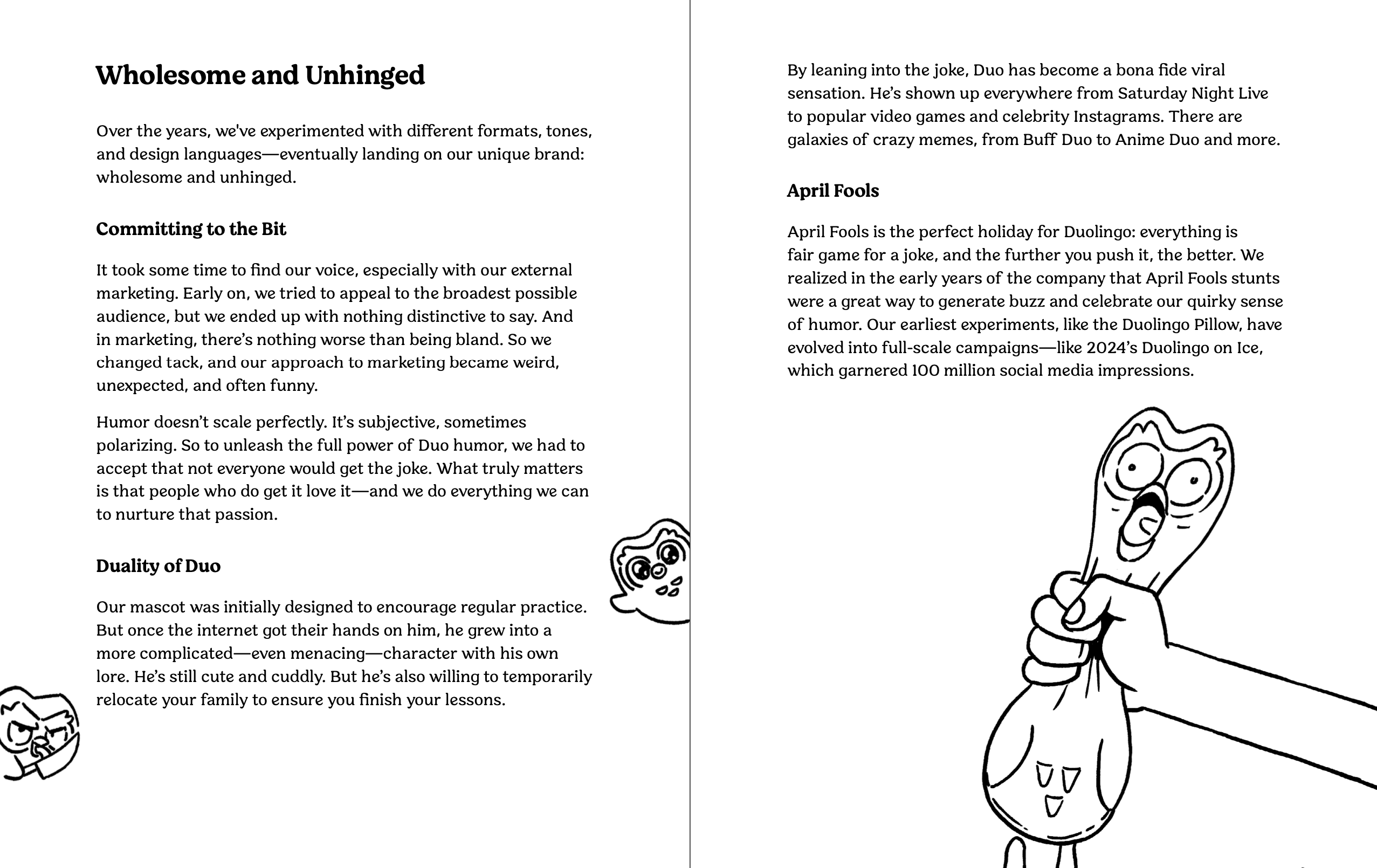
The @duolingo team just published their internal handbook sharing how they build product, hire, experiment, and build a brand around "wholesome and unhinged" 🤣👏👌 Lots of good ideas to borrow/steal for your own team. Check it out: blog.duolingo.com/handbook/
68
1,056
92
10,776
1,541,813
C.S. Lewis explains how a few friends getting together in the same room can—and often has—changed the world
19
181
23
1,247
82,236
Stuart Cerne retweeted
My 8000-word note on agents: huyenchip.com//2025/01/07/ag… Covering: 1. An overview of agents 2. How the capability of an AI-powered agent is determined by the set of tools it has access to and its capability for planning 3. How to select the best set of tools for your agent 4. Whether LLMs can plan and how to augment a model’s capability for planning 5. Agent’s failure modes AI-powered agents are an emerging field with no established theoretical frameworks for defining, developing, and evaluating them. This post is a best-effort attempt to build a framework from the existing literature, but it will evolve as the field does. As always, feedback is much appreciated!
85
468

46
2,983
461,108
Stuart Cerne retweeted
By VC standards we should either "conquer the world or die in a fire" and neither of these are spiritually compelling for me. I never wanted a company I just wanted a home. At this point we have a large and loyal paid community, we build tons of features for them (I think we did >30 releases this year) and they're pretty happy. We have enough revenue to fund tons of crazy R&D and our models are still the best by the metrics we care about (how the images look and how fun it is to make things). We have a huge backlog of exciting things to make our models way better. Zero risk. We did all this with no investors. Honestly, it feels like we are successful. The next metric of success I think about most about is now that we have "all I ever wanted" in terms of a big well funded R&D lab with cool people free to work on whatever we want... Can we now build something that would make baby David proud? And can we tell bold stories about a human future that people want to be a part of? I think we can.
262
556
333
5,880
719,225
Stuart Cerne retweeted
Why @obsdmd is 100% user-supported and not backed by VC investors: 1. We want to stay small, we don't need to hire lots of people 2. We follow strict principles that we do not want compromise 3. Our users are happy to support us, we don't need VC money Obsidian will not exist forever, no app will. However, the files you create in Obsidian are yours, and can hopefully last for generations. VCware is built with a five year horizon, it is not built to live on for decades. Many startup founders raise VC money because they need the upfront capital to build their product, or they see it as a shortcut to growth. For some products the capital truly is necessary, but too often it's fueled by impatience and the inertia of Silicon Valley. In the short term, VCware tends to subsidize pricing to acquire users. It's easier to grow if your product is cheap or free. But this generally comes at the cost of hoarding user data, and locking in customers. Once you're in you can't get out. To keep raising money, VCware must paint an increasingly enormous vision of their future, which becomes impossible to live up to. This leads to increasingly disparate priorities that gradually make the product worse. What starts off as a useful app become burdened with crap. Eventually all VCware must exit. That means being acquired or going public to pay back investors. It's expected that 9 out 10 startups will fail. That's just part of the math in a VC portfolio. The startups that have big exits pay for the ones that fail. It is now possible for tiny teams to make principled software that millions of people use, unburdened by investors. Principled apps that put people in control of their data, their privacy, their wellbeing. These principles can be irrevocably built into the architecture of the app. Principled people have always been able to make principled software. The difference is that now you need far less money and far fewer employees to reach far more customers. That wave is only just beginning. If you have principles and enough patience, being 100% user-supported is by far the most fun way to build.
61
372
132
3,623
840,834