
Professor of Bioinformatics at University of California, Irvine
Irvine, CA
Joined July 2010
- Tweets27
- Following55
- Followers813
- Likes18

Wei Li retweeted

Now online! A genome-wide spectrum of tandem repeat expansions in 338,963 humans dlvr.it/T576KX

Thrilled to share our UCI TR-gnomAD published in Cell today: cell.com/cell/fulltext/S0092…. UCI TR-gnomAD is the first biobank-scale genetic reference for ~1.0M Tandem Repeat (TR) expansions across 340K humans, facilitating TR-based disease association studies and clinical diagnostics


Our new paper @NatureComms performed the first Alternative polyadenylation transcriptome-wide association study for 11 brain disorders with 17,300 RNA-seq samples. We identified 354 novel APA-linked risk genes including ATXN3 for ALS.
nature.com/articles/s41467-0… – at Irvine, CA
Wei Li retweeted

Ultimately, adjusting hidden covariates or not examines different DE effects (conditional vs marginal). But regardless of this difference, I still think no DE genes are expected be found (in the average sense) from permuted samples where conditional labels are randomly shuffled.

Wei Li retweeted
We thank @borishej et al for sending us the draft of their correspondence on May 3. Here is a threshold of key points in our reply sent on that day. 1/ The main message of our article is that using popular methods without a sanity check may lead to inflated FDR.
Wei Li retweeted

Study of false positives when calling differentially expressed genes, from @YM123411, @ge_xinzhou, @FanglueP, @superweili & @jsb_ucla. With population-scale sample sizes, common methods have inflated FDR. The authors suggest using Wilcoxon rank-sum test genomebiology.biomedcentral.…
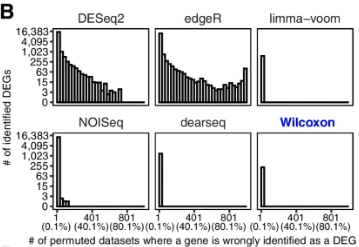
ALT Graphs of number of identified DEGs versus number of datasets where a gene is wrongly identified as a DEG for six different methods
Wei Li retweeted

Population-scale genetic control of alternative polyadenylation and its association with human diseases
journal.hep.com.cn/qb/EN/10.…
Our new scDaPars tool for single-cell alternative polyadenylation is published
@genomeresearch
genome.cshlp.org/content/ear…
Wei Li retweeted

💥An atlas of alternative polyadenylation quantitative trait loci contributing to complex trait and disease heritability | by Eric J. Wagner & Wei Li and colleagues
Find it here 👇@NatureGenet
go.nature.com/2SF8aCU

Wei Li retweeted

Congratulations to @mourisl on the great improvement on the TRUST algorithm! github.com/liulab-dfci/TRUST…


1/6
Our lab has developed the TRUST method to recover T/B-cell receptors from RNA-seq data. We present its new version TRUST4 in the @naturemethods paper, with features of better CDR3 accuracy, full-length assembly, and supporting single-cell data. nature.com/articles/s41592-0…
Super excited to share our recent work on 3′UTR alternative polyadenylation (APA) quantitative trait loci (3′aQTLs), which can explain ~16.1% GWAS SNPs and are largely distinct from eQTLs. Wonderful collaborations with @Wagnerlab_RNA @LeiLi_bioinfo
nature.com/articles/s41588-0…
Excited to share our new paper: Cellular Heterogeneity–Adjusted cLonal Methylation (CHALM) improves prediction of gene expression
nature.com/articles/s41467-0…

Our cancer driver gene prediction paper is finally online. advances.sciencemag.org/cont…
Wei Li retweeted
Twenty years of Genome Biology. Quite honored that our MACS is one of the top papers published in the last two decades, together with Bowtie, DESeq, TopHat2, SCANPY, DAVID, and BioConductor!
genomebiology.biomedcentral.…

Wei Li retweeted
Super Excited to share our new pre-print describing the first atlas of human 3'QTLs, i.e. ~0.4 million genetic variants associated with APA of target genes across 46 #GTEx tissues. @FanglueP @Wagnerlab_RNA @superweili biorxiv.org/content/10.1101/…

Wei Li retweeted

Congratulations @XShirleyLiu !!! Well deserved and long overdue!!

February 25, 2019: ISCB Congratulates and Introduces the 2019 Class of Fellows!
iscb.org/iscb-news-items/390…
Nice work – at Pearland, TX

Our new paper is online at Nature! Tumor-suppressor genes are often inactivated through changes in mRNA processing that enable expression of truncated proteins. This mechanism of inactivation does not require DNA mutations in the affected genes. rdcu.be/5iTD


Homeobox oncogene activation by pan-cancer DNA hypermethylation genomebiology.biomedcentral.…
