

https://teapawt.net/t.co/YUMx3wnGzg
Joined March 2024
- Tweets34
- Following142
- Followers235
- Likes81




Pinned Tweet
Can we forecast benchmark accuracy from models that score zero?
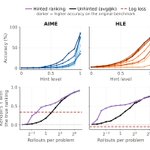
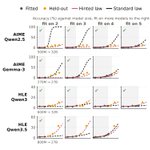
We (co-leads @LukeBailey181 @rckpudi) turn a benchmark into a series of easier hinted versions. Jointly modeling scale C and hint level H enables forecasting GSM8K acc (H=0) within 3 pts from 5600x less compute 🧵

These watermarks let you estimate how much text is AI written across a population while limiting what any single text reveals. This would be super societally beneficial to have in place!

Anthropic and OpenAI will watermark their responses.
Yet this violates user privacy and incentivizes users to paraphrase away the watermark. A lose for both sides!
Instead, we rethink the incentive structure, and propose to shift the AI provenance goal from individual tracking to estimating aggregate AI usage.
We develop locally differentially private watermarks which provably limit the evidence that any individual text can contribute to detection, while still enabling accurate estimation of population prevalence of watermarked texts.

Suze van Adrichem retweeted

Anthropic and OpenAI will watermark their responses.
Yet this violates user privacy and incentivizes users to paraphrase away the watermark. A lose for both sides!
Instead, we rethink the incentive structure, and propose to shift the AI provenance goal from individual tracking to estimating aggregate AI usage.
We develop locally differentially private watermarks which provably limit the evidence that any individual text can contribute to detection, while still enabling accurate estimation of population prevalence of watermarked texts.
Suze van Adrichem retweeted

really love this idea of using privileged info to predict scaling laws for weak models!

Can we forecast benchmark accuracy from models that score zero?
We (co-leads @LukeBailey181 @rckpudi) turn a benchmark into a series of easier hinted versions. Jointly modeling scale C and hint level H enables forecasting GSM8K acc (H=0) within 3 pts from 5600x less compute 🧵
Suze van Adrichem retweeted

How well do you understand training dynamics for deep nets?
Here’s a CS312 (Deep Learning Alchemy) prediction question: midway through training an LM, we temporarily lower the learning rate and then restore it. How does validation loss change relative to the original run? ↓
We train a 35M-parameter LM with a WSD learning-rate schedule (peak LR 0.003, tuned roughly to be optimal for this setting). Consider two different learning rate schedules
A short LR drop: between 40-50% of training, dropping to 0.1x the original LR.
A longer, shallower LR drop: between 35-55%, dropping to 0.55x the original LR.
These LR drops are matched so that the total sum of the removed LRs is the same in both.
How does the shape of the dip affect validation loss during the dip and after the LR returns?
The image shows four qualitative predictions.
A: The deeper LR drop leads to a larger loss drop and a large penalty after
B: A deeper LR drop leads to a large temporary loss drop, but both match soon after.
C: Both LR drops keep the loss curve monotone, but a larger LR drop leads to slower progress
D: The deeper LR drop leads to a larger temporary loss drop, and this gain persists long term
Try the full quiz: deep-learning-alchemy.github…

Suze van Adrichem retweeted

Scaling laws depend on a metric that improves gradually with scale in order to extrapolate to a large target scale. We are interested in the accuracy metric, but you might get zero accuracy for small models. You can't extrapolate from a bunch of zeros.
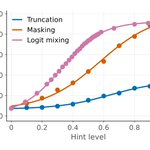
Key idea: introduce a *hint* level, and fit a joint scaling law Accuracy(scale, hint) = ... More hinting makes the problem easier in a controlled way, so accuracy is no longer zero, allowing for extrapolation! Learn more below.
Can we forecast benchmark accuracy from models that score zero?
We (co-leads @LukeBailey181 @rckpudi) turn a benchmark into a series of easier hinted versions. Jointly modeling scale C and hint level H enables forecasting GSM8K acc (H=0) within 3 pts from 5600x less compute 🧵
Suze van Adrichem retweeted

Figuring out principled AI equivalents of wind tunnels, model organisms, tabletop experiments (etc.) is critical for academia to keep advancing our understanding of AI in an era of massive compute.
Very cool work from @suze_va, @LukeBailey181, @rckpudi et al. using Delphi!
Can we forecast benchmark accuracy from models that score zero?
We (co-leads @LukeBailey181 @rckpudi) turn a benchmark into a series of easier hinted versions. Jointly modeling scale C and hint level H enables forecasting GSM8K acc (H=0) within 3 pts from 5600x less compute 🧵
Suze van Adrichem retweeted
A great method that extracts more signal about model capabilities at a low cost!
Can we forecast benchmark accuracy from models that score zero?
We (co-leads @LukeBailey181 @rckpudi) turn a benchmark into a series of easier hinted versions. Jointly modeling scale C and hint level H enables forecasting GSM8K acc (H=0) within 3 pts from 5600x less compute 🧵
Suze van Adrichem retweeted
We can't improve what we can't measure, and LM safety and capabilities are limited by a lack of scaling laws for advanced abilities.
Scaling up past 'emergence' can work, but can be wildly costly. Instead of scaling up the model, what if we could scale down the evals?
Can we forecast benchmark accuracy from models that score zero?
We (co-leads @LukeBailey181 @rckpudi) turn a benchmark into a series of easier hinted versions. Jointly modeling scale C and hint level H enables forecasting GSM8K acc (H=0) within 3 pts from 5600x less compute 🧵
Suze van Adrichem retweeted

The last paper from my PhD is finally out! Check out @suze_va's great thread and this talk I gave a few weeks back. Also a couple more takeaways in 🧵 below
Zoom link: stanford.zoom.us/rec/share/f…
Passcode: FZfpZ1p&

Can we forecast benchmark accuracy from models that score zero?
We (co-leads @LukeBailey181 @rckpudi) turn a benchmark into a series of easier hinted versions. Jointly modeling scale C and hint level H enables forecasting GSM8K acc (H=0) within 3 pts from 5600x less compute 🧵
Suze van Adrichem retweeted

I'm really excited about benchmark hinting. It is a general method to "scale down" the complexity of a task distribution. We use this to create better forecasts of model capabilities. One can imagine using the method to control other aspects of task distributions we care about.
Can we forecast benchmark accuracy from models that score zero?
We (co-leads @LukeBailey181 @rckpudi) turn a benchmark into a series of easier hinted versions. Jointly modeling scale C and hint level H enables forecasting GSM8K acc (H=0) within 3 pts from 5600x less compute 🧵
Suze van Adrichem retweeted

A super elegant idea to use privileged information to fit smooth task-specific scaling laws!!
Really awesome and exciting work!
Can we forecast benchmark accuracy from models that score zero?
We (co-leads @LukeBailey181 @rckpudi) turn a benchmark into a series of easier hinted versions. Jointly modeling scale C and hint level H enables forecasting GSM8K acc (H=0) within 3 pts from 5600x less compute 🧵
Suze van Adrichem retweeted

One step closer to fully end to end scaling laws from pretraining to posttraining!
Can we forecast benchmark accuracy from models that score zero?
We (co-leads @LukeBailey181 @rckpudi) turn a benchmark into a series of easier hinted versions. Jointly modeling scale C and hint level H enables forecasting GSM8K acc (H=0) within 3 pts from 5600x less compute 🧵
Suze van Adrichem retweeted

Magic actually exists!
Can we forecast benchmark accuracy from models that score zero?
We (co-leads @LukeBailey181 @rckpudi) turn a benchmark into a series of easier hinted versions. Jointly modeling scale C and hint level H enables forecasting GSM8K acc (H=0) within 3 pts from 5600x less compute 🧵
Suze van Adrichem retweeted

Hinting is a really cool new primitive for building downstream task scaling laws and more
Awesome work by @suze_va @LukeBailey181 @rckpudi and team!
Can we forecast benchmark accuracy from models that score zero?
We (co-leads @LukeBailey181 @rckpudi) turn a benchmark into a series of easier hinted versions. Jointly modeling scale C and hint level H enables forecasting GSM8K acc (H=0) within 3 pts from 5600x less compute 🧵
9/10 There is lots more information in the paper, including how pass@k can be considered a hinting method and how our hinting methods forecast better than it. Paper link again:
Paper: arxiv.org/abs/2611.02270
Code: github.com/tatsu-lab/hinted-…

10/10 I am eternally grateful to my collaborators and mentors without whom this project would never have happened!
@LukeBailey181, @rckpudi, @christinexye, @neilbband, @AhmedSQRD and advisors John Duchi, @percyliang and @tatsu_hashimoto