

Scientist 👨🏻🔬 @tronmainz . Regenerative approaches for heart failure 🫀Climber 🧗♂️Cyclist 🚲
Mainz, Deutschland
Joined April 2017
- Tweets108
- Following358
- Followers217
- Likes444






Tim Stüdemann retweeted

🫀 Dr. Tim Stüdemann at @DZHK_germany and team demonstrates that transplanted cardiomyocytes can electrically couple to the host myocardium and stimulate the recipient heart.
bit.ly/4dmq41j
And it’s out:
doi.org/10.1016/j.stemcr.202…
In this small study we show that engrafted iPSC cardiomyocytes can initiate an impulse that leads to whole ventricular contraction. These results highlight to watch out for graft-induced arrhythmia!
@weinberf @SimWieg
New preprint! We use optogenetic iPSC-cardiomyocytes to override the host cardiac rhythm after transplantation. This is experimental evidence that engrafted cardiomyocytes can cause ventricular arrhythmia!
biorxiv.org/content/10.1101/…
@weinberf @SimWieg @dzhk_germany @UKEHamburg

Happy to share our latest work, an in-depth characterisation of optogenetic BiPOLES to alter cardiomyocyte electrophysiology!
link.springer.com/article/10…
@weinberf @SimWieg @Pan_Bangfen @dzhk_germany @YoungDZHK @UKEHamburg
Tim Stüdemann retweeted

📢Come and join us, @LabSinha are recruiting 2 exciting opportunities for post doc research associates.
Apply before 6 November here:
jobs.cam.ac.uk/job/43305/
and
jobs.cam.ac.uk/job/43293/
Tim Stüdemann retweeted
BioNTech has always been deeply rooted in academia. #STEM grads can now explore #science projects and apply for a full-time contract via our ATLAS #PhD program, a collab with TRON. Students with a sweet spot for #biomedical #research can apply by Oct 31. atlas-phdprogram.com/how-to-…
Thinking about doing a PhD? Become a member of the @JKimLaboratory at @tronmainz to work on translational therapies for heart repair! Check out project P02! We will be employing RNA to improve iPSC derived cardiomyocyte therapy for heart repair 🫀
atlas-phdprogram.com/project…
Tim Stüdemann retweeted

Interested in #neurocardiac interactions? If so check out our preprint human #engineered innervated muscle from #iPS cells. A project supported by @dfg_public @MBExC_de @dzhk_germany. Thank you @lennberto @pharmaumg @lab_fischer for the amazing effort.
biorxiv.org/content/10.1101/…
Tim Stüdemann retweeted

I took 1 star reviews of #Barbie from furious men on letterboxd and put them on the posters because it makes the film seem ever cooler.


Tim Stüdemann retweeted

How hard is it to do science in a language that’s not your first language? We quantified the severity of #languagebarriers for non-native English speakers when reading/publishing papers and attending/presenting at international conferences.
doi.org/10.1371/journal.pbio…
1/9

Tim Stüdemann retweeted

Wir sind zutiefst betroffen und traurig: DZHK-Professorin Jeanette Erdmann ist am 8. Juli 2023 plötzlich verstorben. Sie war eine fabelhafte Wissenschaftlerin und ein wundervoller Mensch. Unser Mitgefühl gilt den Angehörigen. Wir werden sie nie vergessen. 🖤

Jetzt online: Abenteuer Diagnose #59 "Die Forscherin und das Geheimnis der Zebrafische" ist in der ARD Audiothek, auf der Visite-Website und bei Apple Podcasts zu finden. #COL6 @UKSH_KI_HL @UniLuebeck @cardiogenetics @dzhk_germany #DGM
1.ard.de/AD_F59_DieForscheri…

Happy to announce that I have recently started working @tronmainz in the newly founded Center of Cardiovascular Immunology and Regeneration 🫀🧬👨🏻🔬 Lots of exciting cardio and vascular science to come

Tim Stüdemann retweeted

BIG NEWS: @helmholtz_de has decided to establish the Helmholtz Institute for Translational AngioCardioScience (HI-TAC) as a branch of the @MDC_Berlin on the campus of @UniHeidelberg. This marks a new era for CV research in Germany! Many new exciting jobs (helmholtz.de/newsroom/artike…)

Tim Stüdemann retweeted

Fun fact: the European Hedgehog (Erinaceus europaeus) fluoresces under ultraviolet light! Wild blues and pinks. Taken this evening in my backyard while looking for fluorescent flowers.
Love the cedar twig hair decoration, one stylish ‘hog.


Tim Stüdemann retweeted

We’re excited to extend noninvasive optogenetics beyond the brain to address a nearly 150-year-old question in a new study out today @Nature:
nature.com/articles/s41586-0…
Work led by @HsuehBrian, myself, and @KarlDeisseroth, with an amazing team in the D-lab and many others!

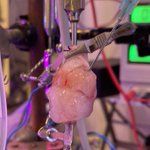
Newly set up ECG on our Langendorff device! This is a Guinea pig heart 9 weeks after injury (pale area) with transplanted iPSC-cardiomyocytes


