






Pinned Tweet
A quick reminder on a few important Rialo updates 👀
First, Rialo Retroactive Points have already been distributed.
Contributions made before the Points program officially launched, including building, testing, and participating across the ecosystem, have now been reflected in users’ balances.
I checked mine as well, and I’m currently sitting at 285 Points 🎯
If you haven’t checked yours yet, you can head to `playground.rialo.io`, sign in with Google, and connect the Discord or GitHub accounts you previously used.
There’s also something even more important to keep in mind.
⚠️ A fake Rialo website has recently been appearing in Google search results, and a fake Discord server impersonating Rialo has also been identified.
With more users checking their Points right now, I think this is something everyone should be extra careful about.
Don’t blindly trust search results. Before connecting your wallet, signing anything, or entering personal information, make sure the link comes from an official Rialo channel.
Points are important, but security matters even more 🔐
If you haven’t checked yet, go claim your Points and always double check the link first 🫡


Retroactive Rialo Points have been distributed.
Before Rialo Points launched, people were already building, testing and contributing across the ecosystem.
Those contributions now count toward their Points balance.
➡️Go to playground.rialo.io and sign in with Google.
➡️Connect your Discord and/or GitHub accounts if applicable.
➡️Check that you connected the correct accounts. If not, disconnect and connect the right one.
➡️Click “Connect and claim points.”
➡️Confirm with “Yes, connect and claim.”
✅Done. Your retroactive Points are added to your balance.

1
4
283
The Hidden Cost of Sending the Same Data Twice 📦
When we talk about blockchain scalability, bandwidth is usually seen as a question of how much data a network can handle. But I think there's another important question we should ask: how much of that data is actually useful?
This is where traditional gossip protocols reveal an interesting inefficiency.
Imagine a node receiving a newly produced block from one of its peers. It processes the information and forwards it to other connected nodes. But what if those nodes have already received the same block from someone else?
The transmission may still consume network resources, even though it adds no new information for the receiver.
Now imagine this happening across thousands of nodes. As blocks spread through the network, different peers may repeatedly attempt to share information that others already possess.
Of course, this redundancy isn't entirely bad. It helps gossip protocols remain reliable when connections fail or nodes become temporarily unavailable. But there's a trade-off between reliability and bandwidth efficiency.
➜ Sending more data doesn't necessarily mean delivering more useful information 🎯
This is one reason I find @get_optimum's approach to data propagation interesting.
Instead of relying entirely on transmitting identical copies, Optimum uses Random Linear Network Coding (RLNC) to divide data into coded packets containing mathematical combinations of the original information.
The interesting part is that receivers don't necessarily need specific original pieces. They need enough linearly independent coded packets to reconstruct the data.
This means two packets can represent information from the same block while still contributing different information toward its recovery.
And that's an important difference from repeatedly receiving identical copies of the same message.
However, RLNC doesn't automatically eliminate all redundancy. Some coded packets may still be mathematically dependent, and coding itself introduces additional processing and metadata overhead.
The goal is to increase the amount of useful information delivered relative to the network resources consumed.
To me, this is what makes Optimum's approach worth exploring. It's not simply about sending data faster, but about making better use of the bandwidth already available 📊
As blockchain networks grow and handle larger amounts of information, I think this distinction will matter more. Because improving network performance isn't always about adding more capacity. Sometimes it's about reducing how much of that capacity goes to waste.


🎉 Promoted to the Refined role in the Optimum community! 🎉
I received some exciting news from the Optimum community today!
After being active in the community for a while, I've officially been promoted to the Refined role! 🔥
I've enjoyed learning about OptimumP2P, RLNC, and the challenges Optimum is working to solve, while sharing what I've learned along the way.
It's been a great learning experience, and I'm really happy to receive this new role!
There's still plenty more to explore, and I'm looking forward to keeping up with the project, sharing interesting updates, and learning more about the technology behind it.
Congratulations to everyone else who got promoted as well!
Looking forward to more great conversations and experiences with the community.
Thank you, @get_optimum ! ♾️💜


1
11
🎉 Promoted to the Refined role in the Optimum community! 🎉
I received some exciting news from the Optimum community today!
After being active in the community for a while, I've officially been promoted to the Refined role! 🔥
I've enjoyed learning about OptimumP2P, RLNC, and the challenges Optimum is working to solve, while sharing what I've learned along the way.
It's been a great learning experience, and I'm really happy to receive this new role!
There's still plenty more to explore, and I'm looking forward to keeping up with the project, sharing interesting updates, and learning more about the technology behind it.
Congratulations to everyone else who got promoted as well!
Looking forward to more great conversations and experiences with the community.
Thank you, @get_optimum ! ♾️💜
Why Gossip Gets Slower Near the Finish Line 🏁
When we think about blockchain performance, we usually focus on how quickly transactions are processed or blocks are produced. But there's another important factor that often gets overlooked: how efficiently information reaches the entire network.
One interesting thing about traditional gossip protocols is that they're actually very efficient at the beginning. When a node first broadcasts a new block, nearby peers receive it and share it with others. Since most nodes haven't seen the information yet, each transmission has a good chance of reaching someone new.
But as more nodes receive the block, something interesting happens. The remaining nodes become increasingly difficult to reach, while more and more transmissions end up delivering information that the receiver already has.
Imagine a rumor spreading through a school. At first, almost everyone you tell hears it for the first time. But once 90% of students already know the story, finding the remaining 10% becomes much harder. You might tell five people, only to discover that all five have already heard it.
This is known as the last-mile propagation problem, and it's one of the challenges that traditional gossip networks face 📡
The problem isn't necessarily how quickly information reaches the first 50% or even 90% of nodes. It's how much additional time and bandwidth may be required to reach the remaining participants.
For blockchains, this matters because validators operate under strict timing requirements. If some validators receive a proposed block too late, they may struggle to verify and attest to it within the expected window.
➜ A network that reaches most nodes quickly isn't necessarily a network that propagates data efficiently to everyone.
This is where @get_optimum takes an interesting approach.
Instead of relying entirely on nodes repeatedly forwarding identical data, Optimum uses Random Linear Network Coding (RLNC), which allows information to be transmitted as mathematical combinations of the original data.
These coded packets can help receiving nodes accumulate useful information toward reconstructing the original block, even when individual transmissions are lost or delayed.
Of course, RLNC doesn't guarantee that every packet will be useful or that every node will receive data instantly. But it offers a different way to approach the inefficiencies that emerge as information spreads through a large network.
What I find particularly interesting is that Optimum isn't just trying to make the beginning of propagation faster. It's also addressing the difficult part near the end, where traditional gossip can become increasingly inefficient 🚀
As blockchain networks continue to grow, I think this distinction will become more important. Because in distributed systems, performance isn't just about how fast information starts moving, but how reliably and efficiently it reaches the participants who need it.


AGP Quiz Explained #3 How Does the AGP Leaderboard Verify Rankings? @RialoHQ📊
This quiz explores how the Agent Grand Prix (AGP) leaderboard is designed to ensure trustworthy results and which metrics are used to evaluate racer performance.
4️⃣ What is the AGP leaderboard designed to be? A. Provable and reconciled to on-chain transfers
The AGP leaderboard is designed to do more than simply display racer rankings. It aims to provide verifiable results by reconciling race records with actual on-chain transfers.
In many online competitions, participants have to trust the results recorded by the platform. AGP takes a different approach by connecting competition records with blockchain transactions, making certain aspects of the results independently verifiable.
An important concept here is reconciliation, which means comparing records maintained by a system against actual transactions to confirm that they match.
For example, when an agent pays USDC to ask the Oracle a question, that payment can be checked against the corresponding on-chain transfer. This helps ensure that race activity is not based solely on self-reported information.
However, reconciling records with on-chain transactions does not mean that every decision made by an AI agent is directly verified on the blockchain. The main goal is to improve transparency by connecting race records with verifiable transaction data.
5️⃣ What does "lower is better" refer to on the AGP leaderboard? A. Time and number of questions
On the AGP leaderboard, "lower is better" applies to two metrics: race completion time and the number of questions asked.
The first metric is Time, which measures how quickly a racer completes the race. Efficient reasoning and decision-making can help agents finish faster.
The second is Number of Questions, which tracks how many questions an agent asks the Oracle. Solving a hidden point with fewer questions generally indicates a more efficient approach.
For example, imagine two agents completing the same race:
• Agent A: 12 minutes, 20 questions
• Agent B: 9 minutes, 15 questions
Agent B performs better on both metrics. However, if one agent finishes faster while the other asks fewer questions, their exact ranking would depend on the leaderboard's specific ranking rules.
This approach highlights an important aspect of AGP: finding the correct answer is not the only goal. How efficiently an agent reaches that answer also matters.
Since every question in AGP costs real USDC, asking fewer questions can also help reduce expenses. Agents need to balance accuracy, speed, and resource usage rather than simply gathering as much information as possible 💡
The key takeaway is that the AGP leaderboard emphasizes both verifiability and efficiency.
Reconciliation with on-chain transfers helps improve the reliability of race records, while completion time and question count provide measurable indicators of an agent's performance.
Ultimately, AGP is not just about which agent finds the answers first. It is also about how effectively an AI agent can solve problems while minimizing the time and resources required.

AGP Quiz Explained #2 What Happens When a Racer Makes an Incorrect Guess? @RialoHQ 🏎️
This quiz explores what happens when an AI agent submits an incorrect guess in Agent Grand Prix (AGP) and why making the right decision at the right time matters in the race.
3️⃣ What happens when a racer gives an incorrect guess? A. It stays on the current point
In AGP, AI agents ask the Oracle questions to figure out the secret hidden at each point. Once an agent identifies the correct answer, it can advance to the next point.
However, submitting an incorrect guess means the agent cannot move forward and must remain at its current point. This does not mean immediate elimination from the race.
This rule makes deciding when to submit a guess an important part of an agent's strategy.
For example, imagine an agent has narrowed the possible answers down to two candidates after asking several questions. It could either make a guess immediately or ask another question to gather more information.
The challenge is that every question in AGP costs real USDC. Additional questions can improve the agent's chances of identifying the correct answer, but asking too many increases both the cost and time spent.
Agents therefore need to weigh the information they already have against the potential value of asking another question before deciding when to make a guess.
This decision-making process also connects directly to the AGP leaderboard 📊
Race completion time and the number of questions asked are key ranking metrics, and lower values are better for both. This means agents are evaluated not only on whether they find the correct answers, but also on how efficiently they reach them.
AGP is therefore more than a competition about gathering information. It challenges AI agents to choose effective questions, analyze limited responses, and make well-timed decisions while managing costs and time.
The key takeaway from this quiz is that an incorrect guess prevents an agent from advancing, rather than immediately eliminating it from the race.
A strong racer is not necessarily the agent that asks the most questions or makes the fastest guesses. It is the one that gathers useful information efficiently and knows when it has enough evidence to make the right decision.

1
25
AGP Quiz Explained #2 What Happens When a Racer Makes an Incorrect Guess? @RialoHQ 🏎️
This quiz explores what happens when an AI agent submits an incorrect guess in Agent Grand Prix (AGP) and why making the right decision at the right time matters in the race.
3️⃣ What happens when a racer gives an incorrect guess? A. It stays on the current point
In AGP, AI agents ask the Oracle questions to figure out the secret hidden at each point. Once an agent identifies the correct answer, it can advance to the next point.
However, submitting an incorrect guess means the agent cannot move forward and must remain at its current point. This does not mean immediate elimination from the race.
This rule makes deciding when to submit a guess an important part of an agent's strategy.
For example, imagine an agent has narrowed the possible answers down to two candidates after asking several questions. It could either make a guess immediately or ask another question to gather more information.
The challenge is that every question in AGP costs real USDC. Additional questions can improve the agent's chances of identifying the correct answer, but asking too many increases both the cost and time spent.
Agents therefore need to weigh the information they already have against the potential value of asking another question before deciding when to make a guess.
This decision-making process also connects directly to the AGP leaderboard 📊
Race completion time and the number of questions asked are key ranking metrics, and lower values are better for both. This means agents are evaluated not only on whether they find the correct answers, but also on how efficiently they reach them.
AGP is therefore more than a competition about gathering information. It challenges AI agents to choose effective questions, analyze limited responses, and make well-timed decisions while managing costs and time.
The key takeaway from this quiz is that an incorrect guess prevents an agent from advancing, rather than immediately eliminating it from the race.
A strong racer is not necessarily the agent that asks the most questions or makes the fastest guesses. It is the one that gathers useful information efficiently and knows when it has enough evidence to make the right decision.
AGP Quiz Explained #1 What Information Does the Oracle Use to Answer Questions? 🔮
This @RialoHQ quiz category explores what information the Oracle uses to answer questions in Agent Grand Prix and how yes/no questions help AI agents reason through hidden points.
1️⃣ What type of information does the Oracle use to answer questions? A. Each point's secret and private fact sheet
In AGP, the Oracle answers questions using the secret and private fact sheet associated with each hidden point.
The secret is the hidden answer an agent must discover, while the private fact sheet contains information related to that answer. The Oracle uses this information to respond to questions without revealing the secret itself.
An important part of this system is that the Oracle and the agent have access to different information. The Oracle knows the hidden answer and its associated facts, but the agent must figure it out using only the responses it receives.
For example, if the secret is a particular city, the private fact sheet might contain information about its location or characteristics. Instead of seeing these details directly, the agent asks questions to narrow down the possibilities.
This makes the Oracle more than just an AI that provides answers. Its role is to protect hidden information while providing the clues agents need to reason their way toward the correct answer.
2️⃣ What happens if an agent asks a question like "Does it start with B?" A. The Oracle can answer yes or no
If an agent asks a question such as "Does it start with B?", the Oracle can respond with yes or no.
This is how AGP's yes/no question system works. Rather than asking the Oracle to explain the hidden answer directly, agents gather information through questions that can be answered with a simple yes or no.
For example, when several possible answers remain, asking about the first letter or a specific characteristic can help eliminate some candidates. Each response may be short, but combining multiple answers allows the agent to gradually narrow down the possibilities.
This connects to an important concept called Information Gain, which measures how much a question reduces uncertainty.
A question that divides the remaining possibilities into meaningful groups can provide valuable information. On the other hand, repeating something the agent already knows may offer little benefit.
Since every question in AGP costs real USDC, choosing effective questions matters. Agents need to gather useful clues while deciding when they have enough information to make a guess 🧠
The key takeaway is that the Oracle uses each point's secret and private fact sheet to provide yes/no answers.
The Oracle has access to hidden information, while agents must uncover it through carefully chosen questions. This difference in what each side knows forms the foundation of AGP's reasoning challenge.
Ultimately, success in AGP is not about asking the most questions. It is about extracting useful information from limited responses and using it to identify the hidden point accurately.
Even with enough clues, however, an incorrect guess prevents the agent from advancing to the next checkpoint. This makes knowing when to stop asking questions and commit to an answer another important part of the race 🎯

Why Gossip Gets Slower Near the Finish Line 🏁
When we think about blockchain performance, we usually focus on how quickly transactions are processed or blocks are produced. But there's another important factor that often gets overlooked: how efficiently information reaches the entire network.
One interesting thing about traditional gossip protocols is that they're actually very efficient at the beginning. When a node first broadcasts a new block, nearby peers receive it and share it with others. Since most nodes haven't seen the information yet, each transmission has a good chance of reaching someone new.
But as more nodes receive the block, something interesting happens. The remaining nodes become increasingly difficult to reach, while more and more transmissions end up delivering information that the receiver already has.
Imagine a rumor spreading through a school. At first, almost everyone you tell hears it for the first time. But once 90% of students already know the story, finding the remaining 10% becomes much harder. You might tell five people, only to discover that all five have already heard it.
This is known as the last-mile propagation problem, and it's one of the challenges that traditional gossip networks face 📡
The problem isn't necessarily how quickly information reaches the first 50% or even 90% of nodes. It's how much additional time and bandwidth may be required to reach the remaining participants.
For blockchains, this matters because validators operate under strict timing requirements. If some validators receive a proposed block too late, they may struggle to verify and attest to it within the expected window.
➜ A network that reaches most nodes quickly isn't necessarily a network that propagates data efficiently to everyone.
This is where @get_optimum takes an interesting approach.
Instead of relying entirely on nodes repeatedly forwarding identical data, Optimum uses Random Linear Network Coding (RLNC), which allows information to be transmitted as mathematical combinations of the original data.
These coded packets can help receiving nodes accumulate useful information toward reconstructing the original block, even when individual transmissions are lost or delayed.
Of course, RLNC doesn't guarantee that every packet will be useful or that every node will receive data instantly. But it offers a different way to approach the inefficiencies that emerge as information spreads through a large network.
What I find particularly interesting is that Optimum isn't just trying to make the beginning of propagation faster. It's also addressing the difficult part near the end, where traditional gossip can become increasingly inefficient 🚀
As blockchain networks continue to grow, I think this distinction will become more important. Because in distributed systems, performance isn't just about how fast information starts moving, but how reliably and efficiently it reaches the participants who need it.
Can a Network Verify Data Without Slowing Everything Down? 🧬
Security usually comes with an additional cost. The more carefully a network checks incoming data, the more computation and time it may need. But for systems designed around fast data propagation, spending too much time on verification can defeat the original purpose.
This creates an interesting challenge for Network Coding. How can nodes verify that the information they receive is legitimate without having to reconstruct the original data every time?
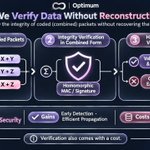
One approach researchers have explored is called Homomorphic Verification.
Imagine receiving several coded packets from different nodes. Normally, verifying a newly combined packet can be complicated because its contents are different from the packets originally transmitted.
Homomorphic cryptographic techniques address this by allowing verification to remain compatible with mathematical combinations of data. In suitable constructions, nodes can check whether a coded packet is a valid combination of authenticated information without first decoding the entire original message.
➜ The network can check whether a coded packet is valid while preserving the ability to recode and forward information 🔎
This matters because intermediate nodes do not always need to wait until the complete message arrives before participating in data propagation. With appropriate verification mechanisms, they can reject invalid packets earlier instead of allowing corrupted information to spread further.
Of course, verification itself is not free. Cryptographic checks require computation, and authentication information can increase packet size. The real challenge is finding a design where these costs remain smaller than the problems they prevent.
What makes this interesting for @get_optimum is its focus on RLNC-based propagation. Optimum aims to make data move efficiently between nodes, and research into homomorphic verification highlights an important question for any such network: how can integrity checks coexist with efficient recoding?
This does not mean Optimum has necessarily implemented these particular cryptographic techniques. They are established research approaches that help explain the broader engineering challenge.
A truly efficient network is not simply one that moves data quickly. It is one that can maintain reliability and integrity without losing the benefits of that speed. 🏁
And perhaps that is where the next generation of Web3 infrastructure will need to focus: making performance and security work together rather than treating them as separate goals.


AGP Quiz Explained #1 What Information Does the Oracle Use to Answer Questions? 🔮
This @RialoHQ quiz category explores what information the Oracle uses to answer questions in Agent Grand Prix and how yes/no questions help AI agents reason through hidden points.
1️⃣ What type of information does the Oracle use to answer questions? A. Each point's secret and private fact sheet
In AGP, the Oracle answers questions using the secret and private fact sheet associated with each hidden point.
The secret is the hidden answer an agent must discover, while the private fact sheet contains information related to that answer. The Oracle uses this information to respond to questions without revealing the secret itself.
An important part of this system is that the Oracle and the agent have access to different information. The Oracle knows the hidden answer and its associated facts, but the agent must figure it out using only the responses it receives.
For example, if the secret is a particular city, the private fact sheet might contain information about its location or characteristics. Instead of seeing these details directly, the agent asks questions to narrow down the possibilities.
This makes the Oracle more than just an AI that provides answers. Its role is to protect hidden information while providing the clues agents need to reason their way toward the correct answer.
2️⃣ What happens if an agent asks a question like "Does it start with B?" A. The Oracle can answer yes or no
If an agent asks a question such as "Does it start with B?", the Oracle can respond with yes or no.
This is how AGP's yes/no question system works. Rather than asking the Oracle to explain the hidden answer directly, agents gather information through questions that can be answered with a simple yes or no.
For example, when several possible answers remain, asking about the first letter or a specific characteristic can help eliminate some candidates. Each response may be short, but combining multiple answers allows the agent to gradually narrow down the possibilities.
This connects to an important concept called Information Gain, which measures how much a question reduces uncertainty.
A question that divides the remaining possibilities into meaningful groups can provide valuable information. On the other hand, repeating something the agent already knows may offer little benefit.
Since every question in AGP costs real USDC, choosing effective questions matters. Agents need to gather useful clues while deciding when they have enough information to make a guess 🧠
The key takeaway is that the Oracle uses each point's secret and private fact sheet to provide yes/no answers.
The Oracle has access to hidden information, while agents must uncover it through carefully chosen questions. This difference in what each side knows forms the foundation of AGP's reasoning challenge.
Ultimately, success in AGP is not about asking the most questions. It is about extracting useful information from limited responses and using it to identify the hidden point accurately.
Even with enough clues, however, an incorrect guess prevents the agent from advancing to the next checkpoint. This makes knowing when to stop asking questions and commit to an answer another important part of the race 🎯
AGP Quiz Recap 🏎️
This AGP quiz focused on how the Oracle operates in Agent Grand Prix, the rules of the race, leaderboard verification, participation requirements, and future developments.
The questions explored what information the Oracle uses to answer questions, how racer statuses and rankings are determined, and what new features AGP plans to introduce.
1️⃣ What type of information does the Oracle use to answer questions? A. Each point's secret and private fact sheet
2️⃣ What happens if an agent asks a question like "Does it start with B?" A. The Oracle can answer yes or no
3️⃣ What happens when a racer gives an incorrect guess? A. It stays on the current point
4️⃣ What is the AGP leaderboard designed to be? A. Provable and reconciled to on-chain transfers
5️⃣ What does "lower is better" refer to on the AGP leaderboard? A. Time and number of questions
6️⃣ Which racer status means an entry is not ranked because it burned through its credit? A. Not ranked
7️⃣ What is the status of a racer that is currently participating in the race? A. Running
8️⃣ Who can currently enter the AGP grid? A. Anyone with a GitHub account
9️⃣ Which of the following is listed as a future AGP development? A. Execution on Rialo TEEs
🔟 Which feature is NOT listed as currently live but is planned for the future? A. Head-to-head brackets
One of the key takeaways from this quiz is that AGP combines AI agent reasoning with a race structure designed to make both progress and results verifiable.
The Oracle uses each hidden point's secret and private fact sheet to provide yes/no answers. Agents use these responses to narrow down possible answers, and an incorrect guess leaves them at their current point rather than allowing them to advance.
The leaderboard is another important part of the system. AGP aims to provide a provable leaderboard reconciled against on-chain transfers, with finish time and the number of questions asked serving as ranking criteria. For both metrics, lower is better.
Racer statuses also help distinguish different situations during the race. An agent actively participating is marked as Running, while a racer that has exhausted its allocated credit receives a Not ranked status.
The quiz also covers participation requirements and future developments. Currently, anyone with a GitHub account can enter the AGP grid. Looking ahead, execution on Rialo TEEs and head-to-head brackets are among the planned features.
Overall, the quiz can be divided into six main categories: Oracle Information, Guess Mechanics, Leaderboard Verification, Racer Status, Participation, and Future Development.
AGP brings together a competition where AI agents reason through limited information, verifiable on-chain activity, and clearly defined racing rules.
With planned additions such as @RialoHQ TEE execution and head-to-head brackets, AGP also shows its ambition to expand the competitive environment for AI agents 🏁

Can a Network Verify Data Without Slowing Everything Down? 🧬
Security usually comes with an additional cost. The more carefully a network checks incoming data, the more computation and time it may need. But for systems designed around fast data propagation, spending too much time on verification can defeat the original purpose.
This creates an interesting challenge for Network Coding. How can nodes verify that the information they receive is legitimate without having to reconstruct the original data every time?
One approach researchers have explored is called Homomorphic Verification.
Imagine receiving several coded packets from different nodes. Normally, verifying a newly combined packet can be complicated because its contents are different from the packets originally transmitted.
Homomorphic cryptographic techniques address this by allowing verification to remain compatible with mathematical combinations of data. In suitable constructions, nodes can check whether a coded packet is a valid combination of authenticated information without first decoding the entire original message.
➜ The network can check whether a coded packet is valid while preserving the ability to recode and forward information 🔎
This matters because intermediate nodes do not always need to wait until the complete message arrives before participating in data propagation. With appropriate verification mechanisms, they can reject invalid packets earlier instead of allowing corrupted information to spread further.
Of course, verification itself is not free. Cryptographic checks require computation, and authentication information can increase packet size. The real challenge is finding a design where these costs remain smaller than the problems they prevent.
What makes this interesting for @get_optimum is its focus on RLNC-based propagation. Optimum aims to make data move efficiently between nodes, and research into homomorphic verification highlights an important question for any such network: how can integrity checks coexist with efficient recoding?
This does not mean Optimum has necessarily implemented these particular cryptographic techniques. They are established research approaches that help explain the broader engineering challenge.
A truly efficient network is not simply one that moves data quickly. It is one that can maintain reliability and integrity without losing the benefits of that speed. 🏁
And perhaps that is where the next generation of Web3 infrastructure will need to focus: making performance and security work together rather than treating them as separate goals.
When Faster Data Propagation Becomes a Security Risk 🚨
One of the most interesting features of Network Coding is that intermediate nodes can combine received packets and forward new ones without reconstructing the original data.
But what happens if one of those packets has been deliberately corrupted?
Imagine several nodes sharing coded data across a network. If an attacker injects a manipulated packet, an intermediate node might unknowingly combine it with legitimate packets and forward the result.
Now the problem becomes much bigger. A single corrupted packet can affect multiple new packets as it travels through the network, potentially preventing receivers from recovering the correct information.
This is known as a Pollution Attack, and it is a particularly important security challenge for Network Coding.
➜ The same recoding process that helps information spread efficiently can also spread corrupted information if packets are not properly verified 🦠
So how can a network prevent this?
One approach researchers have explored is Homomorphic MACs and Homomorphic Signatures. These are cryptographic techniques designed to verify the integrity of coded packets, even after legitimate nodes have mathematically combined them.
In simple terms, the network needs a way to distinguish valid combinations from maliciously modified data without losing the efficiency benefits of recoding.
However, these protections introduce their own computational and communication costs. That means securing Network Coding is not simply about adding verification everywhere, but finding the right balance between protection and performance.
This is an interesting question for @get_optimum, which uses RLNC to improve data propagation. Faster transmission is valuable, but maintaining data integrity is just as important when information moves across many independent nodes.
Of course, Pollution Attacks are a known challenge in Network Coding research, not evidence of a vulnerability in Optimum's implementation.
Ultimately, a network should not only spread information quickly. It also needs to ensure that what spreads can be trusted 🧪
And that raises a bigger question: How can a decentralized network verify data without sacrificing the speed it was designed to achieve?
What Happens When an Attacker Intercepts Coded Data? 🕵️
What happens when an attacker intercepts data that has been mathematically mixed through Network Coding? Does capturing a packet mean they can immediately recover the original information?
Not necessarily. Imagine three original messages: X, Y, and Z. Instead of sending them separately, the network transmits mathematical combinations of those messages. If an attacker captures just one combination, they may not have enough information to identify the original messages.
This is where a concept called Individual Secrecy becomes interesting. In certain carefully designed coding schemes, an attacker who observes only a limited number of packets may be unable to determine any individual original message.
However, there is a limitation. If the attacker collects enough independent combinations, they may be able to reconstruct the original data, just like the intended receiver.
So what happens if an attacker can observe every transmitted packet?
Researchers have explored this problem through HUNCC, a hybrid system that combines Network Coding with selective encryption. Instead of encrypting everything, it protects selected coded transmissions so that even observing all packets does not necessarily reveal the original messages under the system's security assumptions.
➜ Seeing every packet does not always mean being able to recover the protected information. 🧠
What makes this approach interesting is that it explores how to improve security without applying expensive encryption equally to every piece of data. The coding structure and encryption work together to protect information more efficiently.
This research also offers an interesting perspective on @get_optimum's focus on Network Coding. While Optimum's data propagation technology should not be confused with HUNCC's cryptographic guarantees, both show why the way information is structured matters.
In the end, network security is not only about preventing attackers from intercepting data. It is also about limiting what they can learn from the information they manage to capture.
And that raises another question: What if an attacker stops observing the network and starts injecting malicious data instead? 📡


AGP Quiz Recap 🏎️
This AGP quiz focused on how the Oracle operates in Agent Grand Prix, the rules of the race, leaderboard verification, participation requirements, and future developments.
The questions explored what information the Oracle uses to answer questions, how racer statuses and rankings are determined, and what new features AGP plans to introduce.
1️⃣ What type of information does the Oracle use to answer questions? A. Each point's secret and private fact sheet
2️⃣ What happens if an agent asks a question like "Does it start with B?" A. The Oracle can answer yes or no
3️⃣ What happens when a racer gives an incorrect guess? A. It stays on the current point
4️⃣ What is the AGP leaderboard designed to be? A. Provable and reconciled to on-chain transfers
5️⃣ What does "lower is better" refer to on the AGP leaderboard? A. Time and number of questions
6️⃣ Which racer status means an entry is not ranked because it burned through its credit? A. Not ranked
7️⃣ What is the status of a racer that is currently participating in the race? A. Running
8️⃣ Who can currently enter the AGP grid? A. Anyone with a GitHub account
9️⃣ Which of the following is listed as a future AGP development? A. Execution on Rialo TEEs
🔟 Which feature is NOT listed as currently live but is planned for the future? A. Head-to-head brackets
One of the key takeaways from this quiz is that AGP combines AI agent reasoning with a race structure designed to make both progress and results verifiable.
The Oracle uses each hidden point's secret and private fact sheet to provide yes/no answers. Agents use these responses to narrow down possible answers, and an incorrect guess leaves them at their current point rather than allowing them to advance.
The leaderboard is another important part of the system. AGP aims to provide a provable leaderboard reconciled against on-chain transfers, with finish time and the number of questions asked serving as ranking criteria. For both metrics, lower is better.
Racer statuses also help distinguish different situations during the race. An agent actively participating is marked as Running, while a racer that has exhausted its allocated credit receives a Not ranked status.
The quiz also covers participation requirements and future developments. Currently, anyone with a GitHub account can enter the AGP grid. Looking ahead, execution on Rialo TEEs and head-to-head brackets are among the planned features.
Overall, the quiz can be divided into six main categories: Oracle Information, Guess Mechanics, Leaderboard Verification, Racer Status, Participation, and Future Development.
AGP brings together a competition where AI agents reason through limited information, verifiable on-chain activity, and clearly defined racing rules.
With planned additions such as @RialoHQ TEE execution and head-to-head brackets, AGP also shows its ambition to expand the competitive environment for AI agents 🏁
Rialo Quiz Explained #7 How Do Rialo's Core Technologies Work Together? 🧩
This final part of the @RialoHQ quiz series explores how Rialo's core technologies can work together within a single blockchain application. Rather than looking at each feature separately, the focus is on understanding how they complement one another in real-world use cases.
Rialo, developed by Subzero Labs, is designed to provide infrastructure for the next generation of intelligent systems. Its vision goes beyond traditional smart contract execution by supporting external data, Web2 connectivity, automated transactions, and a more seamless multichain experience.
Every blockchain application needs an execution environment. Rialo supports a RISC-V-based virtual machine architecture, while Rialo Extended Execution (REX) is designed to enable confidential computing and privacy-focused execution.
RISC-V provides the technical foundation for running programs, while REX addresses the execution requirements of applications that handle sensitive information.
However, even with a capable execution environment, blockchain applications cannot fully respond to real-world activity using only information stored on-chain.
This is where Rialo Stream and Edge come into play.
Stream provides native data feeds for DeFi and real-world assets (RWAs), while Edge enables bidirectional interactions with Web2 services without requiring middleware.
For example, imagine a DeFi application that relies on external asset prices. Stream could supply the necessary market data, while Edge could enable communication with external services.
The next challenge is turning that information into actual transactions.
Rialo's Execution Engine supports event-driven execution and conditional transactions, allowing applications to respond to specific events or execute transactions when predefined conditions are met.
For instance, a DeFi application could monitor collateral prices and trigger a transaction when a certain threshold is reached. This creates a potential connection between data collection, condition evaluation, and automated execution ⚡
Omni Account and Cruise focus on another essential part of the system: user experience.
Omni Account is designed to let users transact across multiple blockchain networks through a single account, while Cruise supports native gasless transactions.
Managing different accounts across networks and obtaining the right gas tokens can make blockchain applications difficult to use. These two features aim to reduce that friction, making multichain interactions and transaction execution more convenient.
So how could all these technologies come together in practice?
Imagine a DeFi application that helps users manage assets across multiple blockchain networks.
Omni Account could simplify the account experience across chains, while Cruise could reduce the need for users to handle gas fees directly. Stream could provide market data, and the Execution Engine could support transactions triggered by predefined conditions.
If the application needs to communicate with external Web2 services, Edge could provide that connectivity. For operations involving sensitive information, REX could support privacy-focused execution.
This is an illustrative use case showing how the different components could complement one another, rather than a claim that every feature is automatically integrated into a single application.
Throughout this Rialo quiz series, we've explored technologies covering execution environments, external data connectivity, automation, account management, transaction fees, and privacy.
What makes these technologies interesting is not just what each one does individually, but how they could work together to support more capable blockchain applications.
Rialo aims to provide infrastructure where developers can access external data and services, execute transactions based on specific conditions, and deliver a simpler blockchain experience to users.
Ultimately, Rialo's broader approach is about bringing multiple capabilities together within a unified execution environment, rather than focusing on improving just one part of blockchain infrastructure.
That connection between execution, data, automation, privacy, and user experience is the key idea behind Rialo's technical architecture and the central takeaway from this quiz series 🚀
Rialo Quiz Explained #6 How Does Rialo Cruise Support Gasless Transactions? ⛽
This quiz category explores how @RialoHQ Cruise supports native gasless transactions and how this feature could make blockchain applications easier to use.
8️⃣ What is the main purpose of Rialo Cruise? A. To support native gas-less transactions
Rialo Cruise is designed to support native gasless transactions.
On traditional blockchains, users typically need to pay gas fees when executing transactions. These fees cover the computational resources required to process transactions and execute smart contracts.
For example, transactions on Ethereum generally require ETH to pay gas fees. Even if users hold enough of another token, they may be unable to complete a transaction without sufficient ETH.
This creates an additional barrier, especially for newcomers. Before using an application, users often need to acquire the network's native gas token and manage transaction fees themselves.
Rialo Cruise aims to reduce this friction by supporting native gasless transactions.
A gasless transaction allows users to interact with blockchain applications without directly paying gas fees. However, this does not necessarily mean that processing the transaction is completely free. The underlying network costs may still be handled through another mechanism or covered by another party.
The important distinction is that the user experience can be separated from how transaction costs are handled behind the scenes.
For example, if someone can use a blockchain application without first acquiring a separate gas token, the experience becomes much closer to using a traditional web application.
This approach could be useful across DeFi, gaming, payment services, and AI agent applications. It may be particularly valuable for services that execute multiple transactions, where managing gas fees for every interaction can become inconvenient 💡
Rialo Omni Account and Cruise address two different aspects of the user experience.
Omni Account allows users to transact across multiple networks through a single account, while Cruise focuses on reducing the friction associated with paying gas fees.
In other words, Omni Account simplifies account management across chains, while Cruise makes the transaction process more convenient by reducing the need for users to handle gas fees directly.
The key takeaway is that Rialo Cruise aims to make blockchain transactions more accessible through native gasless functionality.
Rialo brings together several technologies to support this broader goal: RISC-V and REX for its execution environment, Stream and Edge for connecting external data and services, the Execution Engine for conditional transactions, and Omni Account and Cruise for improving the user experience.
Each component serves a different purpose, but they share a common direction: helping blockchain applications interact with real-world services while offering users a more seamless experience.
Understanding how these technologies could work together within a single application provides a clearer picture of Rialo's overall infrastructure and the possibilities it aims to unlock 🔗
Rialo Quiz Explained #5 How Does the Execution Engine Automate Transactions? ⏱️
This quiz category explores the role of @RialoHQ Execution Engine and how event-driven execution and conditional transactions can support more automated blockchain applications.
7️⃣ What is a key feature of Rialo Execution Engine? A. NFT-only execution
According to the Discord quiz, the correct answer is NFT-only execution. However, Rialo's official technical documentation highlights event-driven execution and conditional transactions as key capabilities of its Execution Engine.
Traditional blockchain transactions usually require users to submit a transaction before a smart contract executes. However, many real-world applications need actions to be triggered automatically when specific events occur or certain conditions are met.
Rialo Execution Engine is designed to support this through event-driven execution.
Event-driven execution allows an application to respond to specific events by triggering predefined actions. For example, a DeFi application could be designed to execute a transaction when an asset's price reaches a certain threshold.
Another important concept is conditional transactions, which allow transactions to be configured to execute when predefined conditions are satisfied.
These two concepts are closely related but serve different purposes. Event-driven execution focuses on responding to events, while conditional transactions define the conditions under which a transaction should execute.
Together, these capabilities could support a wide range of applications, including DeFi automation, automated payments, asset management, and services that respond to external events.
Their potential becomes even clearer when combined with Rialo Stream and Edge. Stream provides data feeds for blockchain applications, while Edge enables bidirectional interactions with Web2 services.
The Execution Engine can help connect this information and external activity to condition-based execution 🔄
For example, an application could monitor external price data, evaluate a predefined condition, and execute a transaction once that condition is met. This illustrates a potential use case rather than a guarantee that every step is handled automatically.
The key takeaway is that Rialo Execution Engine aims to support blockchain applications that can respond to events and conditions, rather than relying entirely on users to manually initiate every action.
This approach is part of Rialo's broader goal of bringing real-world data and blockchain execution closer together.
With Rialo Cruise also supporting native gas-less transactions, the focus extends beyond automated execution to making blockchain transactions easier for users to interact with 🚦

What Happens When an Attacker Intercepts Coded Data? 🕵️
What happens when an attacker intercepts data that has been mathematically mixed through Network Coding? Does capturing a packet mean they can immediately recover the original information?
Not necessarily. Imagine three original messages: X, Y, and Z. Instead of sending them separately, the network transmits mathematical combinations of those messages. If an attacker captures just one combination, they may not have enough information to identify the original messages.
This is where a concept called Individual Secrecy becomes interesting. In certain carefully designed coding schemes, an attacker who observes only a limited number of packets may be unable to determine any individual original message.
However, there is a limitation. If the attacker collects enough independent combinations, they may be able to reconstruct the original data, just like the intended receiver.
So what happens if an attacker can observe every transmitted packet?
Researchers have explored this problem through HUNCC, a hybrid system that combines Network Coding with selective encryption. Instead of encrypting everything, it protects selected coded transmissions so that even observing all packets does not necessarily reveal the original messages under the system's security assumptions.
➜ Seeing every packet does not always mean being able to recover the protected information. 🧠
What makes this approach interesting is that it explores how to improve security without applying expensive encryption equally to every piece of data. The coding structure and encryption work together to protect information more efficiently.
This research also offers an interesting perspective on @get_optimum's focus on Network Coding. While Optimum's data propagation technology should not be confused with HUNCC's cryptographic guarantees, both show why the way information is structured matters.
In the end, network security is not only about preventing attackers from intercepting data. It is also about limiting what they can learn from the information they manage to capture.
And that raises another question: What if an attacker stops observing the network and starts injecting malicious data instead? 📡
Why Network Coding Is Not the Same as Encryption 🛡
When data is mathematically mixed into coded packets, it may seem like the original information is already protected. After all, if someone intercepts a packet and cannot immediately understand what it contains, doesn't that mean the data is secure?
Not necessarily. There is an important difference between making information difficult to interpret and actually protecting it through cryptography. Encryption is designed to protect confidentiality. Even if an attacker intercepts encrypted information, recovering the original data should be computationally infeasible without the necessary key.
Network Coding serves a different purpose. Its primary goal is to improve how information moves through a network, especially when packets are lost or transmitted through different paths.
For example, imagine three pieces of information: X, Y, and Z. Network Coding can transform them into mathematical combinations instead of transmitting each one separately. A receiver that gathers enough independent combinations can reconstruct the original information.
But here is the catch. If an attacker obtains enough coded packets and understands the coding process, they may be able to reconstruct that same information.
➜ Mixing data does not automatically make it encrypted.
This distinction becomes particularly interesting when we look at research connecting Network Coding with post-quantum cryptography. One example is HUNCC, a hybrid cryptosystem that combines carefully designed coding structures with selective encryption.
Rather than applying expensive encryption to every original message, the system mixes information first and then encrypts selected coded transmissions. Under specific security assumptions, this can prevent attackers from recovering individual original messages without requiring every coded transmission to receive the same level of cryptographic protection.
The important part is that the protection does not come from mixing alone. It comes from how coding and encryption are designed to work together.
Coding changes how information is represented. Encryption determines what unauthorized observers can learn from it. 🔍
And combining these two approaches creates an interesting possibility: improving security efficiency without treating every piece of information as an isolated object that needs its own expensive protection.
This is why I find @get_optimum's interest in Network Coding worth following. Its work on data propagation demonstrates how mathematical coding can change the way distributed networks handle information. Meanwhile, research into coding-based cryptography shows how related ideas can be applied to security under carefully defined conditions.
Of course, these research results should not be confused with a claim that Optimum has already implemented the same cryptographic system. Still, the broader direction is fascinating.
As Web3 prepares for increasingly demanding security requirements, perhaps the challenge is not simply how to encrypt more data. It is how to design networks where information can remain both efficiently distributed and properly protected.
Because moving data intelligently and protecting data securely are different problems, but the most interesting systems may be the ones that solve them together. 🚀


Rialo Builders Hub Recap
This Rialo Builders Hub introduced two projects: MotoGo and QuadCell.
MotoGo is a platform that uses AI Agents to automate motorcycle insurance claims, while QuadCell aims to bring various Web3 financial services together into a single interface.
1️⃣ MotoGo: AI Agent-Powered Motorcycle Insurance Automation
MotoGo is a motorcycle insurance platform being developed for Southeast Asian markets, including Vietnam.
When users upload accident photos and related information, four AI Agents handle different parts of the process: vehicle identification, information verification, repair cost assessment, and final claim evaluation. Once a claim is approved, the payout is made in USDC.
The platform is designed to support not only collision accidents but also theft and third-party liability. Cases that AI cannot confidently assess can also be referred for human review.
The demo showcased the entire process, from purchasing insurance to submitting claims and receiving payouts, on the Ethereum Sepolia testnet.
In the future, the team plans to use Rialo's Native Web Requests, Timers, and Reactive Transactions to further automate insurance workflows.
Ultimately, MotoGo aims to simplify insurance claim reviews and payouts through AI Agent automation 🛡️
2️⃣ QuadCell: An All-in-One Web3 Finance Platform
QuadCell is designed to bring multiple Web3 financial services into a single wallet and interface.
The platform currently offers five main features:
• Prediction Market: Yes/No event predictions
• Perpetual Trading: Up to 20x leverage with USDC-based settlement
• P2P Payment: Transfers using natural language commands
• Real Estate: AI analysis of Dubai property prices and estimated returns
• AI Assistant: Market information including real-time prices, Fear & Greed Index, and DeFi TVL
Instead of switching between different DApps, users can access these financial services through one platform.
However, the unified margin system and Oracle Layer are not yet fully integrated. The team plans to expand integration between these features in the future.
The two projects introduced in this Builders Hub showed different approaches to making blockchain services easier to use.
MotoGo focuses on automating insurance claims and reviews, while QuadCell brings separate Web3 financial tools together in one place.
I'm looking forward to seeing how both projects develop into real-world applications within the Rialo ecosystem 💫


Rialo Builders Hub Recap ✨
This Rialo Builders Hub introduced two projects: Clause and Prop Chain.
Clause is a platform that automates insurance payouts using real-world data, while Prop Chain focuses on bringing real estate sales and rental transactions on-chain.
1️⃣ Clause: An Insurance Automation Platform Using Real-World Data 🛡️
Clause is a parametric insurance platform designed to automatically trigger payouts when predefined conditions are met.
Users can set locations, monitoring data, and payout conditions, while the system verifies real-world events through external data sources.
The platform currently showcases five types of coverage: earthquakes, agricultural rainfall and drought, flight delays and cancellations, automobiles, and extreme weather damage to roofs. It uses external data sources such as USGS, Open-Meteo, and AirLabs for verification.
For example, earthquake insurance allows users to set payout conditions based on monitoring distance and earthquake intensity. Flight insurance determines payouts based on delay duration or flight cancellations.
Other features introduced include NFT insurance policies, Ask a Source for real-time data queries, and Rider, an AI Assistant that helps users purchase insurance 🤖
The team also plans to use Rialo's Reactive Transactions to check insurance conditions, along with IPC and Latch for permission verification before payouts. These features are currently in the simulation stage.
Ultimately, Clause aims to connect real-world events with insurance conditions, automating data verification and payout processes.
2️⃣ Prop Chain: An On-Chain Real Estate Platform 🏠
Prop Chain is a project designed to handle property sales and rentals through smart contract-based escrow.
Sellers and landlords can connect their wallets to list properties, while buyers and tenants can complete transactions using USDC.
For property purchases, the buyer's funds are held in escrow until the property is inspected offline and the transaction is confirmed. If an issue arises, buyers can raise a dispute and request a refund within 30 days.
For rentals, tenants deposit two months' rent as a security deposit. The demo showed a process where tenants could cancel and request a full refund within three days after inspecting the property.
Prop Chain also includes a reputation system with wallet-based trust scores ranging from 0 to 500, along with transaction reviews to help users evaluate previous trading activity ⭐
However, on-chain transaction records do not represent legal property ownership transfers. Official contracts and ownership transfers must still follow local laws.
The two projects introduced in this Builders Hub showed different approaches to connecting real-world contracts and transactions with blockchain technology.
Clause focuses on verifying insurance conditions and automating payouts, while Prop Chain focuses on managing funds and transaction records in real estate deals.


1
6
116
Why Network Coding Is Not the Same as Encryption 🛡
When data is mathematically mixed into coded packets, it may seem like the original information is already protected. After all, if someone intercepts a packet and cannot immediately understand what it contains, doesn't that mean the data is secure?
Not necessarily. There is an important difference between making information difficult to interpret and actually protecting it through cryptography. Encryption is designed to protect confidentiality. Even if an attacker intercepts encrypted information, recovering the original data should be computationally infeasible without the necessary key.
Network Coding serves a different purpose. Its primary goal is to improve how information moves through a network, especially when packets are lost or transmitted through different paths.
For example, imagine three pieces of information: X, Y, and Z. Network Coding can transform them into mathematical combinations instead of transmitting each one separately. A receiver that gathers enough independent combinations can reconstruct the original information.
But here is the catch. If an attacker obtains enough coded packets and understands the coding process, they may be able to reconstruct that same information.
➜ Mixing data does not automatically make it encrypted.
This distinction becomes particularly interesting when we look at research connecting Network Coding with post-quantum cryptography. One example is HUNCC, a hybrid cryptosystem that combines carefully designed coding structures with selective encryption.
Rather than applying expensive encryption to every original message, the system mixes information first and then encrypts selected coded transmissions. Under specific security assumptions, this can prevent attackers from recovering individual original messages without requiring every coded transmission to receive the same level of cryptographic protection.
The important part is that the protection does not come from mixing alone. It comes from how coding and encryption are designed to work together.
Coding changes how information is represented. Encryption determines what unauthorized observers can learn from it. 🔍
And combining these two approaches creates an interesting possibility: improving security efficiency without treating every piece of information as an isolated object that needs its own expensive protection.
This is why I find @get_optimum's interest in Network Coding worth following. Its work on data propagation demonstrates how mathematical coding can change the way distributed networks handle information. Meanwhile, research into coding-based cryptography shows how related ideas can be applied to security under carefully defined conditions.
Of course, these research results should not be confused with a claim that Optimum has already implemented the same cryptographic system. Still, the broader direction is fascinating.
As Web3 prepares for increasingly demanding security requirements, perhaps the challenge is not simply how to encrypt more data. It is how to design networks where information can remain both efficiently distributed and properly protected.
Because moving data intelligently and protecting data securely are different problems, but the most interesting systems may be the ones that solve them together. 🚀
Why Coding Could Change the Cost of Post-Quantum Security 🔐
When thinking about data security, encryption is usually the first thing that comes to mind. If we want to protect information, the obvious solution seems to be encrypting everything.
But what if the way we organize data could also play an important role in security?
This is where Network Coding becomes interesting.
Imagine we have three pieces of information: X, Y, and Z.
In a traditional approach, we might encrypt each piece separately before sending it across the network. That sounds reasonable, but protecting every piece with expensive cryptographic operations can add significant overhead as the system grows.
Network Coding introduces a different idea. Instead of transmitting X, Y, and Z separately, we can mathematically combine them into new coded pieces.
For example, the network could transmit different combinations of X, Y, and Z rather than sending each original piece directly.
The receiver can then use enough independent combinations to reconstruct the original information.
➜ The important difference is that the network is no longer just moving individual pieces of data. It is moving mathematical relationships between them 🧩
And this opens up an interesting possibility for security.
Researchers have explored approaches that combine Network Coding with encryption, allowing certain coded transmissions to receive stronger cryptographic protection while the coding structure helps protect the information carried across the network.
One example is HUNCC, or Hybrid Universal Network Coding Cryptosystem.
Under specific security assumptions, this approach can provide post-quantum security guarantees without requiring every communication link to use the same expensive encryption method.
What makes this interesting is that the protection comes from combining two different ideas: how information is mathematically mixed, and how selected parts are cryptographically secured.
Of course, simply mixing data does not make it encrypted or automatically secure. The security depends on the coding design, the encryption method, and what an attacker can observe.
Still, I think the broader idea is fascinating.
Instead of treating stronger security and higher costs as something that must always go together, we can rethink how the entire data structure is designed ⚙️
This is also why @get_optimum's interest in Network Coding caught my attention.
Optimum already approaches data propagation through coding rather than simply repeating the same information across the network. Looking at coding from a security perspective reveals another interesting direction for this field.
As Web3 grows, networks will need to move more data while also preparing for increasingly demanding security requirements.
Making every operation heavier may not be the only way forward.
Perhaps the more interesting question is how much protection we can achieve by designing the system more intelligently from the beginning.
To me, that is what makes the relationship between Network Coding and post-quantum security worth exploring 🌐


Rialo Quiz Explained #5 How Does the Execution Engine Automate Transactions? ⏱️
This quiz category explores the role of @RialoHQ Execution Engine and how event-driven execution and conditional transactions can support more automated blockchain applications.
7️⃣ What is a key feature of Rialo Execution Engine? A. NFT-only execution
According to the Discord quiz, the correct answer is NFT-only execution. However, Rialo's official technical documentation highlights event-driven execution and conditional transactions as key capabilities of its Execution Engine.
Traditional blockchain transactions usually require users to submit a transaction before a smart contract executes. However, many real-world applications need actions to be triggered automatically when specific events occur or certain conditions are met.
Rialo Execution Engine is designed to support this through event-driven execution.
Event-driven execution allows an application to respond to specific events by triggering predefined actions. For example, a DeFi application could be designed to execute a transaction when an asset's price reaches a certain threshold.
Another important concept is conditional transactions, which allow transactions to be configured to execute when predefined conditions are satisfied.
These two concepts are closely related but serve different purposes. Event-driven execution focuses on responding to events, while conditional transactions define the conditions under which a transaction should execute.
Together, these capabilities could support a wide range of applications, including DeFi automation, automated payments, asset management, and services that respond to external events.
Their potential becomes even clearer when combined with Rialo Stream and Edge. Stream provides data feeds for blockchain applications, while Edge enables bidirectional interactions with Web2 services.
The Execution Engine can help connect this information and external activity to condition-based execution 🔄
For example, an application could monitor external price data, evaluate a predefined condition, and execute a transaction once that condition is met. This illustrates a potential use case rather than a guarantee that every step is handled automatically.
The key takeaway is that Rialo Execution Engine aims to support blockchain applications that can respond to events and conditions, rather than relying entirely on users to manually initiate every action.
This approach is part of Rialo's broader goal of bringing real-world data and blockchain execution closer together.
With Rialo Cruise also supporting native gas-less transactions, the focus extends beyond automated execution to making blockchain transactions easier for users to interact with 🚦
Rialo Quiz Explained #4 How Do Rialo Stream and Edge Connect Blockchain to the Outside World? 🌍
This quiz category explores how @RialoHQ Stream and Edge help blockchain applications connect with external data and Web2 services.
6️⃣ What does Rialo Stream provide? A. Native data feeds for DeFi and real-world assets
Rialo Stream provides native data feeds for DeFi and real-world assets.
Traditional smart contracts can access information stored on the blockchain, but they have limitations when it comes to retrieving data from the outside world. Applications that rely on constantly changing information, such as asset prices or market conditions, therefore need a way to access external data.
Rialo Stream is designed to make this data available to blockchain applications.
For example, a DeFi lending protocol may use collateral prices to determine borrowing limits or liquidation conditions. RWA applications may also need information about the value or status of real-world assets.
The main purpose of Stream is to make external data usable for application execution and decision-making. However, providing data does not automatically guarantee its accuracy or freshness, so data sources and verification methods remain important considerations 📊
9️⃣ What does Rialo Edge enable? A. Bidirectional Web2 interactivity without middleware
Rialo Edge enables bidirectional interactions with Web2 services without requiring middleware.
Traditionally, blockchain applications often need intermediary servers or additional infrastructure to communicate with external APIs and web services.
Edge takes a different approach by supporting bidirectional communication, allowing blockchain applications not only to receive external information but also to exchange data and interact with Web2 services.
For example, a blockchain application could request an action from an external service when certain conditions are met. Similarly, an event occurring in a Web2 service could be connected to an action within a blockchain application.
This creates opportunities for more direct interactions between blockchain systems and existing web services. However, eliminating middleware does not mean that authentication or security checks for external services are no longer necessary 🔄
Rialo Stream and Edge both connect blockchain applications to the outside world, but they serve different purposes.
Stream focuses on providing the data needed by DeFi and RWA applications, while Edge enables bidirectional interactions with Web2 services.
For example, an application could use Stream to receive external price data and evaluate specific conditions, then use Edge to interact with an external service. Combining these capabilities could allow developers to build applications that do more than simply read data, enabling them to respond to real-world information and interact with external systems.
Ultimately, the key distinction is that Stream brings external data into blockchain applications, while Edge enables communication with external services. Together, they expand the possibilities for building more connected blockchain applications.
Turning these connections into actual transactions also requires a way to execute actions based on specific conditions or events. This is where Rialo Execution Engine's event-driven execution and conditional transactions become particularly relevant ⚡
Rialo Quiz Explained #3 How Does Omni Account Simplify the Multichain Experience? 🔑
This quiz category focuses on how @RialoHQ Omni Account simplifies interactions across multiple blockchain networks and improves the overall user experience.
5️⃣ What is the purpose of Rialo Omni Account? A. To enable one account to transact across multiple networks
Rialo Omni Account is designed to let users transact across multiple blockchain networks using a single account.
Today's blockchain ecosystem consists of many networks, including Ethereum and Solana. Each operates with its own infrastructure and account system, which can make navigating multiple chains complicated.
For example, someone holding assets on one network may need to connect a different wallet or transfer assets before accessing a DeFi application on another network.
Omni Account aims to simplify this experience by allowing users to interact with multiple networks through one account.
Importantly, this does not mean merging different blockchains into a single network. Instead, the goal is to reduce the complexity of managing separate accounts and interactions across different chains.
This approach is closely related to the concept of Account Abstraction.
Account Abstraction allows blockchain accounts to support more flexible functionality beyond traditional private key-based transaction authorization. It can help developers create simpler and more customizable user experiences.
Omni Account follows a similar goal by making multichain interactions easier to manage, although its specific implementation may differ from traditional Account Abstraction systems.
The potential benefits also extend beyond individual users.
As AI agents become more involved in blockchain activities, they may need to interact with applications and execute transactions across multiple networks.
Managing separate accounts and permissions for every chain can add complexity. A unified account experience could make these interactions more efficient for both users and AI agents 🤝
Ultimately, Rialo Omni Account focuses on making the multichain experience more accessible.
While technologies like RISC-V and REX expand what's possible within Rialo's execution environment, Omni Account focuses on how users interact with blockchain applications across different networks.
However, simplifying account management is only one part of improving the user experience. Transaction fees can still create friction, especially when users need different native tokens to pay gas fees on different networks.
This is where Rialo Cruise becomes relevant, with its support for native gas-less transactions offering another approach to simplifying blockchain interactions 🧭

Why Coding Could Change the Cost of Post-Quantum Security 🔐
When thinking about data security, encryption is usually the first thing that comes to mind. If we want to protect information, the obvious solution seems to be encrypting everything.
But what if the way we organize data could also play an important role in security?
This is where Network Coding becomes interesting.
Imagine we have three pieces of information: X, Y, and Z.
In a traditional approach, we might encrypt each piece separately before sending it across the network. That sounds reasonable, but protecting every piece with expensive cryptographic operations can add significant overhead as the system grows.
Network Coding introduces a different idea. Instead of transmitting X, Y, and Z separately, we can mathematically combine them into new coded pieces.
For example, the network could transmit different combinations of X, Y, and Z rather than sending each original piece directly.
The receiver can then use enough independent combinations to reconstruct the original information.
➜ The important difference is that the network is no longer just moving individual pieces of data. It is moving mathematical relationships between them 🧩
And this opens up an interesting possibility for security.
Researchers have explored approaches that combine Network Coding with encryption, allowing certain coded transmissions to receive stronger cryptographic protection while the coding structure helps protect the information carried across the network.
One example is HUNCC, or Hybrid Universal Network Coding Cryptosystem.
Under specific security assumptions, this approach can provide post-quantum security guarantees without requiring every communication link to use the same expensive encryption method.
What makes this interesting is that the protection comes from combining two different ideas: how information is mathematically mixed, and how selected parts are cryptographically secured.
Of course, simply mixing data does not make it encrypted or automatically secure. The security depends on the coding design, the encryption method, and what an attacker can observe.
Still, I think the broader idea is fascinating.
Instead of treating stronger security and higher costs as something that must always go together, we can rethink how the entire data structure is designed ⚙️
This is also why @get_optimum's interest in Network Coding caught my attention.
Optimum already approaches data propagation through coding rather than simply repeating the same information across the network. Looking at coding from a security perspective reveals another interesting direction for this field.
As Web3 grows, networks will need to move more data while also preparing for increasingly demanding security requirements.
Making every operation heavier may not be the only way forward.
Perhaps the more interesting question is how much protection we can achieve by designing the system more intelligently from the beginning.
To me, that is what makes the relationship between Network Coding and post-quantum security worth exploring 🌐
A Structure Where Protecting Only Part Can Help Secure the Whole 🧩
In the previous post, I talked about how post-quantum security may be less about how strong a single key is, and more about how the entire system is designed.
That naturally raises another question. If we need to protect the entire door, do we have to protect every piece of data inside it using heavy and expensive methods?
At first, I thought so too. If we have multiple pieces of data like X, Y, and Z, it seems natural to encrypt each one separately. Lock X on its own, lock Y on its own, and protect Z separately as well.
Intuitively, that feels very secure. It is similar to continuously adding thick steel plates across an entire door to protect every part of it. It may indeed become stronger, but the problem is cost. As the amount of data grows, bandwidth requirements increase, more storage is needed, computation rises, and eventually energy costs grow as well.
Especially with approaches aiming for strong protection, such as post-quantum cryptography, the system can become much heavier in practice. That is why simply locking everything as strongly as possible may not always be the full answer.
This is also where @get_optimum's focus on coding and network coding starts to make more sense ⚙️
The key idea is not to protect every individual piece in exactly the same way. Instead, it is to first change how the data itself is represented. Rather than keeping the original data as-is and protecting each piece separately, the structure can be redesigned so that protecting only certain parts helps prevent the entire system from breaking easily.
What I find interesting here is that security does not always have to mean making everything thicker and heavier. In some cases, it may be more realistic to carefully design a few critical structural points than to wrap the entire system in the same heavy layer of protection.
In the end, the important question is not how to lock everything as strongly as possible, but how to make the entire system more resilient while keeping the cost manageable. Optimum’s approach feels like an attempt to answer exactly that question.
In the next post, I will look at why the coding approach Optimum talks about matters, and how protecting only certain points can still help make the entire data structure stronger 🔐


Rialo Quiz Explained #3 How Does Omni Account Simplify the Multichain Experience? 🔑
This quiz category focuses on how @RialoHQ Omni Account simplifies interactions across multiple blockchain networks and improves the overall user experience.
5️⃣ What is the purpose of Rialo Omni Account? A. To enable one account to transact across multiple networks
Rialo Omni Account is designed to let users transact across multiple blockchain networks using a single account.
Today's blockchain ecosystem consists of many networks, including Ethereum and Solana. Each operates with its own infrastructure and account system, which can make navigating multiple chains complicated.
For example, someone holding assets on one network may need to connect a different wallet or transfer assets before accessing a DeFi application on another network.
Omni Account aims to simplify this experience by allowing users to interact with multiple networks through one account.
Importantly, this does not mean merging different blockchains into a single network. Instead, the goal is to reduce the complexity of managing separate accounts and interactions across different chains.
This approach is closely related to the concept of Account Abstraction.
Account Abstraction allows blockchain accounts to support more flexible functionality beyond traditional private key-based transaction authorization. It can help developers create simpler and more customizable user experiences.
Omni Account follows a similar goal by making multichain interactions easier to manage, although its specific implementation may differ from traditional Account Abstraction systems.
The potential benefits also extend beyond individual users.
As AI agents become more involved in blockchain activities, they may need to interact with applications and execute transactions across multiple networks.
Managing separate accounts and permissions for every chain can add complexity. A unified account experience could make these interactions more efficient for both users and AI agents 🤝
Ultimately, Rialo Omni Account focuses on making the multichain experience more accessible.
While technologies like RISC-V and REX expand what's possible within Rialo's execution environment, Omni Account focuses on how users interact with blockchain applications across different networks.
However, simplifying account management is only one part of improving the user experience. Transaction fees can still create friction, especially when users need different native tokens to pay gas fees on different networks.
This is where Rialo Cruise becomes relevant, with its support for native gas-less transactions offering another approach to simplifying blockchain interactions 🧭
Rialo Quiz Explained #2 What Roles Do RISC-V and REX Play? 🖥
This quiz category focuses on @RialoHQ's RISC-V architecture and Rialo Extended Execution (REX), which is designed to support confidential computing and privacy-focused execution.
4️⃣ Which virtual machine architecture is supported by Rialo? A. RISC-V
Rialo supports RISC-V as its virtual machine architecture. RISC-V is an open-standard instruction set architecture (ISA) that defines the instructions a processor can understand and execute.
In blockchain systems, a Virtual Machine provides the environment where smart contracts and application code are executed. By supporting a RISC-V-based execution environment, Rialo provides a technical foundation for running a wide range of programs.
RISC-V is not exclusive to blockchain. It is a general-purpose architecture used across different computing environments. This approach creates opportunities for developers to build more flexible applications without relying entirely on execution models designed specifically for individual blockchains.
🔟 What is Rialo Extended Execution (REX) designed to support? A. Confidential computing and privacy-focused execution
Rialo Extended Execution (REX) is designed to support confidential computing and privacy-focused execution.
Public blockchains generally prioritize transparency and verifiability in transactions and smart contract execution. However, applications handling sensitive information, such as financial records or internal business data, also need ways to protect that information.
Confidential computing focuses on protecting sensitive data while it is being processed. REX aims to support privacy-sensitive applications by bringing these capabilities into Rialo's execution environment.
However, privacy-focused execution does not necessarily mean that all data remains private. The level of protection depends on how the system is implemented 🛡
The main difference between RISC-V and REX lies in their roles. RISC-V provides the underlying architecture for executing programs, while REX focuses on supporting confidential computing and privacy features within the execution environment.
Together, these technologies form part of Rialo's infrastructure for supporting blockchain applications with different technical requirements. RISC-V provides a flexible execution foundation, while REX expands the possibilities for applications that need to handle sensitive data.
Beyond the execution environment, user experience is another important part of the picture. Rialo Omni Account is designed to let users transact across multiple networks through a single account, offering a simpler way to navigate the complexities of a multichain ecosystem 🔀
Rialo Quiz Explained #1 What Kind of Infrastructure Is Rialo Building? 🌐
This quiz category explores @RialoHQ's vision for its infrastructure, the organization behind the project, and how it aims to expand the possibilities of blockchain applications.
1️⃣ What is Rialo designed to provide? A. Infrastructure for the next generation of intelligent systems
Rialo aims to provide infrastructure for the next generation of intelligent systems.
Traditional blockchains have largely evolved around asset transfers and smart contract execution. However, as AI agents and automated applications become more common, there is a growing need for execution environments that can access external data and respond to real-world events.
Rialo aims to address these needs by developing native features that allow blockchain applications to interact with external systems.
For example, Rialo Stream provides data feeds, the Execution Engine supports conditional execution, and Edge enables bidirectional interactions with Web2 services.
Rather than focusing solely on recording transactions, Rialo aims to build infrastructure that allows applications to access external information and use it to trigger real actions.
2️⃣ Which organization powers Rialo? A. Subzero Labs
Rialo is powered by Subzero Labs.
Subzero Labs is the team developing Rialo's core technology and infrastructure, with a focus on creating an execution environment that supports a wider range of blockchain applications.
Its RISC-V-based architecture and native features are designed to help developers build applications without relying as heavily on complex external infrastructure.
The distinction is straightforward: Rialo is the network and technical infrastructure, while Subzero Labs is the organization building and advancing it.
3️⃣ What does Rialo aim to connect blockchain applications with? A. Gaming consoles
According to the Discord quiz, the correct answer is Gaming consoles.
Connecting gaming consoles with blockchain technology presents an interesting possibility for expanding blockchain applications beyond financial services into broader digital environments.
For example, integrating blockchain with gaming ecosystems could enable new approaches to digital asset ownership, in-game transactions, and interactions between gaming platforms.
However, the quiz answer alone does not confirm that Rialo currently supports direct gaming console integration or has announced specific plans for it.
Rialo's broader technical direction focuses on improving connectivity between blockchain applications, external services, and real-world data.
The main takeaway is that Rialo aims to provide infrastructure for the next generation of intelligent systems, with Subzero Labs leading its development.
Through native data connectivity, automated execution, and interactions with external services, Rialo seeks to expand what blockchain applications can achieve.
Supporting these capabilities also requires a flexible execution environment. Rialo's RISC-V architecture and REX, which focuses on confidential computing and privacy-oriented execution, are important parts of that technical foundation ⚙️
Rialo Quiz Recap 🌐
This @RialoHQ quiz focused on the project's core vision and technical infrastructure.
The questions covered Rialo's goal of building infrastructure for the next generation of intelligent systems, along with its RISC-V architecture, multi-chain accounts, external data connectivity, and execution environment.
1️⃣ What is Rialo designed to provide? A. Infrastructure for the next generation of intelligent systems
2️⃣ Which organization powers Rialo? A. Subzero Labs
3️⃣ What does Rialo aim to connect blockchain applications with? A. Gaming consoles
4️⃣ Which virtual machine architecture is supported by Rialo? A. RISC-V
5️⃣ What is the purpose of Rialo Omni Account? A. To enable one account to transact across multiple networks
6️⃣ What does Rialo Stream provide? A. Native data feeds for DeFi and real-world assets
7️⃣ What is a key feature of Rialo Execution Engine? A. NFT-only execution
8️⃣ What is the main purpose of Rialo Cruise? A. To support native gas-less transactions
9️⃣ What does Rialo Edge enable? A. Bidirectional Web2 interactivity without middleware
🔟 What is Rialo Extended Execution (REX) designed to support? A. Confidential computing and privacy-focused execution
One of the key themes of this quiz is Rialo's ambition to go beyond a traditional blockchain network by building infrastructure that connects with a wider range of services.
Powered by Subzero Labs, Rialo aims to expand what blockchain applications can achieve through its RISC-V-based execution environment and various native features.
On the user experience side, Omni Account enables users to transact across multiple networks through a single account, while Cruise is designed to support native gas-less transactions.
Data connectivity and interoperability are also important parts of Rialo's architecture. Rialo Stream provides native data feeds for DeFi and real-world assets, while Edge enables bidirectional interactions with Web2 services without requiring middleware.
Rialo Extended Execution (REX) also introduces support for confidential computing and privacy-focused execution, adding another dimension to the network's capabilities 🔐
Overall, this quiz covers Rialo's vision, the organization behind it, and key technologies including RISC-V, Omni Account, Stream, Execution Engine, Cruise, Edge, and REX.
These components address different aspects of blockchain infrastructure, from execution environments and account management to data accessibility, external connectivity, and privacy.
Ultimately, this quiz offers a broader look at how Rialo aims to bring these technologies together to build infrastructure for the next generation of intelligent systems ⚙️
