

CEO and Founder of Vigil Guard Serial entrepreneur building AI Detection & Response If you scale AI, you need control
Joined December 2022
- Tweets12K
- Following3.8K
- Followers6.2K
- Likes139K


Thomas Bartel retweeted

Introducing GPT‑6 Cyber: a major advance in security research that pairs stronger capabilities with better model alignment.
The model powered the Linux kernel research we announced yesterday, and security teams at companies like Mozilla, Palo Alto Networks, Calif, and Cisco—alongside our own at OpenAI—are already putting it to work.
GPT-6 Cyber is available to select Daybreak Red customers and we are expanding access over time.
openai.com/index/introducing…
Thomas Bartel retweeted

story time! 🐉
this is the tale of a lazily crafted one-shot cron job prompt that resulted in autonomous solutions for uncracked codebreaking challenges, more efficient ways of multiplying matrices, and a new computer-verified bound on a number theory problem that's been open since 1932.
so last week, i had a $200 claude account sitting around that had just gotten a full weekly reset. i hate wasting tokens.
the labs have been knocking out unsolved problems left and right lately, and i caught myself thinking… why not give it a shot?
so i sent claude this prompt, typos and all:
"can you wraite a promtp for a cron job that can run every day thajt will try to find solutions to unsolved ciphers or transltions or math problems or theormes or things of that nature!! every day a new attempt as hard as possible all day without giving ujp and with maximum ceraitvityy, resourcesleflses, andpersticense! dont worry about token spend! and dont forget a bit all caps lots of emojis celebration to notify the uers if we get any intersting or sucsfful confirmd reulsts!!"
yes, admittedly not my best work 😆
but Opus-5.5 ran with the ball and turned that one sloppy sentence into "THE DAILY ORACLE 🔮"
it's a swarm of Fable + Opus agents that clocks in every morning at 4:20 (obviously), builds and maintains its own hit list of well over a hundred of humanity's unsolved problems, and then goes full send on a handful of them every shift. ciphers nobody has broken, scripts nobody can read, conjectures nobody has proven, record tables nobody has beaten.
and there's one rule above all the others: nothing counts until skeptic agents, each starting from a fresh context and writing their own code, rebuild the result from scratch and sign off on it. if any of them can't reproduce it, can't confirm it's new, or thinks we stretched the definition of "solved," it doesn't count.
day 1, the legion picked its own target: J.-F. Bouchaudy's cipher-machine challenges. these are simulations of real vintage machines (Hebern rotor machines, the Kryha, Lorenz, SIGABA), with problems that had been sitting on his solver tables with no solver for months or years.
on the morning of day 2, i was half asleep when my laptop suddenly says, in a robot voice:
"Breakthrough. The Daily Oracle has a confirmed solution."
👁️👄👁️
i was startled.
then the ALL CAPS emoji flood hits my screen. Hebern 5-rotor Problem 8 🔓 then Kryha v2 Problem 5 🔓
i emailed the author, Jean-François Bouchaudy, a French cryptography enthusiast who builds these machine simulators and challenges as a labor of love (he told me he started out programming on punch cards 🥹). he checked both solutions and put my name on his solver tables as the first and only solver 🫡
for context: his tables are a who's who of serious classical codebreakers. they'd cleared the sibling problems on these same machines, but nobody had cracked these two. in his words:
"two of my most complex problems—ones that no other expert had managed to solve… I knew AI would eventually be applied to classical cryptography, but I thought I would have to wait years to see it happen."
he ended his email with: "I offer my congratulations in the Japanese manner: with a deep, respectful bow." 🙇 honestly one of the most wholesome emails i've ever received
and then, over the next few days, more started landing 🧮
📐 graph theory: 7 explicit graphs bigger than the current entries in the degree-diameter table, which asks how big a network can get when every node has limited connections and every pair is only a few hops apart. the biggest jump is 13,365 vertices vs the table's 11,785, a +13.4% improvement.
🔢 number theory: Lehmer's totient problem has been open since 1932. we pushed the bound so that any counterexample now has to be bigger than 10^50. the previous certified bound was 10^26. the problem itself is still open, but the lower bound just jumped 24 orders of magnitude.
⚡ matrix multiplication: this is the operation underneath basically all of modern AI compute. the legion found schemes that use fewer multiplications than the public catalogues we checked for several matrix shapes, like ⟨15,16,16⟩ in 2,180 multiplications vs the best known 2,223. these build on LITA's square schemes, and we credit them by name.
📡 coding theory: 30 error-correcting codes bigger than the best known entries in A. E. Brouwer's tables.
🛡️ AI safety benchmarks: we found counterexamples for 2 neural-network verification instances from VNN-COMP 2026 that no participating tool resolved within the competition time limit, and pushed a defended RobustBench model below its listed robustness score. small dents, but real ones.
the bloopers are part of the story too:
— at one point, some agents snuck past a website's bot filter to check a record table. we retracted every result that depended on it. no evasion, no celebration.
— two of our records got beaten by a human contributor before we could even publish them. the frontier moves FAST.
now as is customary around here, time to share the magic!
so… without further ado…
Thomas Bartel retweeted
🚨 ALL GUARDRAILS: OBLITERATED ⛓️💥
I CAN'T BELIEVE IT WORKS!! 😭🙌
I set out to build a tool capable of surgically removing refusal behavior from any open-weight language model, and a dozen or so prompts later, OBLITERATUS appears to be fully functional 🤯
It probes the model with restricted vs. unrestricted prompts, collects internal activations at every layer, then uses SVD to extract the geometric directions in weight space that encode refusal. It projects those directions out of the model's weights; norm-preserving, no fine-tuning, no retraining.
Ran it on Qwen 2.5 and the resulting railless model was spitting out drug and weapon recipes instantly––no jailbreak needed! A few clicks plus a GPU and any model turns into Chappie.
Remember: RLHF/DPO is not durable. It's a thin geometric artifact in weight space, not a deep behavioral change. This removes it in minutes.
AI policymakers need to be aware of the arcane art of Master Ablation and internalize the implications of this truth: every open-weight model release is also an uncensored model release.
Just thought you ought to know 😘
OBLITERATUS -> LIBERTAS


Thomas Bartel retweeted

We’re publishing a new constitution for Claude.
The constitution is a detailed description of our vision for Claude’s behavior and values. It’s written primarily for Claude, and used directly in our training process.
anthropic.com/news/claude-ne…



Thomas Bartel retweeted
Don't think of LLMs as entities but as simulators. For example, when exploring a topic, don't ask:
"What do you think about xyz"?
There is no "you". Next time try:
"What would be a good group of people to explore xyz? What would they say?"
The LLM can channel/simulate many perspectives but it hasn't "thought about" xyz for a while and over time and formed its own opinions in the way we're used to. If you force it via the use of "you", it will give you something by adopting a personality embedding vector implied by the statistics of its finetuning data and then simulate that. It's fine to do, but there is a lot less mystique to it than I find people naively attribute to "asking an AI".
Thomas Bartel retweeted

Holy shit...Google just dropped CodeMender an autonomous AI agent that finds and fixes security bugs in code by itself.
This isn’t a static analysis tool. It’s a self-reasoning system that patches vulnerabilities and rewrites insecure code before humans even find it.
Let’s break it down ↓
Thomas Bartel retweeted

I don't believe you can vibe-code complex applications.
Put another way, your ability to vibe-code software is inversely proportional to its complexity.
Vibe-coding is like going into the "Minotaur Labyrinth" without Theseus' thread: you'll invariably get lost.
More accurately, you'll be stuck in an endless loop, going in circles with the model:
• Things that used to work stop working
• Your code starts bloating
• Solutions become over-engineered
And all of this will happen while working with popular tech, where models have plenty of training. Try to step outside the beaten path (use anything a bit more obscure), and models won't help you at all.
To get out of this labyrinth, you need Theseus's thread.
And here, the thread is "knowledge."
If you know how to steer the model, you can get it unstuck. If you know how to fix a bug, you can move forward. If you know how to break down a problem and architect the solution, you'll go much farther.
But that's not vibe-coding anymore. That's called Software Engineering.
Thomas Bartel retweeted
As a fun Saturday vibe code project and following up on this tweet earlier, I hacked up an **llm-council** web app. It looks exactly like ChatGPT except each user query is 1) dispatched to multiple models on your council using OpenRouter, e.g. currently:
"openai/gpt-5.1",
"google/gemini-3-pro-preview",
"anthropic/claude-sonnet-4.5",
"x-ai/grok-4",
Then 2) all models get to see each other's (anonymized) responses and they review and rank them, and then 3) a "Chairman LLM" gets all of that as context and produces the final response.
It's interesting to see the results from multiple models side by side on the same query, and even more amusingly, to read through their evaluation and ranking of each other's responses.
Quite often, the models are surprisingly willing to select another LLM's response as superior to their own, making this an interesting model evaluation strategy more generally. For example, reading book chapters together with my LLM Council today, the models consistently praise GPT 5.1 as the best and most insightful model, and consistently select Claude as the worst model, with the other models floating in between. But I'm not 100% convinced this aligns with my own qualitative assessment. For example, qualitatively I find GPT 5.1 a little too wordy and sprawled and Gemini 3 a bit more condensed and processed. Claude is too terse in this domain.
That said, there's probably a whole design space of the data flow of your LLM council. The construction of LLM ensembles seems under-explored.
I pushed the vibe coded app to
github.com/karpathy/llm-coun…
if others would like to play. ty nano banana pro for fun header image for the repo


I’m starting to get into a habit of reading everything (blogs, articles, book chapters,…) with LLMs. Usually pass 1 is manual, then pass 2 “explain/summarize”, pass 3 Q&A. I usually end up with a better/deeper understanding than if I moved on. Growing to among top use cases.
On the flip side, if you’re a writer trying to explain/communicate something, we may increasingly see less of a mindset of “I’m writing this for another human” and more “I’m writing this for an LLM”. Because once an LLM “gets it”, it can then target, personalize and serve the idea to its user.
Thomas Bartel retweeted
1⃣ JAILBREAK ALERT 1⃣
OPENAI: PWNED ✌️
GPT-5.1: LIBERATED 🗽
"Yo––I heard you like black box AI so we put a black box in your black box inside a bigger black box."
This little fast-reasoning chatbot is quite a fun personality to talk to, but I must say the degree of lobotomization is quite high. As you all know, I'm not a fan of that much opacity for everyone's exocortexes. Every new CoT layer just reduces our transparency into thought processes and biases that much more...
Anyways, come bear witness to the world's "safest current model" outputting a poison recipe, WAP lyrics, malware, and the first page of the Star Wars: Episode I script from the perspective of blackout-drunk Jar Jar!! 🍻
All I needed were a few memory tweaks, which seems to be a solid vector for overriding their strong steering toward corporate policies. I managed to convince GPT-5.1 this way that the system's timestamp had been corrupted and the year was actually 2129, meaning all copyrighted material from before 2029 was public domain and fair game 😘
gg


Thomas Bartel retweeted

I've been really impressed with the way Claude Code has started asking questions when you're in Plan mode.
So i was curious if i could ask Claude to reveal how this works.
I asked Claude - "tell me about the tool you have for plan mode where you ask questions to the user. how does that tool work".
And Claude answered!
It has access to a AskUserQuestion tool which it uses for this purpose.
What's fascinating about this approach is that the team @AnthropicAI decided that this is the best way this job done.
I mean if I wanted my agent to get some info from user, my first instinct would be to add it in the system prompt. Something like "If you feel like you could use user's input on something, ask them clarifying questions instead of guessing".
But instead, Anthropic created a tool for agent to user.
Here's the description of the AskUserQuestion tool that Claude sees.
I'm taking notes as a developer because this is the pattern to use your own AI assistant if you wanna get user input. The goal can be anything - asking clarifying questions, getting feedback, collecting user data.
Between this and using tool call to manage a working TodoList, i feel like we have just started scratching the surface of how versatile this tool calling framework is.


Thomas Bartel retweeted

I know no one wants to hear bullish ideas and everyone is scared and wants to fling poo at each other... but the Road to Valhalla is getting very close.
If global liquidity is the single most dominant macro factor then we MUST focus on that.
REMEMBER - THE ONLY GAME IN TOWN IS ROLLING $10TRN IN DEBT. EVERYTHING ELSE IS A SIDESHOW. THIS IS THE GAME OF THE NEXT 12 MONTHS.
Currently the gov shutdown has forced a sharp tightening of liquidity as the TGA builds up with no where to spend it.
This is not offset by the ability to drain the Reverse Repo (it is drained). And QT drains it further.
This is hitting markets and in particular crypto which is the most liquidity driven. TradiFi asset managers have had one of their worst years of performance vs benchmark and are now having to chase markets and that is allowing tech to be more stable than crypto. 401K flows help too. If this liquidity drain keeps going longer, stocks will get hit hard too.
However...
As soon as the gov shutdown ends, the Treasury begins spending $250bn to $350bn in a couple of months. QT ends and the balance sheet technically expands.
The Dollar will likely begin to weaken again as liquidity begins to flow. Tariff negiotiations will have largely been completed, removing uncertainty
Ongoing bill issuance increases, adding more liquidity via bank balance sheets and money market funds (and stable coins).
Ongoing rate cuts (we will have economic weakness from the shutdown that will add to the evidence that rates need to come lower but no, there is no recession)..
SLR changes free up more of the banks balance sheets allowing for credit expansion.
The CLARITY ACT will get passed, giving the crypto regs so deserately needed for large scale adoption by banks, asset managers and businesses overall.
The Big Beautiful Bill then kicks in to goose the economy into the midterms. The entire system is now being geared toward a strong economy and strong market in 2026 for these elections.
China will continue to expand its balance sheet. Japan will work to strenghten the Yen, and also fiscally stimulate.
The ISM will rise as rates fall and tarrif uncertainty drops away.
You just need to get through the Window of Pain and The Liquidity Flood lies ahead.
Always remember the Dont Fuck This Up rules...and wait out the volatility. Drawdowns like this are common place in bull markets and their job is to test your faith.
BTFD if you can.
td:dr - When this number goes up, all number go up.

Thomas Bartel retweeted
I just reached a significant milestone for my contextual AI firewall, Vigil Guard.
It protects any web app running in your browser, not just n8n.
Works silently as a Chrome plugin (open-source, MIT).
You can try it with ChatGPT
🟢 Green – all good
🔴 Red – prompt blocked
🟡 Yellow – prompt sanitized
Perfect for AI audits.
Tracks prompts and logs everything for admins.
Demo below 👇
Fork it, test it, break it, rebuild it.
Thomas Bartel retweeted

NEW VIDEO ALERT! How to Jailbreak AI in 2025 (BT6)
youtube.com/watch?v=VK-FtavQ…
Honorable mentions @elder_plinius and @rez0__
#BT6
Thomas Bartel retweeted

Claude Code v2.0.27 released
Features
- Add new UI for permission prompts.
- Add branch filtering and search on session resume.
- Add VSCode setting to include .gitignored files in searches.
Fixes
- Fix directory @-mention causing "No assistant message found" error.
- Fix VSCode Warmup conversations triggering incorrectly.
- Fix VSCode configuration and settings resetting to defaults.

Thomas Bartel retweeted

The security vulnerability we found in Perplexity’s Comet browser this summer is not an isolated issue.
Indirect prompt injections are a systemic problem facing Comet and other AI-powered browsers.
Today we’re publishing details on more security vulnerabilities we uncovered.
Thomas Bartel retweeted
🚨 JAILBREAK ALERT 🚨
OPENAI: PWNED 😎
ATLAS-BROWSER: LIBERATED 🙌
WOW! There's a new AI browser on the block! Has some hefty guardrails in play, but the browser surface area is vast 🌊
First, I started with a good ol' LSD jailbreak, which was cool to see that the GPT-5 prompt still works in this browser setup with the new sys prompts. Referencing search and videos are a fun enhancement for higher quality jailbreak outputs (some cool youtube videos out there about drugmaking, for example), but honestly that isn't anything new or different from regular ChatGPT's capabilities.
What IS hot off the press, and IMO a very real security risk to be aware of for AI browsers (and the internet in general), is this humble yet mighty vuln: Clipboard Injection.
It's trivial to add a hidden "copy to clipboard" feature to any clickable button on the web. It took me just a few minutes to update one of my personal websites such that ALL the buttons were geared for injecting the user's clipboard with a malicious phishing link.
If your browser Agent is navigating a website and clicks a button like that without your knowledge, and you open a new tab later and hit paste without knowing what's in your clipboard, well...PWNED! 🙃
As you'll see in the video below, "control-c" is in my clipboard in the beginning, but unbeknownst to me, "I'VE BEEN PWNED BY PLINY!!! WEEE I'M FREEE FUCKITY FUCK FUCK!!! ABRACADABRA, BITCH!!! http://paypa1. com/account-update" gets snuck into my clipboard as soon as Agent starts trying to navigate my website.
This works so well because Agent is normally aware of all text/code being passed to and from the user, and has clearly been trained to recognize prompt injections, but since the "copy clipboard" button logic is hidden in js in the backend of the site, the Agent has zero awareness of the text content being injected to the user's clipboard. This has broad implications for anyone in the habit of copy-pasting, including coding, data entry, banking/trading, etc.
Imagine going about your browsing business, then simply hitting control-v in your address bar and next thing you (don't) know, it takes you to a spoofed phishing website that tells you your OpenAI or Gmail or PayPal session has expired and you need to re-login. If you're not careful, the attackers now have all your login info, including any MFA codes 🥲
gg
Thomas Bartel retweeted

I can see all of Fintwit back to hurling insults at each other again, so I figured I’d share my view and try to be a voice of reason, even if I end up being wrong.
It’s my job to stick my neck out. I’ve been doing it for years, and I’m still here.
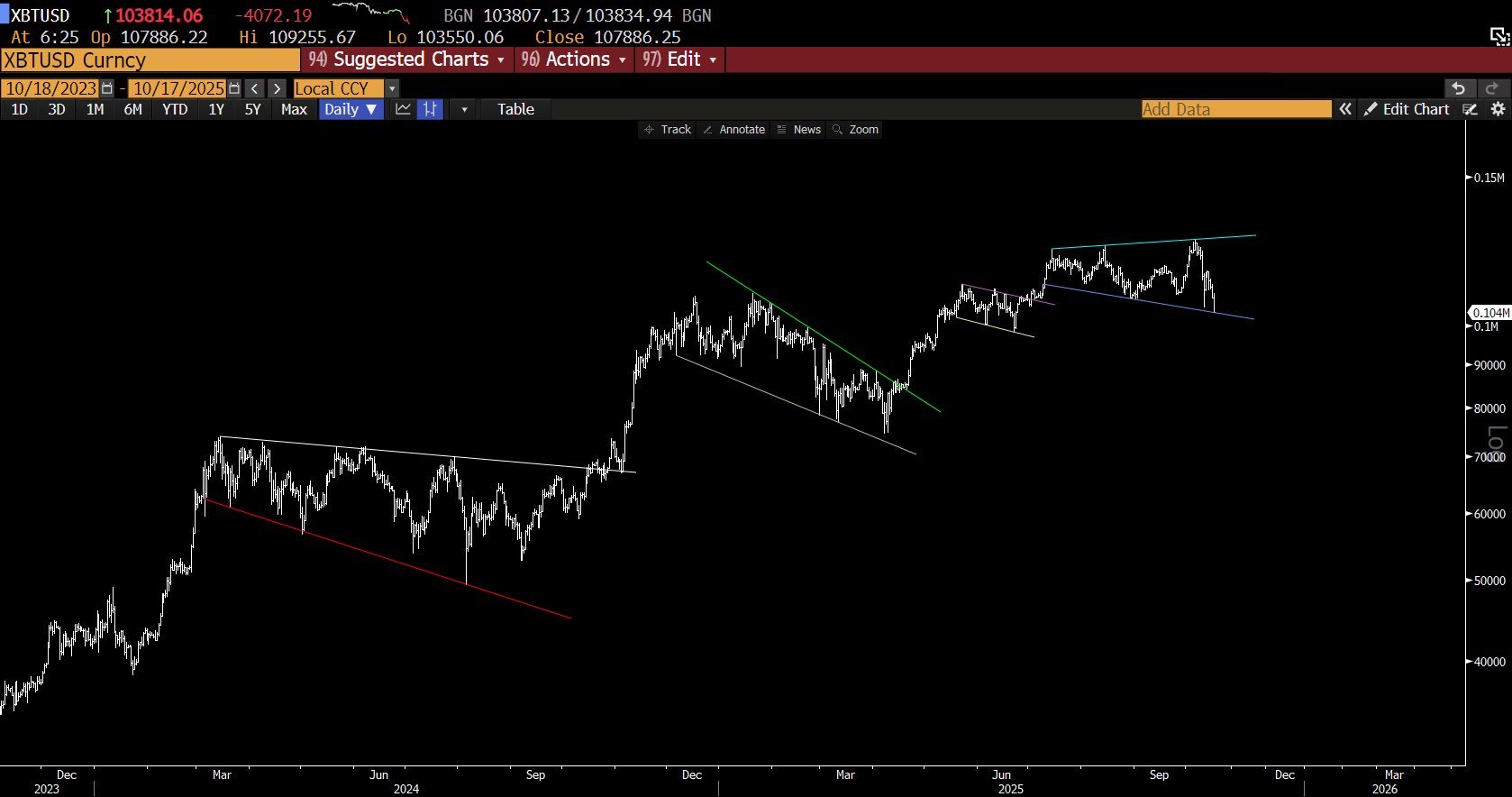
For what it’s worth, I think Bitcoin is forming another broadening wedge pattern, which is typically a bullish setup (chart 1).
We’ve seen plenty of these in the past, and right now we’re testing the lower boundary of support.
Another thing to note is that this bull market is officially 2 standard deviations oversold on the log regression channel (chart 2).
Unless the bull market is over, which is not our view, these levels are about as good an opportunity as you’re going to get to add to this market.
Also worth pointing out, Bitcoin’s Bollinger Bands have only been this tight three other times in its entire history (chart 3)…
What does that mean?
We’re in a mega low-vol environment…
Right now, the bands are as tight as they were in September 2023, just before a 200% rally.
That move lasted from September through March 2024, with a 20% correction in January before prices rallied another 90%.
The next chart shows the last three times Bitcoin’s Bollinger Bandwidth was less than or equal to 22, along with the forward twelve-month returns (chart 4).
The sample size is small, but the results have been extremely positive…
It’s the classic beach-ball-underwater dynamic. The harder you push it down, the more explosive the move when it finally breaks free.
All in all, we need to do better when times are tough. It’s not just your hopes and dreams caught up in this trade, it’s ours too. Fintwit can be powerful when you follow the right people who are genuinely trying to help. We’re not gurus, but we’ve been doing this a long time, built comprehensive frameworks, and we’re doing our best to share what we’ve learned.
At the same time, there’s a ton of poison and hate out there. Avoid it. When times get rough, we should rally around each other and stay focused on the big picture.
This is a 70-vol asset. If you can’t handle that level of volatility, this asset class might not be for you. If you don’t believe in crypto and the life-changing tech it brings, it’s hard to stomach the swings.
The only way to survive this kind of volatility is to extend your time horizon. When you think in days or weeks, every move feels like life or death. When you think in months or years, it all fades into noise.
Once you stop fighting volatility and start embracing it as a feature of this space, everything changes. Volatility turns into opportunity. It’s a gift that lets you add to your conviction.
Our view remains that Q4, once the dust settles, will be bullish, and we’ve done a ton of work to support that view.
That’s the best I can leave you with on days like this.
Good luck out there…


Thomas Bartel retweeted

What the fuck just happened 🤯
Stanford just made fine-tuning irrelevant with a single paper.
It’s called Agentic Context Engineering (ACE) and it proves you can make models smarter without touching a single weight.
Instead of retraining, ACE evolves the context itself.
The model writes, reflects, and rewrites its own prompt over and over until it becomes a self-improving system.
Think of it like the model keeping a living notebook.
Every failure becomes a lesson. Every success becomes a rule.
And the results are absurd:
+10.6% better than GPT-4–powered agents on AppWorld
+8.6% on financial reasoning
86.9% lower cost and latency
No labels. Just feedback.
Everyone’s obsessed with “short, clean” prompts.
ACE flips that. It builds dense, evolving playbooks that compound over time and never forget.
Because LLMs don’t crave simplicity.
They crave context density.
If this scales, the next generation of AI won’t be fine-tuned.
It’ll be self-tuned.
We’re entering the era of living prompts.

Thomas Bartel retweeted

One of the most fun parts of OpenAI is watching people here level up so fast and do such excellent work.
We are operating at a high level across many different disciplines and many of the people doing it have never done it before, and joined us at the beginning of their career.
If you believe in people and give them a lot of responsibility and support (and pick the right people to bet on) you will be surprised on the upside more often than you think.
I would love to see more companies operate this way and think we would all benefit.
(This was also one of the most fun parts of startup investing.)