


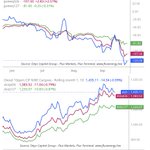
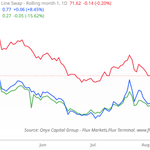


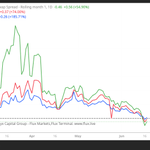


Many thanks for the invitation to chat oil markets with Neil Bradford and General Index. A fun taxi ride format in a London Black Cab, for episode 2 of their Knowledge series. Thanks Adam Stead for setting up 👍
15 minutes to pack and unpack the latest market trends, trading and other miscellaneous topics. Hope you enjoy the conversation.
#OOTT #OIL #TRADING #Blackcab #London
youtu.be/HU3yFA9eAHQ?is=8b5d…

3
476
Brent, like Trump, is down but not out
Oil began retreating before Americans went to the polls. Qatar’s diplomatic push, alongside broader regional efforts to revive talks between Washington and Tehran, raised hopes that another round of fighting might be avoided. Donald Trump’s assurance that he had no immediate plans to strike Iran gave the market further permission to sell.
The move became a rout after the US midterm elections. January 2027 ICE Brent settled at $94.62 a barrel on Wednesday, down almost 9% on the day and close to its level at the start of October. Today, Brent’s January futures contract has staged a tentative recovery. At the time of writing, this looks like a technical bounce after the sharp fall pushed the relative strength index into oversold territory. January ICE Brent is attempting to reclaim $97 a barrel, a level that has repeatedly served as either support or resistance in recent months.
But the politics behind the sell-off deserve closer examination. The market appears to read the result as a constraint on military action: Democrats have captured both chambers of Congress, weakened the president and increased the political and institutional cost of such action. A Democratic Congress can scrutinise the administration, contest military funding and make escalation harder to pursue.
Yet it would be a mistake, in my view, to confuse constraint with paralysis. The new Congress will not take office until January. Even after it does, the White House will retain freedom to initiate military operations, while Mr Trump will still have considerable latitude in foreign policy. The election may have narrowed Mr Trump’s room for manoeuvre, but it has not left him devoid of options.
Washington and Tehran remain divided over sanctions, Iran’s nuclear programme, the US blockade and the terms under which negotiations might resume. They also remain at odds over Tehran’s non-negotiable conditions for reopening passage through the Strait of Hormuz. Meanwhile, fresh incidents involving shipping demonstrate that maritime risk has not disappeared. Even where Gulf export volumes have recovered, the oil is moving through a system burdened by higher freight costs, insurance premiums and elaborate logistical workarounds.
Mr Trump may now have stronger political reasons to seek an accommodation. But recent history gives little reason to expect one election to change either his position towards Iran or Tehran’s position towards Washington. The market may have repriced oil for de-escalation yesterday, but prices could rise as swiftly as they fell.
ICE Brent, like Mr Trump, is down but not out. Yesterday’s sharp reversal could easily be followed by another in the opposite direction over the coming days. The market may have removed the risk premium prematurely given that the underlying risks—geopolitical tensions, supply disruption, transit through Hormuz and logistical difficulties—still remain.
#OOTT #TRUMP #MIDTERMS #OIL #BRENT

@JavierBlas what do you think about options a, b and c all at the same time? Afterall that was more or less what was happening during the Geneva talks before the February start of hostilities.
Not sure how the market will take this, do the bears or the bulls have to worry? I am curious on people’s thoughts in the poll below
360
Europe is increasingly reliant on the US for its marginal diesel barrel, as Middle Eastern exports have fallen with the US-Iran conflict and reduced Russian supply is intensifying competition elsewhere. With little spare refining capacity, strategic stocks may become Europe’s first line of defence should President Trump ban US diesel exports.
#oott #diesel #US #Europe #Trump #exports #ban
Diesel: mind the gap
President Trump has indicated that he is considering a ban on US diesel exports to keep more supply at home and ease domestic prices. Global diesel markets are already under strain. The US-Iran conflict has damaged key Middle Eastern refining infrastructure, including export-oriented plants geared towards maximising distillate output. Meanwhile, Russian exports have been crippled by Ukrainian attacks on refineries and wider energy infrastructure.
Europe is especially exposed. Though the EU may not import Russian diesel, Moscow’s efforts to redirect barrels elsewhere, including Latin America, Turkey and Africa, ease Europe’s competition for US diesel to plug its structural deficit. Its reliance on the US has grown as Middle Eastern supplies have fallen. With little spare refining capacity, the marginal barrel will become more costly if US exports are stopped.
So when President Trump floats a ban, and Treasury Secretary Scott Bessent asks “whether it’s feasible in terms of the overall refining capacity and whether a full or partial ban would work”, the market pays attention. US Energy Secretary Chris Wright has expressed misgivings and suggested voluntary limits instead. The White House has since reportedly assured refiners that it does not intend to impose an outright ban - to be seen. If Washington nevertheless limits or stops exports, Europe will have to compete harder for international barrels. US industry groups have pushed back, not least because of the legal quagmire around long-term contracts. They also warn that curbs could backfire as storage saturation will reduce domestic refinery throughput.
The initial market reaction was telling. European diesel futures jumped as much as 7%, even as crude prices were little changed. The East-West diesel arbitrage also weakened, reflecting expectations that Europe may need to pull more supply from Asia.
Then there is the question of authority. The US crude oil export ban was lifted by Congress in 2015 through legislation signed by President Barack Obama. Congress retains ultimate constitutional authority over foreign commerce. Yet, that is unlikely to prevent Mr Trump from invoking executive powers under the International Emergency Economic Powers Act or the Energy Policy and Conservation Act. In practice, Congress remains the cleanest route. Whether a Republican Congress would oblige, with November mid-term elections approaching and unfavourable polls in the background, is another matter.
For now, NWE diesel valuations remain high. If President Trump does not follow through, stretched valuations could take a breather and gap lower. If he pursues restrictions, prices could gap higher, at least initially, potentially forcing Europe to consider releasing strategic diesel stocks. Either way, diesel cracks will move with the price of the product as crude prices have seemingly found a new equilibrium in September.
What do you think: ban or no ban?
#OOTT #Oil #Diesel #US #Europe

OPEC: past, present and future — the case of Venezuela
In OPEC’s 66-year history, no founding member has left. Could Venezuela become the first?
Bloomberg reported yesterday that Venezuela may be weighing a departure from OPEC. The headline follows reports from Axios, later covered by The Wall Street Journal, that the US has discussed taking direct stakes in a dozen or more Venezuelan oil fields.
Venezuela is one of OPEC’s five founding members, alongside Iran, Iraq, Kuwait and Saudi Arabia. The group was established at the Baghdad Conference on 10–14 September 1960. Since then, several countries have joined, left or suspended their participation, including Angola, Ecuador, Qatar and Indonesia. Most recently, the UAE announced its withdrawal from OPEC, effective 1 May 2026.
No founding member has ever left the producer group. That makes Bloomberg’s report on Venezuela noteworthy. The future of a country with some of the world’s largest oil reserves has shifted since the capture of President Nicolás Maduro in January, even if the regime remains largely intact under President Delcy Rodríguez. Venezuelan crude production peaked at about 3.5 mb/d in the 1970s. Since then, years of mismanagement, underinvestment and sanctions have caused output to collapse, with production recently running at around 1.3 mb/d.
The US has been clear about its intentions since Maduro’s capture, particularly over the development of Venezuela’s vast oil reserves, whose crude is well suited to US Gulf Coast refiners. Exxon said in January that Venezuela was “uninvestable” under the existing legal and commercial framework. Reporting by Axios and the WSJ indicates Washington is seeking direct stakes in the country’s most promising oil fields. If talks with Caracas were to conclude successfully, they may help draw Exxon and ConocoPhillips back into Venezuela, two decades after their assets were nationalised by then President Hugo Chávez, and unlock the capital needed to lift production.
If Washington’s initiative bears fruit, Venezuela may eventually have to reconcile rising production from US-operated fields with continued OPEC membership. Bloomberg says a departure has already been discussed with US officials. However, it may take years for output to recover far enough for quota participation, suspended in 2016, to become relevant again.
If the current US administration ultimately pushes Venezuela to maximise production, Caracas may one day have to choose between output growth and quota adherence. But political timelines are short. As Caracas aligns more closely with Washington, the question is not whether that choice exists, in my opinion, but when it will have to be confronted.
What are your thoughts? I would love to hear them in the comments.
#OOTT #OPEC #VENEZUELA
2
308
Dubai — The Return of the King
Last week, ADNOC announced that, effective 1 November 2026, it will price Murban, Das, Umm Lulu and Upper Zakum against the Platts Dubai benchmark (PCAAT00), replacing the IFAD Murban futures methodology that underpinned its official selling prices (OSPs) since 2021.
The stated objective is to align OSPs more closely with the loading month so they better reflect prevailing market conditions. It is a pragmatic change and, in my view, an improvement. ADNOC has yet to publish the detailed pricing mechanics, including the averaging period for the Platts Dubai benchmark or the methodology for grade differentials. The benchmark references Platts Dubai M1 (PCAAT00), the prompt physical assessment established through the Platts Dubai Market on Close (MOC) assessment window, typically cargoes loading around two months later.
Under the IFAD methodology, the OSP was derived from the settlement prices of the prompt Murban futures contract, averaged over the applicable pricing period, approximately two months before physical loading. If market conditions shifted materially in the interim — as seen with the recent US-Iran conflict—the OSP could diverge significantly from prevailing physical market values.
The move also brings ADNOC's pricing framework closer to that of other Middle Eastern producers. While Saudi Aramco references a Dubai/Oman basket, ADNOC is now anchoring its OSPs to the region's established benchmark. This improves comparability across Middle Eastern crudes while simplifying valuation and hedging by reducing the need to manage separate Murban and Dubai benchmark exposures. It also reinforces Dubai's position as the region's principal pricing benchmark, supporting liquidity in Dubai swaps, calendar spreads and the Brent/Dubai EFS, while increasing the importance of the Dubai forward curve in forecasting ADNOC's OSPs.
There is also an important commercial dimension. Under IFAD, the benchmark component of the OSP was largely formula-driven. The new framework retains an objective benchmark, but the differential becomes ADNOC's principal commercial pricing tool, giving it flexibility to respond to refinery economics, competing crude values and adopt a more aggressive pricing strategy to defend or expand market share.
Finally, the ambition of establishing Murban futures as an independent global benchmark has clearly receded. As such, ADNOC regains greater control over the commercial pricing of its crude through the differential, rather than relying on a market based futures-derived benchmark. Murban futures are unlikely to disappear, but the centre of gravity in Middle Eastern crude pricing has shifted back towards the Platts Dubai benchmark and the price discovery process underpinning it. By extension, the integrity and robustness of the Platts Dubai benchmark takes on greater importance as more Middle Eastern crude pricing becomes anchored to it.
What are you thoughts? Comment Below
#OOTT #ADNOC #Dubai

5
468
Harry Tchilinguirian 🛢 retweeted

🇸🇦Saudi Arabia's escape route from Hormuz is now being REROUTED again.
After shifting exports to Yanbu and Bab el Mandeb, Houthi attacks are forcing Asian cargoes north through Suez and then around Africa.
A Yanbu to Taiwan voyage jumps from
19 to 48 days.
Fuel costs rise from $1.26M to $2.87M, plus about $1M in Suez fees.
The oil still moves, but far slower and more expensively.

Asian Gasoil – What Goes Up Must Come Down
The front-month Asian gasoil crack swap (versus Brent) has rallied sharply in recent weeks to the highs seen after the outbreak of the US-Iran conflict. The initial strength reflected disruptions to distillate shipments from the Middle East before being reinforced by lower Chinese refinery run rates and tighter controls on refined product exports. Recently, the suspension of Russian diesel exports has arguably provided an additional tailwind to Asian refining margins.
Can the Singapore gasoil crack extend its relentless move higher?
From a technical perspective, the answer may still be yes. The price, together with the short- and longer-dated moving averages, has formed a golden cross, suggesting upside momentum remains constructive, although the RSI has now entered overbought territory. The more important question, however, is whether today's elevated cracks will sow the seeds of their own correction.
High gasoil and jet fuel cracks provide a strong incentive for Asian refiners to increase crude throughput. This is especially true in China, where refinery utilisation rates remain well below historical norms. Beijing has relaxed constraints on refined product exports while maintaining the second batch of export quotas broadly in line with historical practice. Zhejiang Petrochemical has notably been permitted to resume exports after a four-month suspension.
Chinese export margins are highly attractive, providing a strong incentive for refiners to fully utilise their export quotas. In my view, this creates scope for an exportable diesel surplus to emerge in Asia, particularly if regional demand remains sluggish.
The latest macroeconomic data from China continue to paint a subdued picture for gasoil/diesel consumption. Weak fixed-asset investment, a still-struggling property sector and the ongoing switch away from oil in road transport all point to soft distillate demand. Any surplus barrels would either accumulate in storage or need to be exported.
This brings us to whether the depressed East-West gasoil spread can weaken further, encouraging more barrels to move to Europe. The spread is now trading close to the lows seen in March this year and is below its historical average level. But there is scope for a further move lower, particularly as the RSI shows that the spread has yet to move convincingly into oversold territory.
If Asian cracks remain elevated, they are likely to encourage a refinery supply response that will ultimately work against them. Additional refinery runs could generate an exportable distillate surplus, weighing on Singapore gasoil values sufficiently to facilitate arbitrage into Europe.
Ultimately, the trajectory of both the Singapore crack and the East-West spread will depend less on changes in diesel demand than on how aggressively Asian refiners respond to today's strong margins.
What do you think? Have Asian gasoil cracks run their course?
#OOTT #Gasoil #Crack #Asia

2
457
A Day in the Life of Oil
The latest moves in the oil market reflect what has become a familiar pattern in US-Iran diplomacy: one step forward, two steps back.
Despite President Trump's tougher rhetoric and the latest military exchanges, neither Washington nor Tehran appears quite ready to abandon negotiations altogether. Rather, the current phase increasingly looks like one in which military pressure and diplomacy are operating in parallel, with each side trying to improve its position before returning to the table.
President Trump first urged ships to "start their engines" and transit the Strait. He then proposed a 20% transit fee through Hormuz, only to abandon the idea shortly afterwards in favour of investment in the US, before warning that military action against Iran would continue if necessary. Each shift in tone has been reflected almost immediately in oil prices. Only days ago, Brent's prompt price structure reflected a relatively benign market, with DFLs in contango. Today, DFLs are back in backwardation.
For traders, the pattern has become familiar. Optimism over diplomacy gives way to renewed confrontation, only for talks to resume quietly. Oil prices rally on one headline before reversing on the next. Physical fundamentals, however, change much more slowly than market sentiment.
There is, in effect, one important fundamental difference compared with the first phase of the conflict. Commercial and strategic inventories have already been drawn down, leaving the market with a much smaller inventory buffer should disruptions persist. That means each setback has the potential to have a greater impact on prompt pricing than it did earlier in the year. With depleted inventories needing to be replenished and Hormuz apparently currently closed to transit, I am not sure how quickly Brent's pricing structure can soften back towards contango.
The oil market debate, in my view, is also moving beyond simply reopening the Strait of Hormuz. It is increasingly about how traffic through the Strait will be managed in the future and what role the US, Iran and Oman may play, either individually or jointly...
Until one side believes it has improved its negotiating position sufficiently, periods of escalation and renewed diplomacy are likely to continue side by side. Volatility in the flat price has become part and parcel of the negotiating process.
We may not yet know how many holes it takes to fill the Albert Hall... but as far as Brent pricing is concerned, the recent easing in DFLs does not, in my view, mean that backwardation will easily deflate. I would personally be hesitant to sell DFLs as we enter a new phase in the relationship between the protagonists. We do not have any degree of supply certainty, and the prompt structure remains vulnerable to repricing should the negotiating process take yet another unexpected turn.
#OOTT #OIL #Brent #DFL #US #Iran #Hormuz

340
To reinforce Bob’s point on price targeting, OPEC has historically pursued higher prices by managing supply to reduce inventories in consuming countries, particularly across the OECD. The difference of inventory levels to their recent five-year average was a crude (no pun intended) but often used barometer in this regard.
Lower inventories will, in time, support a higher flat price. But the real prize for OPEC, by reducing inventories, is pushing the market into backwardation. In a backwardated market, every marginal barrel the group chooses to withhold—or return—has a disproportionately larger impact on prompt flat price, giving supply policy greater leverage over the market.
1
91
The MOU signed by the US and Iran foretold this development. Clause 5 provides for Tehran and Muscat to discuss the future administration of maritime services in the Strait of Hormuz. The digital ink is barely dry, and Iran is moving at light speed to implement a new transit regime by redrawing shipping routes and introducing new traffic management.
Markets may have priced the reopening of Hormuz, but I wonder if they have considered what reopening would actually look like, specially after the 60-day period - assuming we get there.
1
4
493
Following President Trump "Ships around the world, get your engines running. Let the oil flow." Iran is wasting no time in restoring its exports, in particular as US CENTCOM has indicated that the US naval blockade is has been lifted with american forces are no longer impeding the transit of vessel to and from Iranian ports.
2
827
US-Iran MOU: batteries not included
A memorandum of understanding (MOU) between the US and Iran was signed by President Trump during a dinner hosted by President Macron at Versailles, rather than in Geneva. Beyond the symbolism of treaties concluded at Versailles, attention now turns to the agreement's 60-day toll-free transit period through the Strait of Hormuz. The oil market's initial reaction has been another leg lower in Brent futures, with the prompt contract trading well below $80/bbl.
The path to a lasting settlement is fragile. Vice President JD Vance is tasked with steering negotiations towards a broader agreement. Yet the deal resembles a toy with no batteries included: the difficult part is making it work. Although both sides have set a 60-day deadline, the talks can be extended by mutual consent.
In the near term, shipowners and insurers are likely to remain cautious while sea mines are cleared and security concerns persist. Shut-in production should gradually return, as stranded laden and ballast tankers clear Hormuz amid easing logistical constraints. Iran should resume exports quickly, as sanctions waivers are now in effect and CENTCOM has declared that the US naval blockade has been lifted. The bigger question lies beyond the initial 60 days, as the MOU allows discussions over the future administration of the Strait. Should Iran and Oman ultimately impose transit charges or assert sovereign claims, shipping volumes may not fully return to pre-war levels.
The US and Iran now enter what, in baseball parlance, is theoretically the last inning: negotiations over Iran's nuclear programme. Unlike a treaty, the MOU offers few irrevocable commitments. Almost every concession rests on continued counterparty performance. Any slippage could prompt either side to walk away. Clause 1 commits both sides to ending military operations across all fronts, including Lebanon. Whether Israel ultimately complies remains a key uncertainty. Furthermore, clause 8 addresses the disposal of Iran's enriched uranium stockpile, another issue that could easily become a stumbling block.
For now, the oil market is focused on the prospect of more crude rather than the agreement's fine print. The market is discounting the legal reopening of Hormuz rather than the operational normalisation of Gulf oil exports. The underlying barrel arithmetic has not changed. Inventory draws are likely to moderate, and Asian demand for Atlantic Basin crude should ease, but the collapse in the Dated Brent-to-Frontline futures (DFL) spread implies supply certainty that the MOU itself does not guarantee. In my view, prompt DFLs, alongside CFDs, have overshot to the downside. Any setback in negotiations could see Brent structure firm up just as quickly as it weakened. The market has priced the signature but not the risks attached to the MOU's execution. As usual, financial pricing is moving faster than the physical reality.
#OOTT #OIL #MOU #US #Iran #Brent #DFL

1
3
399
What is interesting about the MOU is that it sets out a series of commitments in black and white. This is the formal dimension of the prospective agreement, against which compliance can, at least in principle, be objectively assessed.
More interesting, however, is what may lie beyond the written text. In my view, there is likely to be an informal dimension to the agreement—understandings, assurances or tacit expectations that are not explicitly documented. These will be far more difficult to monitor and verify, yet could ultimately prove the very issues that determine whether either side continues to honour the agreement.
1
1,006
Yes, no doubt it was used prematurely with that goal in mind.
I suppose that the domestic politics played a role in the decision to preempt concerns over higher gasoline prices. Nothing like high gasoline prices in the US to loose an election or loose popularity in the polls
1
1
119
In theory, the purpose of strategic petroleum reserve (SPR) releases is to respond to a genuine supply disruption. Such releases are intended to be temporary and finite, buying time for producers with spare capacity to ramp up output and fill the supply gap.
The irony, if it can be called that, is that during the US–Iran conflict, the countries with the greatest spare production capacity were precisely those unable to deliver additional oil to the market. The closure of the Strait of Hormuz forced them to saturate available storage before ultimately having to shut in production at the wellhead. Existing pipeline bypasses around Hormuz were simply insufficient.
Instead, the market has relied on SPR releases to cushion the supply shock and limit the rise in prices, alongside weaker Chinese crude imports, made possible by the country’s substantial inventory build-up last year. At the same time, President Trump repeatedly argued—on more than three dozen occasions—that a deal with Iran was close at hand, effectively jawboning market expectations around a resumption of oil flows through Hormuz.
Absent SPR releases and this sustained moral suasion, the market would have been forced to find a new equilibrium through higher prices, thereby rationing demand.
From the perspective of the US administration, my guess is that the inflationary consequences of such an outcome—and the almost inevitable pressure for higher interest rates, with damaging implications for equity markets and the cost of refinancing US government debt—largely explain the path President Trump chose to pursue.
1
2
331
Harry Tchilinguirian 🛢 retweeted
127 Years of Global Oil Power 🛢️🌍
This long run dataset tracks how the world’s largest petroleum producers have risen and fallen from 1899 to 2026
Production is measured in barrels per day and includes
🔸Crude oil
🔸Other petroleum liquids
🔸Biofuels
🔸Refinery processing gains
The ranking shows more than production growth
It shows the shifting balance of geopolitical power
🔹 The early dominance of the United States
🔹 The rise of the Middle East
🔹 The expansion of Soviet and Russian output
🔹 The emergence of new producers
🔹 The return of US energy dominance through shale
Oil leadership has never been permanent Technology changes it, Politics changes it,War changes it, Investment changes it..
More than a century of petroleum history shows one constant
The countries that control supply help shape the global order
Do not miss my latest analysis on oil + macro, link in below comments👇
Source US Energy Information Administration International Energy Statistics
Oil Time Spreads: Not so fast
The collapse in prompt time spreads this week has been remarkably swift, following the announcement that the US and Iran are expected to sign a memorandum of understanding (MOU) in Geneva tomorrow. Physical premiums across both the Brent and Dubai complexes have also retreated sharply.
The market is now firmly in 'expectational' mode, pricing possible future conditions rather than current physical reality. Investors are discounting President Trump's promise of the immediate reopening of the Strait of Hormuz and a rapid return to normal oil flows through the Strait of Hormuz. The front-month ICE Brent futures spread has moved close to contango, while the prompt Dubai swap spread has already slipped into contango.
But does this abrupt change in the shape of the forward curve—normally a barometer of prompt fundamentals and inventory conditions—really imply that the physical balance has changed overnight? The simple answer is, of course, no. What we have here is a classic case of sentiment-driven overshooting.
The barrel arithmetic still points to a supply deficit. Oil is not suddenly going to gush out of Hormuz simply with the stroke of a pen and President Trump calling on tankers to "start your engines". Today's monthly Oil Market Report from the IEA reinforces the view that the market continues to rely on inventory buffers to offset the supply deficit, noting that global observed inventories continued to draw at an accelerated pace through May and warning that stocks could decline further before the market eventually moves into surplus.
Even if the MOU is signed tomorrow, shipping, insurance, mine clearance and logistical constraints will almost certainly delay the return to normal flow rates. These operational frictions should continue to underpin physical markets and find their way back into the forward curve's shape.
In an earlier post, I argued that being short Dubai spreads was a sensible trade, and that has worked out. I now wonder whether the pendulum has swung too far. In my view, the prompt forward curve is discounting a normalisation in physical balances that may take considerably longer to materialise than current pricing suggests.
My view is that, once the initial euphoria fades, prompt structure will recover to reflect the underlying physical realities of the market. Accordingly, I expect the prompt Dubai swap structure to return to shallow backwardation. Now may be the time to opportunistically go long on the prompt Dubai swap spread or express the trade through 'flys' to capture a rebound.
#OOTT #Brent #Dubai #Oil #OilPrice #Contango #Backwardation #OilCurve
