

Coding | AI & Tech | Gadgets Mtech in AIML @bitspilaniindia Building a wellness retreats platform with AI-powered recommendations 🧘♂️🤖
Joined September 2026
- Tweets339
- Following434
- Followers442
- Likes351






Pinned Tweet
Software is becoming a commodity. But engineering isn't.
With AI tools making software development faster and more accessible, writing code is no longer the biggest differentiator.
Almost anyone can generate code with the right AI tools.
But can everyone:
→ Identify the right problem to solve?
→ Design a scalable architecture?
→ Make the right technical decisions?
→ Understand security and performance trade-offs?
→ Review and validate AI-generated solutions?
→ Turn a business idea into a reliable product?
Probably not.
This is where strong engineering fundamentals matter more than ever.
AI may reduce the effort required to write code, but it doesn't eliminate the need to understand what we're building and why.
The value is shifting from writing code to creating solutions.
If you are in tech, let's connect!!!
#BuildInPublic
2
14
849
Does anyone REALLY understand how the X algorithm works?
Some days, a random post gets 5K impressions.
Other days, you spend 30 minutes crafting a thoughtful post and X shows it to 12 people. 💀
What's the secret?
- Consistency?
- Engagement?
- Replies?
- Timing?
- Or just pure luck?
What's your experience with the X algorithm?
3
43
Day 11 — Code to Customers
Multi-tenancy is not a feature you add at the API level. It's an architectural responsibility across the entire application.
Getting this right early can save a lot of painful refactoring later.
Read till the end.
One missing tenant check can turn your multi-tenant SaaS into a data privacy nightmare.
While building my Agency Client Portal, I've realised that implementing multi-tenancy is much more than adding a "tenantId" column to database tables.
You need to think about tenant isolation at every layer.
Here are a few things I'm paying attention to:
Data isolation: Every tenant-owned record must be scoped to the correct tenant.
Authorization: Authentication tells you who the user is. Authorization determines what they're allowed to access.
API security: Never blindly trust a tenant ID coming from the frontend.
Database queries: Tenant context must be consistently enforced across reads, updates and deletes.
Background jobs: Scheduled tasks and async workers must also respect tenant boundaries.
Caching: Cache keys must account for tenant context to prevent cross-tenant data leakage.
Testing: Test whether users from one agency can ever access another agency's data.
For those who've built multi-tenant SaaS products:
What's the most challenging part of implementing tenant isolation?
#BuildInPublic #SaaS #MultiTenancy #SoftwareEngineering
2
4
107

Day 10 — Code to Customers
Can another AI model take over your project tomorrow and continue exactly where you left off without you explaining everything again?
Read till the end.
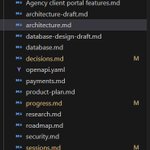
While building my Agency Client Portal, I realised how important proper project documentation is, especially when working with AI coding assistants.
I asked Claude Code to maintain dedicated documentation files for different aspects of the project.
Here's what I'm maintaining:
Architecture — System design and architectural decisions.
Database Design — Schema, relationships and data modelling.
Security — Authentication, authorization and security considerations.
Payments — Payment flows and related implementation details.
Webhooks — Integration and event handling documentation.
Product Plan & Roadmap — Features, milestones and upcoming work.
Decisions & Progress — Why certain decisions were made and what's already completed.
Why does this matter?
Imagine starting a fresh Claude Code session or switching to another AI model.
Instead of asking it to understand the entire codebase from scratch, these documents give it the context to understand:
- What we're building.
- How the system is architected.
- Why certain technical decisions were made.
- How the database is structured.
- What has already been implemented.
- What needs to happen next.
CLAUDE.md provides the starting instructions and points to the model towards the relevant documentation.
My biggest takeaway:
Code tells AI what the system does. Documentation tells AI why it was built that way.
Don't just build for today's AI session. Document for the next one.
How are you managing project documentation in your AI-assisted development workflow?
#ClaudeCode #BuildInPublic #SaaS #AIEngineering

9
6
213

Day 9 — Code to Customers
You're probably not getting the best out of Claude Code if you're using the same model for every task.
One thing I'm learning while building SaaS is how important it is to use Claude Code strategically.
Different development phases need different strengths.
Here's how I'd divide the work:
Opus —
- Planning & Architecture
- Understanding complex requirements.
- Designing system architecture.
- Evaluating technical trade-offs.
- Breaking features into implementation milestones.
Sonnet —
- Coding & Implementation
- Building features and APIs.
- Writing production code.
- Refactoring and debugging.
- Handling everyday development tasks.
Why Sonnet? It offers a good balance of capability, speed and cost per token.
Haiku —
- Lightweight Testing Tasks
- Generating repetitive test cases.
- Writing boilerplate tests.
- Simple assertions.
- Documentation and smaller tasks.
Sonnet / Opus —
- Critical Testing
- Unit and integration test implementation.
- Complex edge cases.
- Tenant isolation and authorization testing.
- Identifying potential security vulnerabilities.
- Investigating difficult test failures.
The idea is simple:
Don't spend your most expensive model's capabilities on tasks that a faster, more cost-efficient model can handle.
My approach:
Opus to think. Sonnet to build. Haiku to assist with testing.
Of course, review the output and use stronger models whenever a task demands deeper reasoning.
Claude Code is powerful, but using it strategically makes a huge difference.
How do you distribute models across your development workflow?
#ClaudeCode #BuildInPublic #SaaS #AIEngineering
2
2
99

Day 8
Code to customers
Your database schema is not just about storing data. It's about shaping the future of your application.
As I am progressing in building a SaaS product, I've realised how important a well-designed database schema really is.
A poorly designed schema can make even simple feature additions surprisingly complicated.
Here's why getting it right matters:
→ Defines clear relationships between business entities.
→ Maintains data integrity and consistency.
→ Helps optimise query performance and indexing.
→ Reduces unnecessary complexity in application logic.
→ Makes future feature development easier.
→ Establishes clear domain boundaries.
One thing I'm learning along the way:
Don't just design your database for today's requirements. Design it with tomorrow's growth and changing business needs in mind.
Especially when building a multi-tenant SaaS, decisions around tenant isolation, relationships, constraints and indexing deserve careful thought.
What's one database design lesson you learned the hard way?
#SaaS #DatabaseDesign #SystemDesign #BuildInPublic
1
1
64
Day 7
Code to customer
The best feeling isn't just building with AI. It's seeing how much you can actually ship with it.
Working on my multi-tenant SaaS, moving from one milestone to another.
Architecture, backend development, debugging, feature implementation — one step at a time with Claude Code.
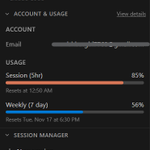
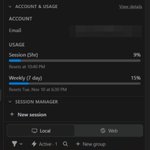
And at the end of the day, seeing full usage feels oddly satisfying.
Not because of the usage numbers, but because of the progress behind them.
Ideas are exciting. Building them is even better.
Back to building! 🔥
#BuildInPublic #ClaudeCode #SaaS #IndieHacker

4
3
173
My last 7 days on X, in numbers
• 6.5K impressions
• 563 engagements
• 8.5% engagement rate
• 135 profile visits
• 213 replies
• 209 likes
• 6 bookmarks
• 0 reposts (something to work on 😄)
Still learning, building, sharing, and connecting with amazing people here.
Really enjoying the conversations and the support from this community. ❤️
How was your week on X?
If you're into tech, AI, SaaS, or building cool products, let's connect!
4
132
If you're into tech, AI, or building amazing products, let's connect!
Always excited to meet fellow builders, creators, and curious minds.
1
68
What's your favourite playful status message in Claude Code? 😂
Mine are:
• Flibbertigibbeting
• Noodling
I don't know what they mean, but they never fail to make me smile. 😄
What's your favourite?
1
71
Looking for my people on X!
People who:
- Build instead of just talk.
- Experiment with AI.
- Love building SaaS products.
- Share their failures as well as wins.
- Believe in learning by doing.
I'm Manish, building from India 🇮🇳
If this sounds like you, let's connect.
Let's grow together!
24
16
429
Day 6
Code to Customer
AI can write your code. But can it make your application maintainable 2 years from now?
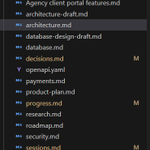
While building my application, I've been spending time reviewing and maintaining documentation before moving further with implementation.
Architecture, database design, security, sessions, payments, webhooks, API specifications, product decisions, and roadmap.
These aren't just documentation files. They are the foundation of a well-engineered application.
Even with AI coding assistants like Claude Code and GitHub Copilot, I believe software engineers must understand the fundamentals.
Because someone still needs to:
→ Make the right architectural decisions.
→ Understand database relationships and access patterns.
→ Think about scalability and security.
→ Identify edge cases and failure scenarios.
→ Review AI-generated implementations.
→ Ensure different modules work together cohesively.
AI can accelerate implementation, but it doesn't eliminate engineering responsibility.
Don't just prompt your way into building software. Understand the system you're building.
I'm curious to hear from others:
When building with AI coding assistants, how much time do you spend on planning and documentation versus actual implementation?
Do you maintain architecture and design documents, or do you prefer an AI-first, iterative approach?
Would love to hear your thoughts and experiences.
#SoftwareEngineering #AI #BuildInPublic

3
2
122
Microservices aren't always a sign of good architecture. Sometimes, choosing a monolith is the better engineering decision.
For the Agency Client Portal I'm building, I've decided to go with a Modular Monolith Architecture.
Why?
My initial goal is to build an MVP for around 50 agencies, with an architecture that can evolve as the product grows.
A modular monolith makes sense at this stage because it offers:
- Clear domain boundaries
- Simpler operations
- Cost efficiency
- Faster development
- Future flexibility
I'm not designing for hypothetical scale. I'm designing for current requirements while keeping future growth in mind.
Curious to know how you approach architecture decisions.
What factors influence your choice?
Traffic and concurrency? Domain complexity? Independent scalability? Team size? Operational cost?
Or something else?
If you're exploring tech and ai let's connect.
6
8
246
It's amazing how a community can inspire you to push beyond your limits.
100 new followers in one day!!!
Honestly, this means a lot ❤️
Every follow, interaction, reply, and word of encouragement motivates me to keep building, learning, and sharing more.
Thank you for being part of this journey. We're just getting started!

5
6
149