

optimist @ scale venture partners
San Francisco, CA
Joined August 2021
- Tweets92
- Following488
- Followers423
- Likes92









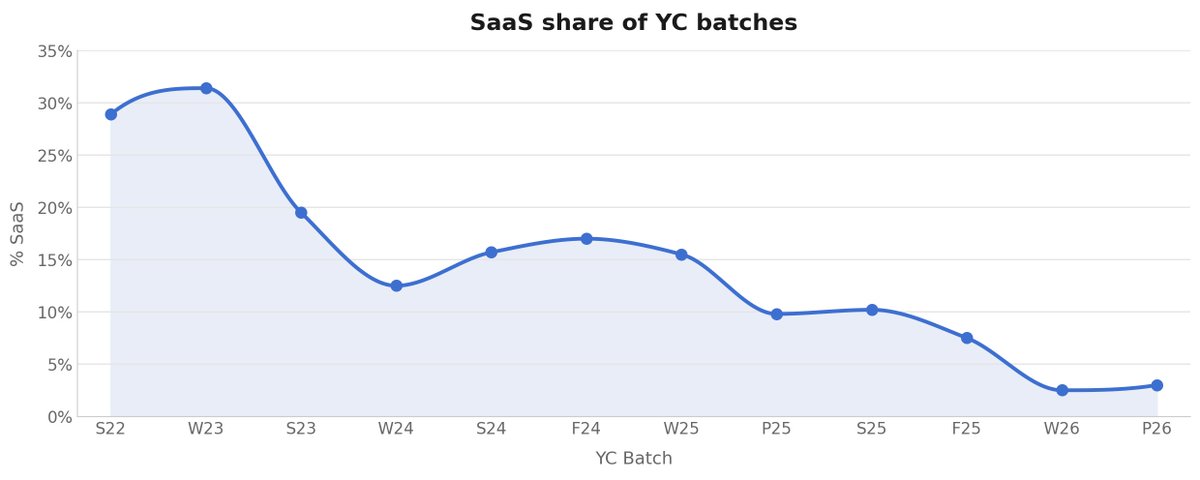
All of a sudden, software startups have disappeared. SaaS companies, the staple and meme of Silicon Valley, are no longer being founded. VCs are scratching their heads at the drought of application layer companies to fund. Where did all the software go?
9
863
every VC round of this year, visualized by round size
tedchai.com/2026-VC-rounds

2
8
822

Ted Chai retweeted

Tech has decided that regulation is the enemy of progress, but innovation requires capital
Regulation builds the trust necessary to inject billions into markets
To enable free innovation, Andera raised a $37M series A led by Lightspeed to scale financial oversight with agents


Ted Chai retweeted

new @OpenAI — in collaboration with @paradigm, we developed an evaluation to measure AI on critical smart contract security capabilities


Introducing EVMbench—a new benchmark that measures how well AI agents can detect, exploit, and patch high-severity smart contract vulnerabilities. openai.com/index/introducing…


Ted Chai retweeted

🚨How does an AI-native startup unseat an incumbent?🚨
👇Enter the Greenfield Strategy: AI-native startup bingo.
The battle between every startup and incumbent comes down to whether the startup gets distribution before the incumbent gets innovation. One of the most powerful, and underrated, ways for startups to win distribution is to serve companies at their formation: greenfield companies.
@stripe @deel @mercury @cartainc @brexHQ @tryramp have all done this at scale.
Why does this work?
Simply put, acquiring customers de novo is easier than getting customers to switch:
- Many of the large software incumbents have hostages, not customers. Their customers would love to switch, but ripping and replacing existing software is risky and expensive. New companies don’t face those switching costs; they simply look for the best solution and evaluate based on merit.
- New companies don’t need as many features to have a complete solution.
- New companies have fewer stakeholders. You only have to convince the founders.
Grow with your customers:
If you attract all of the new companies at formation and grow with them, you will become a big company as your customers become big companies. Consider @stripe: many of Stripe’s customers did not yet exist when Stripe was founded. Some of those early customers later became large businesses in their own right. So when enterprises outside of Silicon Valley also needed to prepare themselves for a shift to ecommerce models, Stripe was an obvious choice, with plenty of relevant reference customers already in place.
Incumbents, on the other hand, would much rather sell to existing businesses vs. companies that don’t exist now but might exist in huge numbers in a few years. They are bound by the rules of P&L (Profit & Loss) – and there’s no “P” for greenfield companies that don’t exist yet, just “L” (in sales, marketing, and product development costs). The startup, however, isn’t bound to a financial model – the startup doesn’t need one; it's still figuring stuff out! That leaves ample room for the startup to define the category.
Graduation moments:
In a similar way, software “graduation moments” (the moments when a startup begins to develop enterprise needs) also create opportunities to execute this greenfield strategy. QuickBooks may be great for single-product, single-entity companies, but once businesses add multiple subsidiaries, currencies, or more complex reporting needs, they outgrow it and require the controls, integrations, and scalability of an ERP like NetSuite. And you can now build a far better ERP with AI - just look at @RilletHQ.
AI-native startup Bingo:
There are many different categories of enterprise software. Enough to fill a 5x5 Bingo board and more!
In each category of the Bingo board, there sits an incumbent that could be dethroned by an AI-native alternative.
So, how does a new company win the game of Bingo?
- Pick a square
- Make a narrow wedge much better
- Find a constant source of new customers
- Rapidly iterate and add features to grow with your customers
- Don’t be constrained by the division of existing categories
If you’re building a category-defining company on the Bingo board - come and talk to us.
cc: @arampell @astrange @a16z

Excited to share @recallai has raised a $38M Series B led by Bessemer!
We’re building the infrastructure that gives AI access to the world’s largest dataset: conversations.
If you’re building with conversation data, we’d love to hear from you.

We've raised our $38M Series B, led by @BessemerVP, with HubSpot Ventures and @SalesforceVC joining.
Over 2,000 companies (including @HubSpot, @clickup, @useapolloio) build on @recallai, the API for meeting recording.
2
5
604
Ted Chai retweeted

I'm excited to announce our $22M Series A here at Orchard!🍎
Here @Orchard_Robots, we’re securing America’s food supply by building the AI farmer that automates our nation’s farms.
Our mission is to make farming profitable, efficient, and sustainable again.
SF gov spends $102k/year on social services per homeless person. A luxury high-rise apartment costs $36k/year. Homelessness here isn't about housing.
1
302
If Singapore installed all of the GPUs it's buying, datacenters would account for 13% of the nation's total energy usage—almost equal to the consumption of every SG household combined
290
So sad that 7 years of NIMBYism transformed the Cupertino Vallco development from a modern icon (1st pic) into a collection of generic apartments (2nd pic)


1
477
