

Stories that Scale. Systems that Sell. Strategic storytelling + AI systems for the attention economy. Building brands that move culture
Everywhere
Joined December 2021
- Tweets5.2K
- Following2.9K
- Followers1.4K
- Likes6.8K









Your buyers are tired of guessing whether a real person wrote your posts.
Every time they hit another generic AI post, they have to stop and ask: is this real? Can I trust this? That little moment of doubt adds up, and it’s happening with your content too.
Thread 🧵


Gartner found 65% of people think brands make too much AI content, and 57% trust them less for it. Polish used to mean effort. Now AI makes polish free, so it means nothing.


Social reach resets with every post. An owned audience compounds.
It runs as a flywheel. You capture rented attention into subscribers, it compounds because no algorithm sits between you and the inbox, that direct access becomes pipeline, and their behavior feeds back to sharpen your next move. Each turn makes the next one easier.
The mechanism is simple. Email reaches the person. Social makes you re-earn attention every single time. The concept isn't new either, Forrester formalized owned vs rented media back in 2009.
What's one thing worth subscribing to that only you could send?

Calling yourself the best is now helping your competitors win.
Founders publish "why we're the best" pages to win AI search. AI reads them, then recommends someone else. In one study, when a brand's own "best of" list got cited by AI, it left that brand out of the recommendation 69% of the time. Your self-praise becomes a map to your rivals.
Thread 🧵


The reason is simple. AI doesn't trust you to rate yourself, and neither do buyers. What others say about you is what counts, and nearly half of AI citations come from places you don't own: YouTube, Reddit, podcasts.


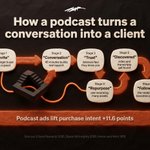
Six steps turn a conversation into a client. You invite a target buyer as a guest, the 45-minute conversation builds rapport no cold email could, listeners come to feel they know you, one recording becomes many assets, video and transcripts get you found, and the follow-up turns the relationship into pipeline.
The trust is measurable. Standard podcast ads lift purchase intent by 11.6 points (Signal Hill, 2026). A founder who is the content plausibly does more.
Which step is your show missing?

LinkedIn stopped rewarding applause. A save now drives about 5x the reach of a like, and total reach is down 47% year over year. The posts that get kept are the posts that travel.


Here's the shift. A like says "nice." A save says "I'll need this later." One is a reflex, the other is a vote of real value, and the algorithm can tell the difference.


A hook isn't a clever line. It's a mechanism, and it's been studied for decades.
It does two jobs in sequence. First it breaks the pattern, your brain snaps to anything that violates what it expected (Itti and Baldi, 2009). Then it opens a curiosity gap, the itch you feel when you know something is missing (Loewenstein, 1994). Specificity raises the stakes, the reward state actually sharpens memory, and the payoff closes the loop.
The window is brutal. On video, the first 3 seconds decide up to 47% of a campaign's value.
Save this before you write your next first line.

When an AI answer sits at the top of the results, people read it and leave. Clicks to real sites drop from 15% to 8%, and only 1% click the sources the AI quoted. The answer replaced the visit.
Thread 🧵


So the only safe audience is one you own. An email list has no algorithm in the middle, and a business newsletter can hit 10,000 subscribers in a median 61 days. That's a this-quarter project, not a someday one.


Getting quoted by AI isn't about writing the best page. It's about surviving seven filters.
A query becomes a cited answer through a pipeline: your page has to be indexed, the query has to trigger an AI answer, that question gets fanned out into sub-searches, passages get retrieved, fed to the model, and only then does it name the sources it used. Most founders lose at the first three steps, not the writing.
And here's the part nobody mentions. Even when you get cited, only about 1 in 100 people click through. Being named is the win, not the traffic.
Which step do you think your content is losing at?

When a buyer asks ChatGPT about your category, it answers by naming sources, and across 9.5 million citations, about 75% of LinkedIn's came from individuals, not brand pages. A second study put people at 59% on ChatGPT and Google AI.
Thread🧵


Here's the part that should change your plan. More than half of cited content came from people with under 10,000 followers. Expertise gets quoted. Audience size doesn't.


If you're a founder in MedTech or health, your best content is the stuff you're too scared to post.
Legal gets nervous, so you stay vague and safe, and safe is forgettable. Meanwhile your market is drowning in regulatory uncertainty. New rules, shifting guidance, unclear timelines and nobody credible is explaining it to them.
Thread🧵


Take one rule or guidance change and explain, in plain language, what it means for the people it affects. Not legal advice. Just making sense of the noise.
It works because the people who care about a regulation are the people in the market. Bystanders scroll past. Buyers stop and read. And you stay safe by explaining what changed, not what anyone should do about it, then running it past compliance once before you post.


