

Swing and position trader for 25+ years. Finding simplicity amid chaos. Uncomfortable truths found here. Owner: https://teapawt.net/t.co/7VGLgI90D6
Joined November 2008
- Tweets28.6K
- Following0
- Followers30.2K
- Likes8.6K
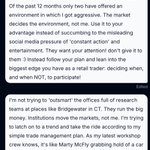


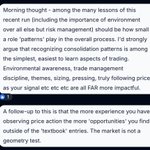


Matt Petrallia, CMT retweeted
Often your best course of action as a swing / position trader is to do nothing. In an environment with no follow-through: do nothing. In a conducive environment with plenty of tailwinds: let your open positions work, i.e. do nothing. Reframe your mindset to embrace this simple concept.
Matt Petrallia, CMT retweeted
Spend more time risking nothing, and less time risking more at the right time.
Being in the market for as little time as possible can be a goal in itself. The default state for many always seems to be nearly constant active engagement.
But why? It’s part of the whole action = progress misalignment. Turn it upside down.
Make as much progress as possible being in the market as little as possible. Make your risk count. Stay out when the environment is anything less than ripe for your style.
Of course, like most things, it’s much easier said than done. But even identifying this as a goal can be powerful.
Matt Petrallia, CMT retweeted
Most think scrolling social media is somehow helping them (or they at least want it to be). More information, more ideas, more input. But in reality it’s likely the biggest distraction keeping you from doing the actual work - the things that move the needle.
Most don’t need a new strategy or tactic - certainly not more opinions.
Most need to actually follow the simple strategy they already have. That can only come from you. Face it head on or it never changes.
Matt Petrallia, CMT retweeted
The four dead-simple ingredients of a poor environment for my simple trend-following style:

Environment > Setup
Like most things, this can mean something different to everyone.
Here's what it means to me:
First, I define 'Environment' through price action. I don't use multiple breadth measurements, momentum indicators, sentiment etc etc. I rely on PRICE and PRICE only.
Second, what 'Environment' am I looking for? I'm looking for an environment that is conducive to MY style - and I'm someone that exploits trends through swing and position trading. I don't care if it's a great day trading environment - I'm not a day trader.
So what's my key ingredient? FOLLOW THROUGH. Period. In a conducive environment I'm seeing clear follow through in price action - leading names trending on key SMA's and being quickly supported on pullbacks. Breaks above trendlines or pivots that see follow through the next session, for example.
What are the key ingredients of a POOR ENVIRONMENT for my strategy?
1 - Multiple material opening gaps in both directions
2 - Multiple material intraday reversals
3 - Weak / Ambiguous mid-term trend structure
4 - News Driven Price action
The result is LACK OF FOLLOW THROUGH. Names will break above a trend line or a pivot and almost immediately reverse.
Each of the above items is base solely on PRICE action. They are easily identifiable to anyone with a cursory understanding of price charts and don't require the extra ambiguity of indicators, oscillators etc etc etc.
Fighting a poor environment by constantly engaging 'setups' will reduce your probability of success. It's that simple. Conversely, I want to hit the gas when follow through (as evidenced by price action) is strong. In a strong environment with robust follow through even mediocre setups will move in the direction of the trend.
Simple concept. Simple process. Over 27 years of trading I have found VERY few things more impactful to my returns than getting aggressive in a 'strong environment' and backing off during a 'poor environment'. Focus on impactful decision.
Matt Petrallia, CMT retweeted
Think Like a Trader. Not Like a Follower.
In collaboration with @KynaKosling
🔗tinyurl.com/2sxrd477
Be brutally honest with yourself:
Have you ever made or changed a trading decision based on something you saw on social media or financial news? Did an external input make you deviate from your plan?
My guess is that every single trader, at some point in their journey, failed this litmus test.
Someone else’s opinion stopped you from following your strategy.
Maybe it’s a big account tweeting that they closed their position, so you also closed yours — even though your plan was to hold the name until it closed below a key moving average.
The outcome is irrelevant; this is entirely about process.
🔗 tinyurl.com/2sxrd477


Matt Petrallia, CMT retweeted

Do you have trouble holding a name for a big move as it rides a key SMA?
SOME IDEAS THAT CAN HELP:
1 - Sell an initial partial INTO strength. This will de-risk your trade and give you the psychological edge of having taken a small profit, making holding less daunting.
2 - Review past leaders and momentum names. See how the strongest trending stocks tend to ride a key moving average for MUCH longer than you might expect. Use the “replay” function on TradingView, or similar. It helps you internalize that the daily “emotions” in strong trenders can be a rollercoaster despite what is an obvious clear, simple trend in hindsight. Risk happens in real time. This simple exercise can help internalize what is “normal” in a trend, even in huge movers. Prove to yourself how stocks move. AND it doesn’t require 10,000 hours of blood shot eyes staring at charts. You don’t have to ignore your children and your spouse. Just spend some time on it. Have a life. That’s the point.
3 - Know in your bones that you WILL NOT catch the top. Your job is to catch the meat of the move, not an exact bottom or an exact top. Those trying to catch a top are just guessing, nothing more. Be at peace with this. Let the market decide and let a key SMA be your guide. Your observations in step 2 will help with this.
4 - Size smaller until you can condition yourself to follow your simple trade management plan; a close below a key SMA for example. Smaller size reduces the emotional swings. MAKE yourself follow the plan. Get yourself used to how you feel on pullbacks as well as how you feel when the trend continues and you haven’t closed out the trade. Size can come later. Train your brain first.
5 - Mix swing and position trades. This helps lessen the “rollercoaster” and smooths your equity curve. For me, having some swing trades that I sell INTO strength helps me hold the names I’m really trying to ride for bigger moves. If my entire account is in position trades the emotions are heightened; the drawdowns more intense. Mix the two to suit YOU. PERSONALIZE. It’s your chance to work with your own strengths and weaknesses. Everyone is different.
Less is more when holding for a bigger move. Less button pressing. Less micro-managing. Less intraday screen time. NO intraday charts - more WEEKLY charts. Let the trend work for you without succumbing to constant noise and action on social media.
Matt Petrallia, CMT retweeted

Someone who read The Trader's Journey told me this week that the chapters on trading psychology hit them harder than any strategy chapter.
I'm not surprised.
Most traders don't fail because they need a new strategy.
They fail because they can't consistently apply the strategy that they already have.
Matt Petrallia, CMT retweeted
One of the biggest mistakes I made early on was believing I needed to be in the market all the time.

Matt Petrallia, CMT retweeted
As traders gain experience I see more and more truly feeling the importance of environment in their bones. When the right tailwind for your style can make progress feel so "easy", why even bother when that tailwind isn't there? It's a huge step.
Matt Petrallia, CMT retweeted
There's really two Fintwit phases - the chest-thumping, screenshotting phase when the environment is ripe. And then the bottom-calling phase when things are choppy. It really is possible to ignore all of it and just follow a simple strategy where you're doing nothing most of the time.
Matt Petrallia, CMT retweeted
Overtrading hurts in two distinct ways:
1 - Constantly pressing buttons in a poor environment for your style will lock you into the boom and bust cycle. You’ll perform well when you have a tailwind but give it all back, and then some, when you don’t.
2 - Constantly pressing buttons in a conducive environment for your style will knee-cap your winners and put a hard ceiling on your returns. You’ll close trades out far too early and abandon your simple plan. You short-circuit your chance to let the market do the heavy lifting.
Action does not equal progress.

Matt Petrallia, CMT retweeted
Trade Rules are not a magic cheat code that optimize for perfect outcomes.
Rules - the ones you keep - are really tools to manage YOU.
Matt Petrallia, CMT retweeted

Working with @theEquilibrium truly is a pleasure. Immersing yourself in Matt’s content has that ‘equilibrium’ effect on you, helping you stay grounded and focused.
Trading is all about stacking edges, and one of the most important edges is a favourable environment for your strategy — the big focus of his new article.
My favourite part is where different tactics get discussed: offence vs defence.
As a risk-averse person, my biggest trading challenge was learning to get comfortable with aggression. That challenge was made harder by simply not being clear on the purpose of different sell rules — what sort of tactics are appropriate in which environment? Now, it seems so obvious that I feel rather stupid for not realising sooner, but that really hadn’t clicked for me a couple of years ago.
As to my struggle to get aggressive, in the end, it was my now-former employer who taught me that mindset change. They put me in a situation where it didn’t make sense to NOT take the risk, twice, with the first leading to personal explosive growth (via TTRH) and the second leading to my resignation and self-employment.
When the risk–reward makes sense, aggressive action becomes 10x easier — because it becomes the obviously right decision.
Learning to get comfortable with (controlled) risk-taking has hugely improved both my content and my trading returns — but only when the right conditions come along. And until they do, you focus on playing defence so that, when the time is right, you’re in a position of strength to take those bigger risks.
This new article explains, in Matt’s words, why environment is so important, how to assess the environment (follow-through), and how to adapt to different environments.
Thank you again, Matt! Working with you truly is a pleasure :)
New FREE Stack
In collaboration with the extremely talented @KynaKosling
Environment Over Setup: Action ≠ Progress
Most traders focus on learning yet another setup, whether to use candlestick or bar charts, or whether the 20 SMA or 21 EMA is better.
None of that moves the needle.
Focus on impactful decisions.
Over 27 years of trading, after learning risk management, I’ve found nothing to move the needle on your returns more than learning to:
➡️Get aggressive in a conducive environment.
➡️Back off in a poor environment.
🔗 tinyurl.com/mptb58wr


Matt Petrallia, CMT retweeted
What's the benefit of seat time and those "deep dives" you hear so much about? It's not unearthing some secret code or setup no one has seen before, it's truly internalizing and developing your own understanding of price action. This can't be handed from one trader to another.
Matt Petrallia, CMT retweeted
I have seen MANY who think of themselves as price-action traders, but then will ask about breadth, economic data, credit spreads, seasonality, on and on.
This shows that they have not truly internalized price as their signal.
Everything else is secondary. You're either acting on your signal or you're not.
Matt Petrallia, CMT retweeted
Personalization is Your Greatest Edge
You can copy someone’s external framework, but not their internal wiring.
Your relationship with discomfort is different from theirs — which will come out when you trade.
You can condition yourself to handle the constant discomfort, but can’t fully hide your personality. No one is precisely you, except you.
And that’s a good thing. Because your uniqueness is your edge.
FREE Substack now live!
🔗 tinyurl.com/53pj8kmu

Matt Petrallia, CMT retweeted
I’m launching a brand new FREE Substack this Saturday!
The first post, in collaboration with the talented @kynakosling , focuses on harnessing one of your biggest edges: YOU.
Personalization is at the heart of building a process you can repeat, that’s tailored to your brain and no one else’s. Create rules built to manage YOU.
You can copy someone else’s external framework, but you can’t copy their internal wiring.
Your success in the market depends on how you handle discomfort. That’s why personalization is REQUIRED.
🔗 tinyurl.com/y35a5ku5


Matt Petrallia, CMT retweeted
One of the best insights I learnt from @TheEquilibrium is that rules don’t optimise for perfect outcomes, but are really tools to manage YOU.
This realisation is key to developing trading rules that bring out your strengths, and with it, your edge — then being at peace with the inevitably suboptimal outcomes.
So, to now work with Matt on precisely that topic is beyond cool!
We’re launching this Saturday. Make sure you’re subscribed to get this first post (and future newsletters) straight to your inbox :)
I’m launching a brand new FREE Substack this Saturday!
The first post, in collaboration with the talented @kynakosling , focuses on harnessing one of your biggest edges: YOU.
Personalization is at the heart of building a process you can repeat, that’s tailored to your brain and no one else’s. Create rules built to manage YOU.
You can copy someone else’s external framework, but you can’t copy their internal wiring.
Your success in the market depends on how you handle discomfort. That’s why personalization is REQUIRED.
🔗 tinyurl.com/y35a5ku5