

Examining naval history and maybe some current events.
United States
Joined July 2017
- Tweets7.3K
- Following99
- Followers15.5K
- Likes1.9K




The battleship USS Alabama (BB-60) under construction at the Norfolk Navy Yard on 3 July 1942. At the time of this photo, Alabama was nearing completion, with commissioning on 16 August 1942.
The photo particularly highlights her forward turrets. The number 1 turret still lacks its faceplate; what is more noteworthy is that the backing plate is missing.
During construction, the turret interiors of United States Battleships were sheathed with plates of Special Treatment Steel (STS). These STS plates served as backing to the actual armor plates that were then attached to them. Unlike structural steel, STS had protective qualities and actually contributed to the overall armor of the turret.
STS steel was similar to homogeneous Class B armor used by the US Navy (As opposed to face-hardened Class A armor). In addition to its protective qualities, STS steel was also elastic and resisted tearing. This made it very effective as a backing plate, as it helped contain spalling, shrapnel, and shell fragments.
When listing the armor of the South Dakota class battleships, some publications list the 18" (457mm) of armor on the turret faceplate only. However, this ignores the protection afforded by the backing plate underneath. The faceplates of the South Dakota class were actually 20.5" (521mm) thick due to the STS steel.
Factoring in the STS plate, the true armor thickness of the South Dakota class turrets would look like this:
Turret Front: 18" (457mm) Class B armor + 2.5" (64mm) STS
Turret Sides: 9.5" (241mm) Class A armor + .75" (19mm) STS
Turret Rear: 12"(305mm) Class A armor + .75" (19mm) STS
Turret Roof: 7.25" (184mm) Class A armor + .75" (19mm) STS
Now back to Alabama
In the photo, Alabama is missing her STS backing plate on the turret front. Like her sisters, Alabama utilized STS backing plates on the turret sides, rear, and roof. However, her turret faceplates were completely different in that they did not use STS backing.
Alabama experimented with single plates of armor for the turret faceplates. Rather than combine Class B and STS, Alabama simply utilized a thicker slab of Class B armor, using a single plate that was just shy of 19" (483mm) in thickness.
Presumably, this was done because a single plate of homogeneous Class B should be of equal effectiveness to two plates of homogeneous Class B and STS, even if the two plates had a combined thickness that was slightly greater. The equality in protection would be benefited by simpler construction and a slight savings in weight.
Alabama was the only member of her class to experiment with this style of faceplates. However, it seems that the potential advantages never materialized as the system was not repeated in subsequent designs. The Iowa class returned to mounting Class B armor over STS for the front of its turrets. The Montana class also used Class B and STS backing, though with far greater thicknesses.

If 10 battleships met 15 battleships, how much damage could they inflict before being destroyed? As long as there have been fleet battles, naval commanders have debated overall firepower in relation to fleet size. While ideas varied from one navy to the next, one man sought to develop a more accurate mathematical formula.
In his latest article, Matthew Wright looks at this formula, developed by engineer and mathematician Frederick Lanchester.
navygeneralboard.com/frederi…

The battleship USS Texas (BB-35) cutting a fine silhouette against the setting sun. The photo was taken while she was assisting with convoy operations in the North Atlantic during the Summer of 1941.

The capsized hull of the German heavy cruiser Admiral Scheer at Kiel, Germany, in May of 1945. In the foreground, the bow components of two Type XXI submarines lie unfinished.
Admiral Scheer almost survived the Second World War. After conveying a group of refugees to Kiel in late March, Admiral Scheer began a partial refit. While docked, a large RAF bomber force attacked the harbor facilities on 9 April 1945. During the attack, several bombs struck the cruiser and caused her to flood until she capsized. Though partially scrapped, the majority of the cruiser's hulk was simply buried as the harbor was filled in. The buried cruiser was pinpointed during a survey in 2024 and confirmed to be underneath a parking lot.

Sailors aboard the battleship USS Arkansas (BB-33) wave from the crow’s nest as the battleship approached the Brooklyn Bridge on 16 January 1915.
Arkansas had a hectic schedule at the time. In October of 1914 she took part in fleet maneuvers off Virginia. That same month, she steamed north to the Brooklyn Navy Yard for maintenance. This repair work was interrupted as Arkansas then departed to undergo another round of exercises off Virginia. In December of 1914, she then returned to the Brooklyn Navy Yard to resume repairs before departing once again on 16 January 1915 when this photo was taken. Her destination was Virginia for, yet again, more exercises.

The destroyer USS Halsey Powell (DD-868) comes alongside the battleship USS Wisconsin (BB-64)(@NauticusNorfolk) to take on fuel in February of 1945.
Firepower Friday!
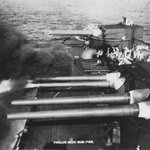
Crewmembers gathered on the aft deck of the battleship USS Arkansas (BB-33) watch as the big guns fire during gunnery exercises.
A Wyoming class battleship, Arkansas was armed with twelve 12" (305mm) guns in six twin turrets. Two turrets were arranged in a superfiring pair forward of the superstructure. The remaining four turrets were divided between two additional superfiring pairs aft of the superstructure. The photo shows these turrets, with turret No.3 closest to the camera.


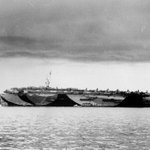
You could make the arguement that the first drone carrier for the US Navy was USS Marcus Island (CVE-77) in 1944!
She transported a batch of Interstate TDR-1 assault drones to the Pacific for operational evaluations. Granted, it was a transport role, they didn't operate from her flightdeck, and she had to take along the Avenger control aircraft as well (seen in the photo), but it was incredibly futuristic for the time.
The drones were deployed 50 times and achieved a success rate of 62%. Sadly, the Navy decided against further development as they determined that conventional weapons were enough to beat Japan.


The secondary guns of the battleship USS New Mexico (BB-40) providing gunfire support during the Invasion of Guam in July of 1944.
The loading process for the 5"/25 guns is captured nicely along with the firing of the 5"/51 guns in their casemates.
Though they looked complex, the automatic loaders for the 8" guns were actually the simplest of the models developed at the time. They seemed to have handled shock testing just as well as manually loaded mounts. I suspect removing the relatively "soft" human element would have actually benefitted shock damage in a combat enviornment.
The related models developed for the Worcester class were the more problematic designs, having a few extra features such as dual ammumition feeds (so they could switch from AP to HC immediately).
The Navy was so pleased with the reliability of the Des Moines autoloaders, they wanted to use them for the Worcester replacements, scaled down to 152mm. It was estimated that they could fire at 25 rounds per minute per gun. A post-war analysis on battleship design also recommended scaling the Des Moines autoloaders up to 406mm.


The Fletcher class destroyer USS Brown (DD-546) maneuvers inside the wake of the Essex class aircraft carrier USS Oriskany (CVA-34) during the early 1960s.
The warships were conducting an exercise that simulated refueling at speeds in excess of 25 knots.

One cannot mention the Alaska class cruisers without a firestorm of controversy and opinion. Many are quick to point out that the concept of a large cruiser was archaic. Others point out that their intended targets and role never materialized.
It's important to remember that situations change. Military planners do not have the same luxury of hindsight that observers do today. They can only plan for what they can, trying to make use of whatever data they have attained. As new data comes in and the situations change, the planning changes with it. Good ideas might no longer be good.
So far as the Alaska class goes, this can be seen in the notes from a January 1945 meeting between several Navy officers and the Secretary of the Navy. The discussion was primarily about United States Shipbuilding, touching on topics that included what warships were in development, what was being built, and the direction of the US Navy in the future.
Of particular interest is the following about the Alaska class:
Fleet Admiral Ernest King: Now, there is this 12" — the next is CB, 12" type, of which two are in commission, and one is building. That will be finished this calendar year, will it not?
Rear Admiral Mills: Yes, sir.
Fleet Admiral Ernest King: Well, we don’t know enough about that to warrant going out — it is a new type, and I was the proponent of it when I was a member of the General Board, but I don’t think any of us know enough about its usefulness — and a factor in the usefulness of the 12" type is that the Bureau of Ordnance at long last has developed a rapid-fire type of 8" gun which makes the 8" cruisers loom very large again. I don’t think we are warranted in building any more CB's.
An interesting bit of information to be sure.
Admiral King mentioned that he himself was a proponent of the Alaska class. During his time on the General Board, the German Deutschland class were big in naval circles and there was speculation that Japan was also developing similar cruisers. For the General Board, one of the primary goals was debating counters to foreign developments. At this time, a large cruiser that could outrun, outgun, and outfight enemy cruisers made perfectly logical sense.
By 1945, the situation had changed. The roving cruisers never materialized as expected and exisiting ships could counter the cruisers that did exist. Not surprisingly, King was quick to question the utility of large cruisers of the Alaska type in this new enviornment.
Those existing ships have also changed the enviornment. King noted that the arrival of the cruisers with auto-loading 8" guns would potentially be more useful than the Alaska class with their larger, more powerful 12" guns.
Further down In the meeting notes, there was a debate on the number of heavy cruisers in development. The Secretary of the Navy was unsure of why more heavy cruisers should be built with 27 already in various stages of construction. Admiral King however was keen to secure four additional Des Moines class cruisers for a total of 12 automatic 8" cruisers.


The World's smallest aircraft carrier.
USS Targeteer (YV-3) was a specialized drone carrier, designed to launch and control target drones that would serve as adversaries for training exercises.
She was originally named Gunnison River (LSM(R)-508) where she served as a Landing Ship Medium (Rocket) starting in 1945. Following her decommissioning in 1947, Gunnison River sat idle for several years.
The Navy decided to repurpose her as a Drone Aircraft Catapult Control Ship) in 1960. On 26 June 1960, Gunnison River was renamed Targeteer and began refit. The conversion, lasting into 1961, fitted her with radio-control equipment to control drones. She also recieved a catapult and equipment to handle the drones.
Thanks to her new ability to launch and control drones, the 1,000 ton Targeteer became affectionately known as the "The World's Smallest Aircraft Carrier" to her crew.
In this capacity, Targeteer served until 1968, helping develop navy tactics to fight against Aircraft ( using aerial drones) and fast attack craft (using surface drones). The work was not glamorous, but was instrumental.
