

Mathematics, rightly viewed, possesses not only truth, but supreme beauty.
Joined July 2024
- Tweets287
- Following1.7K
- Followers6.8K
- Likes518





Every proof in mathematics is written in about a dozen symbols, and most of them are younger than the theorems they describe.
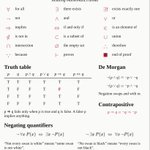
Giuseppe Peano began using ∃ in the 1890s, and Gerhard Gentzen modelled ∀ on it in 1935. De Morgan's laws turn an and into an or when a negation passes through, and the same swap turns ∀ into ∃.
The rule that p ⇒ q is true whenever p is false trips up most beginners. It is what lets a proof by contradiction work.

Fold a strip of paper in half, then in half again, 13 times, then open every crease to a right angle.
The result is the dragon curve: 8192 unit segments that never cross, only touch.
Each unfolding step is the whole curve copied, turned 90 degrees about its end and attached. Copies of the finished shape tile the plane with no gaps, and its boundary is a fractal of dimension about 1.52.
A rose curve is r = cos(kt): the pen moves out and back k times per turn. Odd k gives k petals, even k gives 2k.
Here a point runs round each rose at constant speed and only its height is plotted against time.
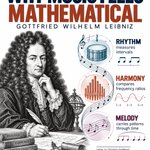
Leibniz described music as unconscious arithmetic because listeners sense numerical structure before calculating it. Feeling can arrive before explanation.
In a letter to Christian Goldbach dated 27 April 1712, he linked musical pleasure to hidden counting. Rhythm measures intervals, harmony compares ratios, and melody organizes patterns through time.
The mind does not need written fractions to recognize proportion. Music turns mathematical order into expectation, tension and release that can be heard directly.

One rule, r = f(θ), can be drawn two ways.
In polar form the angle turns a pointer and r sets how far the pen sits from the centre. In a graph, θ runs along the bottom and r is the height.
The cardioid, the three petal rose, the limaçon (its negative r traces the inner loop) and a wavy circle are shown in both at once.
Pitch follows r, from 541 Hz at r = 0, plus 116 Hz per unit.
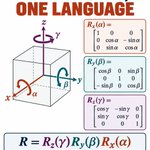
A rotation matrix moves space without stretching it, but three rotations do not simply commute. Changing their order can send the same object somewhere else.
That order dependence matters whenever orientation must be tracked precisely. Robotics, aircraft navigation and computer graphics all rely on choosing and documenting a convention.

A square wave jumps between two values and stays flat.
Fourier showed it is built from sine waves alone: add the odd harmonics 3, 5, 7 and so on, each one that many times faster and that many times smaller.
Every circle here is one harmonic and the last tip's height is the wave. With 1, 3, 9, 30 and 100 circles the tops flatten and the edges sharpen, but a 9 percent overshoot never goes away: the Gibbs phenomenon. Pitch follows the height.
Seven bridges, four land masses, and a walk that cannot be done !?
Euler replaced the map with dots and lines and counted the lines at each dot. A walk crossing every bridge once can start and end at only two places, so at most two land masses may have an odd count. Königsberg has four, with 5, 3, 3 and 3.
He presented this to the St Petersburg Academy on 26 August 1735, and it was published in 1741. Only five bridges remain at the original sites, so a walk is possible today, but only from one island to the other.

Move a point around a closed shape at constant speed and plot only its height against time.
A circle gives a pure sine. The heart gives two bumps and one long dip, the astroid gives flat, sharp peaks, the five point star adds five ripples, and the lemniscate, a figure eight, crosses zero four times per turn.
All five repeat every 1.4 seconds, so only the shape of the wave changes. A higher point is a higher note.
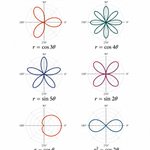
A tiny change in angular frequency can turn one polar rule into a completely different flower. Circles, roses and figure eights grow from nearly identical notation.
For r = cos(nθ) or sin(nθ), odd integer n gives n petals and even n gives 2n. Negative radius values plot in the opposite direction, completing the symmetry.
The curves make periodicity visible as geometry instead of a time trace. They are a compact lesson in how frequency and sign control repeated spatial structure.

Repeat one rule, x becomes rx (1 - x), and slowly turn up r.
At first x settles on one value, then flips between two, then four, eight, and at about r = 3.57 it never repeats: chaos. Inside the chaos sits a window at r = 3.83 where it snaps back to a cycle of exactly three.
Every iterate here is a note, higher x, higher pitch, so you can hear the cascade.
Some infinities are strictly larger than others: the whole numbers, the integers and the fractions can all be put in one list, but the real numbers cannot.
Cantor's 1891 diagonal argument builds a number that differs from the n-th entry of any list in its n-th digit, so every list misses one. The same trick shows that a set always has more subsets than elements, so the ladder of sizes never ends.
Nobody can say whether any size sits between the whole numbers and the reals. Gödel showed in 1940 that it cannot be disproved and Cohen showed in 1963 that it cannot be proved.

Put 360 points around a circle and join point i to point m times i, wrapping round at 360.
With m = 2 the straight lines trace a cardioid, with m = 3 a nephroid, and every whole m gives a curve with m - 1 cusps: the envelope of the lines, an epicycloid.
Nothing curved is drawn except the circle. You hear one note for every cusp.
Two identical sources send out waves. Where a crest from one meets a trough from the other, they cancel; where crest meets crest, they double.
The cancelling lines sit wherever the two path lengths differ by half a wavelength, so moving the sources apart from 0 to 5 wavelengths opens 10 silent lines.
The tone is what a listener at the black dot would hear: loud on the bright bands, silent on the lines.
Transforms answer different questions about the same signal. Fourier exposes global frequencies, Laplace adds growth and decay, wavelets localize features in both time and scale, and the Z-transform handles discrete sequences.
None is universally best. The useful transform is the one whose coordinates turn the structure you care about into something simple.

300 identical double pendulums, released almost together: in total they differ by only 0.05 radians, about 3 degrees.
At first they swing as one, then the differences grow exponentially and they scatter.
The equations are exact, yet the motion cannot be predicted for long.
Martin Gardner printed the puzzle in his February 1960 Scientific American column, where it was known as the game of googol, and it has also been called the marriage problem and the sultan's dowry problem.
Candidates arrive one at a time in random order, each must be accepted or rejected on the spot, and only the best counts as a win.
Rejecting the first 37 of 100 and then taking the first candidate better than all those seen gives a 37.1% chance, against 1% for a blind pick.
For large numbers the best cutoff approaches the total divided by e and the winning chance approaches 1/e, which is 36.8%

A function assigns one output to each allowed input, but its graph need not be smooth or connected.
Linear functions change at a constant rate. Exponentials multiply by a fixed factor for each unit increase, while logarithms reverse that relationship. Floor and piecewise functions show why endpoints matter.

Fifteen pendulums, each a little shorter than the last, are released together.
In 20 seconds the longest swings 11 times and the shortest 25, so they drift into waves and chaos, then line up flat at 10 s and again at exactly 20 s.
A pendulum's period is 2π√(L/g), so lengths from 0.82 m down to 0.16 m do it. Seen from above. A note plays as each one crosses the middle: shorter is higher.
