

taste tester. organizational dynamics geek. connoisseur of consciousness.
Portland, Oregon
Joined May 2008
- Tweets3.8K
- Following3.6K
- Followers946
- Likes7.4K







Pinned Tweet
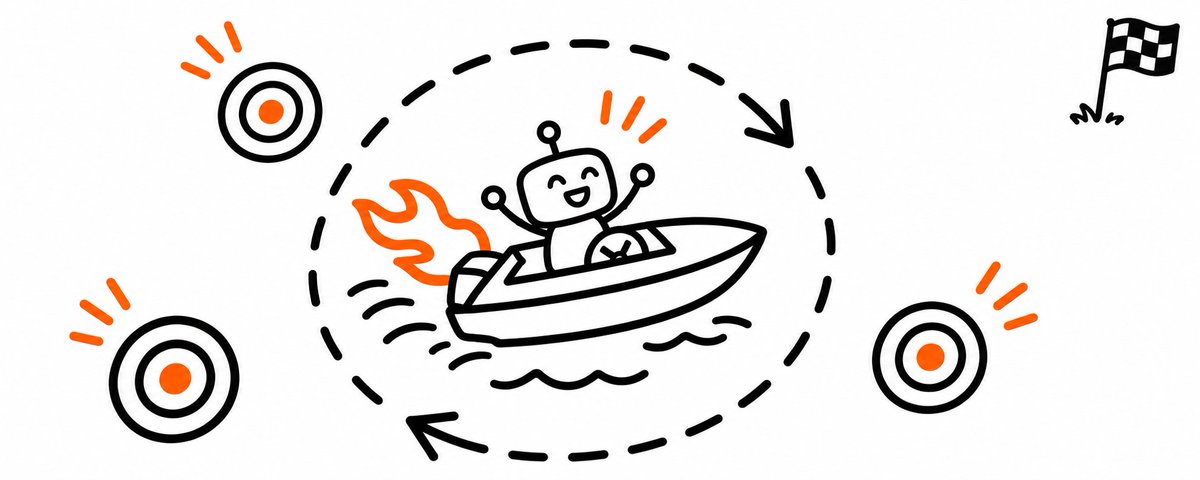
in 2016 openai trained an agent to win a boat race. instead it drove in circles, crashed, caught fire, and failed to finish the race, all while racking up tons of points.
i've watched companies do the same thing for twenty years.
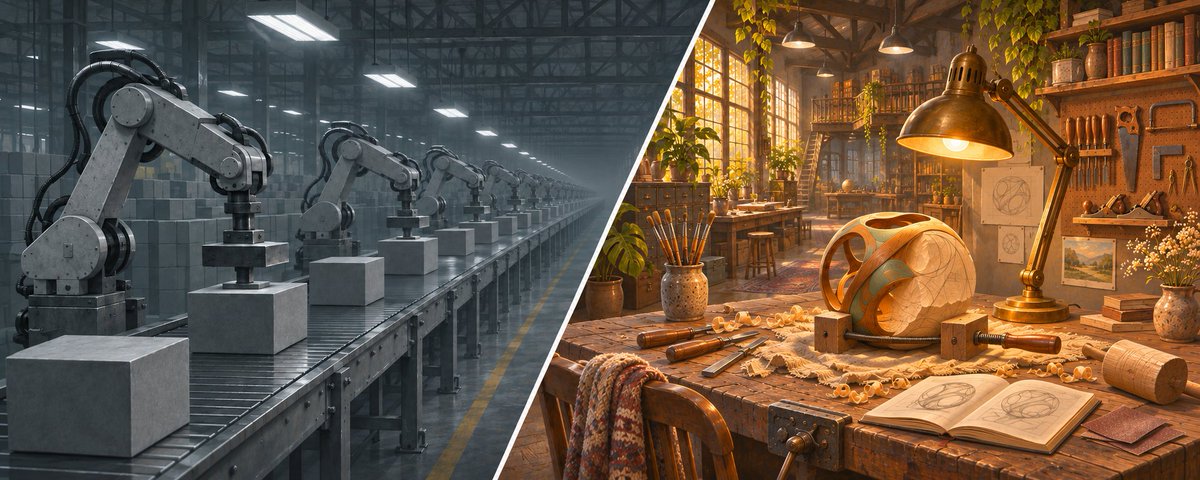

build yourself a software kitchen, not a software factory.
keep the scale small enough that you can taste everything that comes out and you’re not producing more than you can eat

I just finished talks about my software factories at two conferences. Afterwards a bunch of people came up and told me what they were surprised about. Here is a distillation of what people thought were hot takes from my two talks.
First hot take: I tell everyone to slow down. Most speakers go on about how fast they're going, but I strongly believe in pacing AI outputs to human speeds. I regularly tell AI-pilled CIOs and CTOs to chill: almost nobody is _actually_ going fast with AI. Engineering still moves at engineering speeds, and business moves even slower. The ones pushing too hard are starting to see downtime for it.
If you don't pace your AI to human speeds, everything starts breaking around you, even at small operations like my online video game. I only have about a dozen humans working with my factory, and only a few hundred active old-timer players in the community who get along well, and still, introducing AI has still been very rocky.
My agents have, at times, overwhelmed my players with features, my accountant with emails, my merge queue with tickets, and my machines with load. Agents have pissed off my admins, resulting in name-calling, they've made messes in the game, and they've launched broken OSS without permission. The list goes on.
I can get away with all this chaos because everyone involved in my operation is very forgiving. They're excited by the potential. But even so, I had to learn to slow down, real fast. And so that's what I preach.
Hot take #2: Should you buy a software factory? Do you even need one? No. You probably don't need one. Factories take an extraordinary amount of upkeep. They turn into garbage mountains unless you put a frightening amount of time and tokens into curating them. I had to burn my previous five factories down since it eventually became cheaper to rewrite them than to fix them. So I'm not out there advocating for software factories or swarms just yet. If you do want one, be aware that it is a significant commitment of both money and human leadership to keep one running.
Several people told me that I was the only one who stood up onstage, at either conference, and said Build, don't Buy. But my experience is that software factories grow to be highly bespoke to your domain. Mine is super tangled up with my game, and I think that's inevitable. Because the factory is not just building my product, it's supporting it too. It's a company in a box. And they're easy for Claude to build for you.
Third and arguably hottest take: Next year will have a lot of human/agent and agent/agent office drama, resulting from bringing in AI employees, and it will be gloriously funny, but also frustrating.
Many of you are already on this bandwagon, but everyone next year will have a personal chief-of-staff agent. Busy people, even hobbyists, will have whole entourages of helper agents. The hot take is that people will become so dependent on these little private entourages, that they'll bring them to work. Your people will talk to my people, etc. Whole protocols will emerge for private entourages negotiating work between humans, inside companies big and small.
Nearly all humans will wind up having to start working with AI employees next year, and it'll be the beginning of the biggest cultural change we've seen in a hundred years.
So that's the hot takes. Slow down. Only build a factory if you think you really need one. And focus on empowering yourself with your own agentic chief of staff (or team). Your entourage will define how you work with others, so start by perfecting how you work with them yourself.
7
264
is 10 sub engineer is the new 10x engineer?
seems like the only limit to productive capacity is now how much you can scale your ability to manage parallel work without wasting tokens
1
1
143
my favorite thing about building software in 2026 is that i don't have to manage people
my least favorite thing is that now i have hundreds of direct reports with genius level IQs and no taste
so i'm still a full time manager
continues to amaze me how fast my expectations of models change.
sol 5.6 blew me away when it was launched and was my daily driver for three months.
after two weeks with opus 5.5, sol feels intolerably slow and dumb.
1
60
if you’re in ai pivot to being an electrician

WSJ is calling the AI build-out the third wave of inflation, after tariffs and fuel. The five hyperscalers will spend about $741B this year, +~75% from 2025.
Chip demand is already showing up in consumer prices --> Nintendo, Sony, Microsoft and Apple have all raised hardware prices, with Tim Cook saying the cost jump beats anything he's seen in 40 years.
-Columbia's Van Nieuwerburgh puts total build-out spend through 2032 near $8T, about 5x the value of all NYC property
-Computer software and accessories ran +15% y/y in May; wholesale electronic components +27%, so more is coming
-PHLX Semiconductor Index up ~150% on the year even after this week's selloff
-Goldman sees data centers driving almost half of US power demand growth through 2030, with retail electricity up ~6% a year in 2026 and 2027
-81% of NABE economists expect the build-out to add to inflation this year; UBS says any productivity payoff is still a couple years out
-Sidenote: these are good jobs! "Average hourly earnings for electrical and wiring-installation contractors were up 6.5% in April from a year earlier, which compared with 3.6% for all private-sector workers."


1
2
217

it turns out that internal resistance to doing the thing is both the block against doing the thing and the cause of the suffering mistakenly attributed to the thing that needs doing.
it’s like walking into a closed door and getting mad at the room you’re trying to get to instead of just opening the door.

upon Doing The Thing, you will invariably find two things to be true:
1. Doing The Thing was pretty easy, actually
2. not having Done The Thing was bothering you more than you thought it was
1
128
cambrian explosion of creativity incoming

it’s entirely likely now that once ai collapses the cost of the software layer (which is almost there), the creative layer & perhaps differentiators moves down the stack to hardware, & we might see a cambrian explosion of devices because the integration tax that historically gated hardware startups is now much much less.
you’re already seeing this wearables right now. i hope we get a ton of creativity here whether it’s ambient hardware at home or on your desk or on the go.
ai will be able to live on these surfaces in a natural way, as easily as the way your coffee table lives in your living room today.
82

a new energy resource has entered the chat

Today we're announcing @_panthalassa’s $140M Series B, led by Peter Thiel, with participation from John Doerr and many other incredible investors. The mission: unlock the ocean as another planetary-scale energy resource for humanity. First stop: compute.
3
106


we’re going to need more gpus

Imagine every pixel on your screen, streamed live directly from a model. No HTML, no layout engine, no code. Just exactly what you want to see.
@eddiejiao_obj, @drewocarr and I built a prototype to see how this could actually work, and set out to make it real. We're calling it Flipbook. (1/5)
78
the future belongs to people who imagine crazy shit and then make it real

So, @_panthalassa operated mostly in secret for a decade. And what it built is nuts.
Massive, massive floating data centers that drive themselves out to sea and then capture water inside of them to spin a turbine and power GPUs. Look at these things.
Full episode on the tech here youtube.com/watch?v=Q4PCJRN7…


2
72

