

Software Engineer. I build tools before I build products. Enduro MTB. Austin, TX.
Joined June 2020
- Tweets3.3K
- Following648
- Followers453
- Likes2.5K


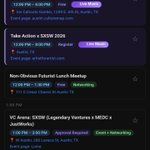


Boston Tech Week by @a16z has 378+ events. I made a map so you can stop raw-dogging the calendar.
Filter by day, track, time, and neighborhood. Click an event to see it on the map.
Boston live now. NYC next.
sxswunofficial.com/boston/te…

Take a scratchy old recording, reverse-engineer the room and the instruments, rebuild it from scratch in hi-fi.
Sneak peak into our submission for the AITX<>Codex community hackathon 👇
@aitxcommunity @OpenAI

Shoutout to my teammate Marko Cekic who architected the audio engine behind this 🎶
linkedin.com/in/markocekic/


added a "happening soon" to the map so you can see unofficial/free @sxsw events happening near you! thinklikeadesigner.github.io…

Rebecca retweeted

The token cost to build a production feature is now lower than the meeting cost to discuss building that feature.
Let me rephrase.
It is literally cheaper to build the thing and see if it works than to have a 30 minute planning meeting about whether you should build it.
It’s wild when you think about it.
This completely inverts how you should run a software organization. The planning layer becomes the bottleneck because the building layer is essentially free. The cost of code has dropped to essentially 0.
The rational response is to eliminate planning for anything that can be tested empirically. Don’t debate whether a feature will work.
Just build it in 2 hours, measure it with a group of customers, and then decide to kill or keep it.
I saw a startup operating this way and their build velocity is up 20x. Decision quality is up because every decision is informed by a real prototype, not a slide deck and an expensive meeting.
We went from “move fast and break things” to “move fast and build everything.”
The planning industrial complex is dead.
Thank god.
Built a consent-aware data vault at @AITXCommunity hackathon. Import your Google Takeout, ChatGPT exports, calendar. Toggle a source to private and it vanishes from shared contexts instantly. @AICollectiveCo @DTinitiative github.com/thinklikeadesigne…


Major memory upgrade in progress. I wanted openclaw's persistence but with multitenant security, so I adapted the architecture and added an archival layer for memory overflow

2 weeks ago this was a hackathon idea.
Today it's a deployed AI agent with:
- tool-use reasoning loop
- Telegram delivery
- Langfuse traces on every call
- PostHog analytics on every event
- $0.015 per interaction
AI products are complicated as fuck. Ship anyway.

I finally did it. Maxed out my RAM and my computer froze. Claude, VS Code, Docker, Obsidian all running fine. The bottleneck? 19.5 GB of Chrome tabs I forgot about.

Rebecca retweeted

built a small CLI tool that moves your AI coding session context between Claude Code, Gemini, Copilot, Codex and OpenCode when you hit rate limits.
no more re-explaining what you were doing, or painful copy/paste from terminal that lose tool-call context.
just `npx continues`
Rebecca retweeted

exploring shapes of thoughts: extracted my obsidian notes' embeddings and arranges them as a 3d network using 3 different topologies:
- centralized: one core idea connecting all
- decentralized: notes cluster into themed hubs
- distributed: edges labeled by llm describing how ideas connect
Your notes are a database you're not querying. Built a local RAG tool with ChromaDB, CLI, and graph viz. Semantic search over your own research for $0 in API costs.
Stop paying to search your own brain.
1/
I asked my AI agent why it kept hallucinating dates. Instead of making excuses, it gave me a root cause analysis with fixes.
This is the kind of self-awareness loop that makes agents actually useful. 🧵
6/
The takeaway isn't "AI is bad at dates."
It's that agents fail in predictable, fixable ways when you actually interrogate them. Most people just re-prompt. Ask your agent WHY it failed and you'll get something you can systematize.