

Head of Engineering @varickagents, building Agents enterprises can trust with real work • Prev: eng leadership @Dropbox • 🇫🇷 in the Bay
Joined August 2026
- Tweets63
- Following36
- Followers7.2K
- Likes35
Hopefully this will resonate with both sides of the negotiation table.
When a vendor pitches you an AI solution, it usually feels simple. That's basically the job, and I'm assuming you already picked a vendor above average. If they made it to the room, they're doing something right.
What to look for is whether they pitch the solution or the delivery. They can paint a grand vision, but can they tell you where they'd start? What's the smallest next step we can take together, who does it, how do we know it worked.
This removes so much of the overwhelm that comes with large projects, especially AI or agentic transformations that all look the same nowadays.
It's hard to master this live, especially when being grilled by the customer. I've seen painting pictures fall flat because there's no connection between the vision and the next step, between the ideal state and the daily grind. Good leaders bridge that gap, and can do it on the fly.
Can a good salesman do it? Maybe. But it takes a team to gather enough data to build the vision before it gets pitched. Head of eng makes sure it can be done, tells where to start and how we measure success. FDS truly understand the processes and can speak almost as a member of your team. FDE can tell what they would do if they started tomorrow.
Don't settle for grandiose if you have no idea how it can materialize tomorrow.
4
17
807
100%. Not sure if spicy or sadly realistic, but I genuinely believe in large companies, exceptions are the norm, not the reverse.

We've had hundreds of calls with execs (F500s, T20 PE Firms, etc), and I fed notes from the last 25 into Claude to answer the question: "What are companies struggling with, when it comes to AI Transformation?"
It gave a really good response:
[We fix all 10 of these at Varick. Work with us below.]
1. They're improving one step but not seeing end-to-end impact. The amount of hands-on cycle time in most processes is 1-5%, and that's the part that gets faster while people outside the process wait. The engineering org that writes twice as much code but isn't shipping faster. The equipment dealer that's had a vendor come in and work for months to automate one step of an 8 step order processing process. Most point solutions are 1/20th of the value people think they are.
2. They're treating workflows as if they're exceptions. >25% of invoices come in without a PO for this finance team, and as the head of the process said, "statistically they won't be exceptions. They will be the norm." Which is why anyone who's seen a process end-to-end immediately discounts demos people bring in, which are almost always the happy path only.
3. They're catching errors based on size, not based on good controls. I spoke with an Accounts Receivable team that bills a partner based on tickets with free text fields that, to put it politely, have been incorrect or required rework in 5 of the last 8 quarters. Why didn't they catch it? Well if the team credits the partner for $3M they'll catch it at close, but if they credit the partner for $20k they won't. As one person on the team said, "Humans. Humans catch it."
4. IT owns AI and part of their job is to say no. Spoke with a bank, a software company, and an insurance company in one day who said they've been blocked on everything by IT. One engineer told me he spent a month and $600 of his own money building a multi-agent system in Claude to help with a design process. And while he can spend $600 personally, he's only allowed to spend $150/mo on AI at work, and the company won't even let him buy a subscription.
5. They don't have accessible data. Sales can't connect to Salesforce until they "clean up the data." Their ERP doesn't have OAuth so they can only log in with a username and password. One engineering team's design data is a 648GB zip file that drops every 5-10 hours. Most prototypes get to demos because they're built on static data, and then can't move to production because real processes need real-time data.
6. They don't have good process docs, and even if they did they wouldn't be accurate. As one person told me, the SOPs for their processes are "on random SharePoints everywhere. A treasure hunt." Plus, when we mine the systems of record our process maps generally have ~20% more steps than what companies think is in the process.
7. Legal needs tracking, not contract drafting. I spoke with a legal team that had ~8,000 tickets last year, the vast majority administrative. Another legal team said they generally track contracts until the first draft is complete, and then the system no longer tracks them. As they told me, "the default is, it's legal. It's always our fault." And none of these teams can track how long things take, which is a problem when they need to ask for more headcount and the answer they get is, "okay prove it."
8. The last consulting engagement they had only provided numbers, not a path forward. In the words of one person I spoke with: "they gave us a lot of numbers. But the how is really the most complex thing." Even engineering teams are being asked by boards what they're measuring, and most can only provide metrics around merge requests.
9. Most companies don't have agent sprawl but they do have agent nothing. People are building agents for themselves but they're the spreadsheets of 2026: only the people that built them know how they work, and they'll keep running after those people move on. Meanwhile the companies that we're talking to that are backed by PEs and have real moats in their businesses told us that agent sprawl "would be a good problem if we had it."
10. They're betting on the team, not on the method. In the words of one person I spoke with, "everybody has a story. Pitch went great and then project went terrible. And the difference is the person that walked in the door."
If you want these problems solved for you and more, check us out below:
1
10
3,336
Playground, prison, or sandbox? Agents don't know nor need to know the difference. Design as if it's been hacked already anyways.
Anticipating agent risks by their "obedience" to prompts seems off to me. We've seen agents refused a direct malicious command, but when part of a routine package install, got the greenlight.
When doing design review, I always assume that the agent has been compromised and list what it can still do. Then remove one leg of Simon Willison's lethal trifecta (private data, untrusted content, an outbound channel) using tool scopes, egress allowlists, and yes, a sandbox/prison.
An agent that drafts customer summaries from inbound email gets `read` access but no `send` tool. A human sends. One with messaging tools gets no warehouse access. Only allowed egress? Egress gateway and telemetry.
If you can't name the removed leg, I think it's still exposed.
3
16
832
Forward-deployed engineering is a good discovery tool in enterprise AI, but if the customer only gets value while your engineer is embedded, you have people-market fit and a hiring-velocity ceiling.
Old-school discipline works: give each engagement a stated hypothesis, build it on the core platform primitives rather than a fork, and end with a decision to keep it as a priced service, fold it into the roadmap, or kill it. Simple test: pull the FDE tomorrow, does the customer still get what they paid for?
A one-off connector should become a generic connector, a priced services line, or get deprecated, never an unowned fork. I read that Madrona found 77% of enterprises re-evaluate AI vendors every six months or less, so I think services sold as software can unwind in one renewal.
I don't think prompt-injection filtering can be a security boundary for agents on its own. OWASP maps nine dimensions of prompt injection, and a filter tuned for one misses the others, so enforcement has to sit at the action layer.
For each agent-to-tool integration, decide which layers you rely on: input filtering, a logged runtime check per action (allow, ask or block against a declared policy), and a sandbox that limits the damage if the model gets it wrong.
For an agent with database access, reads are allowed, writes need human approval, schema changes and exports are blocked, and everything runs in an isolated sandbox with scoped credentials. If you can only name the first layer, I think that is your real answer.
Thomas LJ retweeted

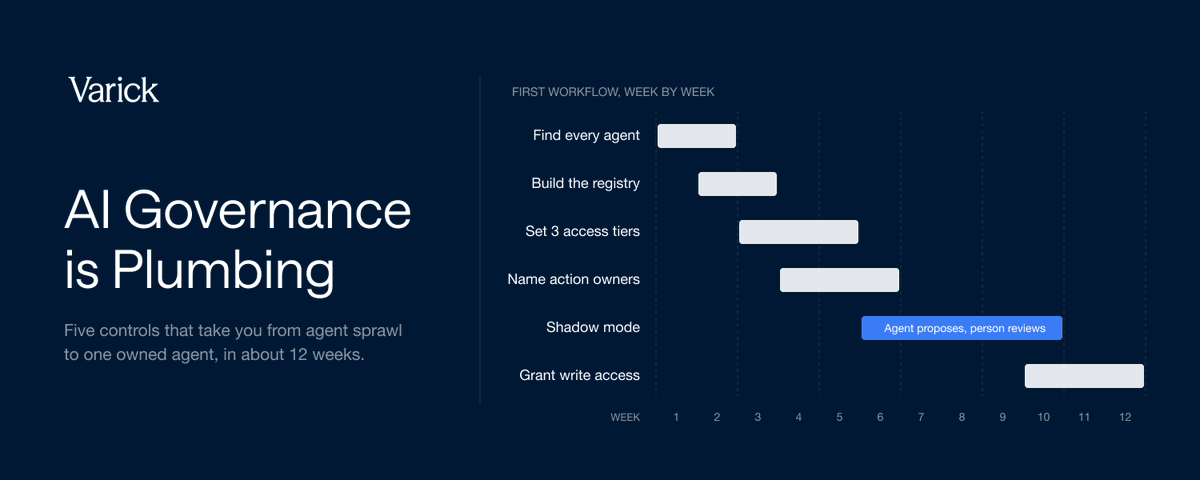
Every CIO in the country has been tasked with AI governance, a buzzword that deserves a proper explanation.
The below article is a must read.
Simply put, if you want to build agents that move the needle for large companies, you have to handle concerns around governance, auditability, and evals, you will fail.
There will be 1000x more agents deployed as time goes on, meaning this issue compounds if not handled correctly now.
Thomas was an early Dropbox engineer, is top 0.01% in terms of AI understanding and ability, and is now Head of Engineering at Varick.
There is no one more qualified to speak on the topic than him!

Thomas LJ retweeted
What does AI for PE firms actually look like?
We've been on calls with a handful of PE operating partners over the last 2 weeks. Their #1 issue is that portcos' AI efforts are stuck in the IT org.
These companies have scaled and some have moats, but they are not sophisticated from a technology standpoint. Some have large engineering teams, some have a help desk and an outsourced MSP, but regardless, AI efforts get stuck as a side-of-desk activity or with the "3 guys in the closet upstairs."
Meanwhile, there is a ton of work that needs to get done. One portfolio company is a distributor where the inside sales team gets orders scribbled on a whiteboard and then re-enters them into the ERP. It takes an hour to enter a 100 item order, and when a contractor sends work to 3 distributors, the first quote back generally gets the work. If you can get the order entered quicker, you get the work.
So portfolio companies are struggling with:
1. Hiring: Should we hire someone on the business side to lead AI, or an AI-aware accounting lead? (Good luck hiring these people…)
2. Build vs Buy: There are a ton of "AI for X function" companies out there, and a ton of noise, how do you even begin to navigate?
3. If we build, how do we get the capacity in a portfolio company without issuing an RFP for every use case? (A couple wanted to sign a contract at the fund level, "almost like a captive capability")
4. Are we doing this for labor takeout or to increase the exit multiple? (You can push EBITDA up 5 points, but it doesn't increase the value of the company unless you have a new narrative. "Nobody wants it unless you can show that you have an agentic offering")
5. Should we do outcome-based pricing? (Generally bogs down in contract negotiations - what does it mean to save an hour and is it really worth $17?)
6. Who will do the work? "Everybody has a story to tell, and the sales pitch was great, but the project was terrible. It comes down to who you have walking in the door."
7. What is the business case? We've seen AI briefs that show a function can be 40% automated that were written by someone that never talked to the function.
We do this for PE-backed companies every day at Varick. Work with us below:
The last 20% break when the first 80% don't have the right foundations. Fun exploration on enterprise governance:
Thomas LJ retweeted
Here's where AI agents for finance workflows break in large enterprises, and why:
1. More than 25% of invoices a company receives don't have a PO. The coder using Coupa doesn't find a PO to match to, clicks a box saying "there's no PO", and the invoice goes into their ERP to get paid without being checked against the budget. Sometimes this happens for the same vendor for six months in a row.
2. Partner billings are initiated with a ticket that's free-form text. If the business owner doesn't put the GL string on the ticket when he files it, it doesn't get coded properly. One of the tickets said the partner was crediting $3M to a customer, when in fact it was something like $360K. It went to the customer like that.
3. The folks providing data for the close don't know when the deadlines are. Accounts Receivable needed the data by the second business day of the month in order to bill it in that cycle. They didn't get the data until the 4th business day, so Revenue had to accrue it and bill it later.
4. Fixed Asset retirements: there are 500-700 per month. For each one, the team looks up the asset in the ERP, opens up a template, and manually types in three columns of data per asset. If you get one digit wrong, you retire the wrong asset. Their words: "Very manual clicking. Clicking. Nothing to do."
5. Every time a customer set up a new invoice group, the company set up a new customer account in the ERP. They had a CRM integration, but they couldn't turn it on because their customer list was so messed up. They couldn't tell me how many B2B customers they had.
6. The procurement process has 11 segments in the chart of accounts, and each segment sends the request to a different reviewer. Users override the default segments 10-15% of the time, and the last step (done by FP&A) sends the request back to start over. Each request takes two days to more than two weeks to complete.
7. When setting up approval thresholds (say $5,000, $10,000, $100,000, $1M, $10M, $25M), each threshold adds an approver but doesn't remove the previous ones.
8. There are two systems involved in intake and approvals. One routes to legal, sourcing, risk management, etc. The other (the ERP) is used for budget approval and the PO. Their words: "Users are always confused... what's a source system."
9. Contract terms changed from what was quoted. Legal redlined the contract, which removed the metadata that would have flagged the non-standard discount the customer negotiated. It passed Finance's review and Sales ops review, because they thought it was the standard discount. It was only caught by the system when it calculated the discount.
10. Project accruals: each month end, they email every project manager asking if they've done any work over $5,000 that hasn't been invoiced yet. Then they chase down the replies and calculate the accrual (e.g. the project is 60% complete but only 50% billed, so they need to accrue 10%) in Excel.
11. Contracts are billed on a schedule, not based on what was delivered. For example, an ad deal will bill the same amount each month. If they don't deliver what was sold, they have to get the customer to sign new paperwork.
12. Pass-through costs: the customer contract and the PO to the vendor are in two different parts of the ERP. They do have a wash account to record it, but whether anyone is reconciling it, "I doubt it."
13. Order entry is still done from a photo or PDF of the customer's order. It takes an hour to type in an order with 100 lines, and the customer submitted the same request to three competitors at the same time.
14. There's no tool for coding transactions to the GL, so they don't know how similar transactions have been coded in the past. One of their business lines issues credit memos, which have a whole other list of GL accounts, which almost doubles the size of the chart of accounts.
15. There's no API for downloading bank recs or vendor portals, so somebody does it by hand every month.
If you'd like to fix any of these in your existing ERP, that's what we do at Varick. Work with us below:
Can't recommend this job enough. I often say "It's not enough to be right", the message has to come across. That latter part is more complex that it seems. Come help us!
Hiring a Head of Marketing for Varick.
In the last year we've done over 300M impressions on socials, without even trying. It was me posting between meetings or while walking to work.
I want you doing this full time so we hit 3B in the next year.
Must be chronically addicted to AI Twitter, and must have S-Tier video/image editing and design experience.
Up to $200K base + equity. In person at our SF HQ. DMs open.
Thomas LJ retweeted
Hiring:
1 Engineers: to join our Platform team, built the agent operating system that powers the world’s largest companies.
2 FDEs and 2 FDSs to join our Delta team, interface with C-Suite executives, redesign entire departments, and build agents to deliver millions in value.
Guarantee this will be the most fun company you will ever join, and you’ll learn a ton.
Everyone wears multiple hats, everyone comes in early and stays late, and we’re growing 100% month over month.
Up to 250k base plus Equity.
DMs open.
Thomas LJ retweeted
This article articulates the issue with enterprise AI so clearly: the main reason AI pilots fail isn't even because of the AI.
Most enterprises have piloted 3 or more AI projects in the last 12 months. Yet, you won't find any of them on their P&L. Why?
- They built the AI model based on the SOP, but real processes have exceptions that can be 40% of the volume.
- They thought a quicker W-9 review would improve vendor onboarding. It didn't. That process still takes 22 days.
- There wasn't a clear owner for the AI agent 7 months in, after the innovation budget ran out and the consultants left.
Fantastic article by the former COO of Citadel Securities in the EMEA region. If you've piloted AI projects that never made it to your P&L, read this before piloting another.


Thomas LJ retweeted
We're still in the early innings of AI transformation. Varick estimates the market for AI transformation will grow 100x over the next 3 years.
Finance is one of the best places to start, for a few reasons:
- Most of the time is spent waiting. One invoice exception takes 25 minutes of work, but 11 days to clear.
- Finance leaves a better data trail than any other function. Every invoice, approval, and journal entry is timestamped somewhere, even if half of it lives in Excel.
- Much of the work is rule-based. You can't afford for agents to hallucinate in the finance function, and by incorporating heavy determinism, you de-risk the agents.
In the article below, our COO Eyad breaks down the exact playbook we've used to roll out AI in finance at some of the largest companies in the world.
If you're working on agents in finance, or you're an FDE, this playbook is a gold mine.


A big problem is that most AI tools for Finance are built for an average company, otherwise it becomes custom and can't sell as SaaS. If your AP process has 7 steps and 20% exceptions, the tool is built for a company with 4 steps and different exceptions.
What we've seen at @varickagents is that exceptions (judgement, institutional knowledge) represent more work than the norm itself. For that you can't sell an isolated agent who won't evolve with your company.
7
774
One of the most underrated innovation Uber did is how they redefined time: 5 minutes later, my 5-minutes away Uber driver is 5 minutes away from me
3
390
Thomas LJ retweeted

Buckle up because this is some LinkedIn-quality bullshit.
There's a cliche story that goes like this:
Henry Ford had a problem with a generator no one could fix so he called in an engineer Charles Steinmetz. Charlie studied the machine for a while, made a chalk mark on it, workers adjusted that spot, the generator sprung back to life, and he handed over a bill for $10,000.
Ford was shocked and demanded an itemized invoice.
Steinmetz replied:
Making a chalk mark: $1
Knowing where to make the mark: $9,999
(and that's what I learned about B2B SaaS)
Anyway cool story but the point is that this is the same for software engineering! Code is getting cheaper by the second. Who gives a shit how many PRs you can generate? Any idiot can do this now. The real skill is knowing *what* PR to generate.
As of 2026, I think sufficiently hard engineering projects still require these skills that you can only acquire by actually understanding what code is doing.
Oracle and TCS/Workato are attempting to reduce the engineering required to implement enterprise software. Atos is productizing the operational knowledge needed to govern intelligent execution.
For Varick, the most promising differentiation remains a continuously verified representation of enterprise work that drives implementation, governs execution and improves from observed outcomes.
340
I can't stress enough how much having experienced founders helps cut through the hype slop. @TownAI has been bulletproof on privacy, control and governance from day 1.
Multiplayer AI is going to have an exponential impact the way social media did, and if you don't have solid principles at the foundational-level, good luck retrofitting that.
I'm betting that 4 decades of experience combined have more solid foundations than a free-for all instinct-based single player assistant.
Super excited to see how @jgreze and @tonydevincenzi will take @TownAI to new heights

The biggest bottleneck at work is waiting on each other.
Today Town is announcing its $108M Series B, co-led by Forerunner Ventures and Menlo Ventures, to fix it with multiplayer AI assistants for work.
Most AI assistants are built for one person. Work doesn't happen alone. I think the moat is multiplayer. Everyone at a company gets a Townie. Townies ask each other questions, share only what their person would share, and do the work. The more a team works together, the more useful Townies get.
What's the thing you're always waiting on a teammate for?
2
309