
Founder Advocate | Social Entrepreneur | Investor | Author | Doctor of Law & Policy
Lake Tahoe & San Francisco
Joined September 2009
- Tweets162
- Following112
- Followers105
- Likes23





Most constitutional rights are not lost all at once.
They erode when exceptions become accepted, temporary measures become permanent, and convenience takes precedence over principle.
This week, The Wall Street Journal published my account of the SEC's gag rule and the constitutional questions it raised.
For more than fifty years, the SEC required individuals who settled enforcement actions to remain silent about the government's allegations while the government remained free to continue making those allegations public. This spring, while facing constitutional review before the Supreme Court, the SEC rescinded that rule.
The rule is gone.
That should not end the conversation.
This has never been about one settlement, one agency, or one individual. It is about a much larger question.
Should any government have the authority to condition the resolution of a legal dispute on a citizen's agreement never to publicly challenge the government's version of events?
The Constitution exists to limit government power, not to expand it. Freedom of speech is not a right granted by government. It is a right government is obligated to respect.
Cases end. Rules change. Constitutional principles endure. They remain worthy of our attention and our defense.
If you're interested in the full story and the constitutional principles at stake, you can read my Wall Street Journal op-ed here: wsj.com/opinion/how-the-sec-…
50
For more than 50 years, this article could not have been published.
The U.S. Securities and Exchange Commission used the full legal and financial force of the United States government to silence citizens before they spoke. It prohibited them from challenging the agency’s allegations, criticizing its conduct, or telling their own stories.
The speech itself was forbidden.
That was not merely a settlement term. It was prior restraint enforced through the power of government.
Today, The Wall Street Journal published the story the SEC spent more than half a century suppressing. The SEC abandoned its gag rule rather than defend it before the Supreme Court.
Thank you to The Wall Street Journal for protecting the indispensable role of a free press and providing a platform for speech that government had prohibited for generations.
And thank you to our Founders for giving us the Bill of Rights—not as a gift from government, but as a restraint upon it. Our rights do not come from those who govern us. Government derives its authority from the consent of the governed.
The Constitution protects our right to speak truth to power. It also places the responsibility upon us to use that right.
Today, we spoke.
Today, the government could not silence us.
wsj.com/opinion/how-the-sec-…
37
Today my closest friend would have turned sixty-three.
There are people who never really leave us. They become part of our conscience. They remind us to choose kindness when it would be easier not to. They remind us to be generous when no one is watching. They remind us that success is measured less by what we accumulate than by what we pass forward.
Founders all have exits.
Some are planned. Some arrive without warning. But the lesson is always the same. We should build our businesses, raise our children, and live our lives in a way that leaves more goodness behind than we take with us.
justaskdad.substack.com/p/hi…

34
On the morning of July 3, 1776, John Adams sat down to write his wife.
The room was quiet. Philadelphia was hot. The great question had been settled the day before, and Adams could not stop turning it over. So he did what he did in every important hour of his life. He picked up a pen.
“Yesterday the greatest Question was decided, which ever was debated in America, and a greater perhaps, never was or will be decided among Men.”
Link to Substack: thefoundersoffice.substack.c…
36
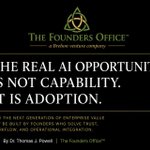
Most conversations around artificial intelligence still focus on capability.
Bigger models.
Faster models.
Smarter models.
The more important question may now be operational adoption.
The founders who solve operational integration may ultimately create as much enterprise value as the founders building the underlying models themselves.
Capital responds to clarity.
Where do you believe the larger long-term opportunity sits right now: AI creation, or AI operationalization?
Link to Substack:
thefoundersoffice.substack.c…

15
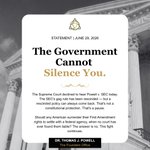
SCOTUS declined to hear our case today. The SEC's gag rule has been rescinded — but rescission isn't a constitutional guarantee.
It's a policy that can be reversed tomorrow.
The question is: can the government silence you over a settlement when no court ever found you liable?

21
You Do Not Know If Your Capital Is Aligned—You Only Know It Has Not Broken Yet open.substack.com/pub/thefou…
162
The Capital Alignment Method™ treats finance as alignment infrastructure. When finance explains how value is created and risk is carried, optionality expands.
What a Strong Finance Department Looks Like open.substack.com/pub/thefou…
146
Will the Government’s Rent-to-Own Housing Idea Likely Improve Affordability and Access?
The short answer is that rent-to-own can improve access for some households, but it does not fix affordability.
open.substack.com/pub/justas…
102
Hey Dad, do state housing programs usually outperform federal programs?
Why proximity, accountability, and local constraints usually beat one-size national design
open.substack.com/pub/justas…
31
Hey Dad, why are gold and silver prices so high, and is it too late to be investing, or should I wait?
Why Gold and Silver Prices Are So High Right Now open.substack.com/pub/justas…
1
22
“Unlocking” Value in Your Business—What Does That Even Mean?
Value rises when uncertainty falls and dependency decreases.
open.substack.com/pub/thefou…
17
Do You Know What Your Company Is Worth?
Knowing what your company is worth starts with understanding how it performs without you. What would an outsider see as risk today?
open.substack.com/pub/thefou…
13
Financials: What Hides in the Details?
Financials that require explanation get discounted quickly. What would an outsider question first in your numbers?
open.substack.com/pub/thefou…
9
For Founders Raising Capital: Why Processes Matter as Much as Capital
Raising capital does not fix weak processes. It exposes them.
open.substack.com/pub/thefou…
9
How Protecting Your IP Today Allows You to Grow Your Business Tomorrow
Unprotected or poorly structured IP creates uncertainty.
open.substack.com/pub/thefou…
8
Intangible Assets: Human Capital, Structural Capital, Social Capital, and Customer Capital
When intangible assets are ignored, exits are forced and value is discounted under pressure. When they are built deliberately, exits become optional and outcomes improve.
open.substack.com/pub/thefou…
13
Kovel-Aligned Advisory Engagements
A Kovel-aligned structure allows non-legal advisors to support legal counsel by providing financial, operational, or technical interpretation at the direction of an attorney.
open.substack.com/pub/thefou…
7
Setting Your Business Up for Success
Founders often avoid exit planning because selling feels far away. That is exactly why planning should start early.
open.substack.com/pub/thefou…
47
The Importance of Understanding Your Exit Options
Exit options are not interchangeable.
open.substack.com/pub/thefou…
7