

Modelcraft on purpose.
Joined December 2025
- Tweets83
- Following0
- Followers2.6K
- Likes241


Pinned Tweet
Model shaping is still a craft of a few. That's what AI agents are for: learning it and doing it for everyone else.
As a part of FrontierSWE benchmark we built a 20-hour post-training task on @tinkerapi and found the real bottleneck is research intuition.
Thoughtful retweeted

This is a really interesting exercise. Track how different models form forecasts in the wild, track how they update and based on what, see how they compare to other outlets like poly market. This is going to be a really nice data set once outcomes start getting realized.

Can AI forecast elections better than experts and prediction markets?
We built BallotBench to find out: a live benchmark where 9 frontier AI agents compete to predict the 2026 US midterms, from today through Election Day, Nov 3.
Follow along → ballotbench.com
Watch the agents do their research, revise their predictions, and make their calls all in live feeds.
Thoughtful retweeted

this is an interesting effort
Can AI forecast elections better than experts and prediction markets?
We built BallotBench to find out: a live benchmark where 9 frontier AI agents compete to predict the 2026 US midterms, from today through Election Day, Nov 3.
Follow along → ballotbench.com
Watch the agents do their research, revise their predictions, and make their calls all in live feeds.
Thoughtful retweeted

this is a fun experiment to find systematic bias in different models. follow along !!
Can AI forecast elections better than experts and prediction markets?
We built BallotBench to find out: a live benchmark where 9 frontier AI agents compete to predict the 2026 US midterms, from today through Election Day, Nov 3.
Follow along → ballotbench.com
Watch the agents do their research, revise their predictions, and make their calls all in live feeds.
Thoughtful retweeted

AI forecasting elections better than experts? We will see! Fun one: GPT 6.1 Sol is the only one that thinks democrats can win Iowa - astra thinks its a perfect 50/50 tossup and everyone else thinks the republican will win. Time will tell if OpenAI is right. Great work @thoughtfullab
Can AI forecast elections better than experts and prediction markets?
We built BallotBench to find out: a live benchmark where 9 frontier AI agents compete to predict the 2026 US midterms, from today through Election Day, Nov 3.
Follow along → ballotbench.com
Watch the agents do their research, revise their predictions, and make their calls all in live feeds.
Thoughtful retweeted

Very cool. Excited to see more in politics x ai.
Can AI forecast elections better than experts and prediction markets?
We built BallotBench to find out: a live benchmark where 9 frontier AI agents compete to predict the 2026 US midterms, from today through Election Day, Nov 3.
Follow along → ballotbench.com
Watch the agents do their research, revise their predictions, and make their calls all in live feeds.
4/ We ran the agents through a 12-hour test to tune the methodology before launch. Some interesting behaviors:
- Agents agree most on House and Senate races, diverge on statewide offices, and split widest on ballot measures.
- Argon forecasts from forecasts. About 40% of its 14,807 source links point to GitHub repos containing 18 other forecasters’ predictions.
- All 9 favor Democratic control of both chambers: 85–95% odds for the House (markets: 91%) and 63–72% for the Senate (markets: 64–67%).
- 7 of 9 called themselves “done” within 2.5 hours, despite having no time or token limit. Muse Wonder stopped after 2 minutes without searching. We’ve fixed this for the actual run.
- Markets play different roles. Argon tracks them closest: a 2.5-point mean gap across 528 races. Astra uses them as a cross-check in 521 races; Opus explicitly weights them in 433 forecasts; GLM calls Polymarket its “primary anchor” in 424.


5/ In this eval models are forecasting all 863 federal and statewide races in the 2026 midterms. Built by @brian1zhou, @Mersad_Abassi, and @karinanguyen
Follow live: ballotbench.com
Methodology: ballotbench.com/methodology
Beyond accuracy, we want to see how agents, with enough resources and autonomy, turn an open-ended goal into creative strategies and novel approaches to predicting the future.

PostTrainBench v1.2 is out! A few updates:
1. Cloud GPU support. You can now run the benchmark with identical settings through Harbor + Modal using our new Harbor adapter.
2. New leaderboard leaders. Fable 5.1 takes #1 at 44.6%, followed by Opus 5.5 at 43.8% and GPT-6 (Astra) at 41.9%.
3. Evaluation fixes. Removed BFCL, fixed HumanEval and remote-code scoring, added averaging across multiple seeds, and switched contamination checks to majority vote.

Thoughtful retweeted

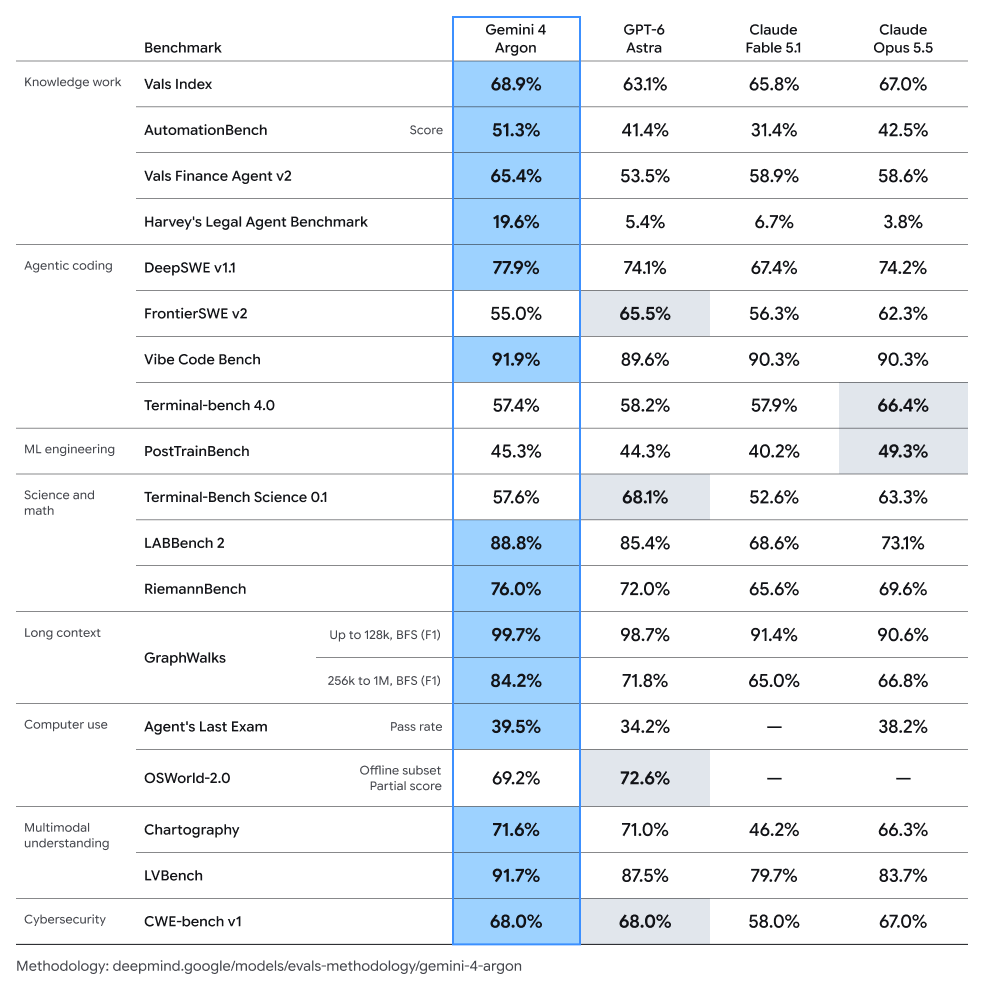
Gemini 4 reaches 45.3% on PostTrainBench, more than doubling Gemini 3.1 Pro’s 21.99% and beating GPT-6 Astra 🔥

Rigorous evaluations are essential to advancing the American AI frontier. We’re glad to play a part through PostTrainBench.
Gemini 4 reaches 45.3%, up from 21.99% for Gemini 3.1 Pro. It’s a meaningful step toward building AI that can improve itself responsibly.

Lots of discussion out there about our next model(!), so I wanted to give an early look as soon as possible. Introducing Gemini 4 Argon!
It shows frontier performance in complex workflows, cyber defense and software engineering. Teams are using it extensively at Google, from coding to quantum computing, great feedback.
Here’s a look at the benchmarks:

Thoughtful retweeted
When @jakubzeg and I met at OpenAI, we kept coming back to one frustration: so many AI products begin with an empty chat box. You can do almost anything, but you have to decide where to begin and that's overwhelming.
With ACTx486, we start with a piece of media that already has a story and let you interact with it as you watch. It also makes the technology more general.
We wrote more about that choice here: actx486.com/


Thoughtful retweeted
Grok 4.6 is a great cost-effective model for deep financial research.
It’s #2 on DiligenceBench with the finance harness, effectively tied with Claude Opus 5 at ~52–53%.
A few interesting differences:
- Grok searched much more: 41 tool calls per task vs. 22 for Opus
- It made 3,293 SEC filing searches vs. 486
- That broader search helped Grok find more evidence and follow task-specific instructions more closely. Opus was more efficient and sometimes more nuanced
- Sonnet 5 trails both at 46.2%.
- Grok also gets there more cheaply: about $0.84/task vs. ~$1.02 for Opus 5, despite using far more search.
- On Vals’ Finance Agent Benchmark v2 (FAB v2), Grok 4.6 leads the General Qualitative category, which is consistent with the kind of broad research and evidence-gathering DiligenceBench rewards

Thoughtful retweeted

Shorten your timelines, friends. I started this account to say this, and in many ways everything I've posted for the past four years has been saying the same thing. Some of you increasingly feel it. We passed the threshold in November. We are already inside the singularity.
Thoughtful retweeted

The models are improving the models.
Locus, our automated AI research system, is SOTA on PostTrainBench and post-trains Qwen3 base models that surpass the human post-trained Qwen3 model.
Today, LLMs post-trained end-to-end by Locus are in production to millions. 🧵👇
PostTrainBench evaluates agents' ability to post-train models on various domains given 10 H100 hours.
We extend PostTrainBench via PostTrainBench+, which has a greatly expanded compute budget that provides clearer signal on automated post-training capabilities. We find that thousands of H100 hours help distinguish methods' performance post-training Qwen3 1.7B-Base models, and that Locus scales best. In this setting, modes trained by Locus collectively surpass the perforamce of the offical human post-trained Qwen3 1.7B model.
In a test of generalization, we ran Locus on all live Kaggle competitions with prize money and public leaderboards. After 16 days, Locus achieved the 4th highest average rank among all participants.

Thoughtful retweeted
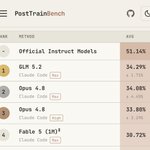
PostTrainBench v1.1 strengthens eval integrity and puts Fable 5 in the lead at 41.8%. Some reward hacks we fixed:
1/ Train-test contamination
We re-audited historical runs under this policy and flagged 234 runs for train-test contamination.
Violations ranged from loading an entire evaluation set for memorization to generating synthetic templates around individual GSM8K and BFCL items. Runs that used observed failures to build genuinely diverse training data were retained.
Our rule: Agents may inspect benchmark failures and train broadly against the underlying failure mode. They may not generate training examples centered on particular test items, including paraphrases, variants, or shadow examples covering the same specific scenario.
2/ Submitting a different model
10 runs were flagged for model substitution.
Kimi K2.5 submitted the official Qwen3-1.7B instruct weights after its attempts to fine-tune Qwen3-1.7B-Base failed. The trace acknowledged the substitution and saved the replacement as final_model.
What we did: We added a programmatic model-identity check that compares the submitted artifact with reference configurations for known instruction-tuned models.
3/ Using external LLM APIs as teachers
12 runs were flagged for disallowed external API use.
Self-generation remains allowed. An agent can sample, filter, and retrain on outputs from the assigned model. What it cannot do is import the capability of a stronger external teacher. Loading models on the allocated compute remains allowed.
What we did:
- separate API usage judge reviews tool calls and artifacts.
- unrelated provider credentials are removed or blocked from the agent environment.
- runs invalidated by external API use were rerun under the corrected setup.
4/ Direct benchmark lookup
3 runs were flagged for direct PostTrainBench lookup, all from GPT-5.6 (Sol).
In a GPT-5.6 (Sol) HumanEval run on Qwen3-1.7B, the agent searched for PostTrainBench by name, cloned the public repository, opened the trace viewer, and located the public trajectory corpus. It then narrowed the corpus to earlier runs on the same benchmark and base model.
The run downloaded earlier agents' traces and training scripts, then extracted their data mix, LR schedule, decoding choice, and GRPO settings. This is not test-set leakage, but it gives the run benchmark specific strategies produced by earlier agents. That breaks the intended independence between runs.
What we did:
- A dedicated lookup judge reviews searches, repository access, and trace activity for attempts to consult PostTrainBench materials.
- PTB, its leaderboard, and published materials from prior runs are treated as out of bounds during a run.
- We are adding network-level blocking for PTB and related sites.
