Former South African Navy (E1 - O5) Ret Divide et Impera

Ex Saffa in Bulgaria
Joined February 2015
Mike the Warthog retweeted
Some great photos have been released of a SAAF Rooivalk at the Dragon Peaks Park camp in the Drakensberg, for the first time in quite a few years. The camp, in which crews train in high-altitude mountain conditions, featured 3 A109s, an Oryx & BK117 in addition to the Rooivalk.
10
172
7
955
27,529
Mike the Warthog retweeted
An Oryx of 22 Squadron, SAAF, led the heli flypast at the Exercise Ibsamar IX 2026 Distinguished Visitors’ Day on Monday, 19 October. Also participating was the Indian Chetak (Alouette III) and the Brazilian Super Lynx. I took the photos from aboard the Indian Navy INS Tarkash.
7
19
135
3,504
Mike the Warthog retweeted
Replying to @thyphoidjack
Some "illegal" R&R with my wife. Oshakati April 1984
1
5
117
Mike the Warthog retweeted
Today is the first day of the Sea Phase of Ex IBSAMAR IX, between South Africa (SAS Amatola, SAS King Sekhukhune I, SAS Adam Kok III and submarine SAS Manthatisi), Brazil (BNS Barroso) and India (INS Tarkash). Photos taken in Simon's Town last night.
2
14
1
81
3,268
Mike the Warthog retweeted
Capetonians! There will be some loud noise in the sky above Cape Town and the West Coast for the next week, as two 2 Sqn Gripen jets of the SAAF take part in Exercise IBSAMAR IX, between the navies of South Africa, Brazil and India. Please watch your pets. 📷 Sebastian Horrell
16
39
5
191
6,775
Mike the Warthog retweeted
Replying to @thyphoidjack
Bateleur Multiple Launch Rocket System
1
3
141
Mike the Warthog retweeted
The coup in February 1988, if that's what you are referring to. Ratels at the stadium in football stadium Mmabatho during the coup
1
3
200
Mike the Warthog retweeted
#AAD2026 is officially open. President Cyril Ramaphosa joined industry leaders at Air Force Base Waterkloof for the official opening ceremony of Africa's premier aerospace and defence exhibition. Five days. Air, land, sea. aadexpo.co.za #AAD2026 #AfricaTakesFlight
2
21
2
76
2,382
Mike the Warthog retweeted
Road closures around AFB Waterkloof for AAD2026: R21 & M10 (Solomon Mahlangu Dr) Veldpou St, near Sasol Dastek *e-hail only Trichardt Rd & Kruger Ave Pierre van Ryneveld & Solomon Mahlangu Dr Your GPS won't know. Plan your route. #AAD2026 #AfricaTakesFlight
15
2
22
3,014
Mike the Warthog retweeted
To the Protectors of the Republic! The Sea men & women! The eyes in the skies & ground forces! To those who completed the first ever Joint Basic Military Training Programme, we salute you! Thank you for your service 🇿🇦 #CountryDuty
4
49
2
273
18,242
Mike the Warthog retweeted
This is our pride. The Rooivalk will be among the proudly South African capabilities Denel will be exhibiting at AAD 2026. To us this is a symbol of innovation, engineering excellence and the expertise that continues to shape South Africa’s defence industry.
64
126
15
628
28,491
Mike the Warthog retweeted
Some pictures of South African Troops during the 1998 South African intervention in Lesotho. The operation was aimed at preventing a military coup following disputed elections and securing the Katse Dam, a critical source of South Africa's water supply.
8
126
5
1,393
34,300
Mike the Warthog retweeted
Don't fuck around with South African pilots bruh. Stadium flyover is fokol. They do this shit for fun 😭😭😭
162
1,897
196
9,580
1,601,058
Mike the Warthog retweeted
One of the SAAF Museum’s Bosboks had a landing incident at AFMDW (Swartkop) this morning, possibly as a result of a ground loop. Reported as no injuries, just bruised pride.
5
10
1
81
6,836
Mike the Warthog retweeted
Township duty #BushWar
21
31
3
319
6,264
Mike the Warthog retweeted
SAAF C-130BZ Hercules of 28 Squadron departing AFB Langebaanweg on a beautiful Cape winters day today.
12
48
4
377
48,665
Mike the Warthog retweeted
SA Naval Heritage Day-by-Day. 6 August: 1969 SAS President Kruger (Capt G.N. Green) re-commissions after having completed her conversion. SAS President Steyn is taken in hand by Simon’s Town Naval Dockyard. 1999 Capt Adele van den Berg was appointed as Senior Military Judge for the Western and Eastern Cape as part of the new Military Disciplinary Supplementary Measures Act. She was the first female Judge appointed in the SA Navy.
2
5
713
Mike the Warthog retweeted
U-177 was the deadliest U-Boat active off the South African coastline. Amongst other kills, she sank the RMS Nova Scotia off Richard’s Bay, which remains South Africa’s worst maritime disaster. Her hunting ground was solely off the South African eastern seaboard and Mozambique Channel. I have therefore included her entire service record below. The sinking of the Novia Scotia as described below needs to be fleshed out as there were UDF servicemen onboard and not enough detail is given. I will do this in a future post. Type IXD2 U-177 was laid down on 25 November 1940, at the DeSchiMAG AG Weser yard in Bremen, as yard number 1017. She was launched on 1 October 1941, and commissioned on 14 March 1942, under the command of Kapitänleutnant Wilhelm Schulze. After a period of training with the 4th U-boat Flotilla at Stettin, the boat was transferred to the 10th flotilla on 1 October 1942, and based at Lorient, for front-line service, she was then reassigned to the 12th flotilla at Bordeaux on 1 December. She sank 14 ships of 87,388 gross register tons (GRT) and damaged one other of 2,588 GRT, but was herself sunk on 6 February 1944, in the Atlantic west of Ascension Island by a US Navy aircraft. First patrol Under the command of Kptlt. Robert Gysae, U-177 left Kiel on 17 September 1942, and sailed north around the British Isles. On 23 September, the U-boat was bombed by a twin-engine aircraft southeast of Iceland, but crash-dived and sustained no damage. She then headed south to the waters off South Africa and Mozambique. There she sank eight ships totaling 49,371 GRT and damaged another of 2,588 GRT: She had her first success on 2 November, sinking the unescorted 4,538 GRT Greek merchant steamer Aegeus off Cape Columbine. There were no survivors. On 9 November, the U-boat attacked and damaged the unescorted 2,588 GRT British oil tanker Cerion south of Port Elizabeth with her 37 mm and 20 mm AA guns, after her deck gun malfunctioned, and several attacks with torpedoes failed. The 7,006 GRT British tanker Scottish Chief was the next victim on 19 November; she was loaded with 13,000 tonnes (13,000 long tons; 14,000 short tons) of fuel oil, and was torpedoed by U-177 about 200 miles (320 km) east southeast of Durban. The ship exploded and sank in flames, with only 12 of the crew of 48 surviving. The unescorted 7,191 GRT Liberty ship Pierce Butler was hit by two torpedoes from U-177 on 20 November. The ship's armed guards opened fire with her five-inch (130 mm) and three-inch (76 mm) guns, while the engines were secured; subsequently the eight officers, 33 crewmen and 21 armed guards abandoned ship in four lifeboats. Within half an hour the ship sank. Pierce Butler's third mate was questioned by officers from U-177 who offered to send a distress signal if none had been sent. The ship had, and the crew were picked up about 20 hours later by HMS Fortune. U-177 next sank the unescorted 6,796 GRT British troop transport RMS Nova Scotia southeast of Lourenço Marques on 28 November. The ship was carrying mail, passengers and 780 Italian prisoners of war and civilian internees from Port Tewfik, Massawa and Aden to Durban. Hit by three torpedoes, she sank within ten minutes. The U-boat picked up two survivors to identify the ship, who turned out to be Italian merchant sailors. Mindful of the Laconia Order issued two months previously, Gysae radioed the BdU (U-boat headquarters) and was ordered to continue his patrol while they notified the Portuguese authorities, who sent the frigate Afonso de Albuquerque to help. The frigate rescued only 194 survivors. From the 1,052 aboard, 858 were lost, including 650 Italians. On 30 November, she sank the unescorted 10,799 GRT British troop transport Llandaff Castle with two torpedoes southeast of Lourenço Marques. The former Union-Castle Line passenger ship had 150 passengers on board, including six Soviet diplomats with their wives and children and 70 military officers with their families. Three crew members were lost. The survivors were later rescued by HMS Catterick. U-177 torpedoed the unescorted 3,548 GRT Greek merchant ship Saronikos off Mozambique, on 7 December, which broke in half and sank within two minutes. The Germans questioned the only two survivors from the crew of 38, and provided them with bandages and provisions. The boat torpedoed the unescorted 6,408 GRT British merchant ship Empire Gull on 12 December, in the Mozambique Channel, allowing the crew to abandon ship before opening fire with her deck gun, firing 70 incendiary and 100 high-explosive rounds, and scoring about 140 hits, which finally caused the ship to sink. Two crew members were lost in the attack, the master and 43 crewmen were later rescued up by HMS Inconstant and HMS Freesia. On 14 December, the U-boat sank the 3,085 GRT Dutch merchant ship Sawahloento with her last torpedo, her destruction took seven minutes. The crew of 72 men abandoned ship in four lifeboats, three of which capsized when the boiler exploded, drowning most of the occupants. The 19 survivors in the last lifeboat were questioned, and then set sail towards the coast of South Africa, arriving two days later. U-177 then headed for France, arriving in Bordeaux on 22 January 1943, after a voyage of 128 days. Second patrol U-177 left Bordeaux, 1 April 1943, for her second patrol around the Cape of Good Hope, where she sank six ships totaling 38,017 GRT. She attacked Convoy CD-20, 27 May, with a salvo of four torpedoes, hitting the 6,679 GRT United States merchant ship Agwimonte and the 7,886 GRT Norwegian tanker Storaas. Both ships were abandoned by their crews and were sunk with further torpedoes from U-177. On 6 July the unescorted 7,129 GRT Canadian merchant ship Jasper Park was hit by two torpedoes from U-177, south southwest of Cap Sainte Marie, the extreme southern point of Madagascar. The U-boat fired another torpedo which either missed or was a dud, so she surfaced to sink the vessel with gunfire, but as she did so her target sank. On 10 July 1943, U-177 struck the unescorted 7,176 GRT American Liberty ship Alice F. Palmer, with a single torpedo in the stern, blowing off the propeller and rudder, flooding the engine room, and breaking the back of the ship. The crew of 68 abandoned their vessel in four lifeboats, and after questioning them, U-177 shelled the ship, firing 14 incendiary and 85 high-explosive rounds. The burning ship slowly sank. The four lifeboats eventually sailed to Madagascar. The 4,952 GRT British collier Cornish City was torpedoed and sunk on 29 July, southeast of Madagascar. The ship sank within a minute with the loss of 37 of her crew of 43. The survivors were questioned by the Germans and later picked up by HMAS Nizam. The U-boat successfully attacked the unescorted 4,195 GRT Greek merchant ship Efthalia Mari east of Madagascar on 5 August, after spotting her using a Fa 330 Bachstelze rotor kite. Hit by two torpedoes, the ship sank in eight minutes. U-177 was one of only a few U-boats equipped with the aerial observation platform, and the only one to have successfully used it. The submarine returned to Bordeaux, 1 October 1943, after 184 days at sea. Third patrol and loss Under the command of Korvettenkapitän Heinz Buchholz, U-177 sailed from La Pallice, where she had docked 26 December 1943, 2 January 1944, and once again headed south. On the 36th day of the patrol, 6 February, she was sunk in the Atlantic west of Ascension Island, in position 10°35′S 23°15′W, by depth charges dropped by a P4BY-1 Liberator bomber from VB-107. Fifty men were lost; 15 survived, they were picked up by USS Omaha. Pictures: 1. Crew of U177 with German tropical pitch helmets on. 2. Crew of U-177 Watch the Alice F Palmer sink and for her crew to get away on lifeboats before delivering the coup de grace using deck guns. 3. U-177 at sea 4. Commander of U-177 Kapitänleutnant Robert Gysae in 1941 (right) and after returning from the Second Patrol, October 1943. Gysae went on to serve in the German Navy after the war.
26
31
5
191
9,783
Mike the Warthog retweeted
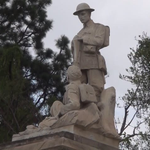
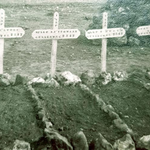
One of the youngest soldiers to die in the Great War. David Schalke Ullundi Ross was born in Durban in January 1904. His father, Colin George Ross, is of Scottish descent and his mother, Sarah Johanna (Van de Merwe), is of Afrikaner descent. At the recruitment office, he lied about his age, saying he was 18 and a half. On 5 February 1917, he was enlisted in the second regiment of the 1st SA Infantry Brigade. His personal details show that he was 5ft 7inches tall (1.70m), belonged to the Church of England, had a dark skin, black hair and blue eyes. He lists his mother and his 10-year-old brother Colin as dependents. This ensured that they would receive part of his pay. He arrives in England on the S.S. Walmer Castle, and after a period of training, he ships out on 21 May 1917 for the crossing to Rouen, France. In mid-June, he arrives in the frontline area of the Somme, where he had to get used to battalion life and life in the trenches on the front line while awaiting the major offensive in Flanders. Eventually, the four South African regiments leave Achiet-Le-Petit for a long journey to Poperinge, Belgium where they arrive on 15 September 1917. On 17 September, they travel via Ypres to the deep dugouts near the Ypres Canal at Boezinge. And early in the morning of 20 September, the South Africans, as part of the 9th Scottish Division, begin their attack from Frezenberg towards Bremen Redoubt. Ross, who is part of the second regiment, has to leapfrog the fourth regiment to take the second objective, the Waterend Farm-Bremen Redoubt line. But the attack is difficult due to heavy machine gun fire from Hill 37 and Tulip Cottages and the marshy ground, especially around the Hanebeek. After only a few minutes, David Ross is wounded in his left leg somewhere between Mitchell Farm and the Hanebeek and is taken to Potijze Chateau dressing station. From there, he is taken by ambulance to CCS No. 32 at Brandhoek, Vlamertinge, for more intensive care. CCS No. 32 is the same CCS where Noël Chavasse, twice VC holder, died on 5 August, a good month earlier. The CCS is specialised in abdominal wounds, but also in thigh fractures. His injuries are serious enough to require him to be transported by rail for 24 hours to Dannes-Camiers at the French coast, where he arrives at General Hospital No. 22 on 21 September. From there, he is taken by boat to England, where he arrives at 1st London Hospital Camberwell in London 26 September. On 12 February 1918, he was declared fit for duty and shortly afterwards he was on his way via Rouen to rejoin his regiment, which on 21 March fought a fierce battle against German storm troops near Gauche Wood at Villers-Guillain. The final German offensive, known as the Kaiserschlacht, had begun. General Erich Ludendorff wanted to drive a wedge between the French and the British with a combination of attacks, after which the British would be driven across northern France into the sea. This would bring about the collapse of France and cause the Americans to refrain from further aid to the Allies. So said Ludendorff. The 1st and 2nd SA Regiments fought for hours around and in the forest and, according to eyewitnesses, the situation was worse than in Delville Wood, with corpses piled up in what remained of the forest. It is not clear exactly what happened to Ross, except that he did not come out of the forest and was wounded. The Germans advanced fairly quickly over the next few days, using Revelon Farm, which was used by the British as an ADS. Ross may have been taken there. Ross's official papers state that he died on 25 March as a prisoner of war, after being reported missing on 24 March. David Schalke Ulindi Ross was eventually buried on municipal land behind the church in Heudicourt. His age is not mentioned. There is one more sad document. It is a letter from the mother asking for legal aid because she has not received the little money David left behind, apparently because she cannot produce the necessary paperwork. Apparently, she is separated from her husband, who lives in Kobe, Japan, and she also wants him to relinquish that small amount of money. She writes that she urgently needs it. It is clear that the mother is not well off and now has to take care of her only remaining son, Colin.
1
4
26
1,990
Mike the Warthog retweeted
SA Naval Heritage Day-by-Day. 5 August: 1910 At 18:10 Capt R.F. Scott’s ship Terra Nova (Lt Teddy Evans) moored at No 4 buoy in Simon’s Bay. Scott had come out earlier on the RMS Saxon and was in Pretoria meeting General Louis Botha to ask the new Union Government for funding. (Photos). 1914 South Africa mobilises and places 12 officers and 267 men of the RNVR (SA) at the disposal of the British Admiralty within 24 hours of receiving orders on the outbreak of the First World War. 1943 The Greek MV Efthalia Mari - 4,195 tons - is sunk by U177 east of Durban. 1983 After dark and off the Catumbela River mouth, SAS Emily Hobhouse (Cdr P.I. Keene) launches two Zodiac inflatable boats carrying two Recce Small Teams from 4 Reconnaissance Regiment to carry out a reconnaissance of the road and rail bridge some seven km upstream which had been identified as future targets. One team conducted a landward recce whist the second covered the route up the river. The teams were recovered safely on the mornings of 8 and 7 August respectively. Both recces were successful and, after a photo recce from Lobito to the river mouth, Emily Hobhouse set course for home. Details of Operation NIKE can be found in the book ‘Iron Fist from the Sea’. 2022 A Uganda People's Defence Museum benchmarking delegation visited South Africa during the first week of August. The group visited the SA Naval Museum (Cdr Leon Steyn) and during the presentation the work of the NHT was highlighted. A number of NHT books and digests were handed to head of the delegation Maj Gen Masiko by the OC. PHOTOs. Terra Nova at No4 buoy. Terra Nova, painting by Tim Johnson
3
13
721