





Pinned Tweet
El otro día me preguntaron que si era religioso: “Creo en el individualismo colectivo, en el libre mercado y la democracia; en el poder exponencial de la tecnología y que en general hay mas buenos que malos.” #seasmamon
JC retweeted

On my way to the office this morning, I passed a group of young people protesting, a Palestinian flag draped over their shoulders.
And I asked myself a question I can't shake: why does this generation always fall into the same trap? No matter the history. No matter the context. Even the ones from wealthy families, who went to the best schools, who were dealt every good card. Always the same trap.
I don't think it's stupidity. I think it's a mechanism. And a mechanism can be taken apart, piece by piece.
A. The observation: everything the state touches becomes unaffordable.
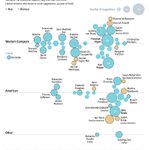
Look at economist Mark Perry's famous chart, the one people call "the chart of the century." It tracks US prices since 2000.
At the top, what explodes: hospital services, college tuition, textbooks, childcare, housing. Increases of +100%, +150%, up to +250%, far above general inflation.
At the bottom, what collapses: TVs, software, phones, toys, clothing. A TV today costs a fraction of what it did in 2000, for an infinitely better product.
Look at what separates the two groups. It isn't technology. It isn't complexity. It's one variable: how much the state is involved.
At the top, sectors that are subsidized, regulated, shielded from competition, where the state funds demand and blocks supply. At the bottom, sectors where companies fight every single morning to serve you better and cheaper.
B. The mechanism: why it's systematic.
When the state subsidizes demand without freeing supply, prices rise. Every time. Guaranteed student loans, and universities raise tuition. Housing aid plus blocked building permits, and rents skyrocket. Administered healthcare, and bureaucracy eats the budget before it ever reaches the patient.
In France it's even more vicious, because the price doesn't disappear: it hides. You never see the hospital bill, you pay it through payroll contributions. You never see the cost of school, you pay it through taxes. Public spending at 57% of GDP, one of the heaviest tax burdens in the world, more than €3.4 trillion in debt. And the result? Overflowing ERs, falling PISA scores, young people who can't afford to live in the city where they work.
The market didn't fail in these sectors. It was never allowed in.
C. Suffering demands a culprit.
A 22-year-old lives all of this in their bones. They can't find a place to live. Their degree either buries them in debt or opens no doors. The future feels blocked. That suffering is real, and I don't deny it for a second.
But human beings can't stand suffering without a culprit. They need a face. A scapegoat.
And this is where everything is decided: who taught them how to read the world?
D. Whoever tells the story picks the villain.
Schools are public. Universities are public. Culture runs on grants. Film goes through funding committees. Public broadcasting shapes the narratives. The people handing down the interpretive framework are, overwhelmingly, paid by the very system that creates the problem.
Do you really think that system is going to name itself as the culprit?
No. It names the capitalist. The boss. The landlord. "The rich." The multinational. The commercial West. Same role, same casting, every time.
E. One lens, a thousand causes.
And this brings me back to that flag. A generation taught to read every situation through a single lens, oppressor on one side, rich, Western, capitalist, oppressed on the other, will apply that lens everywhere. To housing. To climate. To conflicts on the other side of the world. The cause changes, the lens stays. That's why the trap is always the same: it's not the cause that draws them in, it's the way of thinking that was installed in them.
F. The perfect inversion.
Here's the irony. Capitalism is the force that drove down the price of almost everything it touched. The state is the force that blew up the price of almost everything it captured. And young people blame the first for the crimes of the second.
It's like blaming the firefighter for the fire because you saw him at the scene.
G. The ballot box confirms it.
In the US, a few weeks out from the midterms, a large share of urban young voters is getting ready to vote Democrat for more state, more spending, more regulation. New York elected a self-described socialist mayor, carried by young voters, on promises of rent freezes and city-run grocery stores. Rent freezes, the policy that has made housing scarcer everywhere it's been tried. The cure that worsens the disease.
In France, it's the same play in two acts. Part of the youth votes for the radical left, which promises more state. Another part votes for the center, which promises to "manage" the state well, and has dug the debt deeper than ever. Two different ballots, one shared assumption: the problem is the market, the solution is the state.
H. The way out.
These young people aren't stupid. They're right to be angry. They're just aiming at the wrong target.
The day they understand that their rent, their tuition and their hospital are expensive precisely because the state runs them, their anger will change direction. They'll stop protesting against those who create. They'll start protesting against those who capture.
That day, the greatest intellectual scam of our time will be over.


JC retweeted

What would have taken generations of scientists, Google DeepMind just released as a free searchable website.
Your DNA is 3 billion letters long. Change one letter and anything from nothing to a rare disease can happen. There are 9 billion possible single-letter changes. DeepMind just predicted what every single one of them does.
The database is called AlphaGenome Atlas. It maps what each change breaks, what it disrupts, and how much damage it causes. Gene switches, protein instructions, splicing patterns, across hundreds of cell types.
1 petabyte of data. Over 30 times larger than the AlphaFold Database that already changed biology. Searchable from a browser.
Free for every researcher on earth.
This is the part of AI that doesn't trend but quietly changes everything. Not a chatbot. A map of every possible mutation in the human body, open to anyone.

JC retweeted

We're so close to longevity escape velocity (LEV by 2033) that your sole responsibility right now is to avoid dying from something stupid. The next 5 years will deliver more medical breakthroughs than the previous 50.
JC retweeted

This is a brilliant article.
The core idea: you have roughly 12 major “shots” in your career (assuming 4 years each across 50 working years), and three forces determine whether they land. In order of importance: 天 (timing), 地 (place/environment), 人 (people).
Timing matters most because power laws dominate outcomes. You don’t need 12 wins. You need one or two shots that catch the right wave. An average team in the right market at the right moment beats a brilliant team solving yesterday’s problem.
But here’s the tension the framework surfaces: timing is both the most important variable and the least controllable. You can’t predict when 天 aligns. You can only recognize it.
Which changes the strategy completely. The real optimization is shot frequency, not shot selection. You need enough at-bats that one of them accidentally lands in perfect timing. The people who hit outsized outcomes usually ran faster cycles early, failed cheaper, and built the pattern recognition that makes timing visible.
Four years per shot might be too conservative for most people in their 20s and 30s. Compressing cycle time on shots that don’t work teaches you what 天 looks like before you’ve burned half your window.
The “red paperclip” insight in the piece is the real unlock: you probably already have what you need to take your next shot. The constraint is usually permission, not resources.
“You have 12 shots, choose wisely” leads to paralysis. “You have 12 shots, shoot faster” leads to learning.


JC retweeted

La izquierda solo se acuerda del Derecho Internacional cuando se les cae una dictadura de las que apoyan.
JC retweeted

Rara vez México captura titulares en todo el mundo, hoy todos repiten lo mismo:
México protesta por corrupción, impunidad y violencia desbordada.
Al gobierno de Sheinbaum lo describen:
rebasado, sin rumbo y recurriendo al gas y a teorías de conspiración para ocultar su fracaso.

JC retweeted

¿Por qué millones de mexicanos no saben esto? ¿Por qué millones no lo comparten? ¿Por qué millones lo ignoran? ¿Por qué millones no le dan una oportunidad a esta información? ¿Por qué millones seguirán y siguen sus vidas como si nada?
Me lo preguntaré por milenios..



JC retweeted
"Figure out what you’re good at, and start helping other people with it. Give it away. Pay it forward. Karma works because people are consistent. On a long enough timescale, you will attract what you project. But don’t measure—your patience will run out if you count."
@naval


1 semana sin internet!
Imposible lograr que manden un técnico de @infinitum
@TELMEXSoluciona @CdmxProfeco
Increíble la mala calidad en la atención y falta de respuesta.
Lo peor de todo es que NO me resolvió @infinitum @TELMEXSoluciona tuve que sobornar a un técnico que paré en la calle para que viniera. A falta respuesta de la empresa lo que hay es mercado negro

JC retweeted

Did you know that it’s actually possible for you to say, “I don’t know enough about this to have an opinion”

JC retweeted
Timeless:
Science, math, philosophy, rhetoric. First principles. Creating art & business. Family & lifelong friends. Habits to calm mind & body.
Temporary:
Politics, news, entertainment. Memorizing facts. Hourly work. Transactional relationships. Drugs & doctors for mind & body.
