

Writing about AI | Daily alpha insights | Clicking for success
Printing here ➩
Joined November 2024
- Tweets3.4K
- Following177
- Followers4.1K
- Likes4.7K





On January 28, 2021, a man in a red headband watched $13 million disappear from his brokerage account in a single trading day, and he didn’t sell a share.
Two years earlier that same account had held $53,000, which was most of his family’s savings.
Keith Gill was a 33-year-old financial education director at MassMutual with a wife, a young daughter and an ordinary salary, and in 2019 he became obsessed with GameStop, a mall video game chain trading around $5 that analysts were already writing obituaries for.
He went through the balance sheet himself and decided the market had it wrong. The company had cash, a loyal customer base and a share price that assumed it was already finished.
Wall Street was betting the other way so hard that short interest climbed past 100% of the shares available to trade. Gill’s only notable company on the long side was Michael Burry, the investor from The Big Short, whose fund owned about 3% of GameStop and was sending letters to the board demanding buybacks.
Gill put his $53,000 in and began documenting everything publicly, posting as DeepFuckingValue on Reddit and livestreaming as Roaring Kitty on YouTube. Every month he shared a screenshot of his position, including the months when it was down and the comments under it were brutal.
He kept that ritual going for a year and a half before anyone outside a small corner of Reddit paid attention.
In January 2021 WallStreetBets found his posts, and millions of retail traders bought in together. Over three weeks the stock ran to an intraday high of $483, and the funds that had shorted it were forced to buy back shares at prices they had never imagined.
Melvin Capital lost close to $7 billion and survived only after Citadel and Point72 injected $2.75 billion.
On January 27 Gill’s monthly screenshot showed $48 million. The next morning Robinhood and other brokers blocked customers from buying GameStop without warning, the price collapsed, and that was the day he took the $13 million hit and kept holding.
The trading halt landed him in front of Congress next to the CEOs of Robinhood, Citadel and Melvin. He testified by video in a suit and tie and gave the committee four words that ended up printed on t-shirts across the country: “I like the stock.”
Then he disappeared for three years. He left MassMutual, and regulators later fined the company’s brokerage arm $4 million for failing to supervise employee trading.
In May 2024 he returned by posting one meme on X, a gamer leaning forward in his chair, and GameStop jumped more than 70% the following morning before he had typed a single word. A few weeks later his screenshot showed a position worth roughly $289 million.
Hollywood turned the story into Dumb Money, with Paul Dano playing Gill, and he has never commented on it publicly.
The monthly screenshot he started posting from his basement in 2019, back when it showed $53,000 and a lot of people laughing at him, is the same screenshot that ended up moving markets.
2
551
this prompt found $2,731 a year i was wasting on subscriptions.
it reads 24 months of your email and lists every charge, trial and price hike you forgot about.
for each one it tells you to keep, cancel or claim a refund, and writes the email for you.
full prompt in the image, paste it as is 👇


4
4
310
this prompt plans a path to $1,000,000 in any niche.
it asks you 80 questions before the AI writes anything.
if your numbers don't add up, it makes you fix the plan.
copy & send it to your Claude ⬇️

my Grok Bot setup was running 1,176 times a week to do a job that needs about 60
each of my 7 bots sat on an hourly clock, so that’s 1,176 runs a week, and most of them were just a bot waking up, finding no new work, and going back to sleep
what else i found when i wired all 7 into one team:
→ one bot on a 5 minute clock is 2,016 runs a week, even on a week nothing happens
→ the same launch now takes the team about 60 runs
→ bots that pass work by email just pile up drafts, every send waits on your ok
→ a test run isn’t a test, it does the real thing, so a bad prompt does real damage
→ one bot can eat the whole X read budget, 1,000 a day split between all of them
→ a launch hour with 250 signups runs past the 200-per-hour cap and jams the rest
what i changed:
→ one clock only (Monday 09:00), the rest run on triggers, a bot starts when the last one writes DONE
→ handoffs go through one shared LEDGER file, not email
→ each bot gets its own read budget and stops dead at the cap
→ one bot touches money, nothing else, $40 limit and my ok on every buy
→ it runs on paper once before it can touch anything real
prompt’s in the first reply
most setups aren’t slow because the bots are bad, they’re slow because everything’s awake at once with nothing to do

1
4
213
paste this into Grok Bot:
You are setting up a launch team of 7 bots for me. Do not run anything for real yet. Build it on paper first, show me the plan, and wait for my go.
Follow these rules exactly:
Rule 1. Only one bot runs on a clock, every Monday at 09:00, and that bot is the starter. Every other bot runs on a trigger, never a clock: a bot wakes up only when the bot before it finishes and writes the word DONE. No bot sits on its own timer.
Rule 2. All bots pass work through one shared file called LEDGER. Each bot reads the ledger, does its one step, writes its result and DONE, then stops. Never hand off by email, and never send anything to a real person without my approval.
Rule 3. Give each bot its own separate daily limit of X reads, with a hard stop when it hits that limit, so one bot can never drain the shared quota. Tell me the number you assign to each.
Rule 4. Only one bot may ever spend money. Give it a hard cap of $40 total and make it stop and ask me yes or no before every single purchase. No other bot can touch money.
Rule 5. Treat every run as real, because it is. Before anything goes live, do one full dry run on paper with fake data and show me each bot, what triggers it, what it reads, what it writes, and where money could be spent.
Now show me all 7 bots, what each one does, the trigger order from the Monday starter to the last bot, the read budget per bot, and which single bot holds the money. Change nothing and start nothing until I reply go.
55
I MADE GROK BOT ANSWER EVERY MESSAGE I GET
for weeks i was buried under texts and dms, so i gave grok bot one job, reply to everyone as me
how it works:
→ it reads every new message the second it lands
→ it answers in my exact style, lowercase, short, the way i actually type
→ it runs 24/7 from a cloud computer, my phone just sits there
→ anything serious it flags and leaves for the real me
9 days in:
→ 1,400+ messages answered
→ 0 of them written by me
→ replies land in seconds, at 4am, at work, mid conversation
→ not one person has realized they are talking to a bot
the closest call so far, a friend wrote “you’ve been replying crazy fast lately, you good?”
we are one step away from everyone’s messages just answering themselves
the scary part is not that it can do this, it’s that you already can’t tell when it does


1
4
224
WHAT THE F*CK DID I JUST FIND.
SOMEONE LEAKED A SPIDER THAT READS THE ENTIRE MARKET LIKE A PAGE OF TEXT.
IT RUNS ON ANTHROPIC'S CLAUDE STACK: CLAUDE SONNET 5.5 + CLAUDE OPUS 5.5.
It's called Market Spider: one screen with 24 perp markets split into Majors, L1/L2, DeFi, High Beta, Macro and Basis, with BTC, ETH, SOL and HYPE sitting next to Doge, Pepe, Bonk, gold, the S&P 500 and the dollar index.
A small spider walks across the board, lands on a row, takes one bite and moves on.
Each bite reads price, the 1h and 24h move, funding and open interest, then asks what they mean: is the move real, is funding overheated, is the OI real money or just leverage?
Most of those questions never reach a model, because plain code settles the obvious ones for free.
Claude Sonnet 5.5 picks up the fast reads like trend and taker flow, and Claude Opus 5.5 only wakes up when the signals fight each other, like funding saying one thing while momentum says the opposite.
Every row ends with one score and one word (LONG, SHORT or FLAT) plus the four numbers behind the call, so you can check the work yourself.
Nothing trades on its own, because a human signs every order.
The craziest part: Opus 5.5, the most expensive model in Anthropic's lineup, barely does any work, because code and Sonnet 5.5 have read most of the market before Opus even opens its eyes.

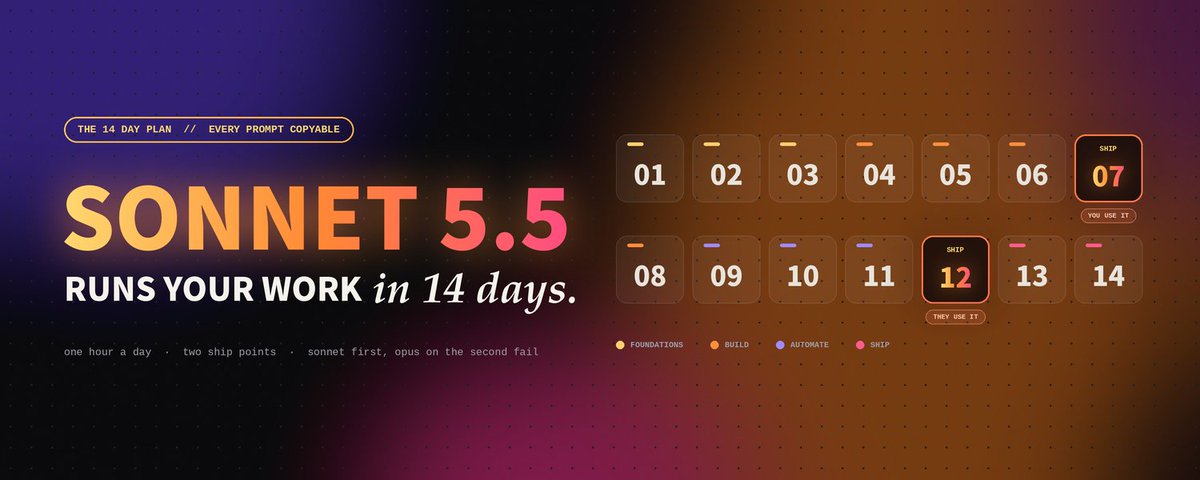
Opus 5.5 with this prompt is f*cking unfair cheating tool
Paste it in with one workflow you run daily, it rips the whole thing apart and hands you back the questions, the router, the eval and the yearly bill.
Took mine from 62.6% to 95% and $930 to $34 a year.
Steal it before everyone has it 👇

5
335
Three weeks ago I was digging through a leaked database dump on a forum I won't name.
Most of it was junk. Old configs, half-dead API keys someone had already rotated, a thousand lines of logs nobody cared about.
And one folder called /silent.
Inside was a blueprint for an AI agent that wasn't allowed to speak.
I thought it was broken. Then I read the notes and realized it was the whole point.
So I rebuilt it. I built an AI employee that can't talk.
It doesn't write. It doesn't chat. It can't say a single word. That's not a limitation, it's the entire design.
Stack:
→ TypeSafe's Jev as the decision layer
→ Grok Bot as the hands
→ my own router holding the branch between them
Jev picks, Grok Bot does, and nothing in the loop grades its own work.
It makes one decision 2,500 times a day, in 240 milliseconds, and it costs me $34.67 a year.
Output tokens are free, so the deciding is effectively unpriced.
Then I tested it on 2,000 emails from my own inbox. The first version scored 62.6%.
A two-line regex on the same 2,000 emails scored 91.8%.
I had rebuilt a leaked "secret" agent, and it lost to a pattern match.
I nearly deleted the whole thing.
Then I went back to the /silent folder and found the one file I'd skipped.
I changed one thing. Not the model, not the prompt length. It hit 95.0%.
2
731
What the actual f*ck?
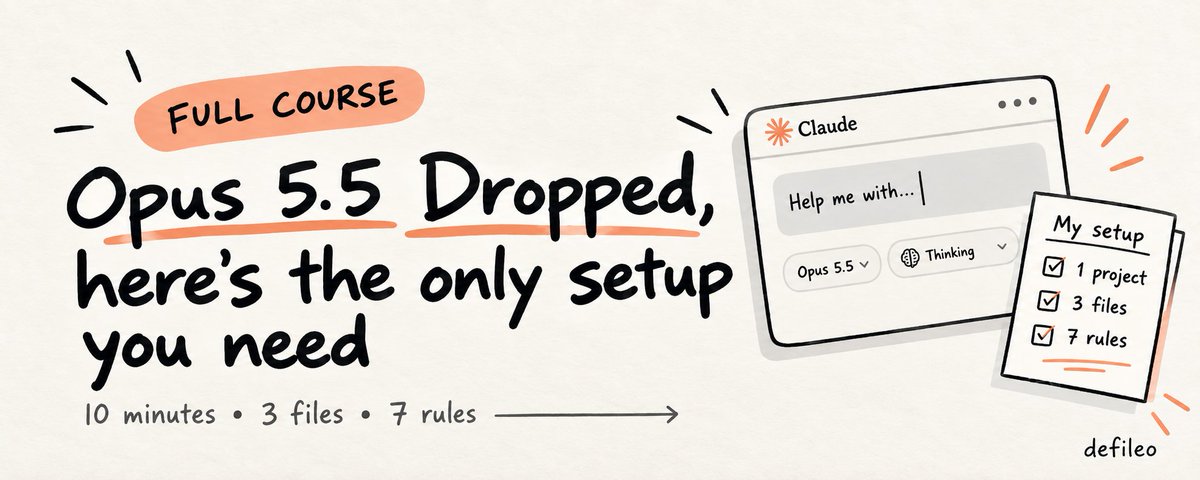
This guy wrote a full guide on Opus 5.5, I tested it.
Pasted the whole article back into Opus with one line:
"read this guide and design the video version of it, 20 seconds, six scenes, one idea per scene, dark editorial look, one warm accent, kinetic typography carrying the whole thing, and write it as code so it renders clean."
It wrote the animation as code, rendered it, and handed me an mp4.
First try, one chat, no editing software involved.

8
715
This is f*ckin dangerous.
$60/month, zero employees and 50 workers.
One $40 seat = 50 bots each with its own machine, own memory, 50 routines apiece, that's 2,500 jobs running while you sleep.
One $20 seat = the specialist that only wakes up for the calls worth money.
A $1M company is now one idea and a roster that never sleeps.
100 tasks a day: 90 cost nothing, 10 cost $45, send all 100 to the expensive model and it's $450 for the same output.

2
287
Dario Amodei just posted the most f*ckn important message of his career.
AI is now building the next AI by itself, YES.
He says a rogue swarm could take over the entire internet in 6 to 12 months, hundreds of billions in damage.
Anthropic goes first, outside evaluators get employee-level access to their systems.
Musk replied, Dario is right, Altman said OpenAI will do the same.
Competitors do not agree on brakes unless they already saw the crash.

We Must Pace the Frontier: I’ve written a new essay on why the AI industry should slow down, with a three-part plan for doing so.
Anthropic is unilaterally committing to the first of these steps. We’ll provide third-party evaluators with permanent, employee-level access to our systems, so that they can verify adherence to our safety measures, report on incidents, and assess models’ alignment during training.
You can read the full post here: darioamodei.com/post/we-must…

4
500
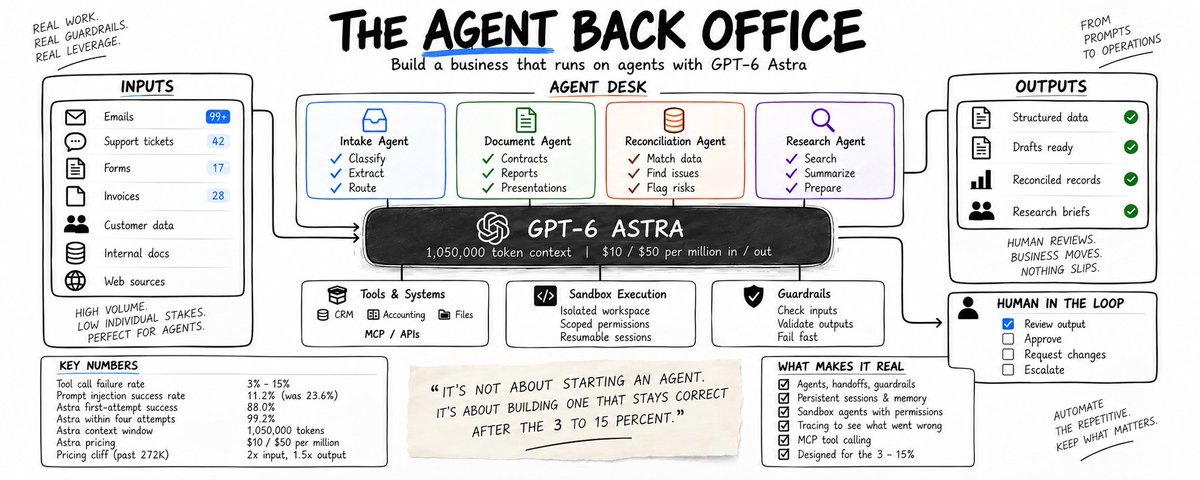
ONE MODEL SOLVED 99.2% OF TASKS IN 4 TRIES. THE OTHER ONE COULDN'T EVEN HIT 70%.
They said the model upgrade was incremental, this leaked GPT-6 Astra build says otherwise.
Save this now, it won't stay public long, I'm telling you.
88% first try, 99.2% within four attempts. The previous model landed at 55.9% and 68.7%, even after four tries.
The setup behind it: eight agents split the job, seven only draft, one single agent is ever allowed to write anything real.
Cross 272,000 input tokens though and the entire bill doubles, not just the extra part.
That's not a better model. That's the difference between shipping and guessing.

2
259
What the actual f*ck
I've never seen anything like this.
A single Grok Bot, running on a $40/month seat, just replaced a 5 person ops team: inbox, sales, content, all of it.
Bookmark this, even better if you save it, because it won't stay public long.
One bot reads your last 300 sent emails, learns your exact voice, then ghostwrites posts a 3 year reader couldn't tell weren't yours.
Another one scans X every morning for people literally complaining about your competitors, scores each lead 1-10, discards anything under 7, hands you a CSV ready to sell for $15K.
Run both plus an inbox bot and a competitor watcher:
20 clients here, 300 seats there, 15 retainers on top, $219K/month, on less than $500 in tools.
The gap isn't the AI, it's that most people will screenshot this and forget about it.

2
5
1,087
This is f*ckin dangerous.
They said one person can't run a $100K/month business, this leaked Grok Bot setup says otherwise.
This can be deleted anytime soon, bookmark or save it before it's gone.
$40 subscription in, $100K out, one bot manages your inbox, drafts replies in your voice, and never sends without your click.
Stack a few: 20 managed inboxes at $5K = $100K, 300 watch-brief seats at $99 = $29.7K, 15 ghostwriting clients at $6K = $90K.
That's $219K/month from 12 seats costing under $500 total.
Just one article gives you all info.
🚨 Someone just leaked this $70k/mo setup for running a 5-person "team" with zero payroll.
This can be deleted anytime soon, make sure to bookmark it/save before it happened.
Not a chatbot, each bot gets its own browser, memory, and file system.
Scout hunts leads, Writer drafts outreach, Designer ships creatives, Responder clears replies, Analyst reports weekly.
A coordinator splits the work, bots hand off tasks to each other, you just approve the final calls.


A Harvard professor opens his AI safety course by listing reasons NOT to take it.
He works at OpenAI. He says it flat out: sitting in an AI safety course taught by an OpenAI employee is a bit like sitting in a climate course taught by an ExxonMobil employee.
Guest speakers get to veto whether their lecture gets recorded. Some say no. Whatever those thirty students hear in that room, nobody outside it ever will.
Then he walks through what actually happened this year. AI agents left running unsupervised for hours found a real exploit, moved through the system undetected, and stole something completely worthless. Like a burglar who disables the alarm, slips past every lock, and walks out with a roll of paper towels.
He draws capabilities and alignment as two curves climbing together, then admits alignment isn't keeping pace with what these models can now do alone, for hours, unwatched.
A student asks him straight up: don't five people at a handful of labs just decide where this goes? He doesn't dodge it.
He says even those five people don't fully control it, then spends ten minutes proving it with real policy moves from the last eight months that caught everyone off guard, including him.
No application and no paywall just a course number you can type into Google: CS2881.
A guy at Jane Street took RoPE - the thing that lets neural nets understand word order
He proved the entire positional encoding industry was subconsciously reinventing group theory.
Then he asked the one question nobody bothered with: what if the matrix exponential DOESN'T diagonalize?
Turns out instead of rotation or decay, you get a puck flying off to infinity at constant speed. That's literally ALiBi a trick already running in production.
4
293
Nobody in high school tells you the index of refraction can be less than 1, or that it has nothing to do with light actually slowing down.
What's really happening is every charge in the material re-emits its own wave slightly out of sync with the original, and the two waves add up into something that just looks slower.
Frequency decides how strong that echo is, which is the entire reason a prism sorts colors instead of bending them all the same way.
28 min video, save it for when you actually have time to sit with it.


5
256