



A real case study from the Binance incident.
- Binance hack reported
- Everything moves at once: rates squeeze, liquidity leaves lending markets, every team tweets about its Binance exposure
- Our alerts fire, including on second and third order effects like stablecoin volatility
- We close our short on a moderately depegged stablecoin and book the gain into the primeUSD vault
- primeUSD prints 11.5% annualized this week on investment grade underlyings
This is what @HypernativeLabs agents are for.

Every layer of our security model assumes another could fail.
With @HypernativeLabs, 200+ agents watch every chain and venue we’re deployed on, 24/7.
🔴 High-confidence threats → automatic vault pauses
🟢 Market signals → our control room
See how our real time security works

Binance is a clear outlier, it has contained damage so brilliantly that we as an industry hardly even noticed ripple effects. It will be worse next time a more fragile product is hacked.
So if you are a high yield leveraged USD guy, how to decrease sensitivity to liquidity squeezes?
Diversify your trades!
- do delta-neutral basis trade - low correlation with defi rate spikes
- Allocate to high yield, non-leveraged RWA positions. They are not exposed to borrow rate spikes
- borrow at fixed rates (ah, right there are no fixed rate markets for USD assets)
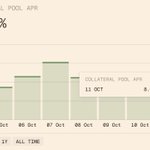
Every major shock shows up onchain as a jump in USDC borrowing costs.
After the @Binance hack, the average borrow rate across Aave, Morpho and Fluid nearly doubled to ~10% within hours, then fell back to pre-hack levels in under two days.
After April’s Kelp DAO exploit, where the bad collateral sat inside @aave itself, rates nearly quadrupled to ~13.5%, held above 11% for four days and took about a week to normalize.
The difference: @tether and @circle moved fast to freeze stolen funds, and Binance quickly committed to covering user losses. That kept the panic out of DeFi lending.
This chart ran first in our monthly newsletter.
Subscribe to get the next one first vaultstreet.com

so here is the story of CARRY
When we went to the drawing board on the high yield product, the ask from the investors was to combine:
- pls be liquid, no material lockups
- pls no cash drag from redemption settlement cycle
- pls high yield and low fees
- pls no stupid sh*t in the vault. we wanna rely on your DD and monitoring
- building yet another leverage loop aggregator? wtf pls no. do something funky, delta neutral is cool
- pls can we borrow against it when needed (actually wait, we just wanna outright loop it)
How about all of that in one product?
Our tremendous team at Vault Street did a f**king great job shipping it with CARRY. Super proud to work with these legends.
And the partner teams whose products we chose to integrate? Absolutely killing it. When you see Superstate, Midas, Hastra, Centrifuge in our vaults' allocations, it's not random. Man, it's because these are great products!
Together, we help people make money, and make it without the stupid sh*t.
Introducing CARRY: 12%+ target yield from leveraged RWAs by @MidasRWA @Figure @SuperstateInc @Bitwise
The 2021 RWA vintage was about tokens with no redemption rights and underwriting by clowns
Today we have real infra, real protections, and professional credit teams. Specialty credit is now sourcing capital faster onchain than in tradfi
Golden era of onchain finance is starting
1
4
197
Love to share this research piece with broader community. Well done @MidasRWA and @Wellington_Mgmt on structuring this one!
mWIN fills a genuine gap in the tokenized fund market, which up to now has clustered at two extremes:
- ultra-low-risk MMFs on one end,
- high-yield specialty asset-backed facilities on the other
A balanced, investment-grade portfolio offering a meaningful, diversified yield pickup is a distinct proposition in the current RWA landscape.
Access to high-capacity leverage via @SentoraHQ vault on Morpho allows investors to amplify returns to 12-14% expectations.
Vault Street has now enabled allocations into mWIN through primeUSD and our upcoming high yield product.
If you look to get a piece of exposure to instruments like this, invest with Vault Street.
New research is live: mWIN - Midas Wellington Income Opportunities, tokenized by @MidasRWA
An actively managed, multi-sector investment-grade fixed income strategy run by Wellington Management's Financial Reserves team.
$36M+ onchain.

Very good breakdown of zeitgeist.
Makes sense to mention also that equity basis trade is not only an exchange risk but also wrapper risk on the inventory side depending on where you hold it.
One way or another, full principal amount is exposed to something on credit/op side, even if you hold only off-exchange collateral; and exchange risk is only on a portion of total amount.
But still, 10% on the properly structured delta neutral trade has a bunch of alpha 😉


3
235
In a covered call strategy, you are selling some of the upside of the asset, also known as selling delta.
In a conservative strategy, you are selling short-dated options at reasonable distance from current price, and slightly longer dated options at higher distance, so that you remain relatively close to 100% delta on the portfolio.
Typically farming call premia gives you positive expected value over time, but the outcomes are lumpy and there is still exposure.
Running this within LBTC means that there can be in practice situations when BTC inventory inside LBTC decreases over a period of time. Which makes LBTC a floating NAV instrument rather than a 1:1 claim.
Also, when you sell calls, you would need to margin your counterparty's exposure to you, so you keep inventory with a third party.
So, a few questions to address here:
1/ is there a stability buffer to offset negative APRs? I would do one
2/ how is the collateral held, and is it triparty settled or sitting with the counterparty

The first iteration of $LBTC established demand. The second is built for scale.
Same token. Same integrations. Same mint and redeem logic.
What changed is the yield-engine: from emissions that fade to options that scale.
If you hold LBTC today, there's nothing to do.
6
1,109
Well done @kamino and @SuperstateInc for following through on this integration! We are here to help make new markets for RWAs we love.

Tokenized U.S. Treasury fund shares are now usable as collateral on Kamino.
@SuperstateInc USTB, the Invesco Short Duration US Government Securities Fund with $950M AUM, is now live with support from @Vault_St, bringing institutional Treasury exposure to onchain credit markets on @solana.

1
7
332
It does not stop to astonish me. Why can't they get a waiver to trash-talk uncle Kim.
Is it like a scheme to psyop the world into believing it works like a piece of garlic against vampires? Only to break it to pull off the biggest heist in the industry some day

North Korean hackers have stolen $6B+ in crypto — and they've been getting hired as devs across the industry for years.
So I went undercover as a recruiter and interviewed one. There's one question none of them can answer.
DON'T MISS IT! Tune in at 4 PM ET 🎧
teapawt.net/i/broadcasts/1YxNrbben…

3
272
Finally, after all these years, the world is safe in the knowledge that the largest digital dollar is audited
News of the year for capital inflows into onchain markets

Tether Completes the Largest Inaugural Financial Audit in History
Read more:
tether.io/news/tether-comple…

1
255
We have been looking into CLO markets since late 2025, and have invested into JAAA previously. And for primeUSD, we have again chosen it as a key part of the vault! Why:
JAAA is a cash+ instrument with an outstanding combination of 120-150bp yield pickup over the rate curve, and credit quality. Credit enhancements of its underlying CLOs allow the whole portfolio to be rated AAA, higher than U.S. Treasury instruments.
If you are a curator or a lending operator looking to onboard quality RWAs - work with @centrifuge and @Vault_St to integrate JAAA

New research is live: JAAA, the Janus Henderson Anemoy AAA CLO Fund, tokenized by @centrifuge.
JAAA holds $687M in AAA-rated CLO tranches, the largest and longest-running tokenized AAA CLO fund, run by Janus Henderson team managing the $25B+ JAAA ETF, with custody at @jpmorgan.

5
338
But really, very few products that I have seen in the space can boast "alpha". Majority of this fancy prop stuff are:
- self-loops
- poorly structured subdelegation
- simple incentive farming
Many operators are too ashamed to be transparent

Talked to a team member at a fast-growing yield-bearing protocol today.
I told him their real-world yield strategy is essentially a black box and shared how they could improve transparency.
His response: they can’t disclose the exact strategy because other dApps might “copy” them.
That’s like Facebook saying it can’t show its UI because someone might copy it.
I think this is one of the biggest problems in DeFi, or, more accurately, on-chain finance, today.
Users need to be able to understand what they’re actually exposed to. Without transparency, it’s incredibly difficult to assess risk.
And when a yield-bearing asset blows up, it becomes far too easy for teams to avoid accountability or hide what actually happened. (I talk about you here @Main_St_Finance)
Hopefully this changes one day.
And one clarification: having a NAV-only dashboard on Accountable does not make a protocol transparent.
4
249

This trade will expand in volumes wildly by the year end. Specialized allocators are already allocating 9-figure amount into DeFi-integrated trades in tokenized RWAs.
It is a killer trade of the new cycle.
The reason is simple - users are accessing real, rated underlyings powered by competitive defi borrow rates. Professionally built protocols are handling complexities of looping and yield smoothing.
Each network with a tokenized asset agenda should be planning integrations with RWA allocator protocols.

1/ $85M of fund shares are live collateral on @Aave Horizon. The funds: USTB, managed by @InvescoUS, and USCC, managed by @Bitwise.
Investors borrow stablecoins without redeeming. Positions stay compliant.
A fund should do more than sit in a portfolio.
superstate.com/newsroom/aave…

Never stop never stopping

Resolv Foundation Q2 2026 Report is out.
Highlights from the quarter Resolv rebuilt:
• recovery framework was developed, settlements are now done or in final stages across essentially every affected counterparty;
• Vault Street, new institutional RWA product line, launched publicly in June with its first low-risk vault, primeUSD;
• $RESOLV staking reopened, with average APR stabilizing at ~20%;
The Foundation's attention turned fully toward growing Vault Street's TVL, allocator base, and rebuilding protocol revenue.

4
255
How many onchain vaults are 100% verifiably investment grade?
JAAA is the largest AAA CLO strategy worldwide, its tokenized parallel fund is a star performer in crypto markets, and we had no doubts that it is the one to make its way into primeUSD.
primeUSD is integrating Janus Henderson's AAA CLO fund (JAAA) tokenized by @centrifuge, with leverage sourced via @aave Horizon.
The vault's yield architecture extends beyond short-duration T-bills into actively leveraged, AAA-rated institutional credit.

6
551
Why sharing research in public at all?
The capital moving into RWAs now requires a level of diligence comparable to what institutional operators apply in global fixed income. To win capital, products should meet that bar with clean, comprehensive, evergreen DD materials.
We help bridge that gap by building the diligence layer that helps allocators invest with confidence.
Vault Street is launching a research portal: the diligence layer for onchain credit.
Our team will be publishing allocator notes with a dedicated focus on RWAs, reflecting the due-diligence framework we apply before committing capital.
First coverage: USTB by @SuperstateInc.
14
2,266
Three months ago the worst thing that can happen to a protocol happened to Resolv. I have been silent on socials since then. Part of that was practical, there was not much we could say while the investigation and negotiations were ongoing. Partly it did not feel right to post while people who trusted us were waiting for resolution. To me, writing something needs a clear reason. The reason here is simple: to share openly what the last three months looked like.
Day 1. March 22.
On day one I was woken up by an early call from a teammate and hopped on. You see the messages and for a moment your brain refuses to process what it is reading.
I am 35. I have been lucky, I had never before faced something that threatened something that was so close to me it was a part of me. That day was the worst of my life so far. Watching Resolv go through that was like watching something we had created from nothing, something I genuinely love, be put in grave danger. That is the only way I can describe it.
The team had already started pausing contracts by the time I got on the first call. Everyone just did their job. But beyond the critical immediate steps, there was confusion and fear, we did not have an exact plan how to sort it all out. But the critical things got done.
Within hours the messages were coming from everywhere. Affected parties, curators, integrated protocols, users, each with their own version of what needed to happen immediately. Everything at once.
Week 1.
The calls blurred into each other. One week felt like one long call. You would walk from the desk to sleep and come back and it was still going.
The hardest part was the contradictions. Every counterparty came with their own demands, their own legal position, their own version of fair. You are sitting in the middle trying to find a path that holds together, knowing every concession in one direction creates pressure somewhere else.
What I can say is that every day was better than the one before. Not resolved, still a lot of problems, but a little less complexity, a little more clarity. That compounding is what carried us through.
During that first week, we started redeeming USR holders with stable pre-existing positions. That part was the clearest path: defined category, defined obligation, execute. Decrease the risk of secondary effects on ecosystem rates and liquidity. We moved fast, redeemed 90%+ of the category.
April.
We spent the next few weeks building the framework for fair treatment across every category, operating simultaneously with lawyers and security firms, which created a specific constraint: almost nothing we were doing could be shared publicly.
The first real unlock came when we reached agreement in principle with Fluid. Lots of respect to @smykjain, @DeFi_Made_Here and the team for being consistent, open and constructive throughout. That matters more than it sounds, the situation involved several categories of affected users, direct leverage positions, levered DEX LP positions, and others, and finding a coherent path across all of them was not straightforward. That is when the rest of the recovery started to come into place on where the potential consensus lay, and what the sequencing needed to be. I am grateful to partners in the industry, especially @gauntlet_xyz, @august_digital, and risk curator teams on Euler and Morpho, who collaborated throughout the process to enable recovery for their users.
In parallel, since early April we have been shaping the relaunch. A lot of folks on our team are creative people with high agency, and it is important to have a vision in front of you. Getting people focused on building something makes it easier to push through the problems at hand that are not particularly nice to deal with. The direction that took shape was to go all-in on RWAs. The market had all the infrastructure pieces, tokenization platforms, lending venues, global asset managers, but lots of improvement areas on product layers that would link it all together. We decided to build that layer, become the leading distributor of tokenized assets, and contribute to making crypto a safer place. At the start, internally we called it Project Valiant, as in, this initiative is bold and we fear nothing. For the public launch we landed on Vault Street.
May–June.
Late May we published the recovery framework.
What we found was that as soon as we could give users clarity, even when the outcome was not what they had hoped for, it already felt better than the uncertainty. For most people, the hardest part was not knowing. Delivering a clear picture of how recovery worked, gave a sense of closure to all.
I want to be honest about the part that does not resolve cleanly. Inevitably, many people were left frustrated, and investors lost a lot of money. As someone who takes pride in the product and the level of care behind it, that is hard to sit with, and it should be. But the only thing worse than failing, is failing and stopping. The incident reinforced that in any situation, no matter how difficult, your job as a builder is to keep moving, deal with problems one by one, make the best of what is in front of you. That matters most when everything is on fire.
Roughly 90% of the recovery work is now behind us.
July.
Vault Street launched primeUSD, its first RWA vault.
The only way is forward.
4
20
1,860
2026 so far has taught us that on-chain markets still have a lot of real work to do before they can absorb regulated capital at scale.
We don't believe crypto has to be a frontier market forever, carrying a permanent risk premium just because of its operational environment. Vault Street is built to prove the opposite thesis: that a lower-risk segment of crypto markets can exist, with the same rigor regulated capital expects elsewhere.
primeUSD is the first step. Investors get exposure to regulated fixed income with stringent, investment-grade rating requirements, plus leverage that's structured to optimize risk-weighted returns. Asset issuers and lending market operators get something just as valuable: a predictable, low-risk allocator they can build connectivity around.
Grateful to the partners who are making this real - @aave, @Token_Logic, @SuperstateInc, and @centrifuge. We will be back shipping more.