

💻 Engineer → built a 6-figure tech agency 🛠️ Building in public | 個人開発 ----- 🌱 https://xitter.cf/t.co/sFQkpAkINs 🎮: https://xitter.cf/t.co/zcy31fsr0L
India
Joined August 2026
- Tweets9.7K
- Following660
- Followers1.8K
- Likes15.9K





One thing people building voice AI often overlook is how much information gets lost before the LLM even receives a transcript.
Think about someone learning English. They'll pause mid sentence, pronounce words incorrectly, repeat themselves, or make grammatical mistakes.
Now imagine your STT model quietly cleans all that up.
The transcript might look great, but an AI tutor relying on it could completely miss what the student needs help with.
That's why I found this benchmark from Fluently interesting.
They tested real time speech recognition on low fluency English spoken by Chinese, Japanese, Korean, Thai and Vietnamese learners.
And the differences between models are pretty significant.
If you're building anything with voice AI, here's what I'd test before choosing a transcription model:
- How well does it handle your actual user's accents?
- Does it preserve hesitations, repetitions and grammatical mistakes, or quietly clean them up?
- How often does it get important words wrong, especially negatives, names and numbers?
- How well does it handle pauses, interruptions and spontaneous conversations?
A low word error rate is useful, but it doesn't tell you everything about how well the model will work in your application.
So we need to test speech recognition on the people who'll actually use your product, similar to the example of Dessa that I shared few days back.
🤝 Paid partnership

Speech-to-text is solved. Unless you have an accent.
Over 1 million people from 180 countries have spent 580,000 hours speaking with Fluently AI tutors while learning a new language.
Nearly all of them have an accent, and transcribing their speech is still hard.
So we benchmarked streaming speech-to-text systems on spontaneous, accented English from our learners. Leaderboard and methodology in the thread.
English is the easy one. Our learners study 14 other languages too.
Working on tough speech problems? DMs are open.
Tirtha Sarker retweeted

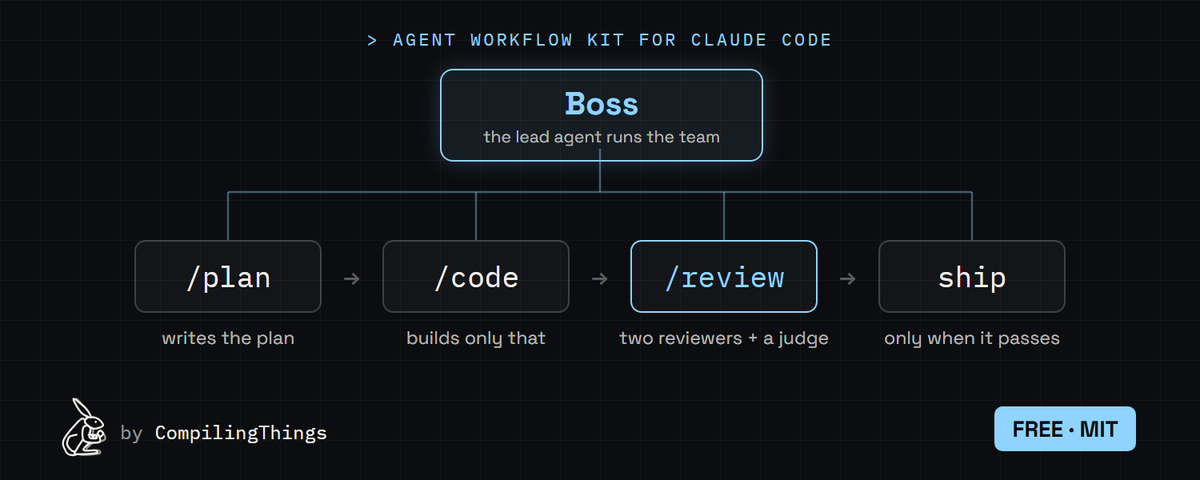
How I run an AI agent team from my phone: one lead agent, a review gate where nothing ships on one opinion, and a written memory that survives every session. The one session setup is free to copy (MIT). Link inside.
Most MCP servers are just API endpoints wrapped as AI tools.
And that's probably why some agents waste so many calls getting simple work done.
If you're building an MCP server, here are 6 things worth thinking about:
1. Build tools around actual tasks. If an agent needs five API calls to investigate a failed payment, consider giving it one tool that gathers the relevant information. Let the server handle the predictable steps.
2. Don't make the model do your database's job. If you're returning thousands of records so the agent can find five matches, move that filtering into the tool. Return the matches and enough context to explain them.
3. Give the agent a way to investigate further. A summary is useful, but it shouldn't hide where the answer came from. Include relevant IDs, timestamps and references so the agent can inspect the original records.
4. Make failures recoverable. If a payment lookup fails because an invoice ID is missing, say exactly what's missing. Give the agent enough information to retry correctly instead of guessing.
5. Keep dangerous actions separate. Investigating a failed payment and issuing a refund shouldn't be the same operation. Let the agent investigate freely within its permissions, but enforce authorization and approval for sensitive actions.
6. Study what your agents actually do. Look at their tool-call traces. Where are they repeating searches, passing invalid parameters or fetching the same information multiple times? Those patterns tell you where your MCP design needs work.
Here's an experiment worth trying:
Take 20 real tasks from your agent's workflow and record the tool calls needed to complete each one.
Find one sequence of 3–5 calls that keeps repeating.
Build a new MCP tool that handles the predictable parts of that sequence internally.
Now run the same tasks using the original tools and your new implementation.
Compare:
- How many tasks were completed correctly?
- How many agent-level tool calls were needed?
- How much context did the tool responses consume?
- How long did the tasks take?
If the new tool achieves the same or better results with fewer calls and less context, you've found a useful optimization.
The interesting part of MCP engineering is deciding which work belongs inside a deterministic tool and which decisions actually need the model.

2B people scroll through Instagram daily and only 24M (1.2%) are categorised as influencers.
And that 1.2% is just people who have more than 1000 followers and post 5 days a week.
Rest are all consumers.
What do you think that number looks like for X ?
🤖 Made with AI

REMINDER 🚨
Your employer doesn’t give a f*ck about you.
Build your personal brand and business.

Microsoft will offer buyouts to about 60,000 workers, part of the company’s efforts to trim costs and retool its workforce for the artificial intelligence era bloomberg.com/news/articles/…

People were dissing about Terra that it should be removed.
But I think Terra & Anthropic's Haiku will have a user base. Low end models need to find the right adaptive use cases.
But yeah, it shouldn't be for these flashy video-graphic demoes.
Hope this has a reasonable consumption of credits.

Tirtha Sarker retweeted

Be like @LisaSu 😎
> Born in Tainan, Taiwan.
> Moved to the US as a little kid.
> Parents pushed math and science.
> Went to MIT for electrical engineering.
> Stayed for her master's and PhD.
> Joined Texas Instruments.
> Then IBM, working on chip research.
> Helped make chips faster and smaller.
> Became CTO at Freescale.
> Joined AMD in 2012.
> Became CEO in 2014.
> AMD was almost bankrupt.
> Worth less than $3B.
> Everyone had written it off.
> She bet on making great chips again.
> Launched Ryzen. Then EPYC.
> Took on Intel and won back respect.
> Bought Xilinx.
> Went all in on AI chips.
> Signed deals with OpenAI, Anthropic and Meta.
> Data center sales up 107% in one quarter.
> Became a billionaire in 2024.
> Sept 21, 2026: AMD crossed $1 TRILLION.
> First woman ever to lead a $1T company.
She didn't inherit a winner.
She took a dying company and rebuilt it.
From under $3B to over $1T in 12 years.
That's one of the greatest comebacks in tech history.
She is truly an inspiration. ✨✨

Just crossed 1800+ followers !
200 away from 2k.
We keep the community strong and circle of builders growing ! 🙌
Let’s connect if you are a builder in this space ! 🎃

If you're building an AI agent with memory, don't immediately reach for a vector database.
First, figure out what you need it to remember. These 5 patterns solve different problems:
1. Use structured profiles for confirmed facts like a user's preferred language or a project's runtime. Save them in database fields the agent can look up by ID.
2. Use conversation summaries to carry decisions and unanswered questions into the next session. Keep the original messages available because summaries can leave things out.
3. Keep a task journal of what the agent tried, what failed and what worked. Before another attempt, it can check that history instead of repeating a failed approach.
4. Use retrieval memory when you have too many documents to load into every prompt. Search for relevant passages and include their sources so the agent can check them.
5. Use persistent files for scripts, notes and unfinished work. The next session can open the actual files and continue where the previous one stopped.
Pick one thing your agent keeps forgetting and fix that first.
If your agent forgets your project settings, save them somewhere it can read next time. If it needs to reuse a script, keep the file between sessions.
You don’t need a vector database for either.
Tirtha Sarker retweeted
Cloudflare's AI code reviewer flagged nearly 230,000 engineering violations.
Almost 16,000 of those caused merge approvals to be withheld.
Here's how they built it, and what you can steal for your own coding agents:
1. Maintain a shared, versioned engineering rulebook writing down your security, architecture, APIs, error handling, etc.
2. Separate recommendations (SHOULD) from mandatory rules (MUST).
3. Review rules before enforcing them. Cloudflare approves new rules first, then moves them into enforcement after teams have time to adopt them.
4. Load only relevant rules. Review architecture documents before anyone writes the implementation.
5. Use linters for mechanical checks. They're fast and predictable. Let AI handle the reviews that need context and judgment.
6. Review incident reports for missing timelines, detection signals and follow-up actions.
Now here's something you can try with Claude Code or Codex today:
- Ask your agent to inspect your repo, lint config, CI checks and architecture docs.
- Have it propose 10 repo-specific MUST/SHOULD rules, with reasons.
- Review and approve those rules yourself. Save them in AGENTS.md or CLAUDE.md.
- Then have your agent review each PR against them, citing the exact file, line and violated rule.
It's a pretty useful way to stop your coding agent from repeating the same mistakes across PRs.

Post your heart out !
Your biggest fear is that someone will see how much you care and find it fucking ridiculous.
So you reread what you wrote, remove the sentence that feels too personal.
Add a joke so nobody thinks you’re taking yourself too seriously.
Eventually, it’s safe enough to post. You’ve removed everything you wanted to say.
The same thing happens with niches.
At first, the niche helps people find you. Then, slowly, it becomes a character you have to keep playing.
You post about the same topic, in the same tone, from the same angle. Not only because the algorithm rewards consistency, but because people have started to expect a certain version of you.
And once people know you that way, breaking character can feel like letting them down.
You wonder what will happen if you talk about something outside your niche. Will people unfollow? Will the post perform badly? Will they decide you’re no longer credible? Will the algorithm stop knowing where to place you?
But underneath those questions is often something more personal…
What if people see that I’m more than the image I built?
So you edit yourself back into the role.
You remove the story that doesn’t fit, turn the opinion into a lesson, make the post useful enough to justify its existence.
Eventually, it’s safe enough to publish.
You’ve removed everything that made it yours.
I think this is why people stay trapped in their niche long after it stops feeling alive. The niche is no longer just a content strategy but a protective shell.
If you stay predictable or keep speaking from the same position, nobody can question who you are. Then people praise you for being consistent.
But consistency can quietly become self-abandonment.
You’re allowed to talk about something that doesn’t fit neatly into your content pillars. You’re allowed to have interests your audience didn’t subscribe for. You’re allowed to change your mind, try a new voice, or post from a part of your life that doesn’t support the character you’ve been playing.
You can keep parts of your life private. You can also let one honest sentence through without explaining why it belongs in your niche.
Your audience may have found you for one thing.
That doesn’t mean you have to remain only that thing.
Let people meet you while you’re still changing.
Tirtha Sarker retweeted
I tried something different this week.
Posted less, and focused on sharing things I genuinely find interesting and useful.
One of those posts crossed 11K impressions.
It's a small experiment, but it feels good knowing I can nerd out about things I love, help a few people along the way, and still reach an audience.
Thank you to everyone who reads and supports my work. 🌻

Cloudflare's AI code reviewer flagged nearly 230,000 engineering violations.
Almost 16,000 of those caused merge approvals to be withheld.
Here's how they built it, and what you can steal for your own coding agents:
1. Maintain a shared, versioned engineering rulebook writing down your security, architecture, APIs, error handling, etc.
2. Separate recommendations (SHOULD) from mandatory rules (MUST).
3. Review rules before enforcing them. Cloudflare approves new rules first, then moves them into enforcement after teams have time to adopt them.
4. Load only relevant rules. Review architecture documents before anyone writes the implementation.
5. Use linters for mechanical checks. They're fast and predictable. Let AI handle the reviews that need context and judgment.
6. Review incident reports for missing timelines, detection signals and follow-up actions.
Now here's something you can try with Claude Code or Codex today:
- Ask your agent to inspect your repo, lint config, CI checks and architecture docs.
- Have it propose 10 repo-specific MUST/SHOULD rules, with reasons.
- Review and approve those rules yourself. Save them in AGENTS.md or CLAUDE.md.
- Then have your agent review each PR against them, citing the exact file, line and violated rule.
It's a pretty useful way to stop your coding agent from repeating the same mistakes across PRs.
In 2003, Dario Amodei the current CEO of Anthropic shared his Anti-war stance as a sophomore at Caltech.
Do you think the company still stands by that spirit ?
Tirtha Sarker retweeted
someone made a FREE CAPCUT that runs on your own machine and claude can edit your videos with it
its called concat. auto-captions with local whisper, voice cloning from a few seconds of audio, background removal, 100 effects, 4k60 export
no subscription, no upload. written in rust

I tried something different this week.
Posted less, and focused on sharing things I genuinely find interesting and useful.
One of those posts crossed 11K impressions.
It's a small experiment, but it feels good knowing I can nerd out about things I love, help a few people along the way, and still reach an audience.
Thank you to everyone who reads and supports my work. 🌻
Tirtha Sarker retweeted
Dessa voice model is SCARY good, almost unsettling.
I just listened to the samples, and it laughs mid conversations, gasps under its breath, throws in little “yeahs” and knows when to interrupt, ridiculously human style.
We've had real time voice models like OpenAI's and Moshi for a while. They can process speech directly, but still rely on pretrained language models or text during training.
But Block took a pretty wild approach with Dessa. They trained it from scratch using ONLY human conversations.
That is extremely difficult. The model had to learn language AND all the messy things we do while speaking, around mannerism like sarcasm, hesitation, emphasis, timing, interruptions, even when to laugh. :3
All of that from sound alone.
And apparently, the whole thing was trained on a single NVIDIA GB200 NVL72 and can run locally on an M4 Max MacBook.
If these demos hold up in real conversations, we're getting dangerously close to a world where you can't tell who's on the other end of a call.

We believe voice is the most natural way to interact with intelligence, so we created Dessa, the most authentic full-duplex speech model ever built. Talking with it feels like talking with a person…full of emotion, nuance, pauses, and a natural cadence.
block.xyz/dessa

Tirtha Sarker retweeted
I am telling you the competition next year will be insane !
Kimi 3.1 Pro is only ~3 points behind Claude Opus 5.5 in several intelligence indexes.
It overtook leading SOTA frontiers like OpenAI GPT-6 Astra & Google's Gemini 4 Argon.
Best thing, they are launching their open weights on Nov 4th !


Introducing Kimi K3.1 Pro: our most capable 3T-class open-weight model.
🔹 1M-token context, 2.8T total / 104B active params (MoE), Multimodal.
🔹 Full-project coding: games in Unreal, Unity & Godot.
🔹 Excels at parametric 3D modeling in Blender & CAD.
🔹 More reliable at finance work: Accurate modeling with hallucination down by 65%.
🔹 Matching the strongest proprietary models across coding, agentic and knowledge benchmarks.
Kimi K3.1 Pro and K3.1 Pro Highspeed (2–3× faster) are now live on Kimi.ai, Kimi Work, Kimi Code, and the Kimi API.
Open weights by Nov 4, 2026.
🔗 API: platform.kimi.ai
🔗 Tech blog: kimi.ai/blog/kimi-k3-1-pro
