






Tito Costa retweeted

It’s out openai.com/index/building-sc…


Tito Costa retweeted

Anthropic spending commitments are crazy


Anthropic has filed an S-1 registration statement with the SEC related to its proposed IPO.
Read more: anthropic.com/news/s1-sec
Legal disclaimer: A registration statement relating to these securities has been filed with the SEC but has not yet become effective. These securities may not be sold, nor may offers to buy be accepted, prior to the time the registration statement becomes effective. This post does not constitute an offer to sell or the solicitation of an offer to buy these securities, nor shall there be any sale of these securities in any state or jurisdiction in which such offer, solicitation or sale would be unlawful prior to registration or qualification under the securities laws of any such state or jurisdiction.


Interesting shift in wording from "kindly funded by the EU to delays due to new EU regulations".
Maybe the propaganda machine is breaking.


Tito Costa retweeted

3. The key is HOW they're spending their money. A French teacher takes home as net disposable less than what he contributes to teacher pensions!!

If you pitch to return-seeking investors, you usually don't start from characteristics usually associated with low returns, like low risk, high predictability and low volatility, but with the vision, the size of the opportunity, unique advantages, growth, ...

🇩🇪 Chancellor Merz promises Germany is the BEST place to invest in, despite its catastrophic energy policies:
"If we agree on delivery dates, we stick to it. If you invite friends from Germany for dinner at 7, we arrive at 6:58.
We are reliable, predictable, precise, and unsurprising. We are, in short, what investors like most.
So the good thing about clichés is this: they tend to be true. So if you pick the core of this assumed Germanness, you might actually like what you get.
Yes, we do have our own challenges, but Germany's DNA proves to be rather helpful in the face of a world which is harder and harder to read and to predict."
So uhh... what are the clichés about mass unvetted migrants, if they "tend to be true"? 🤣
Writers: Mhedi, Michael
I can't get over the fact that if you throw Opus 5.5 at a repo, it will create product walkthrough videos and feature highlights with a faithful representation of the UI and nice transitions
OpenAI Plugin submission has been down for most people since August, due to an identity verification sync problem.
Unusual community.openai.com/t/plugi…

The fact that the vast majority of people in Europe would say that we live in a ruthless capitalistic competitive market economy may be a good answer to the famous question: what important truth do very few people agree with you on?
🇫🇷 France's government SPENDING now equals roughly 57% of its entire economy...
That's higher than the levels shown here for the Soviet Union, communist Romania, Poland, and China.
• USSR at 50%
• Communist Romania at 42%
• Venezuela under Chávez at 38%
• Communist Poland at 36%
• China at 33%
Will France fall?
Source: @randgroup / Writer: Samuel

The point of non return for democratic reform is indeed when a full majority of people live off government handouts or salaries.
The US is not that far behind.

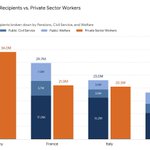
The biggest, and stupidest, myth in European politics, particularly popular in France, is that Europe suffers the consequences of "austerity" and "neoliberalism". In the biggest 5 countries in Europe, more than half of the population makes its income from the state, less than half from the private sector. This is what makes the problem of reducing the welfare state so impossible: more than half of the voters are net recipients. No surprise that Italy's budget has not been balanced in 100 years, France's in 50 years (ooh la la, l'austérité!!):
-France: 30 million from the state versus 21m private sector workers. State spending is 57% of GDP, taxes more than half the economy. The budget hasn't been balanced in the lifetime of most French (since 1974).
- Germany: 35 million adults from the state, versus 34 million from the private sector. 10% of the population is registered as severely disabled. Public spending is over half of GDP. Germany has had a continuous budget deficit since 2019.
-Italy: 23 million from the state, versus 20.5 million private-sector workers. Public spending is 51% of GDP. Italy has had a budget deficit every year since 1925, for 100 years.
- Spain more people get their income from the state since 2024: 18.21 million from the public sector versus 17.9 million people working in the private sector. Since 2025, Spain also had more government employees than self-employed workers (autónomos) for the first time in history. State spending is at 45%, budget has not been balanced since 2007.
- UK: 54% of households now receive more in state benefits than they pay in taxes. State spending is 44.5% of GDP, taxes (40%) are at their highest since 1950, the budget hasn't been balanced since 2001, and 1 in 5 new cars is paid by the government through a bizarre state disability scheme (Motability).

Tito Costa retweeted

The biggest, and stupidest, myth in European politics, particularly popular in France, is that Europe suffers the consequences of "austerity" and "neoliberalism". In the biggest 5 countries in Europe, more than half of the population makes its income from the state, less than half from the private sector. This is what makes the problem of reducing the welfare state so impossible: more than half of the voters are net recipients. No surprise that Italy's budget has not been balanced in 100 years, France's in 50 years (ooh la la, l'austérité!!):
-France: 30 million from the state versus 21m private sector workers. State spending is 57% of GDP, taxes more than half the economy. The budget hasn't been balanced in the lifetime of most French (since 1974).
- Germany: 35 million adults from the state, versus 34 million from the private sector. 10% of the population is registered as severely disabled. Public spending is over half of GDP. Germany has had a continuous budget deficit since 2019.
-Italy: 23 million from the state, versus 20.5 million private-sector workers. Public spending is 51% of GDP. Italy has had a budget deficit every year since 1925, for 100 years.
- Spain more people get their income from the state since 2024: 18.21 million from the public sector versus 17.9 million people working in the private sector. Since 2025, Spain also had more government employees than self-employed workers (autónomos) for the first time in history. State spending is at 45%, budget has not been balanced since 2007.
- UK: 54% of households now receive more in state benefits than they pay in taxes. State spending is 44.5% of GDP, taxes (40%) are at their highest since 1950, the budget hasn't been balanced since 2001, and 1 in 5 new cars is paid by the government through a bizarre state disability scheme (Motability).
Tito Costa retweeted

Mensonges d’idéologue marxiste.
La densité de milliardaires est corrélée au niveau de vie mesuré par le PIB par habitant.


"Quand il y avait moins de milliardaires, on avait plus de prospérité": Thomas Piketty réclame un référendum pour taxer les fortunes de plus de 100 millions d'euros
l.bfmtv.com/0CiF

Readers added context they thought people might want to know
Les données montrent le contraire : le nombre de milliardaires a fortement augmenté depuis 2000 parallèlement à une hausse du PIB mondial par habitant et une baisse significative de la pauvreté extrême.
data.worldbank.org/indicator/NY.G…
pip.worldbank.org
blogs.worldbank.org/en/opendata/se…
en.wikipedia.org/wiki/The_World…


I wonder what the EU Commissioner for Sustainable Transport and Tourism @tzitzikostas thinks about this
